
33rd Annual Report to the Prime Minister on the Public Service of Canada
For the year ending March 31, 2026
Letter to the Prime Minister
June 18, 2026
Dear Prime Minister,
I am pleased to submit the Thirty‑Third Annual Report to the Prime Minister on the Public Service of Canada, covering the period from April 1, 2025, to March 31, 2026.
Last summer, I gratefully accepted the opportunity to lead Canada’s public service at a pivotal moment in our history. We are living through a rare moment in time. The world is changing at an accelerating pace and in ways that are increasingly difficult to anticipate. Longstanding alliances are shifting, technological advances—particularly in artificial intelligence—are reshaping economies and institutions, and global trade patterns are being redefined. These changes present significant challenges, but they also create opportunities to strengthen Canada’s position and build for the future.
As we look to our strengths to drive an agenda of change, I see the federal public service as one of the country’s greatest institutions. Over many decades, it has supported successive governments through periods of uncertainty, adaptation and reform, while strengthening its capacity to reflect the diversity, perspectives and lived experiences of Canadians. Early in my tenure, I sent a message to all public servants calling for a rethink of how we work to ensure that we seize on the opportunities before us. To meet this moment, the public service must focus, simplify, be accountable and draw on our strengths of diversity. Strength of purpose will transform our ability to deliver at the level and speed that the country needs of us.
Over the past year, we sharpened our focus to deliver the outcomes that matter most to Canadians. We started simplifying processes, reducing unnecessary complexity and modernizing the way we deliver programs and services to get results faster. We began shifting accountability toward results, supporting decisions that manage risk rather than avoid it. We also implemented the Government’s comprehensive expenditure review of direct program and operating spending. While difficult, this exercise presents a chance to renew and build a fit-for-purpose public service.
To perform effectively and to maintain the confidence of Canadians, the federal public service must draw fully on the breadth of talent across the country and sustain workplaces where people are respected, supported and able to contribute fully. While progress has been made towards a more representative workforce, sustained effort and leadership are required to build on these gains and eliminate persistent barriers.
Public servants rose to this year’s challenges with professionalism and discipline, bringing much needed urgency to execute on the Government’s priorities.
This report highlights progress made over the past year and sets out a clear direction for continued transformation of the federal public service. It reflects belief in the institution’s ability to adapt and deliver. That said, I am realistic about the substantial work that remains. We have made a good beginning – but it is only a beginning.
Public servants should take pride in the contributions they make every day to Canada. I am confident in what the public service will continue to deliver for the Government and for Canadians in the years ahead.
Best regards,
Michael Sabia
Clerk of the Privy Council
and Secretary to the Cabinet
Introduction
Canada’s public service has a proud and distinguished history. Every day, I see colleagues who are deeply committed to serving Canadians and making a difference for the country.
The federal public service has always served through changing times. Today’s geopolitical uncertainty, rapid technological change, and shifting economic realities have accelerated the pace of change, requiring us to step up and speed up. Fast. Approaches that served us well in the past no longer meet what is being asked of us today.
The Government of Canada has laid out an ambitious agenda. It requires the federal public service to deliver at the pace of this fast-changing world and do so on a large scale. It also demands difficult decisions to return the size of the public service to a more sustainable level, while shifting capacity to achieve your Government’s priorities. The stakes for Canada are high. This is a consequential moment that calls for focus, urgency, and a clear commitment to deliver results. It also offers the opportunity to build the public service that Canadians will need in the years ahead.
I am confident in our ability to meet this moment. With continuing change, the federal public service has the talent, the experience, the sense of purpose and pride required to succeed. While much remains to be done, public servants are working differently, simplifying how we operate and reducing unnecessary complexity, with a focus on what matters most to Canadians.
Over the past year, public servants have served with professionalism and dedication.
This report highlights some of the results the federal public service delivered and how we did it. It also sets out how we will keep driving change to meet current challenges and prepare for what is next.
Seizing our moment
This is a moment that requires clarity about how we work in the public service, not just what we aim to achieve.
In my first message to all public servants, I asked them to keep three words in mind: focus, simplify and accountability.
With these driving efforts, public servants made progress in transforming how we work.
We focussed on what mattered. Teams aligned their work to the Government’s priorities while continuing to deliver core services Canadians rely on. This required urgency. It also required discipline in making tough choices and follow-through to execute and achieve results.
We took steps to simplify. Across organizations, public servants worked to reduce layers, remove duplication, streamline processes and accelerate decision-making. We made better use of digital tools and adapted more quickly as circumstances evolved.
We kept accountability at the forefront. This was about personal responsibility and a commitment to deliver. All public servants were encouraged to take initiative and contribute to success, without being asked. Leaders, meanwhile, ensured formal accountabilities were clear and used performance indicators to understand progress and adjust as needed.
In a period of significant change, public servants remained steadfast in their commitment to serve. We continued to embed our public service values and to build diverse, inclusive, respectful and fair workplaces. We built on our momentum on reconciliation and anti-racism and worked to ensure everyone can thrive and serve to their fullest.
The following are just some highlights of what public servants achieved over the past year.
Focus
The federal public service focussed on the seven missions outlined by the Prime Minister in his mandate letter to Ministers, with concentrated efforts to advance Canada’s economic resilience, growth, affordability and sovereignty.
A sectoral approach was put in place to support key industries and respond to external pressures. This included the rapid deployment of targeted supports, such as the $5 billion Strategic Response Fund, to help firms in all sectors impacted by tariffs adapt, diversify, and grow. It also included Employment Insurance changes that will benefit about 190,000 long-tenured workers by giving them 20 extra weeks of income support. The new Auto Strategy, meanwhile, will complement other major industrial investments and prioritize the development of the full value chain for next-generation vehicles, positioning Canada’s automotive industry for the future.
Public servants worked in close partnership with provinces, territories and international partners and allies to achieve shared goals. Through a coordinated ‘Team Canada’ approach, Canada engaged constructively with the United States on economic and security priorities and maintained the lowest average tariff rates of any major United States trading partner. Working together, public servants diligently supported the Government in achieving a longstanding Canadian goal to remove all federal barriers to internal trade in only a matter of months.
Partnerships with Indigenous Peoples remained crucial to advancing reconciliation and shared goals. Focussed efforts are leading to progress. The Fourth Annual Progress Report on implementation of the United Nations Declaration on the Rights of Indigenous Peoples Act highlights concrete actions being undertaken by 41 federal departments and agencies to implement the Act, and benefits from the insights of 58 Indigenous partners.
Federal public servants are also working with provincial, territorial and Indigenous partners to implement a new plan for Canada’s North, supported by over $40 billion in investments. Their efforts include putting in place measures to defend Arctic sovereignty, including Canadian Armed Forces infrastructure upgrades to airfields, hangars and other facilities and equipment, and building Canada’s Arctic and Northern region through the development of major projects.
The public service focussed on the issues that mattered, bringing public servants together to get things done. Canada signed the Canada-Alberta Memorandum of Understanding through focussed collaboration. It was a team effort, with senior leadership and public servants at various levels coming together to get work done. This nimble approach is also benefiting trade diversification efforts, as federal public servants pursue agreements with other partners while reviewing the Canada–United States–Mexico Agreement (CUSMA).
The Government’s plan to address affordability pressures was urgently implemented. Public servants helped design the $11.7 billion Canada Groceries and Essentials Benefit, balancing speed and diligence to support more than 12 million Canadians. Tax relief measures were also put in place to deliver over $27 billion in expected tax savings to Canadians over five years. Last year also marked the launch of the new Canada Disability Benefit, which has provided critical income support to nearly 300,000 persons with disabilities.
Public servants showcased Canada at home and abroad, supporting the participation of over 250 athletes in the Milano Cortina 2026 Olympic and Paralympic Winter Games in Italy. And public servants welcomed more visitors when the Canada Strong Pass led to a 13% increase in Parks Canada visitors and 15% increase in national museum visits.
Through the Comprehensive Expenditure Review, the public service sharpened the focus on priorities and reoriented organizations to deliver on them. This will set us up to deliver better results, sooner. But I know that transition is not easy. Attrition and workforce adjustment mean colleagues moving on, roles changing and organizations adapting. For some public servants and their families, there continue to be real impacts. For others, there is uncertainty as they wait to see how the review will affect them. I have been encouraged by how public servants have supported each other through this time and remained focussed on serving Canadians.
Simplify
Simplification was key this year, as public servants took concrete steps to reduce complexity and accelerate delivery.
New structures were established to move priority projects forward more quickly. The Major Projects Office is already fast-tracking 15 projects and six transformative strategies to drive $126 billion in new investment and support more than 60,000 jobs. Build Canada Homes was launched in a few short months to build affordable homes at scale, with six initial federal sites identified to support 4,000 homes and additional capacity of up to 45,000 units.
The federal public service helped modernize defence processes to reaffirm Canada’s strategic autonomy and hit the North Atlantic Treaty Organization (NATO) spending target of 2% of gross domestic product (GDP) in March 2026, representing $63.5 billion for 2025-2026. Efforts to improve Canadian Armed Forces recruitment also showed promise, with 13% more applications than the previous year.
We simplified processes in other areas to address pressing needs. For example, a streamlined pathway to permanent residence was introduced for internationally trained doctors, with 5,000 spaces allocated to provinces and territories. The Treasury Board of Canada Secretariat, meanwhile, undertook a review of reporting requirements placed on federal organizations. This resulted in proposals to eliminate or streamline over 60% of the requirements, reducing the administrative burden on organizations while maintaining effective oversight. Implementation of these proposals continues.
Achieving results was about simplifying approaches to complex issues. The public service took a practical look at varied efforts to meet goals and forged straightforward plans to get results faster. The recently launched A Force of Nature: Canada’s Strategy to Protect Nature, for example, provides a clear roadmap for meeting Canada’s 2030 Nature Strategy. As part of the United Nations Declaration on the Rights of Indigenous Peoples implementation, the Department of Justice Canada developed an Indigenous Justice Strategy to address systemic discrimination and overrepresentation of First Nations, Inuit and Métis in Canada’s criminal justice system.
Public servants also used new digital tools to improve efficiency. This was showcased at the first Artificial Intelligence (AI) Learning Week for the federal public service and in the newly launched Government of Canada AI Register. Recent examples of how public servants are using these tools include the expanded rollout of CANChat, a pilot rollout of GCtranslate, new AI tools to assist Service Canada agents with benefits processing, as well as new Power BI tools such as the one recently launched for the 2024 Public Service Employee Survey. These examples are just the start. There is the potential for great transformation through sustained effort in this space.
Accountability
Accountability is fundamental to public service excellence. It is about ownership and disciplined follow‑through. Formal accountabilities must be clear. But real accountability depends on people stepping forward, taking responsibility, and delivering, especially when no one had to ask. Strengthening both has been a central focus of our work.
Federal public servants demonstrated this accountability by putting forward difficult but necessary proposals to reduce spending on Government operations. This was especially clear as we upheld our responsibility as stewards of public funds and executed the Comprehensive Expenditure Review to achieve $13 billion in annual savings by 2028-2029.
The public service also reinforced formal accountabilities. In June 2025, the Treasury Board of Canada Secretariat launched the Risk and Compliance Process. The process gives deputy heads a yearly, structured way to assess risk, performance, and compliance in key areas of management. A total of 67 organizations participated in the first year and reported that the new process sharpened their understanding of risk and clearly highlighted areas of strength and weaknesses in their organizations.
Serving with excellence was always the goal. And when we fell short, we acknowledged the problem and fixed it. For example, when Canadians had trouble reaching the Canada Revenue Agency last summer, the agency was tasked with improving services in 100 days. The agency’s efforts to develop and implement the 100-day Service Improvement Plan increased call response rates from 35% to 81%.
We also set higher standards for ourselves and will hold ourselves accountable for meeting them. This includes the delivery of passports to Canadians. We exceeded our 90% targets for both our 10-day in-person and 20-day by mail service standards and introduced the new “30-days or free” guarantee backed by automatic fee refunds when it is not met.
Ultimately, accountability is lived through action. It is public servants taking initiative every day and doing their job effectively and professionally. At Veterans Affairs Canada, for example, public servants balanced compassion with accountability in delivering wellbeing programs like the Veterans Emergency Fund. They responded to complex client needs while ensuring the sound management of programs. And at Statistics Canada, public servants took initiative to improve the Producer Price Index programs. Their efforts resulted in a 95% reduction in processing times.
Accountability is also about partnering to deliver tangible results for Canadians. At Health Canada and Service Canada, public servants teamed up to complete the full implementation of the Canadian Dental Care Plan, which has seen over 6.1 million Canadians enrolled, and over 4.2 million having now received critical dental care under this program.
Public servants are there when Canadians need them. When nearly 6,000 wildfires burned 8.3 million hectares and forced the evacuation of more than 85,000 people this past year, federal public servants took action. Their efforts included a 24/7 emergency response and support in response to 13 requests for federal assistance from provinces and territories. More than half of those evacuated, over 45,000 people, were members of 60 First Nations communities affected by wildland fires. Federal coordination also supported four requests for federal assistance specifically related to these First Nations evacuations.
Inclusion and values-based culture
Through it all, public servants continued to shape our culture to position ourselves to do our best work.
Sustained efforts across the federal public service have strengthened representation and contributed to workplaces grounded in reconciliation, anti-racism, accessibility, diversity, and inclusion. The Call to Action on Anti-Racism, Equity, and Inclusion in the Federal Public Service reminded us that diversity is both a shared obligation and a real opportunity.
Investments in learning and development supported more inclusive and representative leadership this year. Through the Action Plan for Black Public Servants, over 5,000 Black public servants participated in targeted programs.
Departments also stepped up to support career development and inclusive hiring. For example, the Canada Revenue Agency launched its third cohort of the Western Region Building Black Leaders Program. The Department of Fisheries and Oceans developed regional Indigenous talent management plans. Health Canada introduced a dedicated Career Navigator to support employees with disabilities, as well as Indigenous and Black employees. The Communications Security Establishment used a range of hiring platforms to better reach diverse talent pools and increase hires from equity-seeking groups.
Through targeted training, we empowered individual action. The Canada School of Public Service launched the enhanced Reconciliation in Practice Program for Executives, equipping leaders to take concrete steps to advance reconciliation in their organizations.
It was encouraging to see inclusion remain at the forefront in times of change. The digital GC Workplace Accessibility Passport was launched to support meaningful conversations between employees and their managers about workplace accessibility. It will help to remove barriers faced by public servants with disabilities and create a level playing field for all employees. And we marked the first Official Languages Symposium (accessible only on the Government of Canada network), which focussed on the potential for AI integration in the public service to support bilingualism.
Employee networks continued to play an important leadership role in supporting their members, building community, and contributing to positive organizational change.
This year also underscored the importance of the Values and Ethics Code for the Public Sector. Organizational codes of conduct were reinforced as living instruments. They were embedded through dialogue, onboarding, and training, rather than treated as one-time exercises.
As the public service adapts, our values continue to guide us. They must continue to inform decision-making and behaviour across all levels and organizations.
Setting our path forward
I know what the federal public service is capable of. Public servants have demonstrated their potential again and again. This year, we proved that when we focus, simplify, and take accountability for results, we deliver more, faster. We will continue to position ourselves to meet Canadians’ needs and expectations.
First, we must stay focussed on what matters most. That means keeping our attention on top priorities and being explicit about what we will pause, stop or accelerate so we can deliver.
Second, we will further simplify how we work. We will modernize faster and make better use of AI tools to improve speed and quality. The adoption of AI can be a driver of fundamental change for public servants and for the people we serve, Canadians. We will find bottlenecks and unnecessary processes, fix them, and scale solutions that work.
Third, we will strengthen accountability. Every shared initiative needs a clear owner who is responsible for end‑to‑end delivery. Every public servant has a role to play and is expected to take initiative and personal accountability for results.
Finally, we will continue to build a representative workforce rooted in our values, where people feel safe, equipped, and empowered to do their best work in workplaces where creativity, innovation, and pride can thrive. Recognizing that diversity in all its forms continues to be founded in merit, it is a strength. It is essential to high performance and trust.
This is about sustained cultural change and practical shifts in how we operate. This moment calls for an entrepreneurial mindset, with measured risk-taking and a willingness to seize opportunities to drive meaningful, long-term change.
To support this, deputy ministers have been asked to identify and deliver one transformational commitment in the 2026–2027 performance review cycle. These commitments must be ambitious, practical, and aligned with the drivers of focus, simplification, and accountability. And they must be delivered within existing resources. This work is now underway.
Canadians expect results. The federal public service will deliver.
Conclusion
Across the country, public servants are advancing the Government of Canada’s priorities and working to change how the federal public service operates.
I want to thank all the members of the public service for their contributions and dedication. Their efforts help to strengthen Canada’s economic resilience, grow our economy and our partnerships around the world, increase affordability for Canadians, and strengthen Canada’s sovereignty.
The year ahead will demand even more from us. We will aim high and move fast.
We have a chance to make a meaningful difference for the country, for Canadians and for the public service itself.
I am confident in what we can accomplish. Let’s seize this moment.
Annex A: 2024 Public Service Employee Survey results and changing how we work
Focus
| 2024 Public Service Employee Survey questions that provide a starting point for changing how we work | 2024 Baseline |
|---|---|
| I know how my work contributes to the achievement of my department’s or agency’s goals. | 82% |
| My department or agency does a good job of communicating its vision, mission and goals. | 65% |
| I have support at work to provide a high level of service. | 71% |
Simplify
| 2024 Public Service Employee Survey questions that provide a starting point for changing how we work | 2024 Baseline |
|---|---|
| I feel that the quality of my work suffers because of overly complicated or unnecessary business processes. | 40% |
| Senior management in my department or agency makes effective and timely decisions. | 47% |
| I feel I would be supported by my department or agency if I proposed a new idea. | 60% |
Accountability
| 2024 Public Service Employee Survey questions that provide a starting point for changing how we work | 2024 Baseline |
|---|---|
| I have clear work objectives. | 77% |
| I am encouraged to be innovative or to take initiative in my work. | 68% |
| I have opportunities to provide input into decisions that affect my work. | 65% |
Inclusion and values-based culture
| 2024 Public Service Employee Survey questions that provide a starting point for changing how we work | 2024 Baseline |
|---|---|
| In my work unit, every individual is accepted as an equal member of the team. | 78% |
| My department or agency does a good job of promoting values and ethics in the workplace. | 68% |
| My department or agency implements activities and practices that support a diverse workforce. | 76% |
| My department or agency implements initiatives that promote anti-racism in the workplace. | 65% |
| I would describe my workplace as being psychologically healthy. | 59% |
Annex B: How we work
Operational context
The Government’s agenda aims to deliver a generational investment to transform the Canadian economy, bringing some of the most significant economic and social changes since the Second World War. The Prime Minister’s mandate letter sets out seven missions, including reducing spending on government operations so Canada can invest more to grow the economy.
To sustain and improve public service performance through the significant changes ahead, public servants want to work differently. This means cultivating a more entrepreneurial public service: one that focuses sharply on priorities, executes quickly, takes well‑judged risks, and cuts through complexity. It requires optimized processes and systems, greater accountability for outcomes, engagement with external expertise from across sectors, and public servants from coast to coast to coast who are empowered and equipped to achieve results for Canada. This shared vision of the public service we are building for the future will help get us there.
How we work
Over the next few years, the culture change objective is to build:
A public service that acts with speed and resolve, focussed on outcomes that matter most to Canadians and powered by high-performing, diverse, inclusive teams that innovate, simplify, and take personal accountability for delivering results.
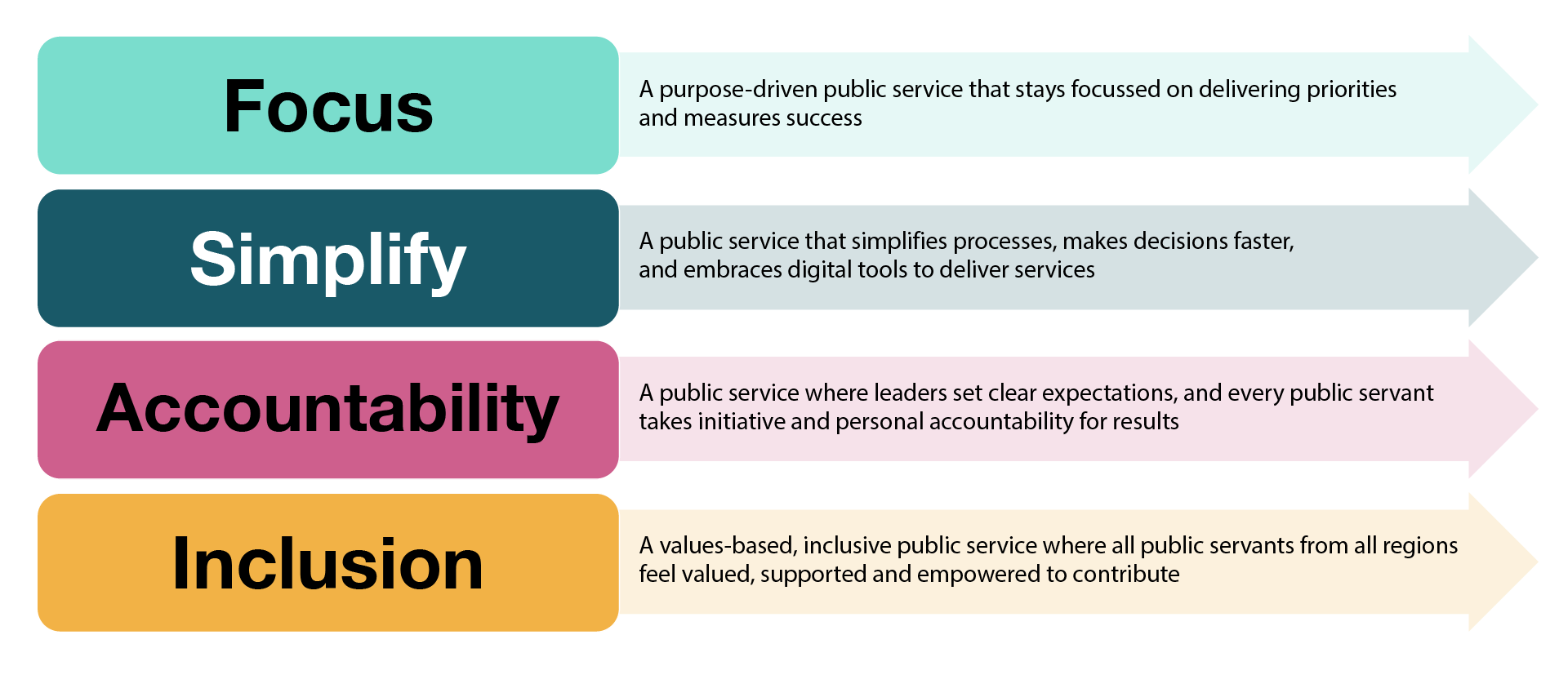
Text version
| Focus | A purpose-driven public service that stays focussed on delivering priorities and measures success |
|---|---|
| Simplify | A public service that simplifies processes, makes decisions faster, and embraces digital tools to deliver services |
| Accountability | A public service where leaders set clear expectations, and every public servant takes initiative and personal accountability for results |
| Inclusion | A values-based, inclusive public service where all public servants from all regions feel valued, supported and empowered to contribute |
Heads of departments and agencies are accountable for driving and communicating progress to their employees, consistent with their operational contexts. They will deliver on a transformation idea that will ground and serve as a model for broader culture change in their organizations. And, they will be evaluated against these objectives as part of the annual performance management process, in accordance with the Current Corporate Priorities.