
Applying for Expungement
Important
Read all the steps carefully before starting your application.
Please note that incomplete or missing information could lead to the application being returned to you and/or delay its processing.
-
Step 1 - Check if you are eligible to apply
Eligible offences
You MAY be eligible* to apply for an expungement order if you, or the deceased person for whom you are applying, has been convicted of one or more offences related to:
- Gross indecency (or attempt to commit gross indecency);
- Buggery (or attempt to commit buggery);
- Anal intercourse (or attempt to commit anal intercourse);
- Bawdy houses (i.e., keeping, being found in, permitting a place to be used as, or transporting to);
- Indecent show, act or exhibition;
- Immoral, indecent or obscene performance;
- Nudity;
- Procuring the miscarriage (abortion) of a woman or female person (or attempt to procure the miscarriage (abortion) of a woman or female person);
- Procuring one’s own miscarriage (abortion) (or attempt to procure one’s own miscarriage (abortion));
- Means or method for causing a miscarriage (abortion);
- Supplying or procuring a substance or an instrument to procure a miscarriage (abortion); and,
- any offence under the National Defence Act or any previous version of that Act for an act or omission that constitutes an offence listed in the Schedule to the Expungement of Historically Unjust Convictions Act.
*Please review the criteria listed in Step 1 for each offence before sending in your application.
Refer to the Schedule to the Act for a complete list of offences. It can be found at: https://laws-lois.justice.gc.ca/eng/acts/E-21.5/page-2.html#h-211856
You DO NOT need to apply for expungement if you:
- have only received an absolute or conditional discharge*; or
- were only convicted in a youth court or youth justice court**.
* For more information, contact the Royal Canadian Mounted Police Pardon & Purge Services.
** Your record(s) will be destroyed or archived once all applicable time periods have elapsed under the Young Offenders Act or the Youth Criminal Justice Act.
Criteria
An expungement can only be ordered if all relevant criteria are met:
- Gross indecency, buggery and anal intercourse
- The activity for which the person was convicted was between persons of the same sex;
- The person(s) other than the person who was convicted had given their consent* to participate in the activity; and,
- The persons who participated in the activity were 16 years of age or older at the time of the activity or subject to a “close in age” defence under section 150.1 of the Criminal Code.
*Section 273.1 of the Criminal Code defines consent as the voluntary agreement of a person to engage in the sexual activity in question.
- Keeping, being found in, or permitting a place to be used as a bawdy house
- The conviction relates to the convicted person’s association with a bawdy house, kept for the practice of acts of indecency and not for the purpose of prostitution**, where consensual sexual activity is viewed or engaged in; and,
- The person who was convicted did not exchange money for providing or receiving sexual services.
- Transporting individuals to a bawdy house
- The conviction relates to a bawdy house kept for the practice of acts of indecency and not for the purpose of prostitution**, where consensual sexual activity is viewed or engaged in.
- Indecent show, indecent acts, indecent exhibition, immoral, indecent or obscene performance and nudity
- The activity for which the person was convicted took place in a bawdy house in which acts of indecency are practiced and not for the purpose of prostitution**, where consensual sexual activity is viewed or engaged in; and,
- The person who was convicted did not exchange money for providing or receiving sexual services.
** The Schedule to the Expungement Act and this Guide refer to “prostitution” as it was the wording used in the previous Criminal Code definition of “common bawdy house”.
- Procuring one’s own miscarriage (abortion); or
- Supplying or procuring a drug or an instrument for the purpose of procuring one’s own miscarriage (abortion)
- The convicted person was the woman or female person who obtained the miscarriage (abortion).
- Procuring the miscarriage (abortion) of a woman or female person (where the convicted person assisted the woman or female person in accessing the means to procure a miscarriage (abortion));
- Procuring own miscarriage (abortion) (where the convicted person assisted the woman or female person in accessing the means to carry out the miscarriage (abortion)); or
- Supplying or procuring a drug or an instrument, for the purpose of procuring miscarriage (abortion) (where the convicted person assisted in supplying or procuring the drug or instrument).
- The convicted person acted at the request of the pregnant woman or female person.
- Procuring the miscarriage (abortion) of a woman or female person (where the convicted person used or assisted in the use of the means to procure a miscarriage (abortion)); or
- Supplying or procuring a drug or an instrument for the purpose of procuring a miscarriage (abortion) (while in the capacity of a medical doctor, nurse or midwife)
- The convicted person was a medical doctor, nurse or midwife at the time of the offence; and,
- The convicted person acted with the consent of the pregnant woman or female person.
Individuals convicted of offences related to selling/advertising the means or a method for preventing a pregnancy or causing an abortion are not subject to any criteria.
Applying on behalf of a deceased individual
You MAY apply on behalf of a deceased person if you are the person’s:
- spouse or common-law partner;
- family member (e.g., child; parent, etc.);
- executor or the administrator or liquidator of the estate;
- agent or mandatary, attorney, guardian, trustee, committee, tutor or curator, or any other person who was appointed to act in a similar capacity before the individual’s death; or
- any other individual who, in the opinion of the Parole Board of Canada, is an appropriate representative of the person.
IMPORTANT!
If you are applying for an expungement on behalf of a deceased person, you must submit a photocopy of a document which supports your relationship with the person and a document that confirms that the person is deceased (see Step 7).
-
Step 2 – Fill in the Expungement Application Form
Form:
Instructions:
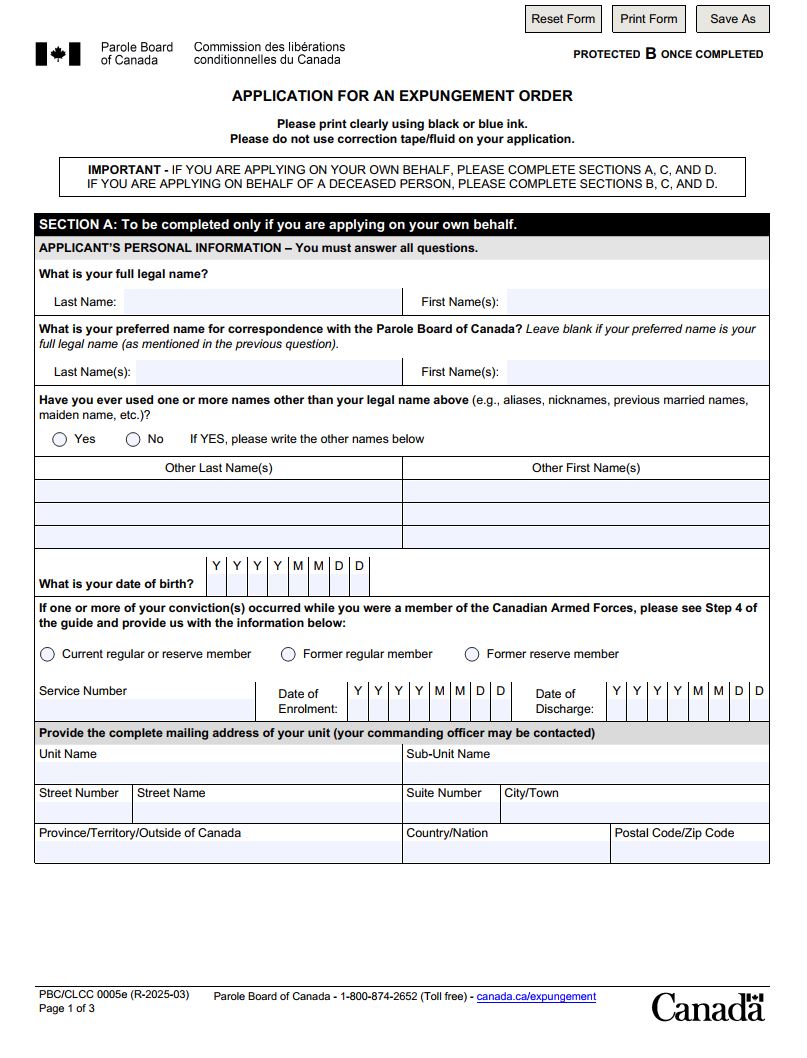
Please use the Expungement Application Form
- If you are applying on your own behalf, please complete Sections A, C, and D.
- If you are you applying on behalf of a deceased person, please complete Sections B, C, and D.
- The application form is fillable, and can be filled in online and then printed. If you are completing it by hand, please print clearly using blue or black ink only. Please do not use correction tape/fluid on your application.
- You must answer all questions truthfully and completely. Concealing information or making false or deceptive statements could result in your application being refused.
- You may attach additional pages to the form if you require extra space to include all of the required information. The Parole Board of Canada reserves the right to contact you to obtain additional information for the processing of your application.
IMPORTANT!
The Parole Board of Canada must be able to contact you directly. If your mailing address changes after you submit your application, please inform the Parole Board of Canada in writing. Make sure your letter includes your:
- name;
- Expungement File Number;
- new mailing address; and
- signature.
Mail your application form and all supporting documents to this address:Parole Board of Canada
Clemency and Record Suspension Division
410 Laurier Avenue West, 5th Floor
Ottawa, Ontario K1A 0R1 -
Step 3 – Get court and/or police documents
Instructions:
You must try to obtain the available court and/or police documents for each of the eligible conviction(s) for which you are applying. This documentation may serve to confirm the existence of the conviction(s) and demonstrate to the Parole Board of Canada that the relevant criteria (see Step 1) for ordering an expungement are met.
Contact the court(s) that heard the case(s) and/or the police service(s) having jurisdiction in the location where the arrest occurred and request a copy of the record(s).
- If the court(s) and/or police service(s) do not have a record of the conviction(s), request confirmation of this in writing.
Review the court and/or police documents carefully to determine if these contain information regarding the relevant criteria for ordering an expungement.
- If you were unable to obtain the court and/or police documents (e.g., the records were destroyed), or if the court and/or police documents do not clearly demonstrate that the relevant criteria for expungement are met, you must produce a sworn statement or solemn declaration (see Step 5).
IMPORTANT!
If you cannot recall the details of your conviction(s), you may wish to request a copy of your criminal record from the National Repository of Criminal Records maintained by the Royal Canadian Mounted Police. Should you have a criminal record within this repository, it may assist you in your search for records. Please consult the Annex at the end of this guide for information on how to obtain a fingerprint copy of your criminal record.
-
Step 4 – Get your Military Conduct Sheet
Instructions:
Did one or more conviction(s) for which you are applying for expungement occur while you (or the deceased person) were a member of the Canadian Armed Forces?
- If NO, you are NOT required to get a Military Conduct Sheet. Continue to Step 5.
- If YES, you MUST get a certified, signed and dated copy of the Military Conduct Sheet by contacting the appropriate organization below.
For Current Regular or Reserve Members:
You must request a Military Conduct Sheet from your Commanding Officer.
FOR FORMER REGULAR MEMBERS:
If you or the deceased person the Canadian Armed Forces left on or after January 1, 1998, contact the Department of National Defence Access to Information and Privacy (ATIP) Branch under the Privacy Act:
Director, Access to Information and Privacy
National Defence Headquarters
Major-general George R. Pearkes Bldg.
101 Colonel By Drive
Ottawa, Ontario K1A 0K2Website: Personal Information Request Form
If you or the deceased person left the Canadian Armed Forces before January 1, 1998, contact the Library and Archives Canada ATIP Branch:
Access to Information and Privacy Branch
Library and Archives Canada
550 de la Cité Boulevard
Gatineau, Quebec J8T 0A7Website: Online requests and forms
FOR FORMER RESERVE MEMBERS:
If you or the deceased person left on or after March 1, 2008, contact the Department of National Defence Access to Information and Privacy (ATIP) Branch under the Privacy Act:
Director, Access to Information and Privacy
National Defence Headquarters
Major-general George R. Pearkes Bldg.
101 Colonel By Drive
Ottawa, Ontario K1A 0K2Website: Personal Information Request Form
If you or the deceased person left the Canadia Armed Forces before March 1, 2008, contact the Library and Archives Canada ATIP Branch:
Access to Information and Privacy Branch
Library and Archives Canada
550 de la Cité Boulevard
Gatineau, Quebec J8T 0A7Website: Online requests and forms
Make sure that your request to obtain a Military Conduct Sheet indicates that the purpose of your request is to apply for an expungement of convictions and that it includes the following information:
If you are applying on your own behalf:
- Your first and last name (if these have changed, please state your complete name at the time of your conviction);
- Your date of birth;
- Your Service Number;
- Your enrolment and discharge dates; and
- Your signature.
If you are applying on behalf of a deceased person:
- The person’s first and last name (if these have changed, please state their complete name at the time of the conviction);
- The person’s date of birth;
- The person’s Service Number (if known);
- The person’s enrolment and discharge dates (if known);
- Your first and last name and signature as applicant;
- A death certificate or other proof of death of the person on whose behalf you are applying; and
- Proof of your relationship with the deceased person.
If no conduct sheet exists or could be located, you must provide a letter from the Commanding Officer or the appropriate organization which indicates that no information is available.
-
Step 5 – Prepare a sworn statement or solemn declaration
Instructions:
A sworn statement or solemn declaration must be submitted with your application for expungement:
- If you were unable to obtain the court and/or police documents, and/or the Military Conduct Sheet, due to retention periods or other reasons; OR
- If you were able to obtain the court and/or police documents, and/or the Military Conduct Sheet, but these do not clearly demonstrate that the relevant criteria are met.
Your sworn statement or solemn declaration should contain information that addresses all relevant criteria for each conviction for which you are applying for an expungement order IF this information is not contained in the court and/or police documents and/or Military Conduct Sheet you are providing.
See Step 1 for the complete list of the required criteria for ordering an expungement.
Make sure that your sworn statement or solemn declaration also includes the following information:
- the reasonable efforts that you made to obtain the documents;
- the reasons why they could not be obtained (e.g., the records were lost or destroyed);
- your sworn statement or solemn declaration is made in support of your application for an expungement order;
- your first and last name(s);
- your date of birth;
- your address;
- the offence(s) for which you are applying, the date(s) and place(s) of conviction(s) and the name(s) of the court(s) where the case(s) were heard;
- if you are applying on behalf of a deceased person, the deceased person’s first and last name and date of birth; and
- your signature and date of signature.
The sworn statement or solemn declaration must be signed by a justice of the peace, attorney, barrister, solicitor, notary public, commissioner of oaths or another official designated that has authority to sign your sworn statement or solemn declaration.
Example of a sworn statement/solemn declaration if you are applying on your own behalf.
Sworn statement/solemn declaration of [Complete NAME]
I, [Complete NAME (with middle name if applicable)], born on [date of birth], residing at [full address], [solemnly affirm or swear] that:
[I make this sworn statement/I solemnly affirm] in support of my application for an expungement order and as such, I have personal knowledge of the matters herein referred to.
- On [date of conviction] I was convicted of [offence], by the court of [name of court] in the city of [name of city] and in the province/territory [name of province or territory].
- On [date] I attended the [name of court] to obtain a copy of the relevant court records for this conviction but I was informed by the court that the records have been destroyed. I attach to this [sworn statement or solemn declaration] the letter from the court dated [date] attesting to this.
- On [date] I attended the [name of police service] to obtain a copy of the relevant police records for this conviction but I was informed by the police service that the records have been destroyed. I attach to this [sworn statement or solemn declaration] the letter from the police service dated [date] attesting to this.
- Address how all relevant criteria for ordering an expungement are met. Please see Step 1 of the application guide for the complete list of the required criteria for ordering an expungement.
Provide sufficient details to demonstrate clearly to the Parole Board of Canada how the criteria are met.
[SWORN OR SOLEMNLY AFFIRMED] BEFORE ME at the
City of (name of city)
In the province/territory of (name of province or territory)
This __________day of __________ (month), _____ (year)Commissioner for taking sworn statements
(or attorney, or other person authorized to swear affidavits)[Complete NAME]
SignatureExample of a sworn statement/solemn declaration if you are applying on behalf of a deceased person.
Sworn statement/solemn declaration of [Complete NAME]
I, [Complete NAME (with middle name if applicable)], born on [date of birth], residing at [full address], [solemnly affirm or swear] that:
[I make this sworn statement/I solemnly affirm] in support of my application for an expungement order on behalf of [full name of deceased person and date of birth] and as such, I have personal knowledge of the matters herein referred to.
- On [date of conviction] [name of person I am applying for] was convicted of [offence], by the court of [name of court] in the city of [name of city] and in the province or territory [name of province or territory].
- On [date] I attended the [name of court] to obtain a copy of the relevant court records for this conviction but I was informed by the court that the records have been destroyed. I attach to this [sworn statement or solemn declaration] the letter from the court dated [date] attesting to this.
- On [date] I attended the [name of police service] to obtain a copy of the relevant police records for this conviction but I was informed by the police service that the records have been destroyed. I attach to this [sworn statement or solemn declaration] the letter from the police service dated [date] attesting to this.
- And, to the best of my knowledge: Address how all relevant criteria for ordering an expungement are met. Please see Step 1 of the guide for the complete list of the required criteria for ordering an expungement.
Provide sufficient details to demonstrate clearly to the Parole Board of Canada how the criteria are met.
[SWORN OR SOLEMNLY AFFIRMED] BEFORE ME at the
City of (name of city)
In the province/territory of (name of province or territory)
This __________day of __________ (month), _________(year)Commissioner for taking sworn statements
(or attorney, or other person authorized to swear affidavits)[Complete NAME]
Signature -
Step 6 – Provide a photocopy of your document to support your identity
Instructions:
You must submit a clear photocopy of a valid document that supports your identity. This government issued (federal, territorial, provincial or municipal) document must have:
- your name;
- date of birth; and
- signature
Examples include: a driver’s license or passport.
-
Step 7 – Provide a photocopy of a document to support your relationship with the deceased person AND a proof of death
Instructions:
If you are applying for an expungement on behalf of a deceased person, you must also submit a copy of:
- a document which supports your relationship with the person.
For example: if you are the deceased person’s child, you could provide a copy of your long form birth certificate to establish your relationship.
- the person’s death certificate.
If you are unable to obtain a copy of a death certificate, another document may be provided, including a statement signed by a medical doctor, coroner or funeraldirector, or a Memorandum of Notification of Death issued by the Chief of National Defence Staff, among others.
The Parole Board of Canada will consider accepting any reasonable evidence that establishes your relationship with the deceased person and proof of death.
- a document which supports your relationship with the person.
-
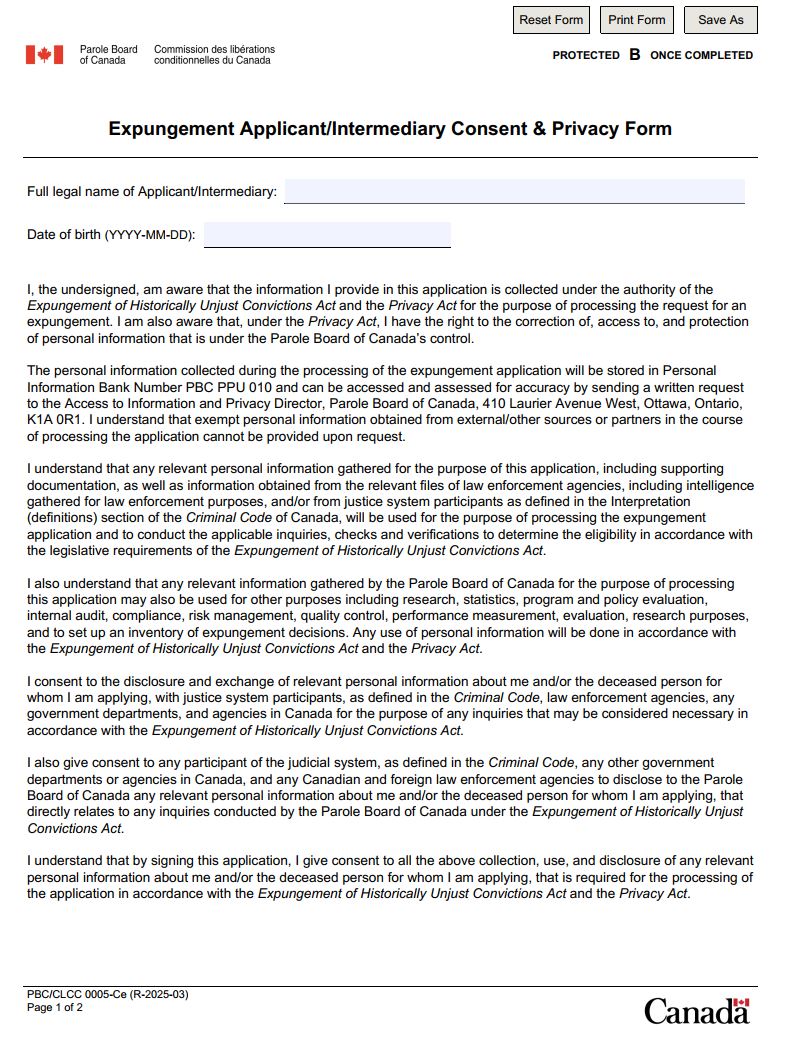
Step 8 – Expungement Applicant/Intermediary Consent & Privacy Form
Form:
Instructions:
You must read and complete the Expungement Applicant/Intermediary Consent & Privacy Form. Please ensure that you include your full legal name and date of birth on the top of page 1, as well as sign and date the form on page 2.
IMPORTANT!
The consent & privacy form is only valid for 12 months from the date you sign it.
-
Before you submit your application
IMPORTANT!
Before you submit your application, please make sure that you have:
- answered all questions accurately and completely; and,
- photocopied all of your application documents for your own records and future reference.
EXPUNGEMENT APPLICATION CHECKLIST
Have you included these documents in your application?
- Check if you are eligible to apply (explained in Step 1)
- Original Expungement Application Form (explained in Step 2)
- Photocopy of the court and/or police documents (explained in Step 3)
- Photocopy of the Military Conduct Sheet, if applicable (explained in Step 4)
- Original sworn statement or solemn declaration, if applicable (explained in Step 5)
- Photocopy of your identification document (explained in Step 6)
- Photocopy of proof of relationship with the deceased person and proof of death, if applicable (explained in Step 7)
- Expungement Applicant/Intermediary Consent & Privacy Form (explained in Step 8)
Mail your Application Form and all official documents to the following address:Parole Board of Canada
Clemency and Record Suspension Division
410 Laurier Avenue West, 5th Floor
Ottawa, Ontario K1A 0R1Should you have any difficulties in obtaining or providing a copy of any document for the purposes of an expungement application, please contact the Parole Board of Canada at 1-800-874-2652 or expungement-radiation@pbc-clcc.gc.ca.
Have a question or need assistance with your application? Contact us
NOTE
Make sure your letter includes your:
- name;
- Expungement File Number;
- new mailing address; and
- signature.
Mail your application form and all supporting documents to this address:
Parole Board of Canada
Clemency and Record Suspension Division
410 Laurier Avenue West, 5th Floor
Ottawa, Ontario K1A 0R1