
Minister's Transition Binder 2021 - Impact Assessment Agency of Canada
Contents
- 1. Ministerial Responsibilities
- 2. Impact Assessment Agency of Canada - Corporate Information
- 3. Upcoming Decisions
- 4. Legislation and Regulations
- 5. Project Forecast
1. Ministerial Responsibilities
The Impact Assessment Act (IAA) provides for the assessment of the environmental, social and economic impacts of major projects (i.e., pipelines, mines or marine terminals that are designated in regulations).
Assessments are conducted by the Impact Assessment Agency of Canada (the Agency) and involve extensive engagement with Indigenous peoples and the public. Assessments may also be referred to an independent review panel or the process may be substituted with that of another jurisdiction.
Impact Assessment Act
The Minister of the Environment (Minister) has various authorities under the IAA during and following assessments, as follows:
- Designation of a proposed project to undergo an assessment for projects that are not already identified by regulations as subject to assessment;
- Referring impact assessments to an independent review panel of experts;
- Approving a provincial process or that of another jurisdiction to substitute for a federal impact assessment process;
- Providing early notice to the proponent of potential unacceptable environmental effects;
- Extending time limits for impact assessments and decision-making; and
- Decision-making after an impact assessment process, including issuing a Decision Statement that includes any enforceable conditions to mitigate effects:
- The decision determines whether the adverse effects within federal jurisdiction are in the public interest; and
- The Minister may refer the decision to the Governor in Council (GIC).
There are currently 15 designated projects being assessed under the IAA.
Canadian Environmental Assessment Act, 2012 (CEAA 2012)
On-going assessments of projects that began under the previous legislation (CEAA 2012) continue to be subject to that legislation. The Minister must determine if the project is likely to cause significant adverse environmental effects, and if so, the Minister must refer to the Governor in Council the final decision as to whether those significant adverse environmental effects are “justified in the circumstances”.
Following the Minister’s decision (when there are no significant effects) or Governor in Council’s decision (when there are significant effects), the Minister must issue a Decision Statement to inform the proponent of the project of the final decision. Subject to the project’s approval, the Decision Statement will include appropriate and enforceable conditions to address environmental effects associated with the project.
There are currently 43 designated projects undergoing assessment under CEAA 2012.
2. Impact Assessment Agency of Canada - Corporate Information
Organizational Mandate
Raison d’être
The Impact Assessment Agency of Canada (the Agency) conducts environmental and impact assessments of major projects to inform Government decision-making in support of sustainable development. Impact and environmental assessments are planning and decision-making tools: they assist with project design; facilitate Indigenous, public, and stakeholder participation; and, ensure that appropriate measures are identified and implemented to mitigate adverse impacts of major projects.
Mandate and role


The Agency:
- leads and manages the impact assessment process for all federally designated major projects;
- leads Crown engagement and serves as the single point of contact for consultation and engagement with Indigenous peoples during impact assessments for designated projects;
- provides opportunities and funding to support Indigenous peoples’ engagement in impact assessments and to support public participation;
- develops and works to ensure that mitigation measures are working as intended; and
- develops and promotes impact assessment best practices through research, guidance and ongoing discussion with stakeholders and other jurisdictions.
The Agency works with other bodies like the Canada Energy Regulator (formerly the National Energy Board), the Canadian Nuclear Safety Commission, the Canada-Newfoundland and Labrador Offshore Petroleum Board and the Canada-Nova Scotia Offshore Petroleum Board and other federal departments and agencies. The Agency also works in cooperation with provinces and territories, Indigenous jurisdictions, environmental organizations and industry.
Senior Executive & Organizational Structure

Terry Hubbard
Acting President and Vice-President, Operations Sector
Terry Hubbard has been named acting President of the Agency effective August 30, 2021.
Terry was appointed Vice-President of the Operations Sector on September 10, 2018. In this role, he is responsible for overseeing the assessment of environmental, social and economic impacts of major projects across Canada to support sustainable development objectives and ensure meaningful participation of Indigenous groups and the public.
Prior to joining the Agency, Terry was Director General of the Petroleum Resources Branch with Natural Resources Canada. In this role, he was responsible for Canada’s oil and gas policy, including overseeing the development and implementation of Canada’s pipeline safety and offshore oil and gas regulatory regimes.
Terry worked as the Government lead on legislative proposals to modernize the National Energy Board (NEB). He has significant background and experience on environmental assessment and regulatory matters having had the responsibility of policy oversight for the NEB and for the Canada-Newfoundland and Canada-Nova Scotia Offshore Petroleum Boards.
Terry graduated from the University of Saskatchewan where he obtained both his Bachelor and Master of Arts degrees in economics.

Patricia Brady
Vice-President, External Relations and Strategic Policy
Patricia Brady was appointed Vice-President of the External Relations and Strategic Policy Sector in January 2021.
Prior to joining the Agency, Patricia held various executive roles at Innovation, Science and Economic Development Canada (ISED), most recently as Director General of Telecommunications and Internet Policy. From 2015-2019, Patricia served as Director General of the Investment Review Division and led economic and national security reviews of foreign investments under the Investment Canada Act. Patricia joined ISED from the Competition Bureau, having served in both enforcement and policy roles.
Before joining the Public Service, Patricia practised law in the corporate group of a major Canadian law firm where she focussed on federal regulatory matters. Patricia has a Bachelor of Arts from Queen’s University and a law degree from the University of Ottawa. She was called to the Bar in Ontario.

Simon Brault
Vice-President, Corporate Services and Chief Financial Officer
Simon Brault was appointed Vice-President of the Corporate Services Sector and Chief Financial Officer (CFO) in February 2020.
Prior to joining the Agency, Simon was Director General of the Corporate Finance, Systems and Procurement Branch at Innovation, Science and Economic Development Canada.
Simon has been in the public service for 29 years, almost all spent in the various incarnations of the Department of Industry. He started as a student and through the many varied roles he held, eventually became Deputy CFO. During those years, Simon worked in many program delivery, policy development and implementation, and corporate services roles.
He holds university degrees in Biochemistry and Economics as well as an MBA, all from the University of Ottawa. Simon also holds a Chartered Financial Analyst designation.
Finances
Summary
- The Impact Assessment Agency of Canada (the Agency) total funding (authorities) for 2021-2022 is $79.0 million, funded as follows:
- $19.3 million in on-going funding; and
- $59.7 million in temporary funding as part of a five year funding package under Budget 2018 to implement the Impact Assessment Act.
- This amount, as tabled in the 2021-2022 Main Estimates, includes:
- $51 million in Operating Expenditures – Vote 1;
- $22.2 million in Grants and Contributions – Vote 5; and
- $5.8 million in Statutory Authorities (or Employee Benefit Programs).
- Full Time Equivalents (FTEs):
- The Agency has 442 funded FTEs at both headquarters in Ottawa and at its six regional offices (Vancouver, Edmonton, Toronto, Quebec City, Halifax, and a satellite office in St. John’s).
- Budget 2018 provided:
- The Agency with $259 million over five years, starting in 2018-2019 to support the new impact assessment mandate (including $68.9 million in dedicated Grants and Contributions programming);
- This temporary funding provided through Budget 2018 represents approximately 75% of the Agency's annual funding; and
- The Agency’s temporary 5 year funding ends March 31, 2023. As such, the Agency will be required to renew its funding profile before 2023.
- Expenditures for 2020-2021:
- Projected spending for 2020-2021 is $76.9 million of the $80.5 million of available funding.
Horizontal Implementation and Funding
In 2018, the Government of Canada allocated approximately $1 billion dollars over five years to nine departments and agencies, starting in 2018-19, to implement the new impact assessment and regulatory regime in support of the following objectives:
- Support the proposed new impact assessment system and the Canada Energy Regulator;
- Increase scientific capacity in federal departments and agencies;
- Implement changes required to protect water, fish and navigation; and
- Increase Indigenous and public participation.
IAAC funding for this horizontal initiative was allocated across three of the following six themes:
- Impact assessment;
- Partnering with Indigenous peoples;
- Cumulative effects, open science, and evidence;
- Protection of Fish and Fish Habitat;
- Protection of the Public Right to Navigation; and
- Regulation of Energy.
Table 1 provides a breakdown of the funding allocated in 2018 to each of the nine organizations across these six themes and internal services.
Org. |
Themes |
Internal Services |
Total |
|||||
|---|---|---|---|---|---|---|---|---|
Impact Assessment |
Partnering with Indigenous people |
Cumulative Effects, Open Science, Evidence |
Protection of Fish and Fish Habitat |
Protection of Public Right to Navigation |
Regulation of Energy |
|||
CIRNAC |
- |
$12,863,625 |
$15,331,658* |
- |
- |
- |
$1,203,632 |
$29,398,915 |
DFO |
- |
- |
$62,738,222 |
$263,663,248 |
- |
- |
$24,847,580 |
$351,249,050 |
ECCC |
$15,622,538 |
- |
$77,356,815 |
- |
- |
- |
$7,050,642 |
$100,029,995 |
HC |
$29,168,322 |
- |
$1,807,664 |
- |
- |
- |
$2,742,081 |
$33,718,067 |
IAAC |
$108,344,451 |
$81,595,595 |
$32,850,267 |
- |
- |
- |
$35,785,094 |
$258,575,407 |
ISC |
$795,540 |
$2,894,804 |
- |
- |
- |
$560,214 |
$4,250,558 |
|
CER |
- |
$15,301,006 |
$6,850,000 |
- |
- |
$28,398,101 |
$4,940,045 |
$55,489,152 |
NRCan |
$7,948,382 |
- |
$63,294,750 |
- |
- |
$7,926,152 |
$6,966,152 |
$86,135,436 |
TC |
$10,451,406 |
$4,921,605 |
$2,476,316 |
- |
$66,940,787 |
- |
$12,887,742 |
$97,677,856 |
Total |
$172,330,639 |
$117,576,635 |
$262,705,692 |
$263,663,248 |
$66,940,787 |
$36,324,253 |
$96,983,182 |
$1,016,524,436 |
Notes: |
||||||||
Source: 2018 Horizontal Results Framework, Impact Assessment Agency of Canada
3. Upcoming Decisions
Assessment Decisions
Background
A number of decisions are required by the Minister under the Canadian Environmental Assessment Act, 2012 (CEAA 2012) or the Impact Assessment Act (IAA). Anticipated decision dates (subject to change) are shown below.
CEAA 2012-Related Decisions
Environmental Assessment Decisions
In the coming ten months, there are up to 12 Environmental Assessment decisions, including up to four assessments that may require the Minister to determine whether the projects are likely to cause significant adverse environmental effects (Tilbury Marine Jetty; Bay du Nord; Énergie Saguenay; and Roberts Bank Terminal 2) within the next 100 days. Should the Minister determine that a project is likely to cause significant adverse environmental effects, a subsequent decision from the Governor-in-Council would be required to determine whether those effects are justified in the circumstances (see Figure 1, Figure 2, and Table 2).
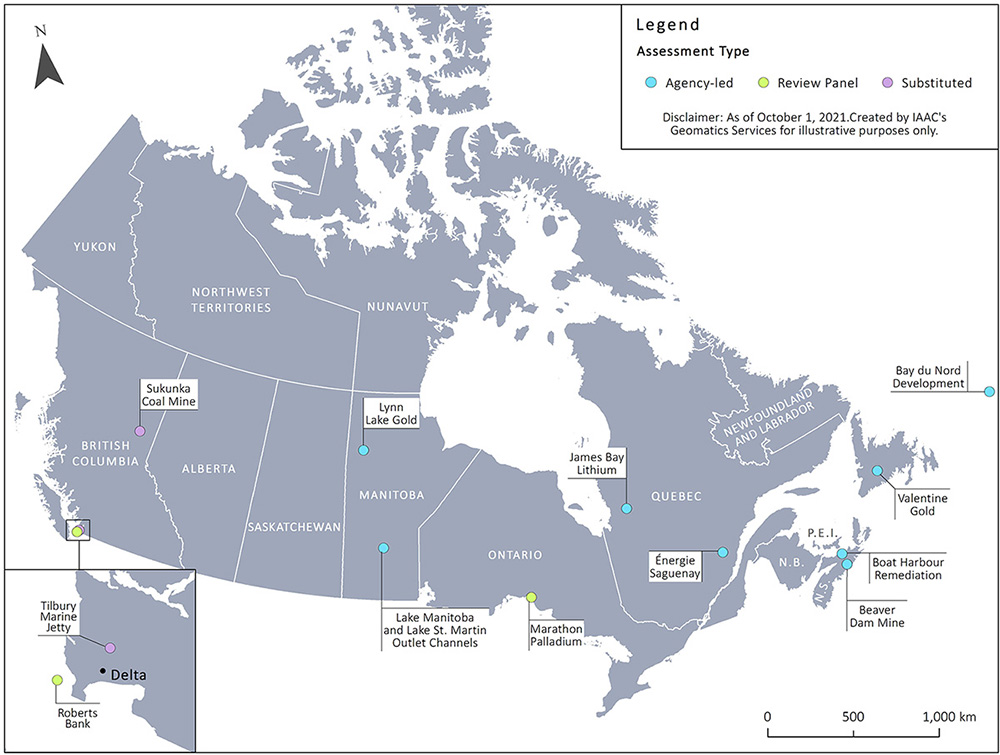
Figure 1 - Text version
Map of Canada depicting the projects undergoing an environmental assessment under CEAA 2012 for which a ministerial decision is expected before or by July 2022.
The projects are:
- Tilbury Marine Jetty (located on Tilbury Island, British Columbia; assessment by substitution of the federal environmental assessment process by that of the Government of British Columbia);
- Roberts Bank Terminal 2 (located at Roberts Bank in Delta, British Columbia; environmental assessment by Review Panel);
- Sukunka Coal Mine (located south of Chetwynd and west of Tumbler Ridge, British Columbia; assessment by substitution of the federal environmental assessment process by that of the Government of British Columbia);
- Lynn Lake Gold (located near Lynn Lake, Manitoba; Agency-led assessment);
- Lake Manitoba and Lake St. Martin Outlet Channels (located in Manitoba; Agency-led assessment);
- Marathon Palladium (located near Marathon, Ontario; assessment by Review Panel);
- James Bay Lithium Mine (located east of James Bay and the Eastmain Cree Village, Quebec; Agency-led assessment);
- Énergie Saguenay (located in Saguenay, Quebec; Agency-led assessment);
- Beaver Damn Mine (located in Marinette, Nova Scotia; Agency-led assessment);
- Boat Harbour Remediation (located east of Pictou, Nova Scotia; Agency-led assessment);
- Valentine Gold (located at Valentine Lake, Newfoundland and Labrador; Agency-led assessment), and;
- Bay du Nord Development (in the Flemish Pass, in the Atlantic Ocean, east of St. John's, Newfoundland and Labrador; Agency-led assessment).
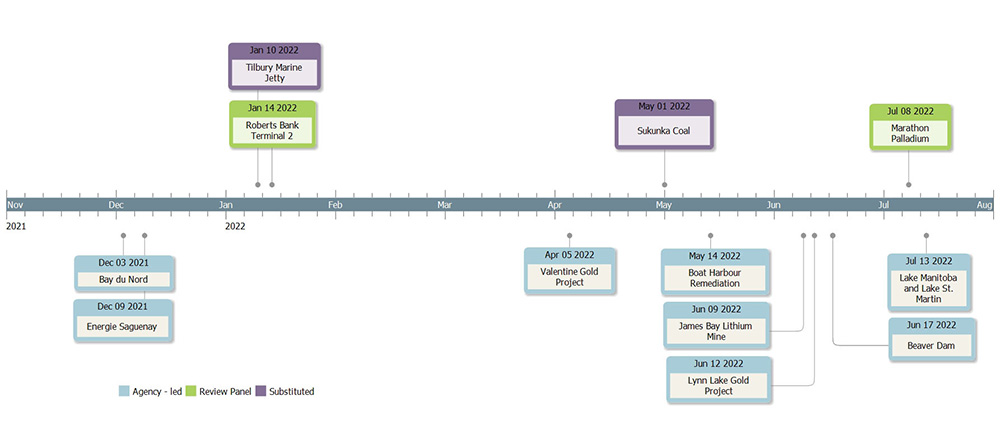
Figure 2 - Text version
Timeline depicting the next anticipated ministerial decision for projects undergoing an environmental assessment under the Canadian Environmental Assessment Act, 2012:
- Bay du Nord (December 3, 2021);
- Énergie Saguenay (December 9, 2021);
- Tilbury Marine Jetty (December 20, 2021);
- Roberts Bank Terminal 2 (January 14, 2022);
- Valentine Gold (April 5; 2022);
- Sukunka Coal Mine (May 1, 2022);
- Boat Harbour Remediation (May 14, 2022);
- James Bay Lithium Mine (June 9, 2022);
- Lynn Lake Gold (June 12, 2022);
- Beaver Damn Mine (June 17, 2022);
- Marathon Palladium (July 8, 2022), and;
- Lake Manitoba Lake and St. Martin Outlet Channels (July 13, 2022).
Project Name |
Project Type |
Capital Investment |
Next Ministerial Decision |
Anticipated Final Project DecisionFootnote 1 |
Assessment Type |
Current Status / Next MilestoneFootnote 2 |
Provincial Status |
Key Issues |
|---|---|---|---|---|---|---|---|---|
British Columbia |
||||||||
Tilbury Marine Jetty |
LNG Transport Jetty |
$260 million |
Jan 2022 |
Winter 2022 |
Substituted (province-led) |
EA Report to Minister Oct 26 |
BC leading EA |
Cumulative effects of marine shipping (Southern Resident Killer Whale, Indigenous communities) |
Roberts Bank Terminal 2 |
Marine Terminal |
$2.5 billion |
Jan 2022 |
Winter 2022 |
Review Panel |
Comment Period on Draft Conditions Oct 6-Dec 5 |
BC EA to be concluded after federal decision |
Cumulative effects on Southern Resident Killer Whale; Salmon; Biofilm; Impacts on Indigenous communities |
Sukunka Coal |
Metallurgical Coal Mine |
$443.7 million |
May 2022 |
May 2022 |
Substituted (province-led) |
Province ends preparation of draft EA Report Jan 31 (TBC) |
Provincial EA ongoing |
SARA (Southern Mountain Caribou); Impacts on Indigenous communities |
Manitoba |
||||||||
Lynn Lake Gold |
Gold Mine |
$493 million |
Jun 2022 |
Jun 2022 |
Agency-led |
Submission of outstanding information Jan 7 (TBC) |
Provincial EA ongoing |
Caribou; Air; Ground and surface water; Indigenous impacts |
Lake Manitoba and Lake St. Martin |
Water Management |
$540 million |
Jul 2022 |
Jul 2022 |
Agency-led |
Submission of outstanding information Jan 14 (TBC) |
Provincial EA ongoing |
Effects to fish and fish habitat; Impacts on Indigenous communities |
Ontario |
||||||||
Marathon Palladium |
Palladium Mine |
$1.067 billion |
Jul 2022 |
Jul 2022 |
Joint Review Panel |
Determination of sufficient info for hearings Oct 15 (TBC) |
Joint Review ongoing |
SARA (Impacts to caribou); water quality and quantity |
Quebec |
||||||||
Énergie Saguenay |
LNG Facility |
$9 billion |
Dec 9 |
Winter 2022 |
Agency-led |
EA Report to Minister Nov 9 (TBC) |
Province Rejected Project in July 2021 |
GHGs; Impacts of marine traffic on beluga |
James Bay Mine |
Lithium Mine |
$507 million |
Jun 2022 |
Jun 2022 |
Agency-led (jointly with Cree) |
Submission of outstanding information Jan 28 (TBC) |
Provincial EA under James Bay Agreement |
Cumulative effects of road traffic and water management |
Nova Scotia |
||||||||
Boat Harbour Remediation |
Waste Management and Remediation |
$311 million |
May 2022 |
May 2022 |
Agency-led |
Submission of outstanding information Nov 4 (TBC) |
No provincial EA NS funding Proponent is a NS crown corp |
Lack of support from Pictou Landing First Nation for disposal location |
Beaver Dam |
Gold Mine |
$526 million (life of project) |
Jun 2022 |
Jun 2022 |
Agency-led |
Submission of outstanding information Oct 22 (TBC) |
Provincial EA is ongoing |
SARA (Impacts to Atlantic Salmon); Impacts on Indigenous communities |
Newfoundland and Labrador |
||||||||
Bay Du Nord |
Offshore Oil & Gas |
$10.9 Billion |
Dec 3 |
Dec 3 |
Agency-led |
EA Report to Minister Nov 11 |
No provincial EA |
Noise on marine mammals; GHGs |
Valentine Gold |
Gold Mine |
$662 million |
Apr 2022 |
Apr 2022 |
Agency-led |
Submission of outstanding information Oct 19 (TBC) |
Provincial EA is ongoing |
SARA (impacts on caribou); Surface and groundwater quality |
IAA-Related Decisions
Requests For Designation And Regional Assessments
The Minister will be required to respond to eight requests to designate physical activities (projects) that are not prescribed by regulations as subject to the impact assessment process (Canadian Pacific Logistics Park; Pitt Meadows Road and Rail Improvements; Lake Diefenbaker; Tenas Coal; Highway 101; Touquoy Gold Mine; Meltech; and Vivian Sands) and one request for a regional assessment (Infill Activities in Halifax Harbour). Should additional requests be received, the IAA requires the Minister to respond publicly with reasons within 90 days (see Figure 3, Figure 4, and Table 3).
Referral To Review Panel
The Minister may be required to make a decision regarding whether to refer the Global Container Terminals Deltaport Expansion Berth Four Project to an independent review panel. Under the process set out in the IAA, the decision to refer the assessment to a review panel, when the Minister is of the opinion that it is in the public interest, would be required within 45 days of the Agency’s issuance of a project’s Notice of Commencement, and after its decision that an impact assessment is required (expected in Fall 2021) (see Figure 3, Figure 4, and Table 3).
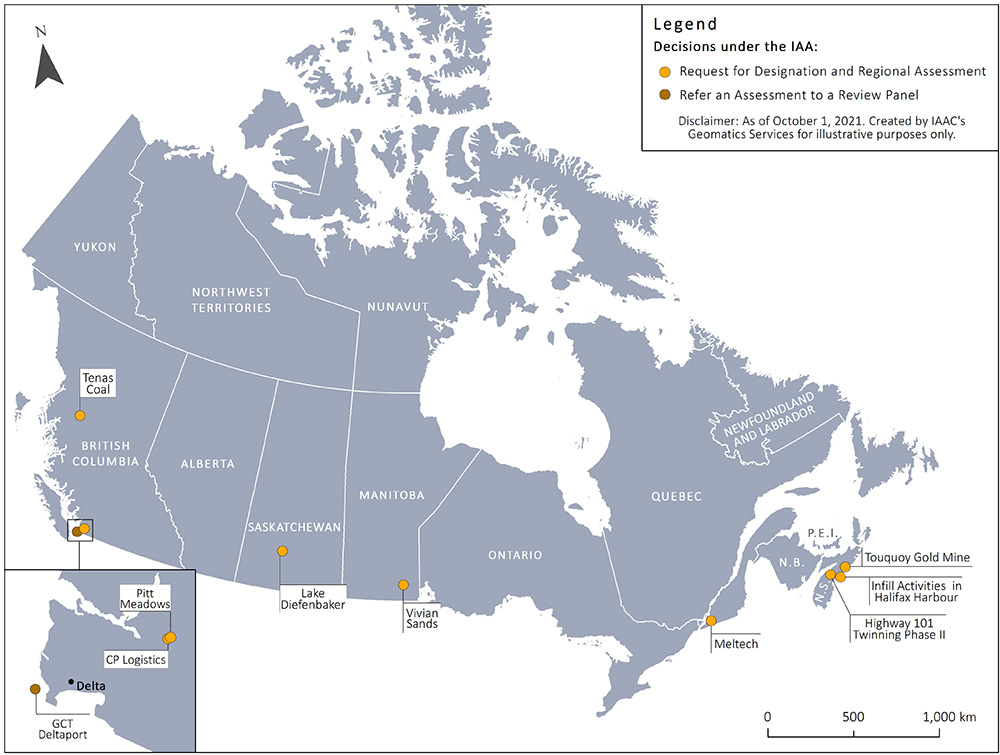
Figure 3 - Text version
Map of Canada depicting the projects for which a ministerial decision or response under the Impact Assessment Act is anticipated by January 2022.
The projects are:
- Tenas Coal (located in British Columbia; request for designation);
- Tilbury Phase 2 LNG Expansion (located in British Columbia; request for substitution);
- GCT Deltaport Expansion (located in British Columbia; decision on referral to a Review Panel);
- Pitt Meadows Road and Rail Improvement (located in British Columbia; request for designation);
- CP Logistics Park Vancouver (located in British Columbia; request for designation);
- Lake Diefenbaker Irrigation Expansion (located in Saskatchewan; request for designation);
- Vivian Sands (located in Manitoba; request for designation);
- Meltech Industrial Building (located in Quebec; request for designation);
- Highway 101 Twinning Phase II Aboiteau and Bridges (located in Nova Scotia; request for designation);
- Infilling Activities in Halifax Harbour (located in Nova Scotia; request for a regional assessment), and;
- Touquoy Gold Mine Expansion (located in Nova Scotia; request for designation).
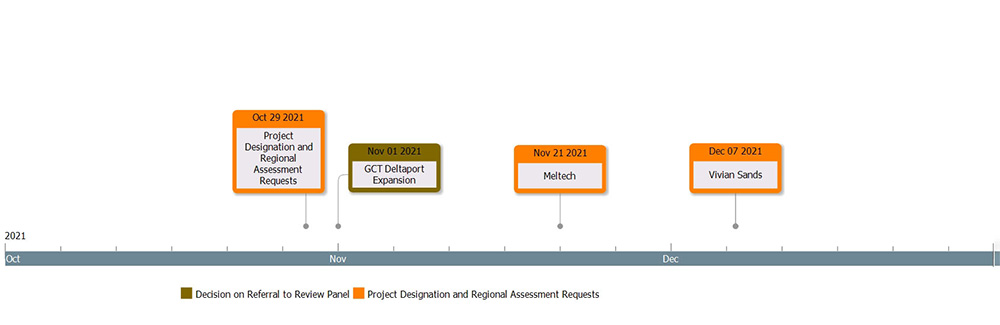
Figure 4 - Text version
Timeline depicting the next anticipated ministerial decisions under the Impact Assessment Act:
- ministerial response on designation and regional assessment requests (Late October; 2021);
- GCT Deltaport Expansion (November 2, 2021; Minister’s decision on referral to a Review Panel);
- Meltech Industrial Building (November 21, 2021; Minister’s response on the request for designation);
- Vivian Sands (December 7, 2021; Minister’s response on the request for designation), and;
- Tilbury Phase 2 LNG Expansion (December 20, 2021; Minister’s decision on the request for substitution).
Project Name |
Project Type |
Anticipated Decision DateFootnote 3 |
Decision Type |
Next MilestoneFootnote 4 |
Provincial Status |
Key Issues |
|---|---|---|---|---|---|---|
British Columbia |
||||||
Canadian Pacific Logistics Park Vancouver |
Transportation Infrastructure |
Late October 2021 |
Designation Request |
Minister response to Request |
No provincial interest or involvement |
Potential impacts to fish and fish habitat that contribute to cumulative impacts on Indigenous use and rights |
Pitt Meadows Road and Rail Improvements |
Transportation Infrastructure |
Late October 2021 |
Designation Request |
Minister response to Request |
No provincial interest or involvement |
Potential contribution to cumulative impacts on Indigenous use and rights |
Tenas Coal |
Metallurgical Coal Mine |
Late October 2021 |
Designation Request |
Minister response to Request |
Advanced provincial environmental assessment underway |
Surface water quality and potential impacts to fish from selenium; impacts to Southern mountain caribou |
GCT Deltaport Expansion, Berth Four Project |
Transportation Infrastructure |
November 1, 2021 |
Decision on Referral to Review Panel |
Proponent submits Detailed Project Description |
Provincial assessment process underway and coordinated with federal process |
Impacts to SARA species (SRKW), fish and fish habitat, Indigenous rights/interests |
Saskachewan |
||||||
Lake Diefenbaker Irrigation Expansion |
Irrigations Project |
Late October 2021 |
Designation Request |
Minister response to Request |
Provincial EA required for Phase 3 |
Surface water quality; potential impacts to fish Indigenous use and rights |
Manitoba |
||||||
Vivian Sands |
Sand Mine |
December 7, 2021 |
Designation Request |
Minister response to Request |
Provincial EA proposal is under review |
Groundwater and surface water quality; cumulative impacts on rights |
Quebec |
||||||
Meltech Industrial Building |
Industrial |
November 21, 2021 |
Designation Request |
Minister response to Request |
No provincial involvement |
Indigenous consultation; monarch butterfly |
Nova Scotia |
||||||
Touquoy Gold Mine Expansion |
Gold Mine |
Late October 2021 |
Designation Request |
Minister response to Request |
In September 2021, MB decided that further information was required |
Impacts to ground and surface water quality and quantity, Fish and habitat |
Highway 101 Twinning Phase 2 & Bridges |
Transportation Infrastructure |
Late October 2021 |
Designation Request |
Minister response to Request |
Provincial EA concluded in June 2017. NS approved the project, with conditions |
Potential impacts to fish passage and related impacts on Indigenous use and rights |
Infill Activities in Halifax Harbour |
Marine infilling |
Late October 2021 |
Request for Regional Assessment |
Minister response to Request |
No provincial interest or involvement |
Effects on fish and fish habitat and other ecological values and human uses in the Northwest Arm. |
Anticipated Litigation Activity
Project Summary |
Next Steps |
|---|---|
Constitutional Reference nstitutional Reference |
|
Reference Re Impact Assessment Act (Canada) In September 2019, Alberta (AB) challenged the Impact Assessment Act (IAA) by referring two constitutional questions to the AB Court of Appeal (ABCA). AB alleges that the IAA and the Physical Activities Regulations (Project List) amount to regulation of matters within exclusive provincial jurisdiction and are therefore beyond Parliament’s constitutional authority. Ontario and Saskatchewan are interveners to the litigation, as are several Indigenous and stakeholder groups. |
ABCA decision is anticipated Fall 2021. Decision on whether to appeal the decision could be needed within the first 100 days. |
Horizon Oil Sands North Pit Extension Project |
|
Mikisew Cree First Nation and Minister of Environment et al. The Mikisew Cree have filed a judicial review in the Federal Court challenging the Minister’s (February 15, 2019) decision not to designate the Horizon Oil Sands North Pit Extension project proposed by Canadian Natural Resources. |
Decision could be provided in Fall 2021. Decision on whether to appeal the decision could be needed within the first 100 days. |
Regional Assessment of Offshore Oil and Gas Exploratory Drilling East of Newfoundland and Labrador and Regional Assessment Regulations (IAA) |
|
Sierra Club Canada Foundation et al. and Canada Judicial Review (JR) 1: The Applicants seek an Order from the Federal Court quashing the Regional Assessment Report on the grounds that it is fundamentally flawed and fails to comply with the Committee’s terms of reference and the requirements of the IAA. The Applicants further argue that the process followed by the Committee failed to meet requirements of procedural fairness. JR 2: The Applicants seek a declaration that the Regulations Respecting Excluded Physical Activities (Newfoundland and Labrador Offshore Exploratory Wells) are beyond the power and the jurisdiction of the Minister and the IAA. The Applicants also seek an Order quashing the Regulations. |
Decisions anticipated late Fall 2021. Decision on whether to appeal the decision could be needed within the first 100 days. |
4. Legislation and Regulations
Background
- The Impact Assessment Act (IAA), the Physical Activities Regulations (known as the Project List and sets out major projects subject to assessment), and the Information and Management of Time Limits Regulations came into force on August 28th, 2019, replacing the Canadian Environmental Assessment Act, 2012 (CEAA 2012);
- The introduction of the IAA followed a legislative review of CEAA 2012 which began in 2017. Among other changes, the new regime added a Planning phase, broadened the scope of assessment to include consideration of social and economic factors in addition to environmental effects and consolidated assessments under the Impact Assessment Agency of Canada (the Agency) with integration of lifecycle regulators (Canada Energy Regulator, Canadian Nuclear Safety Commission and Offshore Boards). Assessment timelines were shortened and regulations were put in place to restrict the reasons that a timelimit could be pause; and
- The Agency is responsible for conducting impact assessments under the IAA and completing the remaining assessment processes under the CEAA 2012.
IAA Objectives
- The overarching objectives set out in the IAA include:
- fostering sustainability;
- ensuring respect for the rights of Indigenous peoples, fostering reconciliation and working in partnership with them;
- promoting cooperation and coordinated action between federal and provincial governments;
- encouraging public participation; and
- providing a predictable and efficient assessment process that enhances Canada’s competitiveness and encourages investment.
Projects Subject to Impact Assessment
Project examples
Major projects in the following sectors or groups are found on the Project List:
- Oil and gas
- Transportation-related
- Marine and freshwater
- Mining
- Nuclear
- Hazarous waste
- Designated projects (i.e., those subject to assessment) are described in the Physical Activities Regulations (Project List).
- Focus on major projects - those with the most potential for adverse environmental effects in areas of federal jurisdiction.
- The Minister may designate a physical activity for assessment if not already on the Project List.
- Designation requests may be submitted by anyone and the Minister must respond within 90 days.
- The IAA includes prohibitions on proponents proceeding with designated projects, unless:
- Agency determines that an assessment is not required;
- proponent complies with conditions in a decision statement following an assessment; or
- permitted by Agency in preparation of an assessment.
IAA Process and Decision-Making

Information and Management of Time Limits Regulations:
- Outlines key information requirements of proponent submissions
- Identifies the documents the Agency is required to provide to a proponent
- Establishes the criteria for suspending legislated timelines
Types of Designated Project Assessments
- Agency-led Assessment
- Agency leads the assessment, engagement and report to Minister;
- Collaboration with other jurisdictions and federal expert departments; and
- Public review through posting on the Impact Assessment Registry.
- Review Panel
- Independent panel appointed by the Minister to lead the assessment, engagement and report to Minister for decision;
- Public hearings held to allow all interested parties to provide views, in addition to posting on the Impact Assessment Registry; and
- Minister may consider the following when referring to a review panel.
- potential for significant adverse environmental effects;
- public concerns related to those effects; and
- opportunities for cooperation with any jurisdiction.
Decision-Making
Based on Impact Assessment Report from the Agency or review panel, Minister or Governor in Council must determine whether the adverse effects in federal jurisdiction (e.g., changes related to fish and fish habitat, aquatic species, migratory birds; Indigenous peoples’ culture or use of lands or health, social or economic conditions; or on federal lands or in another province or country), and adverse direct or incidental effects, are in the public interest
Decision Statement, issued by Minister, must include:
- Public interest determination;
- Reasons for the determination;
- Enforceable conditions;
- Expiry Date; and
- Description of the project.
Public interest determination requires consideration of:
- Project’s contribution to sustainability;
- Extent to which adverse effects within federal jurisdiction and the adverse direct or incidental effects are significant;
- Associated mitigation measures;
- Impacts on Indigenous groups and adverse impacts on rights; and
- Extent that project’s effects hinder or contribute to Canada’s environmental obligations and climate change commitments.
Cooperation with Jurisdictions
- The environment is an area of shared responsibility between federal, provincial and territorial governments under Canada’s Constitution Act;
- Each province has its own assessment regime, resulting in some proposed projects requiring assessment by both federal and provincial governments;
- Assessment processes in the territories and part of northern Quebec and Labrador are administered through regimes that have been established through constitutionally-protected land claim agreements. The application of the federal legislation varies under each of the regimes;
- The IAA articulates the importance of cooperating with jurisdictions that have responsibilities for impact assessment, including the principle of “one project, one assessment”; and
- The IAA provides tools to improve efficiency and effectiveness, which may be considered when conducting an impact assessment:
Coordination
Jurisdictions coordinate activities and, where possible, timelines and documents.
Delegation
Federal government delegates some tasks to one or more jurisdictions, while remaining responsible for the overall process.
Substitution
Federal government allows a jurisdiction's process to replace the federal process, with each jurisdiction making its own decision based on a single assessment report.
Joint Review Panel
Jurisdictions jointly appoint panel members and agree on terms of reference for an independent panel to conduct the impact assessment.
Towards the goal of “one-project, one-assessment”
- Agency must offer to consult with jurisdictions, including Indigenous jurisdictions;
- Some flexibility in timelines to enable cooperation with jurisdictions; and
- Agency may establish formal cooperation agreements with interested jurisdictions to ensure coordinated assessments; currently one cooperaton agreement in place with British Columbia.
Indigenous Engagement, Consultation & Participation
- The Agency acts as the Crown Consultation Coordinator throughout the impact assessment process, leading Government of Canada consultations with Indigenous peoples to meet the statutory requirements of the IAA, the Crown’s common law duty to consult, obligations flowing from provisions of modern treaties and the United Nations Declaration on the Rights of Indigenous Peoples, and the Government of Canada’s commitment to advance reconciliation with Indigenous peoples;
- The IAA includes several significant provisions to support these objectives:
- Authority to create regulations to share federal assessment powers;
- Agency coordinates engagements and consultation for all federal authorities;
- Must take into account Indigenous-led assessments and Indigenous knowledge, rights and culture;
- Adverse impacts on rights must be considered in key decisions; and
- Rights of Indigenous peoples are respected; opportunities and capacity to participate in impact assessments.
- Through its implementation of the IAA, the Agency is working to enhance Indigenous participation and advance reconciliation;
- The Agency is advancing new and innovative partnerships with Indigenous peoples by collaborating on the assessment of project impacts and the development of policies and guidance. The Agency uses a model to consult with Indigenous peoples that emphasizes collaboration and consensus-building;
- As required by the IAA, an Indigenous Advisory Committee, made up of First Nations, Inuit and Métis individuals from across Canada, was established in 2019. The committee provides the Agency with information and expert advice for the development of key policies and guidance to help ensure the unique rights, interests and perspectives of Indigenous peoples are acknowledged, affirmed and implemented in environmental and impact assessment;
- The Agency also negotiates treaty provisions and project-specific bilateral agreements with Indigenous governing bodies related to impact assessment and leads implementation of treaty obligations related to impact assessment; and
- The Agency provides funding to support Indigenous participation in project assessments and to build capacity.
Public Engagement
Public Participation
- The IAA recognizes the importance of meaningful public participation and requires that opportunities are provided through the assessment process;
- The public is offered a number of opportunities to participate during environmental, impact, regional and strategic assessments, at varying stages of the process and on key documents related to assessments; and
- The Agency provides training related to impact assessment processes and practices to Indigenous groups, proponents, federal authorities and the general public.
Registry

- The Agency maintains the online Canadian Impact Assessment Registry (the Registry), which provides information about the impact assessments of proposed projects, projects on federal lands, strategic and regional assessments, and assessments under CEAA 2012;
- The Registry provides users an online engagement platform, making it easier to have a say in projects that concern them; and
- Information submitted by project proponents, comments from the public, stakeholders and Indigenous groups, as well as views of expert federal authorities are posted on the Registry.
Funding Programs
- The Agency administers $22.2 million in grants and contributions consisting of four funding programs that support meaningful public participation and Indigenous consultation:
- Participant Funding Program (PFP): provides financial assistance to individuals, incorporated not-for-profit organizations, as well as Indigenous communities and organizations to help prepare for and participate in key stages of environmental and impact assessments undertaken by the Agency or by review panels, and in regional and strategic assessments;
- Policy Dialogue Program: supports the provision of external advice and participation in the development of policies, methodologies, tools, and practices related to impact assessment, regional assessments, and strategic assessments; and
- Indigenous Capacity Support Program: supports the development of local and regional Indigenous knowledge and capacity in order to effectively participate in, or undertake project impact assessments, regional and strategic assessments, policy engagement, impact assessment monitoring and follow-up activities, and IAA-related activities.
- Research Program: promotes and disseminates new and innovative research that furthers the practice of impact assessment, including regional/strategic assessments.
Regional and Strategic Assessments
Regional Assessment
Proactively assesses effects of existing or anticipated physical activities in a specific region.
Strategic Assessment
Assesses policies, plans programs or issues that are relevant to impact assessment.
- Regional and strategic assessments help inform impact assessments and decision-making from a broader perspective than is possible in specific project assessments;
- Minister sets the terms of reference for a committee or the Agency to conduct a regional or strategic assessment;
- The Minister may enter into an agreement with another jurisdiction to establish a committee to conduct a regional assessment;
- Any member of the public may submit a request for a regional or strategic assessment; the Minister must respond within 90 days; and
- Following a Regional Assessment of Newfoundland and Labrador Offshore Exploratory Wells, the Regulations Respecting Excluded Physical Activities were enacted, providing that exploratory drilling projects in a specific area of the Canada-NL offshore are excluded from the requirement to undergo a project-specific federal impact assessment when they conform to the environmental and consultation conditions outlined in the regulations.
Projects on Federal Lands and Outside Canada
- For projects on federal lands and outside Canada not otherwise designated under the IAA;
- Responsible authorities (federal departments and agencies; port authorities; and, airport authorities) must determine whether a project is “likely to cause significant adverse environmental effects” before taking action or making a decision that would enable the project to proceed;
- Agency provides support to authorities in implementing their IAA obligations though is not involved in decision-making by responsible authorities; and
- Authorities must post notices of assessment and decision on the Agency hosted Canadian Impact Assessment Registry.
- More than 1500 projects posted to date.
CEAA 2012
CEAA 2012 Overview
- IAA includes transition provisions that allowed any environmental assessment commenced under CEAA 2012 to continue under that Act as if it had not been repealed;
- Majority of projects (80%) that the Agency is currently assessing are projects that are continuing under CEAA 2012; and
- CEAA 2012 focuses on determining whether projects are likely to cause significant adverse environmental effects within areas of federal jurisdiction (e.g. fish and fish habitat, effects that cross provincial or international borders).
CEAA 2012 Process
- Minister must make a determination of whether the adverse environmental effects of a project are significant;
- If so, the Governor in Council (Governor General, acting on the advice of the Cabinet) must decide whether those effects are “justified in the circumstances”; and
- Determinations of significance by the Minister under CEAA 2012 are limited to environmental effects; however, additional factors can be considered by the Governor in Council.
- Decision statements are issued by the Minister, with no formal requirements to provide reasons for the decision;
- Indigenous participation is driven by the Crown’s legal duty to consult, under s. 35 of the Constitution Act, 1982; and
- Similar to the IAA, assessments may be coordinated with, or substituted to, another jurisdiction.
- There are ongoing substituted CEAA 2012 project assessments with BC (e.g. Tilbury Marine Jetty, Sukunka Coal Mine).
5. Project Forecast
Assessments under the IAA
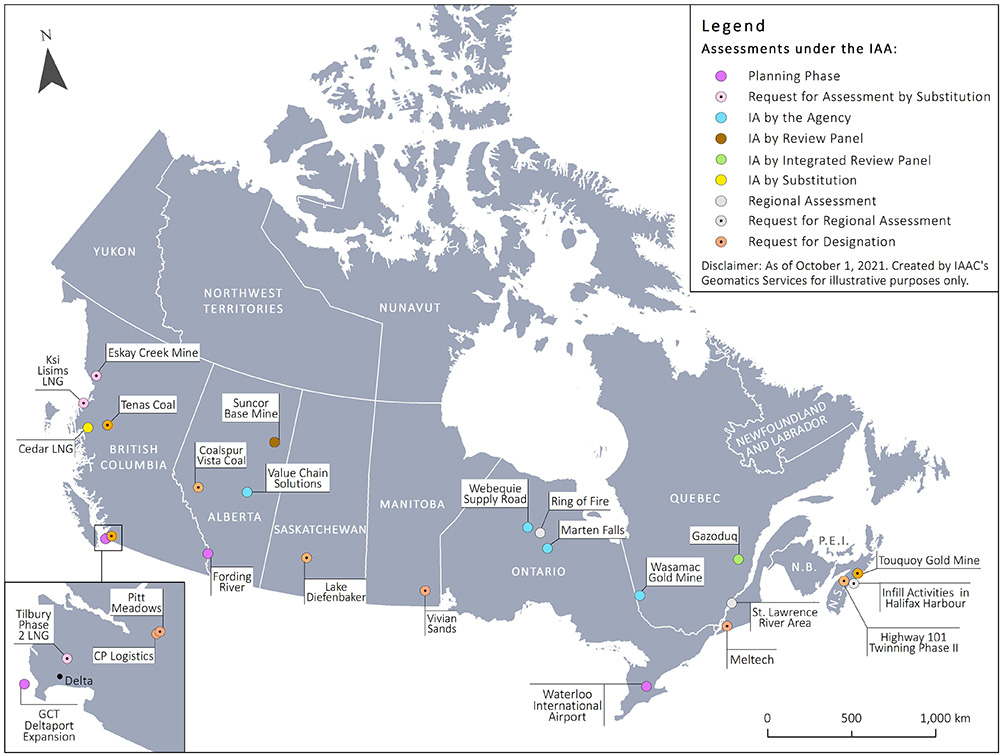
Figure 5 - Text version
Map of Canada depicting location of projects subject to assessments under the Impact Assessment Act:
- Ksi Lisims LNG (British Columbia; request for assessment by substitution);
- Eskay Creek Mine (British Columbia; request for assessment by substitution);
- Cedar LNG (British Columbia; impact assessment by substitution);
- Tenas Coal (British Columbia; request for designation);
- GCT Deltaport Expansion (British Columbia; Planning Phase);
- Pitt Meadows Road and Rail Improvement (British Columbia; request for designation);
- CP Logistics Park Vancouver (British Columbia; request for designation);
- Fording River Extension (British Columbia; Planning Phase);
- Suncor Base Mine Extension (Alberta; impact assessment by Review Panel);
- Vista Coal Underground Mine and Vista Coal Mine Phase II Expansion (Alberta; designated by the Minister);
- Value Chain Solutions (Alberta, impact assessment by the Agency);
- Lake Diefenbaker Irrigation Expansion (Saskatchewan; request for designation)
- Vivian Sands (Manitoba; request for designation);
- Webequie Supply Road (Ontario; impact assessment by the Agency);
- Ring of Fire (Ontario; regional assessment);
- Marten Falls Community Access Road (Ontario; impact assessment by the Agency);
- Waterloo Airport Runway (Ontario; Planning Phase);
- Wasamac Gold Mine (Quebec; impact assessment by the Agency);
- Meltech Industrial Building (Quebec; request for designation);
- Gazoduq (Quebec; impact assessment by Integrated Review Panel);
- St. Lawrence River Area (Quebec; regional assessment);
- Highway 101 Twinning Phase II Aboiteau and Bridges (Nova Scotia; request for designation);
- Infilling Activities in Halifax Harbour (Nova Scotia; request for a regional assessment), and;
- Touquoy Gold Mine Expansion (Nova Scotia; request for designation).
Assessments under CEAA 2012
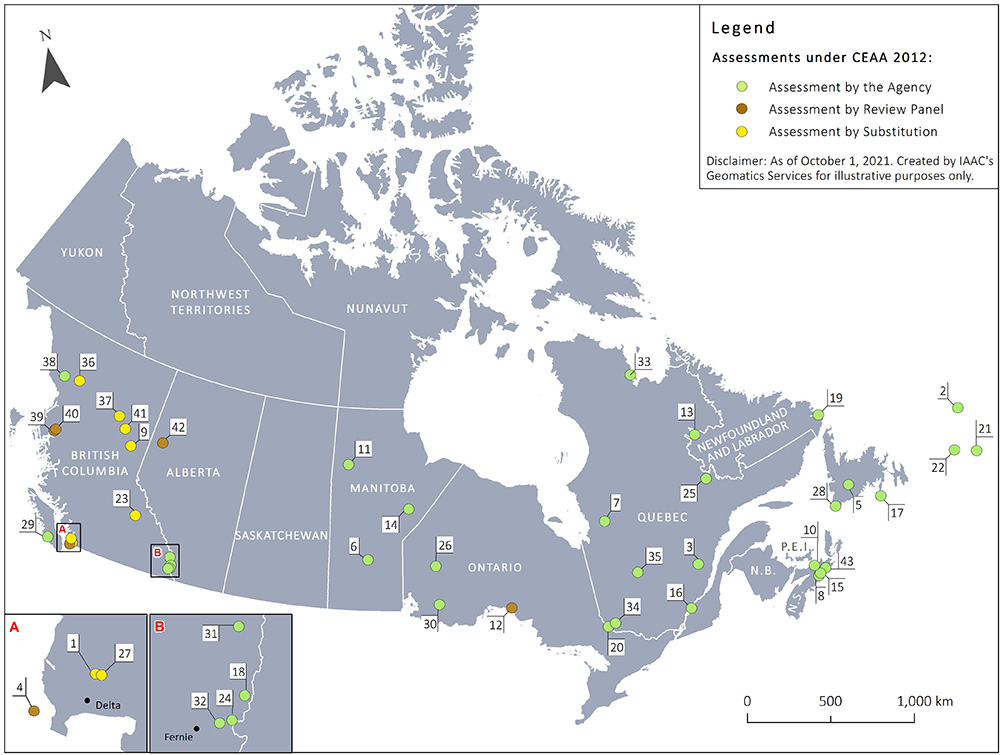
Figure 6 - Text version
See Table 5.
Location Number |
Project Name/Location |
Assessment Led by |
|---|---|---|
British Columbia |
||
1 |
Tilbury Marine Jetty |
Substitution |
4 |
Roberts Bank Terminal 2 |
Review Panel |
9 |
Sukunka Coal Mine |
Substitution |
18 |
Crown Mountain Coking Coal |
The Agency |
23 |
Ruddock Creek Mine |
Substitution |
24 |
Michel Coal |
The Agency |
27 |
Delta Grinding Facility |
Substitution |
29 |
Kwispaa Liquefied Natural Gas |
The Agency |
31 |
Bingay Main Coal |
The Agency |
32 |
Coal Mountain Phase 2 |
The Agency |
36 |
Arctos Anthracite |
Substitution |
37 |
Aley Mine |
Substitution |
38 |
More Creek Hydroelectric |
The Agency |
39 |
Kitimat Clean Refinery |
Review Panel |
40 |
Pacific Future Energy Refinery |
Review Panel |
41 |
Carbon Creek Metallurgical Coal Mine |
Substitution |
Alberta |
||
42 |
Amisk Hydroelectric |
Review Panel |
Manitoba |
||
6 |
Lake Manitoba and Lake St. Martin Outlet Channels |
The Agency |
11 |
Lynn Lake Gold |
The Agency |
14 |
Project 6 - All Season Road |
The Agency |
Ontario |
||
12 |
Marathon Palladium |
Review Panel |
26 |
Springpole Gold |
The Agency |
30 |
Bending Lake Iron |
The Agency |
Quebec |
||
3 |
Énergie Saguenay |
The Agency |
7 |
James Bay Lithium Mine |
The Agency |
16 |
Trois-Rivières Port Facilities Expansion |
The Agency |
20 |
Timiskaming Dam-Bridge of Quebec Replacement |
The Agency |
25 |
Fire Lake North Iron Ore |
The Agency |
33 |
Hopes Advance Iron Mine |
The Agency |
34 |
Kipawa Rare Earths |
The Agency |
35 |
Lac Windfall Mining |
The Agency |
Newfoundland and Labrador |
||
2 |
Bay du Nord Development |
The Agency |
5 |
Valentine Gold |
The Agency |
13 |
Joyce Lake Direct Shipping Iron Ore |
The Agency |
17 |
St. Lawrence Fluorspar Marine Shipping Terminal |
The Agency |
19 |
Foxtrot Rare Earth Element Mine |
The Agency |
21 |
Southeastern Newfoundland Offshore Exploration Drilling |
The Agency |
22 |
Tilt Cove Exploration Drilling |
The Agency |
28 |
Cape Ray Gold Mine |
The Agency |
Nova Scotia |
||
8 |
Beaver Dam Mine |
The Agency |
10 |
Boat Harbour Remediation |
The Agency |
15 |
Fifteen Mile Stream Gold |
The Agency |
43 |
Cochrane Hill Gold |
The Agency |