
Proposed amendments to the Designated Classes of Projects Order
What is the Designated Classes of Projects Order
Under the IAA, federal, port, and airport authorities must determine if non-designated projects on federal lands and outside Canada are likely to cause significant adverse environmental effects before enabling the project to proceed (e.g., by providing funding or issuing a permit). The IAA requires that authorities consider several factors, publish a notice on the Canadian Impact Assessment Registry, and invite public comments.
The Designated Classes of Projects Order lists classes of projects that are excluded from these requirements. Classes of projects can only be listed in the Designated Classes of Projects Order if the Minister of Environment and Climate Change is confident that they will cause only insignificant adverse environmental effects. Please note, this Order is not related to requirements for an impact assessment of a designated project under the IAA.
The Designated Classes of Projects Order came into force in 2019 and lists about 50 low-risk, straightforward, and routine classes of projects, including:
- Buildings with a footprint of no more than 1 000 m2
- Works associated with buildings including lighting systems, parking lots, and sidewalks
- Utility infrastructure including water pipelines, sewers, and telephone lines
- Above-ground petroleum storage tank systems with a capacity up to 5 000 L
Classes of projects are subject to limiting conditions like size, volume, or length limits, and restrictions that protect sensitive environments like wetlands and lakes, as well as migratory birds and species at risk. Projects must meet all applicable limiting conditions to be excluded by the Designated Classes of Projects Order.
Proposed amendments
IAAC is proposing amendments to the Designated Classes of Projects Order, including:
- New classes of projects
- prefabricated structures
- navigational aids for air and marine transportation
- scientific data collection instruments
- underground petroleum storage tank systems up to 5 000 L
- Amendments to existing classes of projects
- raise the footprint threshold for certain buildings like schools, hospitals, medical centres, or housing
- allow buildings of any size to expand by 1 000 m2 if on developed land
- raise the threshold for removing or replacing water pipelines that are not in conventional rights-of-way
- Adjustments to the limiting conditions
- Currently, a project can not be excluded if it causes a change to a water body. Proposed changes would specify new conditions to protect aquatic ecosystems.
All classes of projects in the amended Designated Classes of Projects Order must cause only insignificant adverse environmental effects.
The amendments would help to enable low-risk and routine projects move forward faster, focussing government resources on proposals with a greater potential for adverse environmental effects.
Determining insignificance
Federal, port, and airport authorities were asked to submit proposals to amend the Designated Classes of Projects Order. To ensure that proposed classes of projects would cause only insignificant adverse environmental effects, IAAC only considered proposals that met the following criteria:
- classes of projects must be simple and have minimal interaction with the environment;
- the authority has a good understanding of the environmental effects;
- classes of projects do not require permits from other federal or provincial authorities; and
- by following standard design practices and using established mitigation measures, adverse environmental effects can be reduced to a negligible level.
IAAC analyzed the environmental effects of each proposal, which include impacts on Indigenous Peoples and on the health, social, and economic conditions of Canadians. As outlined in the diagram below, environmental effects were evaluated based on five significance criteria: magnitude, geographic extent, frequency, duration, and reversibility. Environmental effects scoring in the lowest category for each significance criteria were determined to be insignificant. Only classes of projects that would cause insignificant adverse environmental effects are included in the proposed changes to the Designated Classes of Projects Order.
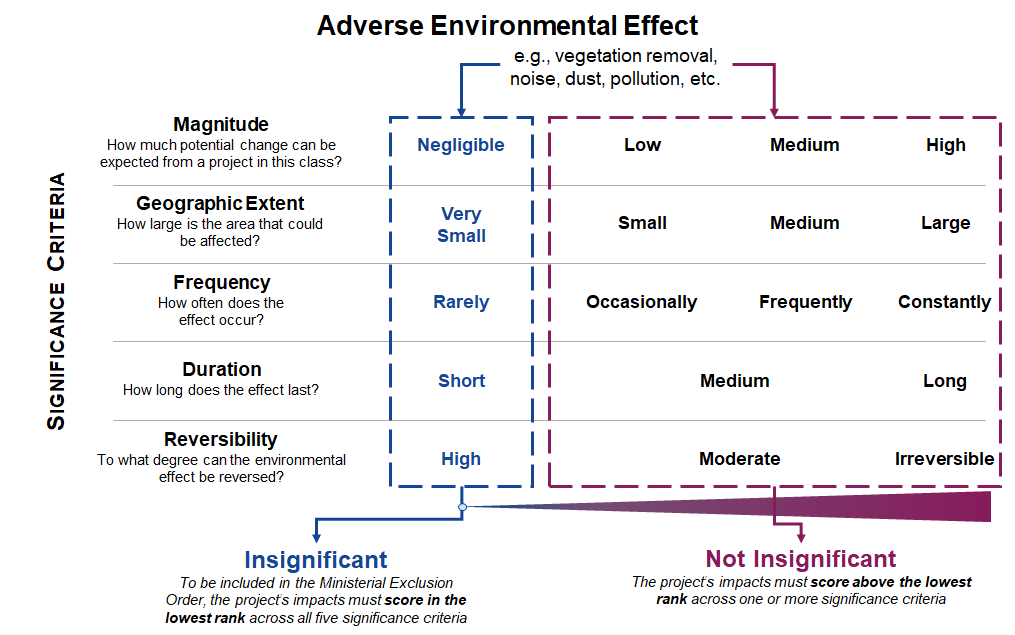
Figure 1: Significance criteria – Text version
The figure illustrates a way to determine if adverse environmental effects are insignificant. The figure notes examples of adverse environmental effects: vegetation removal, noise, dust, and pollution.
A table in the centre of the figure shows five rows. The significance criteria are listed on each row, along with the levels of adverse environmental effects, from lowest to highest. For each of the five significance criteria, the lowest level is marked in blue, while all levels higher than the lowest level are marked in red. To be included in the Designated Classes of Projects Order, a project’s environmental effects had to rank lowest across all five criteria. Projects causing environmental effects scoring higher than the lowest rank across any significance criteria were not included in the Ministerial Exclusion Order.
The first significance criteria is "Magnitude", which means "How much potential change can be expected from a project in this class?" The levels are: negligible, low, medium, and high.
Second is "Geographic extent", which is "How big is the area at risk?" The levels are: very small, small, medium, and large.
The third is "Frequency", which is "How often does the effect happen?" The levels are: rarely, occasionally, frequently, and constantly.
The fourth is "Duration", which is "How long does the effect last?" The levels are: short, medium, and long.
The fifth and last significance criteria is "Reversibility", which is "How much can the effects be reversed?" The levels are high, moderate, and irreversible.