
IRCC Minister Transition Binder 2019: Refugee Resettlement
Introduction
- Canada’s Refugee Resettlement Program is a longstanding humanitarian tradition grounded in the 1951 Refugee Convention and Immigration and Refugee Protection Act.
- Once in Canada, refugees receive protected person and permanent resident status and may not be returned to a country of persecution (“non-refoulement”).
- The United Nations Refugee Agency promotes three durable solutions for refugees as part of its core mandate:
- Voluntary repatriation
- Local integration
- Resettlement
- Resettlement is used when refugees do not have a durable solution in their first country of asylum: it is typically used by the United Nations Refugee Agency as the last solution.
Foundation of refugee status determination
- Well-founded fear of persecution based on:
- race
- religion
- nationality
- political opinion
- membership in a particular social group
- Risk to life or risk of cruel and unusual treatment or punishment
Global Resettlement Trends
Refugees are people who have fled war, violence, conflict or persecution and have crossed an international border to find safety in another country.
Asylum-seekers are people who have fled their home country to seek international protection in another country, but whose request for sanctuary has yet to be processed.
Internally displaced people are forced to flee their homes, often for the same reasons as refugees, but have not crossed a border to find safety. Unlike refugees, they are on the run at home.
At the end of 2018, over 70 million persons were forcibly displaced worldwide due to persecution, conflict, or generalized violence.
- 41.3 million internally displaced people
- 25.9 million refugees
- 20.4 million under UNHCR’s mandate
- 5.5 million Palestinian refugees under UNRWA’s mandate
- 3.5 million asylum seekers
Together, the top three resettlement countries (Canada, the United States and Australia) represent 70% of annual global resettlement, yet only meet less than 4% of global need.
Resettlement admissions 2014-18
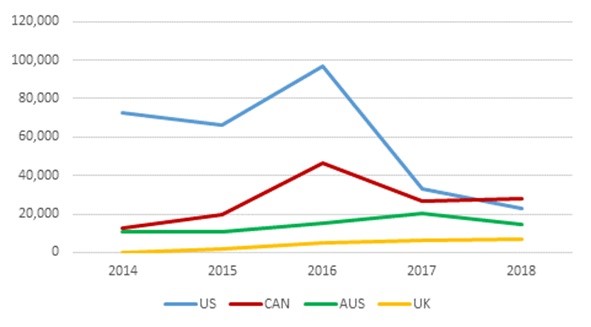
Text version: Resettlement admissions 2014-18
| Country | 2014 admissions | 2015 admissions | 2016 admissions | 2017 admissions | 2018 admissions |
|---|---|---|---|---|---|
| United States of America | 72,820 | 66,517 | 96,874 | 33,368 | 22,874 |
| Canada | 12,959 | 20,022 | 46,319 | 26,976 | 27,809 |
| Australia | 11,016 | 11,001 | 15,552 | 20,257 | 14,825 |
| United Kingdom | 270 | 1,865 | 5,212 | 6,212 | 6,677 |
Canada’s Refugee Resettlement Program
Refugees are selected for resettlement and provided with supports upon arrival:
- Government-assisted refugees represent the most vulnerable refugee populations as identified by the United Nations Refugee Agency, Canada’s primary referral partner. The Government provides welcoming services and income support for one year.
- Privately sponsored refugees represent two thirds of all refugees resettled to Canada, and are identified by Canadians. Most are selected based on family connections of recently arrived refugees. Sponsors provide income and social support for one year.
- Refugees referred by the United Nations Refugee Agency are sometimes identified by visa officers as cases that could be matched with a requesting sponsor, who shares financial supports with the Government (Blended Visa Office-Referred Program).
| Target | Average Cost per refugee | |
|---|---|---|
| Privately sponsored refugees | 19,000 | $11,600 |
| Government-assisted refugees | 9,300 | $45,200 |
| Blended visa office-referred | 1,650 | $26,132 |
The Resettlement Program is reliant on key partners
Overseas
The United Nations Refugee Agency selects and refers vulnerable refugees for resettlement to Canada.
The International Organization for Migration provides critical logistical support (i.e., interpretation, transportation to and from interviews, medical exams, form-filling and transportation to Canada).
In Canada
Private sponsors select cases for resettlement and provide settlement and integration supports to refugees.
Resettlement service providers provide support to refugees upon arrival (e.g., temporary housing, orientation, links to integration services such as language training) on behalf of the Government of Canada.
Communities in provinces and territories receive refugees based on family connections, the availability of medical services, and other factors.
The Province of Quebec operates its own settlement program under the Canada-Quebec Accord.
The Department also engages regularly with refugee advocacy and sponsorship groups such as the Canadian Council for Refugees, Rainbow Coalition for Refugees, and the Sponsorship Agreement Holder Council.
Key Takeaways
Globally, migration and refugee needs are increasing. In 2018, only 92,400 refugees were resettled globally, less than 8% of refugees identified by the United Nations Refugee Agency.
This shift, combined with its focus on humanitarian efforts, made Canada the number one resettlement country in the world in 2018.
In 2019, Canada will resettle 29,950 refugees, its highest annual resettlement number to date.
Briefings will be scheduled on Canada’s upcoming role in various international forums related to refugees and strengthening the Private Sponsorship of Refugees Program.