
IRCC Minister Transition Binder 2019: IRCC – Department overview
Introduction to IRCC
Canada has a managed approach to migration
Canada’s approach to migration is intended to maximize Canada’s economic and social well-being.
While protecting the safety and security of Canadians, the Department
- creates legal pathways for people to come to Canada on temporary or permanent basis; and
- plans the number of new immigrants and the balance between permanent resident categories in advance.
See Annex C: Historical and Projected Annual Admissions – Immigration Levels Planning for Permanent resident landings from 1865 to 2021.
Immigration is more than facilitating the movement of people
People bring skills, talent, social connections. The work of this Department makes a difference to Canadians by contributing to
Economic Development
- Managed migration (temporary or permanent) brings in global talent and skills to support and grow the Canadian economy.
Nation-Building
- Immigration enriches Canada’s diversity and helps reunite families (spouses, children, parents, grandparents)
Global Reach
- RCC’s network of people and offices is truly global. Canada’s approach to immigration is often cited as the benchmark internationally
National Security
- Screening people before they come to Canada to maintain the health, safety and security of Canadians
- IRCC is the only federal department that issues trusted identity documents (e.g., permanent resident card)
The Department’s work is grounded in strong legal frameworks
Immigration and Refugee Protection Act (2002) & Immigration and Refugee Protection Regulations
Enable:
- Immigration to Canada
- Refugee protection
- Enforcement
Co-administered with the Minister of Public Safety and Emergency Preparedness
The Minister also has discretionary tools from the Act:
- Ministerial Instructions
- Public policy provision
The Act also provides the Immigration and Refugee Board of Canada with jurisdiction to hear and decide cases on immigration and refugee matters
Citizenship Act (1947) & Citizenship Regulations
Enable:
- Acquisition of citizenship
- Resumption of citizenship
- Loss (revocation) of citizenship
- Proof of citizenship
- Renunciation of citizenship
Canadian Passport Order (1981) & Diplomatic and Special Passport Order (1956)
Enable:
- Issuance of passports
- Cancellation, refusal, and revocation
Co-administered with the Minister of Public Safety and Emergency Preparedness
Department of Citizenship and Immigration Act (1994)
Established the Department – Sets out the powers, duties and functions of the Minister
International Law
e.g., United Nations Convention Related to the Status of Refugees (1951)
Canada’s approach to immigration is well-positioned to meet the challenges of today and tomorrow
Integrated
- Robust systems in place build links between who comes to Canada and why, how to best help new immigrants settle and become part of the Canadian community and how to support their journey to Canadian citizenship
Evidence-based
- Strong capacity and attention to gathering and analyzing data, grounding decisions in evidence
Continuous improvement
- Constantly monitoring, innovating, and adapting the Department’s programs and services, especially in light of new information and emerging challenges
Two Main Pathways
How do people come to Canada?
Temporary residents: visiting, studying or working in Canada for a limited time
- Visitors
- International Students
- Temporary Foreign Workers
Facilitates the entry of visitors, students and temporary workers for trade, commerce, tourism, international understanding and cultural, educational and scientific activities.
Permanent residents: settling in Canada and eligible for citizenship
- Economic Immigrants
- Spouses and Family Members
- Refugees and Protected Persons
Grants many rights and responsibilities, including the right to live, work or study anywhere in Canada; and social benefits including healthcare coverage.
Permanent residents are also required to pay taxes; and must adhere to and are protected under Canadian law and the Canadian Charter of Rights and Freedoms.
Over six million new permanent residents have arrived in Canada since 1990.
Temporary residents
Demand driven – no caps on annual number of temporary residents
Visitors
- Traveling for business or leisure.
- May require either a temporary resident visa or an Electronic Travel Authorization to come to Canada
- In 2018, 1,675,924 temporary resident visas and 3,947,899 Electronic Travel Authorizations (automated) were issued.
International Students
- Need a study permit before coming to study or train in Canada.
- In 2018, 355,587 international student permits became effective.
Temporary Foreign Workers
- Employer-specific work permit required
- Fill temporary skills shortages when Canadians cannot be found and attract talent
- In 2018, 84,095 permits became effective through the Temporary Foreign Worker Program.
International Mobility Program
- Both employer-specific and open work permits
- Support Canada’s broader economic and cultural interests.
- In 2018, 254,401 permits became effective through the International Mobility Program.
Permanent residents
Balancing economic, social and humanitarian objectives
- Attract talent: Skilled individuals (and family members) that attract investment and drive economic growth and innovation
- Reunite families: Provides support networks, and builds Canada in this generation and those that follow
- Respond to crises & offer protection: Respects Canada’s humanitarian tradition and international obligations
Economic: Canada selects economic immigrants (including their immediate family) for their ability to contribute to Canada’s economy.
- Federal high skilled workers
- Federal business
- Economic pilots
- Provincial nominee
- Quebec skilled workers and business
Family: Family reunification has been an important pillar of Canada’s immigration policy. Citizens and permanent residents are able to sponsor immediate family members.
- Spouses/partners and children/dependants
- Parents and grandparents
Refugees and protected persons: Canada has a strong commitment to its humanitarian goals by resettling refugees and recognizing those persons in need of protection (asylum).
- Protected persons (asylum)
- Resettled refugees
- Government-assisted refugees
- Privately sponsored refugees
- Blended visa office-referred refugees
Humanitarian and compassionate grounds: Permanent residency is granted to those who would not otherwise qualify based on humanitarian and compassionate grounds.
2018 permanent resident (PR) admissions
| Category | Admissions |
|---|---|
| Federal Economic | 94,733 |
| Provincial Economic | 62,440 |
| Quebec Economic | 29,192 |
| Family Class | 85,170 |
| Protected Persons and Refugees | 45,499 |
| Humanitarian & Compassionate & Other | 4,026 |
| Total PR admissions | 321,060 |
The immigration levels plan
The Immigration and Refugee Protection Act requires that the Government’s planned number of permanent resident admissions for the next calendar year be published via tabling in Parliament.
In the levels plan, the Government sets the targets for admission of permanent residents. This allows us to communicate on key immigration priorities related to the following:
- Economic immigration
- Family reunification
- Resettled Refugees and Protected Persons
Levels planning is informed by:
- engagement with provinces, territories, other government departments and agencies, and stakeholders;
- operational realities; and
- research and evidence.
The multi-year levels plan (three years) allows for a longer planning horizon, helping provinces and territories and other partners to better prepare and reflects a commitment to a well-managed system.
The levels plan is a cornerstone of Canada’s managed migration system.
Health and Safety
Safeguarding the health, safety and security of Canadians
The protection of health, safety, and security of Canadians is balanced with facilitating the legitimate movement of people.
Who and What?
Temporary residents
- Temporary Resident Visa: Screening for security and criminality applies to individuals from most countries; medical screening where required by the Immigration and Refugee Protection Regulations.
- Electronic Travel Authorization: Quick online screening, applies to 54 visa-exempt countries
Permanent residents
- Screening for security, criminality and medical
Where?
- Overseas – for temporary and permanent residents
- At the border – Canada Border Services Agency screens all travelers
- In Canada – those seeking a change in status (e.g., temporary to permanent)
How?
- Information provided by clients – e.g., biographic; biometric (fingerprints and photo)
- Information held by trusted partners – domestic security agencies (e.g., Royal Canadian Mounted Police) and international partners (e.g., United States)
- Information in our systems – e.g., previous applications
- Verification of information – e.g., meeting conditions for work or study permits
- Additional screening as needed
Migration health
The health of immigrants is a concern for all Canadians. The Department:
- manages the health screening of migrants to prevent the arrival of infectious diseases, through an international network of physicians and the International Organization for Migration (e.g., pre-departure medical services for resettled refugees);
- notifies provinces/territories of the arrival of newcomers requiring medical surveillance (e.g., latent tuberculosis, HIV); and
- works with the Public Health Agency of Canada and public health authorities.
The Department also administers the Interim Federal Health Program, which provides temporary healthcare coverage to refugees, asylum seekers, and other vulnerable populations until they become eligible for provincial/territorial health coverage.
Settlement and Integration
Settlement programming helps newcomers succeed in Canada
- Canada funds a full array of settlement programming engaging community organizations and civic society to deliver services and create welcoming communities.
- Programming builds human and social capital of immigrants and refugees to help them succeed along their journey.
- Provinces, territories, municipalities, employers and others provide employment, educational, health and social services, and complementary settlement services.
- In addition, resettlement assistance supports government-assisted refugees, and other eligible clients, when they first arrive in Canada by providing financial support and immediate and essential services.
- In 2019-2020, $779M of settlement funding was allocated among provinces and territories through the Settlement Funding Formula (excluding Quebec), and for other settlement funding envelopes
- Pre-arrival services help immigrants plan and prepare to work and live in Canada
- Needs assessment and orientation help immigrants make informed settlement decisions.
- Language training builds a key skill for life and work in Canada.
- Employment-related services prepare for the workplace and link to employers.
- Community connections link immigrants to local communities and institutions.
- Indirect and support services facilitate program participation, foster community planning and partnership
For Canadians
Citizenship – an important privilege
Persons are Canadians by birth in Canada, or naturalized as citizens if eligible after time in Canada as permanent residents.
Eligibility for Naturalization
- Citizenship applicants must meet requirements set out in the Citizenship Act, including: demonstrated knowledge of Canada, language ability, residence requirement, filing income tax returns as required, and not being subject to prohibitions (e.g., criminality).
Acquisition
- Citizenship may be acquired through birth on soil, by descent, or by naturalization (the formal process by which a person can become a Canadian citizen).
- In 2018-2019, via naturalization alone, 207,893 persons became new Canadian citizens.
Loss
- Canadian citizens may renounce their citizenship.
- Citizenship may be revoked from naturalized Canadians if obtained as a result of fraud, false representation, or knowingly concealing material circumstances.
Awareness
- Encourage naturalization, increase knowledge of the rights, responsibilities and privileges of Canadian citizenship and promote citizenship competencies to all Canadians.
Passport – a trusted travel document
The Minister of Immigration, Refugees and Citizenship has sole authority for decisions on passport cancellation, refusal, and revocation, except for cases related to terrorism and national security which fall under the authority of the Minister of Public Safety and Emergency Preparedness.
Issuance
- Facilitates Canadians’ travel and contributes to international and domestic security. In 2018-2019, IRCC issued approximately three million passports.
Service Delivery
- Collaboration with Service Canada (in Canada) and Global Affairs Canada (abroad) for the delivery of routine citizenship and passport services.
- IRCC also handles:
- special and diplomatic passports;
- travel documents to non-Canadians (e.g., refugee travel document); and
- complex passport applications (e.g., complex custody situations).
Security
- Maintain Canadian passport security and integrity through the authentication of identity and entitlement.
- Have the authority and the means to cancel, refuse, revoke, and impose a period of refusal of passport services (e.g., in cases of detected fraud, misuse, or misrepresentation).
Key Partners
Federal partners help us carry out the Department’s work
- Immigration, Refugees and Citizenship Canada
- Canada Border Services Agency
- Service Canada
- Employment Social Development Canada
- Global Affairs Canada
Other federal partners to note:
- Public Health Agency of Canada
- Public Safety Canada
- Canadian Heritage
- Royal Canadian Mounted Police
- Canadian Security and Intelligence Service
- regional economic development agencies
Provinces and territories are key partners to ensure success
IRCC’s relationship with provinces and territories is critical:
- Immigration is a shared federal, provincial, and territorial responsibility with federal paramountcy.
- Provinces and territories leverage immigration to meet their economic needs, and provide social services to newcomers in their jurisdictions.
Quebec and Canada have a distinct relationship on immigration. Under the 1991 Canada-Quebec Accord, Quebec has sole responsibility for the following:
- Selection of immigrants (except Family Class and in-Canada refugee claimants)
- Delivery of integration services, supported by an annual grant from the federal government, based on formula set out in the Accord
Quebec publishes its own immigration levels plan annually.
International relationships are also key to immigration
Canada engages globally to:
- Deter irregular migration and promote the benefits of safe, orderly and regular migration;
- exchange best practices on managing migration;
- build capacity internationally; and,
- support the health, safety and security of Canadians.
Canada engages in numerous partnerships to advance the above objectives, including the following key relationships:
- Bilateral: United States; Mexico; European Commission; other like-minded countries (e.g., Australia)
- Multilateral: Migration Five (Canada, United States, United Kingdom, Australia, New Zealand); International Organization for Migration; United Nations Refugee Agency
- International Organizations: International Organization for Migration; the United Nations Refugee Agency
Canada’s approach to immigration is frequently referred to as a best practice in global migration
Delivering our Services
Organizational structure of the Department
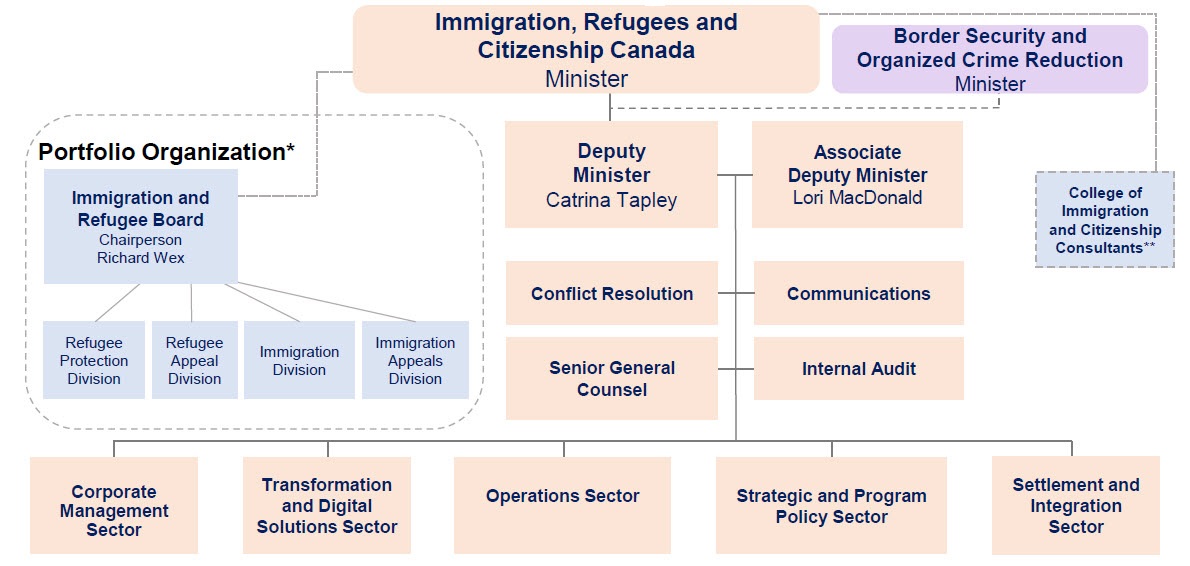
Text version: Organizational structure of the Department
Portfolio OrganizationFootnote *: Immigration and Refugee Board
- Chairperson - Richard Wex
- Refugee Protection Division
- Refugee Appeal Division
- Immigration Division
- Immigration Appeals Division
Border Security and Organized Crime Reduction
- Minister
College of Immigration and Citizenship ConsultantsFootnote **
Immigration, Refugees and Citizenship Canada
- Minister
- Deputy Minister - Catrina Tapley
- Associate Deputy Minister - Lori MacDonald
- Conflict Resolution
- Communications
- Senior General Counsel
- Internal Audit
- Corporate Management
- Transformation and Digital Solutions Sector
- Operations Sector
- Strategic and Program Policy Sector
- Settle and Integration Sector
IRCC’s operational network: in-Canada
IRCC operates a vast network of offices and support centres in Canada that deal with decision-making on application cases, passport issuance, client inquiries, and settlement supports, including citizenship tests and ceremonies.
- Domestic and Settlement Offices: 23 client-facing offices across all provinces
- Case Processing Centres: Sydney, Ottawa, Mississauga, and Edmonton
- Client Support Centre (National Call Centre): Montréal
- Operations Support Centre: 24/7, Gatineau
- Resettlement Operations Centre: Ottawa
- Passport (delivered by Service Canada): 32 dedicated passport offices, 314 Service Canada centres, and two mail processing centres
In total, IRCC has 44 offices across Canada; this includes those listed above as well as those that support the corporate work of the Department (e.g., National Headquarters in Ottawa/Gatineau).
In-Canada immigration and citizenship offices (October 2019)
Domestic and Settlement Offices
- Yellowknife
- Vancouver
- Surrey
- Edmonton
- Calgary
- Saskatoon
- Winnipeg
- Kitchener
- London
- Windsor
- Mississauga
- Scarborough
- Etobicoke
- Niagara
- Hamilton
- Ottawa
- Montreal
- Fredericton
- Charlottetown
- Halifax
- St. John’s
Case Processing Centre
- Edmonton
- Ottawa
- Mississauga
- Sydney
Client Support Centre (National Call Centre)
- Montreal
Operations Support Centre
- Gatineau
Resettlement Operations Centre
- Ottawa
Passport Service Locations
- Yukon: 2
- Northwest Territories: 5
- Nunavut: 3
- British Columbia: 43
- Alberta: 22
- Saskatchewan: 14
- Manitoba: 17
- Ontario: 100
- Quebec: 81
- New Brunswick: 19
- Newfoundland and Labrador: 15
- Nova Scotia: 20
- Prince Edward Island: 5
IRCC’s Operational Network – Overseas
IRCC’s international network is global; it is critical to delivering permanent resident levels, temporary resident entries, and passports to Canadians.
Missions Abroad - Embassies and Consulates:
- 212 locations abroad in 148 countries
- Full passport services are offered in 122 locations, and partial services are offered in 90 locations
Visa Application Centres (Third Party Contractors):
- 160 visa application centres located in 108 countries
- These centres securely send applications and passports to the visa office; are official locations to submit biometrics (fingerprints and a photo); are located around the world; speak local languages
IRCC’s International Network (November 13, 2019)
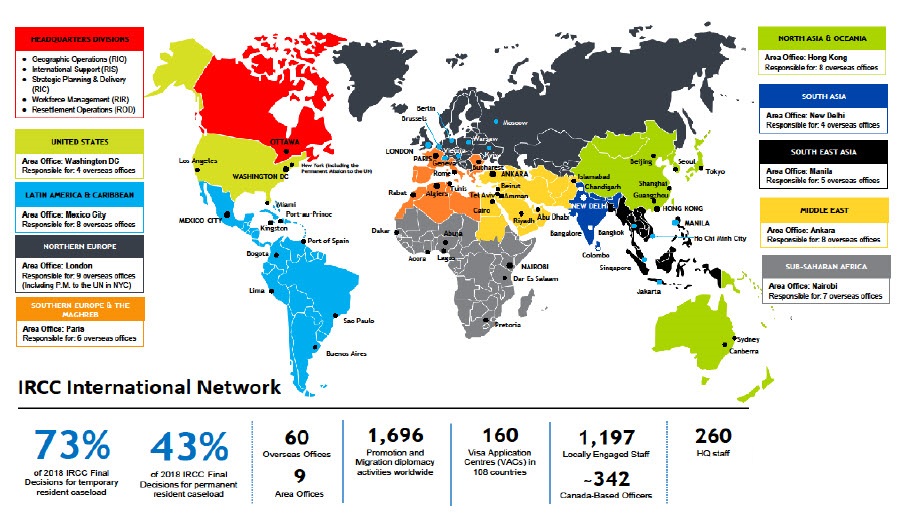
Text version: IRCC’s International Network (November 13, 2019)
- 73% of 2018 IRCC Final Decisions for temporary resident caseload
- 43% of 2018 IRCC Final Decisions for permanent resident caseload
- 60 Overseas Offices
- 9 Area Offices
- 1,696 Promotion and Migration diplomacy activities worldwide
- 160 Visa Application Centres (VACs) in 108 countries
- 1,197 Locally Engaged Staff
- Approximately 342 Canada-Based Officers
- 260 HQ staff
Headquarters Divisions
- Ottawa
- Geographic Operations (RIO)
- International Support (RIS)
- Strategic Planning & Delivery (RIC)
- Workforce Management (RIR)
- Resettlement Operations (ROD)
United States
- Area Office: Washington DC
- Responsible for: 4 overseas offices
- Washington
- Los Angeles
- New York (including the Permanent Mission to the UN)
- Miami
Latin America
- Area Office: Mexico City
- Responsible for: 8 overseas offices
- Mexico City
- Port-au-Prince
- Kingston
- Port of Spain
- Bogota
- Lima
- Sao Paulo
- Buenos Aires
Northern Europe
- Area Office: London
- Responsible for: 9 overseas offices (including Permanent Mission to the UN in New York)
- London
- New York
- Brussels
- Berlin
- Vienna
- Geneva
- Warsaw
- Kyiv
- Moscow
Southern Europe and the Maghreb
- Area Office: Paris
- Responsible for: 6 overseas offices
- Paris
- Rome
- Bucharest
- Rabat
- Algiers
- Tunis
North Asia and Oceania
- Area Office: Hong Kong
- Responsible for: 8 overseas offices
- Hong Kong
- Beijing
- Shanghai
- Guangzhou
- Seoul
- Tokyo
- Sydney
- Canberra
South Asia
- Area Office: New Delhi
- Responsible for: 4 overseas offices
- New Delhi
- Bangalore
- Colombo
- Chandigarh
South East Asia
- Area Office: Manila
- Responsible for: 5 overseas offices
- Manila
- Ho Chi Minh
- Bangkok
- Singapore
- Jakarta
Middle East
- Area Office: Ankara
- Responsible for: 8 overseas offices
- Ankara
- Beirut
- Amman
- Riyadh
- Abu Dhabi
- Cairo
- Tel Aviv
- Islamabad
Sub-Saharan Africa
- Area Office: Nairobi
- Responsible for: 7 overseas offices
- Nairobi
- Dakar
- Abuja
- Lagos
- Accra
- Dar Es Salaam
- Pretoria