
CIMM – OAG Report – April 22, 2026
International Student Program Reforms
Performance audit reports
This report presents the results of a performance audit conducted by the Office of the Auditor General of Canada (OAG) under the authority of the Auditor General Act.
A performance audit is an independent, objective, and systematic assessment of how well government is managing its activities, responsibilities, and resources. Audit topics are selected on the basis of their significance. While the OAG may comment on policy implementation in a performance audit, it does not comment on the merits of a policy.
Performance audits are planned, performed, and reported in accordance with professional auditing standards and OAG policies. They are conducted by qualified auditors who
- establish audit objectives and criteria for the assessment of performance
- gather the evidence necessary to assess performance against the criteria
- report both positive and negative findings
- conclude against the established audit objectives
- make recommendations for improvement when there are significant differences between criteria and
- assessed performance
Performance audits contribute to a public service that is ethical and effective and a government that is accountable to Parliament and Canadians.
This publication is available on our website at www.oag‑bvg.gc.ca. Cette publication est également offerte en français.
© His Majesty the King in Right of Canada, as represented by the Auditor General of Canada, 2026. Cat. No. FA1‑27/2026‑1‑3E‑PDF
ISBN 978‑0‑660‑98190‑1 ISSN 2561‑343X
At a Glance
Overall Message
Immigration, Refugees and Citizenship Canada reduced the number of new study permits issued to control the growth of the International Student Program. The reduction in new study permits disproportionately affected smaller provinces. The department also introduced a tool to strengthen application processing but did not effectively respond to other weaknesses in integrity controls.
After applications for study permits increased by 121% between 2019 and 2023, the federal government announced a limit on study permit applications in January 2024. While the department’s implementation of these limits successfully reduced the number of new study permits issued, the combined effect of fewer applications and lower‑than‑projected approval rates led to a sharper decline than forecasted. In 2024,
the department approved fewer than half the forecasted number of new study permits. This continued into 2025, with just over 50,000 of the 255,360 forecasted number of new study permits approved by September. The department did not know why approval rates were lower than projected.
As part of the reforms, the department committed to strengthening the program’s integrity controls. The department successfully implemented a tool to verify the authenticity of school acceptance letters, an important step in processing study permit applications. However, we found weaknesses in how the department responded to suspected cases of study permit non‑compliance and immigration fraud.
Addressing these issues promptly is important to make sure only genuine students are arriving in or remaining in Canada.
Key Facts and Finding
Although reforms projected decreases in approved new study permits of 10% or less in Manitoba, Prince Edward Island, Nova Scotia, and New Brunswick—and increases in Newfoundland and Labrador and Saskatchewan—all experienced a 59% or greater decrease in approvals in 2024 compared with 2023.
The department’s new letter‑of‑acceptance verification system successfully verified 97% of over 841,000 letters between December 2023 and September 2025. The remaining 3% were processed manually.
Between 2023 and 2024, the department identified over 153,000 students as potentially non‑compliant with study permit conditions but had funding to investigate only 2,000 cases each year.
In 2023 and 2024, the department launched 4,057 investigations into students potentially not complying with study permit conditions. Approximately 40% of cases (over 1,600 students) were not closed because students did not respond to requests for more information.
In 3 investigations, the department identified 800 study permits issued between 2018 and 2023 for which applicants had either used fraudulent documentation or misrepresented information on their applications to gain entry into Canada. Most of these individuals later applied for other immigration permits once in Canada.
See Recommendations and Responses at the end of this report.
Introduction
Background
- Immigration, Refugees and Citizenship Canada manages the International Student Program, which authorizes the entry of international students to study at Canadian educational institutions. There are multiple requirements that students must meet for post‑secondary study permit approval (Exhibit 1).
- Since 2019, Canada promoted itself as a destination for international students, highlighting education as a pathway to permanent residency. As a result, interest in studying in Canada increased, with new study permit applications rising 121% from approximately 426,000 in 2019 to about 943,000 in 2023.
- This rapid growth prompted an internal review of the International Student Program in 2023, in which the department identified several concerns. These included the misalignment between increasing application volumes and the potential for future permanent residency, risks to program integrityFootnote 1 increased student vulnerability due to financial hardship, and a lack of diversity in the international student population.
- In fall 2023, the department committed to reforming the International Student Program. This report focuses on reforms in 3 key areas: controlling program growth, strengthening program integrity controls, and improving the diversity of the international student population. In addition to selected regulatory amendments, a suite of reform measures supported these priorities (Exhibit 2).
- In March 2024, the federal government announced a goal to reduce the number of temporary residents in Canada to 5% of the population by the end of 2026. Measures to reduce the number of international students were already underway and became a key component of meeting this goal. The government’s 2026–2028 Immigration Levels Plan further reduced the number of international students and extended the limit on study permit applications to 2027 to help achieve a new goal of a temporary resident population below 5% of Canada’s population.
Exhibit 1 – International post-secondary study permit application process
Application requirements
Letter of acceptance
From designated learning institution in Canada
Proof of financial support
To cover tuition fees, living expenses, and return transportation
Provincial attestation letter
Confirmation that the student has been allocated one of the study permit application spots by the province
Valid travel and identity documents
Can include biometrics
Immigration, Refugees and Citizenship Canada assessment
Verify documents
Letter of acceptance
Banking information
Identity documents
Assess immigration admissibility
Does the student meet immigration criteria to enter Canada?
Assess program eligibility
Does the student meet program criteria? For example, do they meet the financial requirement and intend to leave Canada after their studies?
Study permit conditions
Actively pursue studies
Stay enrolled
At designated learning institution on permit
Abide by work hour limits
For those with work permits
Respect permit expiry date
By applying for extension or leaving before permit expires
After Graduation
Post-graduate work permit
Eligible former students can also apply to work in Canada for up to 3 years
Permanent residency
Eligible former students can also apply to stay in Canada permanently
Exhibit 2—Three key priorities for International Student Program reform
Control program growth
- Limit post-secondary study permit applications.
- Allocate a set volume of study permit application spaces to each province and territory.
- Limit eligibility for post-graduate work permits
Strengthen integrity controls
- Verify the authenticity of all letters of acceptance with designated learning institutions.
- Impose consequences for learning institutions that do not report on the enrolment status of international students.
- Require international students to reapply to Immigration, Refugees and Citizenship Canada when changing schools or starting new programs.
Protect and diversify the student population
- Reduce systemic barriers to diversity.
- Implement a pilot program for francophone minority communities.
- Increase the financial requirement for applicants from $10,000 to approximately $20,000 so that students are financially prepared for life in Canada. This amount is adjusted each year on the basis of cost-of-living data from Statistics Canada.
- Immigration, Refugees and Citizenship Canada. The department manages the International Student Program, which authorizes the entry of eligible foreign nationals seeking to study at a Canadian educational institution. Under the authority of the Immigration and Refugee Protection Act and the Immigration and Refugee Protection Regulations, the department assesses applications and issues study permits, visas, and electronic travel authorizations, among other documents, to applicants that it deems eligible and admissible to Canada. The department is responsible for determining the eligibility and continued admissibility of foreign nationals within Canada applying to extend their study permits or for post‑graduate work permits. The department is also responsible for maintaining the integrity of the International Student Program by verifying students’ ongoing compliance with study or work permit conditions, as outlined in the act, regulations, and other requirements.
Focus of the audit
- This audit focused on whether Immigration, Refugees and Citizenship Canada was effectively implementing reforms to the International Student Program. Our analysis concentrated on post‑secondary international students, who were the focus of the department’s reforms. Our analysis therefore excluded applications to primary and secondary schools. In addition, our analysis was based on when applications were received rather than an application’s decision date—to allow us to track the results of reforms. Our results therefore differ from what the department publicly reports on its website, as the department includes applications to primary and secondary schools.
- This audit is important because the department identified several measures critical for improving integrity and controlling growth in the International Student Program. The effective implementation of these ongoing program reforms is key to upholding the Immigration and Refugee Protection Act principles, including ensuring immigration benefits are shared across the country and maintaining the integrity of the immigration system.
- After our audit period, in February 2026, department officials told us that in addition to continuing the implementation of the reforms discussed in the audit, the department was planning for new initiatives to improve program integrity and retain top talent for Canada’s economic benefit. We did not assess these new additional initiatives, as they were developed after our audit period.
- More details about the audit objective, scope, approach, and criteria are in About the Audit at the end of this report.
Findings and Recommendations
Immigration, Refugees and Citizenship Canada reduced the number of new post‑secondary study permits
Why this finding matters ?
- This finding matters because reducing the number of post‑secondary study permits issued by the department was a key objective of the reforms to the International Student Program.
Context
- In January 2024, the Minister of Immigration, Refugees and Citizenship announced a 2‑year limit on the number of applications the department would accept for international post‑secondary study permits. This temporary limit was intended to control how many international students were approved to study in Canada while providing time for the department to advance its other reforms. The minister established the overall limit and exemptions, with an initial objective to reduce the number of new study permits approved in 2024 by 35% compared with 2023 levels and by a further 10% in 2025.
- When international students are already in Canada, they can apply for study permit extensions if they need additional time to complete their studies or if they seek to start a new program after completing an initial one. As of November 2024, students must now also apply for an extension before switching institutions. The department also processes new study permits as extensions when foreign nationals are already in Canada for other reasons (such as accompanying a parent or spouse or holding a work permit) and apply to study. Study permit extensions were exempt from the limit on study permit applications in 2024 but were included in 2025.
The department controlled growth in the International Student Program
Findings
- In line with the goal of controlling program growth,in both 2024 and 2025, we found that the department reduced the number of new study permits issued. Approved applications for new study permits were below the department’s forecasts. This was due to both lower application volumes and approval rates lower than the department’s projections (Exhibit 3):
- In 2024, the department forecasted approving 348,900 new study permits; 149,559 were approved. This represents a 67% reduction compared with 2023.
- In 2025, the department forecasted approving 255,360 new study permits. As at September 2025, 50,370 were approved.
Exhibit 3—Immigration, Refugees and Citizenship Canada reduced the number of new study permits
Number of New Study Permit Applications
| 2022 | 2023 | 2024 | 2025Footnote * | |
|---|---|---|---|---|
| Applications received | 624,627 | 792,200 | 363,007 | 134,195 |
| Applications approved | 336,981 | 456,690 | 149,559 | 50,370 |
| Forecasted applications approved | 348,900 | 255,360 |
The department did not know why approval rates were lower than projected
Findings
- We found that, in addition to lower application numbers (see Exhibit 3), the department’s overall approval rate for new study permits was lower than projected—approval rates were 41% in 2024 and 38% as at September 2025, compared with 58% in 2023. The department had expected approval rates like those of 2023.
- We found that the department did not know why its approval rates were lower than projected. It did not assess whether its reform measures were contributors either to the reduction in the number of applications that were submitted or to its lower approval rates. Approval rates matter, because they affect how many applications received will be converted into study permits issued.
- As part of our audit, we analyzed the extent to which other reform measures may have contributed to lower approval rates. We found that neither the new letter‑of‑acceptance verification system nor increased financial requirements accounted for the extent of the decline in approval rates:
- Nearly all acceptance letters issued by designated learning institutions were confirmed as genuine (see paragraph 34), which indicates the new verification system was not a significant contributor to declining approval rates.
- Although refusals due to insufficient finances increased by 18% in 2024 compared with the previous year, these refusals had risen steadily since 2022, with the sharpest increase between 2022 and 2023—before any increase in the financial requirement. In addition, financial refusals had dropped by 4% in 2025.
- We found that the department did not provide clear direction to some applicants regarding which documents it expected from applicants to demonstrate that they met the financial requirements. We used representative sampling to examine 51 applications refused for insufficient funds in 2024 and 2025 (up to September) and found that in 23 cases (45%), the department expected documentation not clearly outlined in applicant instructions, such as explanations and evidence for lump sum bank deposits.
Study permit extensions were outpacing new study permits
Findings
- Since the limit on study permit applications was introduced, we found there had been an increase in the number of study permit extensions relative to new study permits. This was due in part to the number of international students with post‑secondary study permits who were in Canada, which, according to the department, totalled 675,070 as at September 2025.
- In 2024, the department received more applications for study permit extensions compared with 2023 and approved more permit extensions than new study permits. Even after extensions were included in the study permit application limit in 2025, we found that about two thirds of approved study permits were for extensions (77,295) as at September 2025 (Exhibit 4), with an additional 60,657 unprocessed extension applications.
Exhibit 4—The Proportion of Study Permit Extensions was Growing
Number of Study Permits
| 2022 | 2023 | 2024 | 2025Footnote * | |
|---|---|---|---|---|
| New Study Permits Approved | 70% | 73% | 43% | 39% |
| Study Permit Extensions Approved | 30% | 27% | 57% | 61% |
Source: Based on data from Immigration, Refugees and Citizenship Canada, excluding primary and secondary school applications
The department did not effectively monitor and adjust to the unintended impacts of study permit reductions
Why this finding matters
- This finding matters because the Immigration and Refugee Protection Act mandates Immigration, Refugees and Citizenship Canada not only to manage immigration, but also to ensure its benefits are shared across Canada. The department also has a statutory obligation to consult provinces on immigration planning and consider regional economic priorities.
Context
- The Minister of Immigration, Refugees and Citizenship set the upper limits on the number of study permit applications and final allocation decisions to the provinces and territories based on analysis done by the department. The department was responsible for tracking results to inform any needed adjustments (Exhibit 5).
Exhibit 5—The process for allocating provincial application spaces to post‑secondary international students
Within the limits set by the minister, Immigration, Refugees and Citizenship Canada forecasts the number of approved study permits for each province. Since not all applications are approved, the department uses an estimated approval rate to determine how many applications it would need to process in order to meet these forecasts. The minister then informs each province of their application spaces.
Each province is responsible for distributing application spaces among designated learning institutions. Provinces then issue attestation letters to prospective international students who have been accepted into a designated learning institution, which confirms that the student has been given one of the provincial application spaces.
Prospective international students apply to the department for a study permit. These applications may or may not be approved.
Source: Based on information from Immigration, Refugees and Citizenship Canada
Smaller provinces were disproportionately impacted by lower study permit approvals
Findings
- Study permit application spaces were intended to be reduced most in provinces with large populations that also have historically high numbers of international students, such as Ontario and British Columbia. Decreases of 10% or less were expected in Manitoba, Prince Edward Island, Nova Scotia, and New Brunswick, while increases were expected for Newfoundland and Labrador and Saskatchewan. However, we found that all provinces experienced greater reductions in approved new study permits than intended (Exhibit 6). In 2024, several provinces experienced a 59% or greater decrease in approvals.
Exhibit 6—New study permit approvals in 2024 were lower than intended for smaller provinces
Change in new study permit approvals
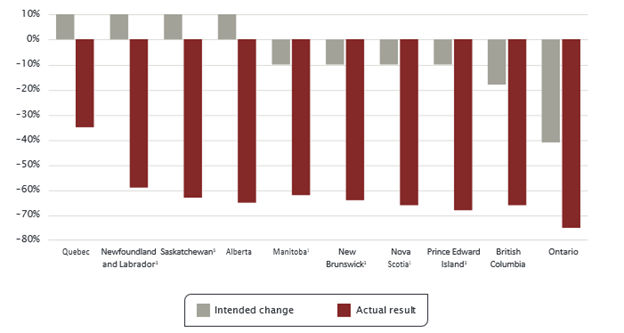
1 In this report, we define small provinces as those with less than 5% of Canada’s total population.
Note: Territories were excluded due to low volume.
Source: Based on data from Immigration, Refugees and Citizenship Canada, excluding primary and secondary school applications
- In 2025, the department had to account for study permit extensions and new study permit applications within the processing limit set by the minister. Therefore, the department’s forecasted numbers of approved study permits in 2024 and 2025 could not be directly compared. We found that as at September 2025, the department was not on track to meet the forecasted number of study permit approvals in smaller provinces (Exhibit 7).
Exhibit 7—Actual approvals were less than forecasted in each province in 2025
Percentage of forecasted approved new study permits and extensions, as of September 2025
| Province/Territory | Percentage |
|---|---|
| Newfoundland and LabradorFootnote * | 15% |
| SaskatchewanFootnote * | 19% |
| Alberta | 25% |
| Nova ScotiaFootnote * | 31% |
| Quebec | 36% |
| ManitobaFootnote * | 39% |
| New BrunswickFootnote * | 43% |
| British Columbia | 47% |
| Ontario | 47% |
| Prince Edward IslandFootnote * | 49% |
Note: Territories were excluded due to low volume.
Source: Based on data from Immigration, Refugees and Citizenship Canada, excluding primary and secondary school applications
- We reviewed the analysis that informed how application spaces were allocated to each province and found weaknesses in 2 areas. Firstly, since the allocation model was based on population, smaller provinces were disadvantaged and received fewer application spaces. Secondly, the department initially overestimated the number of study permit applications it would approve at 60% of applications received. It applied this rate to all provinces to determine their allocations. This was done despite the department’s historical data demonstrating significant variations in approval rates across provinces. As a result, the department’s approach resulted in smaller provinces experiencing 2 compounding challenges: limited allocation spaces and lower study permit approval rates. This was made worse by decreasing application volumes.
- In recognition that some provinces had lower approval rates than 60%, in April 2024, the department provided allocation top‑ups to some provinces. For 2025, the department changed its approach to use province‑specific approval rates based on historical actuals; however, this did little to offset impacts already experienced. We found that even with information on emerging impacts on smaller provinces, departmental analysis for the 2025 study permit application limit did not give sufficient weight to these impacts. As a result, the department did not consider alternative models that did not disadvantage smaller provinces.
- Departmental analysis also did not give sufficient weight to the decline in graduate‑level applications, despite their exemption from the 2024 study permit application limit. Instead, the analysis recommended expanding the categories of students subject to application limits, to include study permit extensions and graduate students, which further reduced the spaces provinces had available for new study permits. According to the department, the analysis prioritized achieving overall reductions in temporary resident volumes to meet the government’s commitment to reducing the temporary resident population to 5% by the end of 2026.
- We surveyed provincial governments, which expressed general dissatisfaction with the level of consultation on program reforms. They reported consultation timing was insufficient to allow meaningful engagement, and the department provided no feedback on how their input was considered. Provinces also reported to us that they were not informed of their allocations in a timely manner in either 2024 or 2025, which impacted their ability to plan for the changes and implement processes to meet the department’s requirements.
Recommendation
- In collaboration with provinces, Immigration, Refugees and Citizenship Canada should tailor its analyses for determining annual study permit allocations for each province.
The department’s response. Agreed.
See Recommendations and Responses at the end of this report for detailed responses.
The department strengthened its process to confirm letters of acceptance
Why this finding matters
- This finding matters because confirming that letters of acceptance from educational institutions are genuine is an important step in the processing of study permit applications. Immigration, Refugees and Citizenship Canada’s new verification system was meant to address previously identified weaknesses in this area.
Context
- The department identified concerns about fraudulent letters of acceptance and launched a verification initiative in February 2018. According to the department, from February 2018 to October 2023, its processing officers completed 30,832 manual verifications by contacting designated learning institutions to confirm each document’s authenticity; during this project, 4,260 (13.8%) letters of acceptance were confirmed by designated learning institutions as fraudulent, altered, or no longer valid.
- In December 2023, to enhance the identification of fraudulent letters of acceptance, the department introduced a secure information portal to verify all letters of acceptance directly with designated learning institutions before processing a study permit application. Designated learning institutions use the department’s system to confirm whether an applicant’s letter of acceptance matches the one they issued (indicating potential fraud) or was valid but later cancelled by the designated learning institution (for example, to defer enrolment to a later date).
- The department’s processing officers verify the results and are expected to follow up when letters are not confirmed by a designated learning institution before approving or refusing an application. Applicants with non‑genuine letters of acceptance may be refused for misrepresentation and receive a 5‑year ban from entering Canada.
New letter‑of‑acceptance verification system was working as intended
Findings
- We found that the department’s new letter‑of‑acceptance verification system was used to process 97% of over 841,000 letters of acceptance submitted with study permit and extension applications between December 2023 and September 2025. The remaining 3% were manually processed. Almost all (94%) of the letters of acceptance were confirmed as genuine by the designated learning institution (Exhibit 8).
- We examined a representative sample of 51 applications out of those flagged as potentially fraudulent to assess whether processing officers acted on the potential fraud indicated by designated learning institutions in the system. We found that processing officers did not follow standard procedure in addressing the potential fraud before reaching their final decisions in 14 (27%) out of 51 applications in our sample.
- In 2 cases, applications were approved without processing officers following up on the potentially fraudulent letter. In the other 12 cases, the officer did not follow up on the potentially fraudulent letter but refused the application for other reasons. When a processing officer does not follow up on potentially fraudulent letters of acceptance, they cannot confirm whether misrepresentation occurred. Applicants refused for some reasons other than misrepresentation are not potentially subject to a 5‑year application ban and are therefore free to reapply.
Exhibit 8—Immigration, Refugees and Citizenship Canada’s New Verification System Indicated the Majority of Letters of Acceptance Were Genuine
Applications received since December 2023: 841,403
94.1% of letters of acceptance (LOAs) verified as genuine: 791,793
1.4% of LOAs flagged for potential fraud: 12,131
1.0% of LOAs cancelled by designated learning institution: 8,666
3.4% of LOAs processed manually (no designated learning institution response or technical issues): 28,813
Notes:
- We did not examine the results of manually processed acceptance letters because these results existed only in each individual’s file.
- The percentages do not add up to 100% due to rounding.
Source: Based on data from Immigration, Refugees and Citizenship Canada
Recommendation
- Immigration, Refugees and Citizenship Canada should follow up on all applications flagged for potential fraud through its new verification system.
The department’s response. Agreed.
See Recommendations and Responses at the end of this report for detailed responses.
The department did not effectively follow up when its existing immigration fraud detection processes identified other risks
Why this finding matters
- This finding matters because fraudulent applicants undermine the integrity of the International Student Program and have an impact on the broader immigration system. Effective and timely action to identify and respond to potential immigration fraud reduces the likelihood of fraudulent applications being approved and non‑genuine students arriving in Canada.
Context
- Immigration, Refugees and Citizenship Canada has 19 offices specializing in risk assessment across its global application processing network. These offices, known as risk assessment units, are responsible for reducing immigration fraud by detecting and evaluating application fraud risks across all types of immigration applications in their assigned regions. The department assigns a “high,” “medium,” or “low” risk profile to every country on the basis of these units’ assessments of the likelihood of use of fraudulent documentation in immigration applications submitted in that region. These risk profiles then guide how processing officers assess applications from each region, including the level of scrutiny and the number of checks performed on each application.
The department had a consistent approach to assessing the risk of fraudulent applications
Findings
- We examined the risk assessment work conducted by 14 of the 19 risk assessment units from 2023 to 2025 for the International Student Program to evaluate whether it was consistent, up to date, and aligned with the level of risk assigned to the countries each unit was responsible for. We found that the department regularly conducted analysis to understand the risks of application fraud in each country. This included detecting and tracking trends in the use of fraudulent documentation in study permit applications, as well as trends in students flagged for not actively pursuing studies once in Canada.
- We also found that the department’s assignment of risk profiles to countries was based on up‑to‑date risk assessments. We found that countries assessed to be at high risk of fraudulent application submissions also had correspondingly low approval rates, with 1 important exception (see paragraphs 42 to 44).
The department was slow to respond to integrity concerns within the Student Direct Stream of the program
Findings
- We found that the department was slow to act on integrity concerns its risk assessment units identified in the Student Direct Stream of the International Student Program. This stream offered the expedited processing of study permits to residents of 14 countries and was part of the department’s efforts to find efficiencies in immigration processes. We found that the department was slow to act on integrity concerns it had identified with the stream, such as higher rates of fraudulent documents, reports of students not actively pursuing their studies, and increased asylum claims by students approved through the stream. Applications in this stream represented a significant proportion of all study permits approved by the department between 2022 and 2024. We found that almost all approved applications in the Student Direct Stream originated from 1 country—India (Exhibit 9).
- Applications processed under the Student Direct Stream were subject to a “light touch” eligibility review by processing officers. We found that in the case of applicants from India, this did not match the high‑risk profile assigned to the country by the risk assessment units. In 2022, the department identified integrity risks in the Student Direct Stream and by August 2023 flagged that the stream was being targeted by non‑genuine students seeking entry to Canada. However, we found that the department did not take steps to address this—for example, by issuing officer guidance to increase scrutiny when processing these applications. During this time, approval rates for applications from Indian nationals processed through the Student Direct Stream rose from 61% in 2022 to 98% in 2024.
- The Student Direct Stream was cancelled in November 2024. While this addressed the integrity risks for new study permit applications, the disproportionately high approval rates for these permits, sustained over several years, created new risks for study permit extensions (see paragraphs 54 to 56).
Exhibit 9—A significant number of new study permits were for Indian nationals approved under the Student Direct Stream
Number of applications approved
| 2022 | 2023 | 2024 | |
|---|---|---|---|
| Indian nationals approved under the Student Direct Stream | 96% | 96% | 87% |
| Approved applications from all other countries under the Student Direct Stream | 152,706 | 232,764 | 46,848 |
| Non-Student Direct Stream applications | 184,275 | 223,926 | 102,711 |
Source: Based on information from Immigration, Refugees and Citizenship Canada
The department did not follow up on several cases when fraudulent documentation was detected after study permits were issued
Findings
- Risk assessment units routinely investigate the use of fraudulent documentation in their regions, which may also include determining whether fraudulent information had been used to obtain study permits by students who had already arrived in Canada. These units provided examples of such investigative reports. We examined 3 of these reports to determine what follow‑up action was taken by the department and found that the department did not act in these cases.
- These 3 reports identified a total of 800 approved study permits issued between 2018 and 2023 in which applicants had either used fraudulent documentation or misrepresented information on their applications to gain entry to Canada. For example, in providing evidence of their previous educational experience, 710 applicants claimed to have attended educational institutions overseas that risk assessment units later found to be either non‑existent or institutions selling qualifications for immigration purposes. Of the 800 approved study permits, 541 (68%) were approved under the Student Direct Stream (see paragraphs 42 to 44).
- According to the department’s policies, it can take actions to address situations where use of fraudulent documentation or misrepresentation is identified, even after issuing a study permit. These include placing an alert on the individual’s file in case of future applications, looking into whether the fraud may be organized by a third party, or taking steps to remove the immigration status of the individual in Canada.
- Although the department had discretion in whether to pursue enforcement actions, we found that the department did not consider acting in any of the 800 cases. This is a serious concern because there was no alert on these individuals’ immigration files for consideration by processing officers when making decisions on future applications. As a result, by the end of our audit period, 92% of these study permit holders either had been approved or were awaiting decisions on other types of immigration permits, including on applications for permanent residence (Exhibit 10). According to the department, it cannot take follow‑up action for 110 of these study permit holders who have now applied for asylum until that process is complete.
Exhibit 10—Most of the 800 permit holders who either used fraudulent documentation or misrepresented information on their applications applied for other permits once in Canada
92% of theses 800 permit holders had applied for other types of immigration permits
63 had an unknown location and no immigration status
124 applied for permanent residence (105 were approved)
110 submitted an asylum claim to the Immigration and Refugee Board of Canada
501 applied for a study permit extension or temporary permit to work or stay as a visitor ( 351 were approved)
2 otherFootnote 2
Source: Based on information from Immigration, Refugees and Citizenship Canada
Recommendation
- Immigration, Refugees and Citizenship Canada should determine how and when it will use mechanisms available to respond to cases in which the use of fraudulent documentation or misrepresentation is found by the department’s risk processes after permits are approved
The department’s response. Agreed.
See Recommendations and Responses at the end of this report for detailed responses.
The department was not effectively managing program risks among students already in Canada
Why this finding matters
- This finding is important because Immigration, Refugees and Citizenship Canada is responsible for having strong program integrity controls not just at the application stage but also after students arrive in Canada and after their study permits expire. This includes making sure students comply with study permit conditions and verifying they continue to meet eligibility requirements if applying to extend their studies, such as sufficient financial resources.
Context
- After study permits are issued and students arrive in Canada, they are required to abide by the conditions of their permits—most importantly to actively pursue their studies. Since 2024, designated learning institutions outside of Quebec have been required to report to the department semi‑annually on whether their international students are complying with these conditions. Quebec designated learning institutions are required to join the reporting process in 2026.
- After their studies are completed, students can apply to extend their studies by starting new programs or also apply for post‑graduate work permits, other temporary resident permits, or permanent residency if eligible. If no other permits are granted, students are expected to leave Canada.
- The Canada Border Services Agency is authorized to remove individuals without valid immigration status in Canada if they overstay their permits and a removal order has been issued. The agency is also responsible for maintaining a database of information for individuals entering and departing Canada.
The department’s process to approve study permit extensions had gaps
Findings
- We found that the department employed a “light touch” approach to processing study permit extensions and did not consistently apply eligibility requirements. This is important because we found that the department approves these extensions at a considerably higher rate than new study permits. Between January 2023 and September 2025, approval rates for study permit extensions ranged from 94% to 95%, compared with those for new study permits, which were between 38% and 58%.
- We reviewed a random sample of 156 study permit extension applications received from 2023 to 2025. We found that 43 applications (28%) were for students applying to new programs after having completed a previous one. We found that of these 43 applications, processing officers approved 19 applications where indicators of ineligibility were present, such as documents provided not demonstrating that the student met the financial requirement. In these cases, processing officers did not follow up with applicants or collect more financial information before approval. Applicants are required to demonstrate that they meet a financial requirement so that processing officers can be satisfied that they can support themselves during their stays in Canada.
- Department officials told us that their “light touch” approach for extensions was based on the assumption that applicants were rigorously assessed before receiving the initial study permit and that unless there was information suggesting they were not complying with the conditions of their current permit, the application was generally approved. For this approach to work effectively and to treat all study permit extensions as low risk, other program integrity controls must be effective, both at the application stage and after the individual has arrived in Canada. We found 2 examples where more rigour was needed:
- Former Student Direct Stream applicants constituted 56% of the 43 study permit extension requests starting new programs from our sample and represented 17 of the 19 approved extensions where indicators of ineligibility were present. As noted in paragraphs 42 to 44, applicants processed under the Student Direct Stream were not screened in accordance with the high‑risk level of their country in the initial study permits.
- The department’s risk assessment unit investigations identified cases where applicants were found to have used fraudulent documentation to gain entry to Canada, but it was discovered only after the original permit was issued (see paragraph 46). We found that 52 of these cases were subsequently approved for study permit extensions.
Recommendation
- Immigration, Refugees and Citizenship Canada should strengthen its controls for study permit extensions by reviewing and adjusting its risk assessment for applicants originally approved under the Student Direct Stream.
The department’s response. Agreed.
See Recommendations and Responses at the end of this report for detailed responses.
The department was unable to confirm the enrolment status of most students it investigated
Findings
- We found that between 2023 and 2024, over 93% of approximately 700 post‑secondary designated learning institutions submitted semi‑annual reports. These reports identified over 153,000 students as potentially non‑compliant with study permit conditions. When a designated learning institution informs the department of a student’s potential non‑compliance, the department must confirm this through an investigation that gives students an opportunity to provide additional information or evidence. However, department officials told us that the department had temporary funding to investigate only 2,000 cases annually from 2023 to 2028.
- We found that for the investigations it did conduct, the department took limited action to confirm non‑compliance beyond contacting the student for more information. According to the department’s data, the department began 4,057 investigations in 2023 and 2024. About 41% of these cases could not be closed because of a lack of response from students. Another 50 cases were identified as non‑compliant and requiring further follow‑up by the department (Exhibit 11).
- We also found that while most designated learning institutions submitted reports as required, 50 of them failed to submit reports for the spring 2025 reporting period. This represented approximately 10,000 students for whom the department had no compliance information. While the November 2024 regulatory reforms allow the department to impose consequences on non‑compliant designated learning institutions (for example, suspension from accepting international students for up to a year), officials told us that they would begin imposing consequences in 2026 on designated learning institutions who did not report.
Exhibit 11—Most students flagged for potential non‑compliance were not being investigated
Out of 153,324 potentially non-compliant students reported in 2023 and 2024
4,057 investigations launched
3,105 investigations completed
915 investigations cancelledFootnote 3
37 investigations still in progress
1,401 students confirmed to be studying
1,654 students did not respond to Immigration, Refugees and Citizenship Canada
50 students confirmed to be non-compliant
Source: Based on information from Immigration, Refugees and Citizenship Canada
The department did not know whether students were leaving Canada after their permits expired
Findings
- We found that the department’s monitoring did not include identifying which students were expected to leave Canada each year or which ones had left. It is important for the department to track this information because students are required to leave Canada after permits expire unless they have applied for other immigration programs. Without this information, the department cannot determine whether additional steps are required to follow up on the non‑compliance with this requirement of their study permits.
- Using the department’s existing information, we examined the status of the 549,000 individuals whose study permits expired in 2024. We found that 93% (approximately 509,500 individuals) were allowed to remain in Canada. We identified approximately 39,500 individuals who should no longer be in Canada because they did not have immigration status.
- We worked with the Canada Border Services Agency to see whether it had information on the departures of these 39,500 individuals. The agency confirmed the departures of about 40%, or 16,000, of these individuals.
Recommendation
- Immigration, Refugees and Citizenship Canada should:
accurately identify how many students with expired permits have not applied for other types of immigration status
provide that list of students to the Canada Border Services Agency so that the agency can reconcile this list of students with entry/exit data
The department’s response. Agreed.
See Recommendations and Responses at the end of this report for detailed responses.
The department did not have a plan to diversify the international student population
Why this finding matters
- This finding matters because as part of program reforms, Immigration, Refugees and Citizenship Canada reiterated its commitment to diversifying the international student population and increasing equitable access to the International Student Program.
Context
- In 2019, as part of the Government of Canada’s International Education Strategy, the department recognized that the population of Canada’s international students had become unbalanced, with more than half of students coming from 2 source countries. At that time, the department committed to diversifying the countries from which international students come to Canada. As part of the 2024 program reforms, the department recommitted to diversifying the source countries of and increasing equitable access to the International Student Program.
- The department is also obligated, under the Official Languages Act, to enhance the vitality of the French linguistic minority communities in Canada. In recent years, interested parties, including the Standing Committee on Citizenship and Immigration, have raised concerns about the department’s high refusal rates for applicants from Africa—specifically, Francophone Africa. In response, the department committed to investigating and addressing potential causes.
- As part of its reform‑based commitments and obligations to francophone immigration, the department launched the Francophone Minority Communities Student Pilot in August 2024. Its aim was to increase access to the International Student Program for French‑speaking students applying from Africa, the Middle East, and the Americas to study at participating French‑language post‑secondary institutions outside of Quebec. This pilot also provided a dedicated program for applying for permanent residency after students completed their studies. To help address the high refusal rates from these regions, applicants to the pilot program were not required to demonstrate their intent to leave Canada at the end of their studies, and the financial requirement was adjusted depending on the community the student will study in.
The department did not have clear goals or indicators to measure progress toward diversity in the student population
Findings
- We found that although the department had committed to increasing the diversity and equity of the student population, it had not established clear goals or indicators to achieve this commitment. Officials told us that there was no plan to do so. Without goals or indicators, it is unclear how the department will measure its progress or how it will decide when and where action is needed. Further, since we found that the department had not assessed the impacts of other program reforms on approval and refusal rates (see paragraph 16), it also did not know whether these program reforms impacted the diversity of the student population or equitable access to the program.
- We examined citizenship trends in the population of new study permits issued both before and after the implementation of the limit on study permit applications. We found that the incoming student population showed some shifts toward greater diversity across global regions (often including multiple countries) compared with previous years (Exhibit 12). This was largely attributable to the significant decrease in the number of students from India with the cancellation of the Student Direct Stream of the International Student Program (see paragraphs 42 to 44).
- The department did take action to increase country diversity and launched the 2‑year Francophone Minority Communities Student Pilot in August 2024 (set to end in August 2026). We found that in the program’s first year, the department received 780 applications, which was lower than the number it expected (2,300). However, preliminary approval rates were 71%—significantly higher than for applicants from the same countries that were not part of the pilot. The department finalized performance indicators specific to the pilot at the end of our audit and planned to begin tracking the pilot’s outcomes in 2026.
Exhibit 12—The incoming student population showed some shifts across certain global regions from 2023 to 2025Footnote *
| 2023 | 2024 | 2025Footnote * | |
|---|---|---|---|
| Non-Francophone African Countries | 8.2% | 6.8% | 6.7% |
| Francophone African Countries | 9.2% | 13.6% | 8.7% |
| Americas and Caribbean | 6.4% | 8.5% | 13.7% |
| China | 4.8% | 10.3% | 18.9% |
| Europe | 3.0% | 8.0% | 21.2% |
| India | 51.6% | 33.6% | 8.1% |
| Indo-Pacific | 14.0% | 15.9% | 19.4% |
| Middle East | 2.8% | 3.4% | 3.3% |
Notes:
- The 2022 data was omitted, as it was largely consistent with the 2023 results.
- The percentages may not add up to 100% due to rounding.
Source: Based on data from Immigration, Refugees and Citizenship Canada
Recommendation
- Immigration, Refugees and Citizenship Canada should set goals and indicators to track outcomes when implementing diversification initiatives.
The department’s response. Partially agreed.
See Recommendations and Responses at the end of this report for detailed responses.
Conclusion
- We concluded that Immigration, Refugees and Citizenship Canada was not effectively implementing reforms to the International Student Program.
About the Audit
This independent assurance report was prepared by the Office of the Auditor General of Canada on Immigration, Refugees, and Citizenship Canada’s International Student Program. Our responsibility was to provide objective information, advice, and assurance to assist Parliament in its scrutiny of the government’s management of resources and programs and to conclude on whether the International Student Program complied in all significant respects with the applicable criteria.
All work in this audit was performed to a reasonable level of assurance in accordance with the Canadian Standard on Assurance Engagements (CSAE) 3001—Direct Engagements, set out by the Chartered Professional Accountants of Canada (CPA Canada) in the CPA Canada Handbook—Assurance.
The Office of the Auditor General of Canada applies the Canadian Standard on Quality Management 1—Quality Management for Firms That Perform Audits or Reviews of Financial Statements, or Other Assurance or Related Services Engagements. This standard requires our office to design, implement, and operate a system of quality management, including policies or procedures regarding compliance with ethical requirements, professional standards, and applicable legal and regulatory requirements.
In conducting the audit work, we complied with the independence and other ethical requirements of the relevant rules of professional conduct applicable to the practice of public accounting in Canada, which are founded on fundamental principles of integrity, objectivity, professional competence and due care, confidentiality, and professional behaviour.
In accordance with our regular audit process, we obtained the following from entity management:
- confirmation of management’s responsibility for the subject under audit
- acknowledgement of the suitability of the criteria used in the audit
- confirmation that all known information that has been requested, or that could affect the findings or audit conclusion, has been provided
- confirmation that the audit report is factually accurate
Audit objective
The objective of this audit was to determine whether Immigration, Refugees and Citizenship Canada was effectively implementing reforms to the International Student Program.
Scope and approach
This audit examined whether Immigration, Refugees and Citizenship Canada’s early implementation of reforms to the International Student Program was effectively supporting the department’s stated reform goals, including controlling program growth and improving program integrity (responding to fraud and non‑compliance) and diversity. Specifically, the audit examined the department’s design and implementation of program reforms announced in 2023 and 2024, including:
- the limits on study permit applications and the related provincial‑territorial allocation model
- a new letter‑of‑acceptance verification system
- regulatory reforms governing the department’s compliance monitoring regime
- actions to advance diversity and equitable access within the program
The audit focused on the quality of planning and analysis, as well as early outcomes, to determine whether these reforms were on track to deliver intended results and whether the department was working to address unintended outcomes, if any had arisen. This work also included an examination of whether the department consulted and worked with partners in provinces and territories and the Canada Border Services Agency to plan for and implement program changes.
We obtained data from the department’s case processing system covering the period of January 1, 2023, to September 10, 2025. All tests covered this period, except for testing of letter‑of‑acceptance verification, which covered the period of January 1, 2024, to May 23, 2025. We also obtained processing data from January 1 to December 31, 2022, which was used for comparative purposes.
We examined the department’s implementation of limits on applications for study permits in 2024 and 2025. This included data analysis to identify trends and changes in study permit application volumes and approval rates from 2022 to 2025, including how these outcomes compared with the department’s overall and specific provincial implementation forecasts to meet program limits. While the territories were included in the limits on applications, the volume of applications was very low, as there were only 3 designated learning institutions across the 3 territories; therefore, results for the territories were not reported. We also sent a questionnaire to all provinces and territories to learn about their experiences with the implementation of reform measures, including consultations by the department. Two territories did not respond. Response rates among provinces was 90%.
We examined the department’s implementation of reforms intended to improve the detection of immigration fraud at the application stage, specifically the use and outcomes of its letter‑of‑acceptance verification system. Further, we examined changes to the department’s compliance regime, which tracks whether study permit holders are actively pursuing studies while in Canada. This included assessing whether designated learning institutions submitted required reports on student enrolment and the outcomes of investigations the department conducted on cases flagged as potentially non‑compliant. This work was completed on the basis of 5 biannual reports covering all designated learning institutions, outside of Quebec, with permits issued to international students—spring 2023 to spring 2025 inclusive (fall 2025 was not available at the time of our audit).
We also performed in‑depth file reviews on several samples of certain types of applications. Where representative sampling was used, samples were sufficient in size to conclude on the sampled population with a confidence level of no less than 90% and a margin of error of no greater than +10%. These included the following:
- Applications refused for insufficient funds. We used representative sampling to examine 51 applications refused for insufficient funds to assess the transparency of new financial eligibility requirements, including whether refusal reasons aligned with the department’s published eligibility instructions and whether refusal letters provided adequate information to applicants on the reasons for refusal.
- Applications with potentially fraudulent letters of acceptance. We used representative sampling to examine 51 applications of a subset of 12,131 that were flagged for potentially fraudulent letters of acceptance to determine whether follow‑ups were completed in accordance with standard procedures. The subset population of 7,533 included study permit applications received between January 1, 2024, and May 23, 2025.
- Applications for study permit extensions between 2023 and 2025. We used representative sampling from each year for a total of 156 extension applications to determine whether applicants were extending their studies or starting new programs within Canada. We also assessed whether processing officers were applying appropriate levels of scrutiny before approving extensions.
We also examined how the department managed immigration fraud risks across its processing networks, including how it assigned risk profiles to applicants from different countries. To do this, we examined immigration fraud risk identification and management practices in a judgmental sample of 14 out of 19 processing offices around the world responsible for processing over 90% of all study permit applications in 2024.
Finally, we worked with the Canada Border Services Agency to identify the number of international students who had departed Canada in accordance with requirements of the Immigration and Refugee Protection Act. We did not audit the accuracy and completeness of the agency’s database.
Criteria
We used the following criteria to conclude against our audit objective:
| Criteria | Sources |
|---|---|
|
Immigration, Refugees and Citizenship Canada provides an informed analysis to decision makers supporting the design of measures to control program growth. Immigration, Refugees and Citizenship Canada has an effective plan to implement measures to control the growth of the International Student Program. Immigration, Refugees and Citizenship Canada is achieving the intended objectives of new measures to control program growth and monitors progress to identify and address implementation gaps or unintended impacts on applicants, students, provinces, and territories. Immigration, Refugees and Citizenship Canada has an effective plan to implement new anti‑fraud and compliance monitoring reforms to address identified risks. Immigration, Refugees and Citizenship Canada effectively assesses and responds to fraud risks in the International Student Program across its processing networks. Immigration, Refugees and Citizenship Canada is achieving the intended objectives of its new and existing anti‑fraud and compliance monitoring measures and takes appropriate follow‑up actions when fraud or non‑compliance is suspected or identified. Immigration, Refugees and Citizenship Canada’s implementation of reforms is helping to advance its goals of improving the diversity of the international student population and improving equitable access to the International Student Program. |
Immigration and Refugee Protection Act Immigration and Refugee Protection Regulations Minister of Immigration, Refugees and Citizenship Mandate Letter, 2021 2025–2027 Strategic Plan, Immigration, Refugees and Citizenship Canada 2024–25 Departmental Plan, Immigration, Refugees and Citizenship Canada Program Delivery Instructions, Immigration, Refugees and Citizenship Canada 2025–2027 Immigration Levels Plan, Immigration, Refugees and Citizenship Canada Policy on Results, Treasury Board Directive on Results, Treasury Board Guide to Integrated Risk Management, Treasury Board of Canada Secretariat Framework for the Management of Risk, Treasury Board of Canada Secretariat Framework on Managing Integrity Risk, Immigration, Refugees and Citizenship Canada Directive on Managing Integrity Risk, Immigration, Refugees and Citizenship Canada Directive on the Management of Projects and Programmes, Treasury Board Transforming Our World: The 2030 Agenda for Sustainable Development, United Nations, 2015 |
Period covered by the audit
The audit covered the period from January 1, 2023, to September 10, 2025. This is the period to which the audit conclusion applies. However, to gain a more complete understanding of the subject matter of the audit, we also examined certain matters or data outside of these dates.
Date of the report
We obtained sufficient and appropriate audit evidence on which to base our conclusion on March 18, 2026, in Ottawa, Canada.
Audit team
This audit was completed by a multidisciplinary team from across the Office of the Auditor General of Canada led by Gabriel Lombardi, Principal. The principal has overall responsibility for audit quality, including conducting the audit in accordance with professional standards, applicable legal and regulatory requirements, and the office’s policies and system of quality management.
Recommendations and Responses
Responses appear as they were received by the Office of the Auditor General of Canada.
In the following table, the paragraph number preceding the recommendation indicates the location of the recommendation in the report.
| Recommendation | Response |
|---|---|
| 29. In collaboration with provinces, Immigration, Refugees and Citizenship Canada should tailor its analyses for determining annual study permit allocations for each province. |
The department’s response. Agreed. Immigration, Refugees and Citizenship Canada’s (IRCC’s) allocation analysis is tailored based on Statistics Canada data on population share by province and territory and jurisdiction‑specific approval rates to account for regional differences. In 2025, provinces used less than half of their allocation spaces. IRCC is working with provinces to support their effective usage of allocation spaces. This includes new talent attraction measures for graduate students. IRCC sets the overall national cap, and the limit or “ceiling” for each province; however, allocation usage is outside of IRCC’s control. Provinces decide which learning institutions receive spaces and how many each learning institution receives, while institutions are responsible for student recruitment and admission decisions. |
| 37. Immigration, Refugees and Citizenship Canada should follow up on all applications flagged for potential fraud through its new verification system. |
The department’s response. Agreed. Immigration, Refugees and Citizenship Canada (IRCC) will ensure follow-up is conducted when potential fraud is detected through the Letter of Acceptance Verification system. To ensure greater consistency, IRCC is currently centralizing functions responsible for pursuing potential misrepresentation related to letters of acceptance. |
| 49. Immigration, Refugees and Citizenship Canada should determine how and when it will use mechanisms available to respond to cases in which the use of fraudulent documentation or misrepresentation is found by the department’s risk processes after permits are approved. |
The department’s response. Agreed. Immigration, Refugees and Citizenship Canada (IRCC) will review the cases presented in the report and create info-alerts on the respective files, where applicable. These alerts flag persons of concern in the event of subsequent applications and will ensure the awareness of partner agencies such as the Canada Border Services Agency as the enforcement authority. IRCC will continue to work with enforcement partners to review and improve internal processes to keep strengthening program integrity. |
| 57. Immigration, Refugees and Citizenship Canada should strengthen its controls for study permit extensions by reviewing and adjusting its risk assessment for applicants originally approved under the Student Direct Stream. |
The department’s response. Agreed. Immigration, Refugees and Citizenship Canada (IRCC) will assess extension applications from former Student Direct Stream applicants with a renewed risk lens, and ensure assessment based on study permit requirements. IRCC launched an advanced analytics model in November 2025 to triage extension applications based on risk and complexity in order to assign them for review to officers with the corresponding level of expertise for review and decision. IRCC will continue to proactively review and strengthen controls as risks are identified. |
|
64. Immigration, Refugees and Citizenship Canada should:
accurately identify how many students with expired permits have not applied for other types of immigration status provide that list of students to the Canada Border Services Agency so that the agency can reconcile this list of students with entry/exit data |
The department’s response. Agreed. Immigration, Refugees and Citizenship Canada will provide the Canada Border Services Agency annually with a list of individuals with expired permits, who have not applied for or received an extension, or applied for or transitioned to permanent residence, or otherwise maintained valid immigration status. |
| 72. Immigration, Refugees and Citizenship Canada should set goals and indicators to track outcomes when implementing diversification initiatives. |
The department’s response. Partially agreed. The Immigration and Refugee Protection Act (IRPA) is country-agnostic by design. Given the fundamental principles of IRPA, Immigration, Refugees and Citizenship Canada (IRCC) does not set country or region-specific targets for the International Student Program. Moreover, Designated Learning Institutions are fully responsible for the recruitment and selection of students for admission to their programs. IRCC does not and should not direct the selection decisions of learning institutions. IRCC supports the objective of reducing overreliance on a single market and drawing talent to Canada from a broader pool. IRCC is therefore tracking regional volumes for information purposes. The cancellation of the Student Direct Stream was part of IRCC’s plan to support diversification, by removing preferential systems based on source country, and ensuring prospective students apply on an equal footing. Data shows early signs of growth in certain regions and reduced reliance on a small number of source countries. More time is needed to see longer term trends. Another key initiative under the diversification pillar of the reform process is the newly launched Francophone Minority Community Student Pilot. This pilot is designed to reduce barriers for underrepresented cohorts, specifically related to the concerns around approval rates and financial requirements. The pilot has a specific set of goals and indicators to track outcomes. |
Appendix—Text Descriptions of Exhibits
Here are the text descriptions of the exhibits.
Exhibit 1—International post‑secondary study permit application process—Text description
This flow chart shows the international post‑secondary study permit application process in 4 parts.
The first part concerns the application requirements, which are as follows:
- Letter of acceptance—From a designated learning institution in Canada
- Proof of financial support—To cover tuition fees, living expenses, and return transportation
- Provincial attestation letter—Confirmation that the student has been allocated one of the study permit application spots by the province
- Valid travel and identity documents—Can include biometrics
The second part concerns the Immigration, Refugees and Citizenship Canada assessment, which consists of the following:
- Verify documents—Letter of acceptance, banking information, and identity documents
- Assess immigration admissibility—Does the student meet the immigration criteria to enter Canada?
- Assess program eligibility—Does the student meet program criteria? For example, do they meet the financial requirement and intend to leave Canada after their studies?
The third part concerns the study permit conditions, which are as follows:
- Actively pursue studies
- Stay enrolled—At a designated learning institution on permit
- Abide by work hour limits—For those with work permits
- Respect the permit expiry date—By applying for an extension or leaving before the permit expires
The fourth part concerns after graduation:
- Post‑graduate work permit—Eligible former students can also apply to work in Canada for up to 3 years
- Permanent residency—Eligible former students can also apply to stay in Canada permanently
Source: Based on information from Immigration, Refugees and Citizenship Canada
Exhibit 2—Three key priorities for International Student Program reform—Text description
This exhibit shows that the 3 priorities of the International Student Program reform are to control program growth, to strengthen integrity controls, and to protect and diversify the student population.
To control program growth means to do the following:
- Limit post‑secondary study permit applications.
- Allocate a set volume of study permit application spaces to each province and territory.
- Limit eligibility for post‑graduate work permits.
To strengthen integrity controls means to do the following:
- Verify the authenticity of all letters of acceptance with designated learning institutions.
- Impose consequences for learning institutions that do not report on the enrolment status of international students.
- Require international students to reapply to Immigration, Refugees and Citizenship Canada when changing schools or starting new programs.
To protect and diversify the student population means to do the following:
- Reduce systemic barriers to diversity.
- Implement a pilot program for francophone minority communities.
- Increase the financial requirement for applicants from $10,000 to approximately $20,000 so that students are financially prepared for life in Canada. This amount is adjusted each year on the basis of cost‑of‑living data from Statistics Canada.
Source: Based on information from Immigration, Refugees and Citizenship Canada
Exhibit 3—Immigration, Refugees and Citizenship Canada reduced the number of new study permits—Text description
This bar graph shows the number of new study permit applications that were received and approved by Immigration, Refugees and Citizenship Canada from 2022 to 2025. After an increase from 2022 to 2023, the number of applications for new study permits that were approved decreased more than expected in 2024 and 2025.
The numbers by year were as follows:
- In 2022, the number of applications received was 624,627, and the number of applications approved was 336,981.
- In 2023, the number of applications received was 792,200, and the number of applications approved was 456,690.
- In 2024, the number of applications received was 363,007, and the number of applications approved was 149,559. The forecasted number of applications was 348,900.
- In 2025, the number of applications received was 134,195, and the number of applications approved was 50,370. The forecasted number of applications was 255,360. The data for 2025 is as at September 2025 (about 26,000 new applications were still being processed).
Source: Based on data from Immigration, Refugees and Citizenship Canada, excluding primary and secondary school applications
Exhibit 4—The proportion of study permit extensions was growing—Text description
This bar graph shows the number of new study permits and study permit extensions that were approved by Immigration, Refugees and Citizenship Canada from 2022 to 2025. The proportion of study permit extensions grew from 30% in 2022 to 61% in 2024.
The proportions by year were as follows:
- In 2022, out of 484,116 approved study permits, 30% were study permit extensions and 70% were new study permits.
- In 2023, out of 622,071 approved study permits, 27% were study permit extensions and 73% were new study permits.
- In 2024, out of 351,070 approved study permits, 57% were study permit extensions and 43% were new study permits.
- In 2025, out of 127,665 approved study permits, 61% were study permit extensions and 39% were new study permits.
Note: Percentages have been rounded to the nearest whole number.
Source: Based on data from Immigration, Refugees and Citizenship Canada, excluding primary and secondary school applications
Exhibit 5—The process for allocating provincial application spaces to post‑secondary international students—Text description
This flow chart shows the process that Immigration, Refugees and Citizenship Canada uses for allocating provincial application spaces to post‑secondary students.
Within the limits set by the minister, the department forecasts the number of approved study permits for each province. Since not all applications are approved, the department uses an estimated approval rate to determine how many applications it would need to process in order to meet these forecasts. The minister then informs each province of their application spaces.
Each province is responsible for distributing application spaces among designated learning institutions. Provinces then issue attestation letters to prospective international students who have been accepted into a designated learning institution, which confirms that the student has been given one of the provincial application spaces.
Prospective international students apply to the department for a study permit. These applications may or may not be approved.
Source: Based on information from Immigration, Refugees and Citizenship Canada
Exhibit 6—New study permit approvals in 2024 were lower than intended for smaller provinces—Text description
This bar chart shows for each province the intended percentage change in new study permit approvals and the actual result for 2024. It shows that the approvals in 2024 for the smaller provinces were lower than intended. In this report, we define small provinces as those with less than 5% of Canada’s total population—that is, Manitoba, Newfoundland and Labrador, New Brunswick, Nova Scotia, Prince Edward Island, and Saskatchewan.
The percentage changes in new study permit approvals are as follows, in descending order first by intended change and then by actual result.
| Province | Intended change | Actual result |
|---|---|---|
| Quebec | 10% | ‑35% |
| Newfoundland and Labrador | 10% | ‑59% |
| Saskatchewan | 10% | ‑63% |
| Alberta | 10% | ‑65% |
| Manitoba | ‑10% | ‑62% |
| New Brunswick | ‑10% | ‑64% |
| Nova Scotia | ‑10% | ‑66% |
| Prince Edward Island | ‑10% | ‑68% |
| British Columbia | ‑18% | ‑66% |
| Ontario | ‑41% | ‑75% |
Note: Territories were excluded due to low volume.
Source: Based on data from Immigration, Refugees and Citizenship Canada, excluding primary and secondary school applications
Exhibit 7—Actual approvals were less than forecasted in each province in 2025—Text description
This bar chart shows the percentage of the forecasted approved new study permits and extensions as of September 2025 for each province. In ascending order, the percentages are as follows:
- Newfoundland and Labrador: 15%
- Saskatchewan: 19%
- Alberta: 25%
- Nova Scotia: 31%
- Quebec: 36%
- Manitoba: 39%
- New Brunswick: 43%
- British Columbia: 47%
- Ontario: 47%
- Prince Edward Island: 49%
In this report, we define small provinces as those with less than 5% of Canada’s total population—that is, Manitoba, Newfoundland and Labrador, New Brunswick, Nova Scotia, Prince Edward Island, and Saskatchewan.
Note: Territories were excluded because of low volume.
Source: Based on data from Immigration, Refugees and Citizenship Canada, excluding primary and secondary school applications
Exhibit 8—Immigration, Refugees and Citizenship Canada’s new verification system indicated the majority of letters of acceptance were genuine—Text description
This flow chart shows the results of Immigration, Refugees and Citizenship Canada’s new verification system applied to the 841,403 applications that were received since December 2023. The system indicated that the majority of the letters of acceptance were genuine.
The system verified 841,403 applications received since December 2023. The results are as follows:
- 791,793, or 94.1%, of the letters of acceptance were verified as genuine
- 28,813, or 3.4%, of the letters of acceptance were processed manually (no designated learning institution response or technical issues)
- 12,131, or 1.4%, of the letters of acceptance were flagged for potential fraud
- 8,666, or 1.0%, of the letters of acceptance were cancelled by a designated learning institution
Notes:
- We did not examine the results of manually processed acceptance letters because these results existed only in each individual’s file.
- The percentages do not add up to 100% due to rounding.
Source: Based on data from Immigration, Refugees and Citizenship Canada
Exhibit 9—A significant number of new study permits were for Indian nationals approved under the Student Direct Stream—Text description
This bar chart shows the number of applications from Indian nationals and from all other countries under the Student Direct Stream, as well as Non‑Student Direct Stream applications. It shows that a significant number of approved applications were from the Indian nationals category.
Of the 152,706 applications approved in 2022, 96% were from Indian nationals approved under the Student Direct Stream, with the rest being approved applications from all other countries under the Student Direct Stream. In 2022, there were also 184,275 Non‑Student Direct Stream applications.
Of the 232,764 applications approved in 2023, 96% were from Indian nationals approved under the Student Direct Stream, with the rest being approved applications from all other countries under the Student Direct Stream. In 2023, there were also 223,926 Non‑Student Direct Stream applications.
Of the 46,848 applications approved in 2024, 87% were from Indian nationals approved under the Student Direct Stream, with the rest being approved applications from all other countries under the Student Direct Stream. In 2024, there were also 102,711 Non‑Student Direct Stream applications.
Source: Based on information from Immigration, Refugees and Citizenship Canada
Exhibit 10—Most of the 800 permit holders who either used fraudulent documentation or misrepresented information on their applications applied for other permits once in Canada—Text description
This donut chart shows the breakdown of 800 permit holders who either used fraudulent documentation or misrepresented information on their applications. It shows that 92% of the 800 permits holders had applied for other types of immigration permits.
The breakdown is as follows:
- 501 applied for a study permit extension or temporary permit to work or stay as a visitor (351 were approved)
- 124 applied for permanent residence (105 were approved)
- 110 submitted an asylum claim to the Immigration and Refugee Board of Canada
- 63 had an unknown location and no immigration status
- 2 other individuals consisted of 1 who was deceased and 1 who had left Canada
Source: Based on information from Immigration, Refugees and Citizenship Canada
Exhibit 11—Most students flagged for potential non‑compliance were not being investigated—Text description
This flow chart shows the results of an investigation of 153,324 potentially non‑compliant students reported in 2023 and 2024. It shows that most of the students who were flagged for potential non‑compliance were not being investigated.
Out of the 153,324 potentially non‑compliant students, 4,057 investigations were launched.
Out of these 4,057 investigations, 3,105 were completed, 915 were cancelled, and 37 were still in progress. Note: Investigations are often cancelled when a study permit holder applies for another immigration permit since the processing officer will consider asking for more information on the non‑compliance as part of processing the new application.
Out of the 3,105 investigations that were completed, 1,401 students confirmed to be studying, 1,654 students did not respond to Immigration, Refugees and Citizenship Canada, and 50 students were confirmed to be non‑compliant.
Source: Based on information from Immigration, Refugees and Citizenship Canada
Exhibit 12—The incoming student population showed some shifts across certain global regions from 2023 to 2025—Text description
This bar chart shows the breakdown of the incoming student population for 2023, 2024, and 2025 (up until September 2025, when the audit period ended). Note: The 2022 data was omitted, as it was largely consistent with the 2023 results.
The chart shows that there were some shifts across certain global regions over the 3 years, most notably for China and Europe (an increase) and India (a decrease).
The breakdown by region is as follows. The percentages may not add up to 100% due to rounding.
| Region | Percentage of student population in 2023 | Percentage of student population in 2024 | Percentage of student population in 2025 |
|---|---|---|---|
| Non‑Francophone African Countries | 8.2% | 6.8% | 6.7% |
| Francophone African Countries | 9.2% | 13.6% | 8.7% |
| Americas and Caribbean | 6.4% | 8.5% | 13.7% |
| China | 4.8% | 10.3% | 18.9% |
| Europe | 3.0% | 8.0% | 21.2% |
| India | 51.6% | 33.6% | 8.1% |
| Indo‑Pacific | 14.0% | 15.9% | 19.4% |
| Middle East | 2.8% | 3.4% | 3.3% |
Source: Based on data from Immigration, Refugees and Citizenship Canada