
Evaluation of the Economic Mobility Pathways Pilot
Evaluation Division
Audit and Evaluation Branch
Immigration, Refugees and Citizenship Canada
July 2026
Table of contents
- Executive summary
- Management Response Action Plan (MRAP)
- List of acronyms
- List of figures
- Overview of the Economic Mobility Pathways Pilot
- Evaluation background and context
- Methodology
- Limitations and mitigation strategies
- Profile of EMPP principal applicants
- Evaluation findings
- Conclusions and recommendations
- Annex A: EMPP expected outcomes
- Annex B: EMPP eligibility criteria
- Annex C: List of Facilitation Measures
Executive summary
Purpose of the evaluation
The evaluation was undertaken to assess the relevance and performance of the Economic Mobility Pathways Pilot (EMPP), and sought to provide strategic evidence to inform future directions of complementary pathways for skilled refugees and other displaced individuals. The evaluation fulfilled requirements under the Treasury Board’s Policy on Results and was confirmed in Immigration, Refugees and Citizenship Canada (IRCC)’s 2024–2025 Departmental Evaluation Plan.
Pilot description
The EMPP is a complementary pathway model for refugee labour mobility, bringing together features of humanitarian and economic immigration. It helps skilled refugees and other displaced persons immigrate to Canada through economic programs by offering administrative facilitation measures to offset the circumstances of their displacement.
The Pilot is comprised of a Regional Pathway leveraging the Provincial Nominee Program (PNP), the Atlantic Immigration Program (AIP), and the former Rural and Northern Immigration Pilot (RNIP), as well as a Federal Pathway including Job Offer and No Job Offer streams. The Pilot is administered through public policies and is implemented with the support of NGO partners.
Evaluation background
The evaluation examined performance in relation to the EMPP’s expected outcomes, with a focus on immediate outcomes. As a secondary area of focus, the evaluation examined the design and implementation of the EMPP. The evaluation covered the period from the creation of the EMPP in 2018 until the end of 2024, though administrative data analysis included information up to August 2025.
Summary of key findings
There is a clear and ongoing need for economic immigration pathways tailored to refugees and displaced persons, and these pathways are feasible when supported by appropriate processing capacity and Immigration Levels space. Within this context, the EMPP aligns well with IRCC and Government of Canada priorities related to economic and humanitarian objectives. However, shifts in program design, including expanded eligibility criteria, evolving labour market profiles, and additional expectations placed on the pilot have introduced uncertainty regarding the EMPP’s core purpose and scope.
From a labour market perspective, the EMPP’s approach based on employer demand effectively supports regional labour markets and facilitates early workforce attachment, contributing positively to retention and community integration. Nonetheless, the evolving job profile of applicants, alongside credential recognition challenges, skills‑matching issues, and financial barriers, may limit longer‑term economic outcomes and increase risks of labour market misalignment.
The facilitation measures in place for EMPP were successful in mitigating the barriers faced by refugees and displaced persons in accessing economic programs, although structural barriers to language testing limit accessibility. EMPP newcomers receive and value support from a mix of IRCC-funded services, NGOs, employers, and informal networks. Employers and NGO partners often provide significant wrap‑around support beyond formal requirements; however, consistency, and duration of support vary widely, reflecting the absence of a standardized approach. NGOs were central to effective delivery of the EMPP but their impact was dependent on organizational capacity and the stability of program conditions established by IRCC.
Operationally, complex and evolving eligibility criteria, limitations in officer training and guidance, and reliance on outsourced protection assessments have introduced program integrity risks.
Recommendations
With the EMPP closed to new applications as of January 1, 2026, the evaluation proposes the following recommendations:
Recommendation 1: To uphold the objectives of the Pathway, maintain trust and collaboration with partners, and restore predictable processing times, IRCC should develop and implement a strategy to manage the remaining pilot inventory, and communicate this strategy, with timelines, to NGO partners, employers, and applicants.
Recommendation 2: Given that the Pilot demonstrated potential as a viable pathway, IRCC should consider moving forward with a permanent economic immigration pathway for refugees and other displaced persons, taking into consideration the lessons learned described below.
Lessons learned
The EMPP provided valuable insights into the feasibility and operationalization of complementary pathways for refugees and other displaced persons. Six lessons learned were identified from the evaluation, which should be taken into consideration for future complementary pathway initiatives.
- Economic complementary pathways for refugees and displaced people are feasible, but dependent on managing application intake with available Immigration Levels space and processing capacity in order to maintain predictability for employers, NGOs, and EMPP applicants.
- There was a clear preference for the Federal Pathway because of its simple program design that benefitted both processing efforts and program accessibility.
- The approach based on employer demand was effective in addressing labour market needs, and supporting early labour attachment and community integration. However, future program designs should include eligibility criteria that ensure more alignment between skills and job offers and support economic outcomes, as well as explore pathways to credential recognition.
- EMPP’s facilitation measures were essential to promoting access and alleviating administrative and financial barriers to economic immigration for skilled refugees and displaced people.
- Employers and NGOs are important sources of support for newcomers. Clear roles, accountabilities and minimum standards for post-arrival support would avoid confusion over responsibilities and prevent support gaps.
- Throughout the evaluation, the Evaluation and Program Policy teams worked collaboratively to ensure that evaluation evidence was informing the program policy decision-making process in a timely way. They should continue this collaborative work in the development and implementation of a future program to support ongoing performance measurement and future evaluation work.
Management Response Action Plan (MRAP)
While efforts to scale up the EMPP were successful, growing application volumes coincided with a change in government direction to reduce Immigration Levels space for PRs, resulting in a large inventory and increased processing times. Despite having a 6 month commitment to expedited application processing, projected processing times for new applications reached four to six years by the pilot’s closure. Long and unpredictable processing times negatively impacted pilot stakeholders and undermined the intent of the EMPP.
Recommendation 1
To uphold the objectives of the Pathway, maintain trust and collaboration with partners, and restore predictable processing times, IRCC should develop and implement a strategy to manage the remaining pilot inventory, and communicate this strategy, with timelines, to NGO partners, employers, and applicants.
Response: IRCC agrees with this recommendation.
IRCC recognizes that NGO partners and applicants require predicable processing times.
Expedited processing of applications was a key facilitation measure of the pilot. IRCC aimed to process 80% of EMPP applications in 6 months or less. However, inventory growth at a time when Immigration Levels space was reduced led to lengthy processing times. Intake was closed in December 2025 to prevent further inventory growth.
IRCC has already started and will continue to examine options to address the inventory.
Any future program would be designed with stricter intake controls to align intake and levels space, to support predicable processing times
| Action | Accountability | Completion date |
|---|---|---|
Action 1A: IRCC will develop options to address the inventory |
Lead: Support: |
Q2 2026–2027 |
Action 1B: IRCC will implement the selected option. |
Lead: Support: |
Q3 2028–2029 |
Action 1C: IRCC will communicate its approach to address the inventory and timelines to external stakeholders. |
Lead: Support: |
Q3 2026–2027 |
Overall, evaluation findings indicated that the EMPP has potential as a complementary pathway; however, its longer term effectiveness depends on clearer alignment between program design, processing and levels capacity, and the operational conditions required to support consistent outcomes for applicants, employers, and partners.
Recommendation 2
Given that the Pilot demonstrated potential as a viable pathway, IRCC should consider moving forward with a permanent economic immigration pathway for refugees and other displaced persons, taking into consideration the lessons learned described below.
Response: IRCC agrees with this recommendation.
Refugee labour mobility can help advance Canada’s economic objectives such as attracting talent. The EMPP has demonstrated success in removing barriers refugees face when applying to economic immigration, leveling the playing field for applicants and providing employers access to a largely untapped talent pool.
IRCC has been exploring options for a permanent program. Based on lessons learned and the evaluation of the program, a revised program design would place greater emphasis on both economic and protection requirements, strengthen overall program integrity, and introduce intake controls to align Immigration Levels space with application intake.
The implementation of a permanent pathway is contingent on addressing the existing EMPP inventory.
| Action | Accountability | Completion date |
|---|---|---|
Action 2A: IRCC will develop a recommended approach for a permanent economic immigration pathway for refugees and other displaced persons. |
Lead: Support: |
Q2 2026–2027 |
Action 2B: IRCC will implement the selected option. |
Lead: Support: |
Q3 2028–2029 |
Action 2C: IRCC will identify key performance indicators and outcomes to support ongoing performance measurement and future evaluation work. |
Lead: Support: |
Q3 2026–2027 |
Lessons learned
The EMPP provided valuable insights into the feasibility and operationalization of complementary pathways for refugees and other displaced persons. Six lessons were identified from the evaluation, which should be taken into consideration for future complementary pathway initiatives.
- Economic complementary pathways for refugees and displaced people are feasible, but dependent on managing application intake with available Immigration Levels space and processing capacity in order to maintain predictability for employers, NGOs, and EMPP applicants.
- Applicants had a clear preference for the Federal Pathway because of its streamlined design that benefitted both processing efforts and program accessibility.
- The approach based on employer demand was effective in addressing labour market needs, and supporting early labour attachment and community integration. However, future program designs should include eligibility criteria that ensure more alignment between skills and job offers, and support economic outcomes, as well as explore pathways to credential recognition.
- EMPP’s facilitation measures were essential to promoting access and alleviating administrative and financial barriers to economic immigration for skilled refugees and displaced people.
- Employers and NGOs are important sources of support for newcomers. Clear roles, accountabilities and minimum standards for post-arrival support would avoid confusion over responsibilities and prevent support gaps.
- Throughout the evaluation, the Evaluation and Program Policy teams worked collaboratively to ensure that evaluation evidence was informing the program policy decision-making process in a timely way. They should continue this collaborative work in the development and implementation of a future program to support ongoing performance measurement and future evaluation work.
List of acronyms
- AIP
- Atlantic Immigration Program
- COPS
- Canadian Occupational Projection System
- ECA
- Educational Credential Assessment
- EMPP
- Economic Mobility Pathways Pilot
- GCMS
- Global Case Management System
- GOC
- Government of Canada
- iCARE
- Immigration Contribution Agreement Reporting Environment
- IFHP
- Interim Federal Health Program
- ILP
- Immigration Loans Program
- IOM
- International Organization for Migration
- IRCC
- Immigration, Refugees and Citizenship Canada
- NGO
- Non-Governmental Organizations
- NOC
- National Occupational Classification
- PA
- Principal Applicant
- PDI
- Program Delivery Instructions
- PNP
- Provincial Nominee Program
- PR
- Permanent Resident / Permanent Residence
- PT
- Province/Territory
- RNIP
- Rural and Northern Immigration Pilot
- SPO
- Service Provider Organization
- TEER
- Training, education, experience and responsibilities
- TPS
- Temporary Protected Status
- TR
- Temporary Resident / Temporary Residence
- UNHCR
- United Nations High Commissioner for Refugee
List of figures
- Figure 1: EMPP newcomers admitted to Canada by admission year (GCMS)
- Figure 2: NOC broad occupational category of job offer or intended work for admitted PAs (GCMS)
- Figure 3: Number of forcibly displaced people globally by year (millions) (UNHCR)
- Figure 4: TEER associated with PAs (all applications), by application year (GCMS)
- Figure 5: Reported salaries of working PAs (Newcomer survey)
- Figure 6: Reported job alignment with education and work experience (Newcomer survey)
- Figure 7: Types of facilitation measures used by EMPP newcomers (Newcomer survey)
- Figure 8: Challenges reported by newcomers when they arrived in Canada (Newcomer survey)
- Figure 9: Sources of support for newcomers in Canada (Newcomer survey)
- Figure 10: Types of post-arrival supports provided by NGOs and employers to newcomers (Newcomer survey)
- Figure 11: Applications received and admissions by year (GCMS)
Overview of the Economic Mobility Pathways Pilot
Pilot background
The Economic Mobility Pathways Pilot (EMPP) is a complementary pathway model for refugee labour mobility. It helps skilled refugees and other displaced persons immigrate to Canada through economic programs by offering administrative facilitation measures to offset the circumstances of their displacement.
The EMPP brings together features of humanitarian and economic immigration, and has two key objectives:
- Support Canadian employers to access a new source of skilled labour to fill in-demand needs across Canada.
- Provide a durable solution for skilled refugees and other displaced individuals that is based on their talents and skills.
The pilot was first launched in 2018 as a feasibility study and evolved into two economic pathways for refugees and other displaced persons with a variety of implementation partners. As of January 1, 2026, IRCC stopped accepting new applications under the EMPP. The pathways were administered through public policies. See Annex A for detailed expected outcomes.
Guiding principles
There are four principles underpinning the EMPP:
- Labour Market Focus: Canada is committed to attracting talent from around the world to fill labour shortages.
- Additionality: The EMPP creates additional spaces for refugees in Canada via existing economic programs, expanding access to durable solutions.
- Changing the Narrative: The EMPP focuses on candidates’ skills and qualifications, and not vulnerability.
- Leveling the Playing Field: The EMPP provides administrative facilitation measures to address displacement-related barriers.
Overview of the pathways
The EMPP comprises a Regional Pathway leveraging the Provincial Nominee Program (PNP), the Atlantic Immigration Program (AIP), and the former Rural and Northern Immigration Pilot (RNIP), as well as a Federal Pathway including Job Offer and No Job Offer streams.
In general, EMPP candidates have to meet two sets of eligibility requirements – one protection-based, and the other economic. To demonstrate their protection eligibility, EMPP candidates have to be outside of Canada and have to have an accepted protection document. To meet the economic eligibility, EMPP candidates have to demonstrate they have relevant work experience and education, and typically require a certain level of English or French competency. These requirements vary by pathway and stream. See Annex B for detailed eligibility criteria.
Facilitation measures and supports
Various pre-arrival facilitation measures are used to address displacement-related barriers of EMPP candidates. They include but are not limited to: fee waivers, access to the Immigration Loans Program (ILP) and settlement fund loans, flexibility in identity and travel document requirements, and expedited processing. See Annex C for a list of these measures.
Non-governmental organization (NGO) partners play an implementation role in the EMPP, including by identifying and referring candidates, engaging employers, facilitating job matching, assisting with the application, and supporting newcomer settlement. Further, select NGOs are Trusted Partners, and authorized to assess candidates against protection-based eligibility criteria and issue Referral Letters.
While in Canada, EMPP newcomers have access to the same settlement services and supports as other economic immigrants. As EMPP newcomers could also require additional support to help with early settlement, NGO partners, Canadian employers, and communities are encouraged to help them with these needs and to connect them with local settlement service provider organizations (SPOs) in the area.
Evaluation background and context
The evaluation assessed the relevance and performance of the EMPP, and sought to provide strategic evidence to inform future directions of complementary pathways for skilled refugees and other displaced individuals.
The evaluation fulfilled requirements under the Treasury Board’s Policy on Results and was confirmed in Immigration, Refugees and Citizenship Canada (IRCC)’s 2024–2025 Departmental Evaluation Plan.
Evaluation focus and scope
As a primary focus, the evaluation examined performance in relation to the EMPP’s expected outcomes. Given that the majority of admissions under the EMPP occurred in 2023 and 2024, the study focused on the pilot’s immediate outcomes, with some consideration of early results related to its intermediate outcomes.
As a secondary area of focus, the evaluation examined the design and implementation of the EMPP, building on efforts of the 2023 stocktake and leveraging ongoing IRCC program integrity work. This examination considered various aspects, including pilot eligibility criteria, facilitation measures, application processing, pilot integrity, and the contribution of NGO partnerships in identifying candidates, job matching and supporting employers and candidates. It also included comparisons between Regional and Federal Pathways where appropriate.
The evaluation covered the period from the creation of the EMPP in 2018 until the end of 2024, with a focus on more recent years. The evaluation did not examine specific outcomes related to the regional economic immigration programs leveraged as part of the EMPP, but did include the contribution of these programs to the expected outcomes of the EMPP.
Evaluation questions
- Is there a need for economic immigration pathways for refugees and other displaced people? To what extent is the EMPP aligned with departmental and Government of Canada objectives and priorities?
- To what extent does the EMPP mitigate displacement-related barriers and facilitate access to economic immigration pathways for skilled refugees?
- To what extent are EMPP newcomers aligned with Canada’s labour market needs and becoming economically independent?
- To what extent do EMPP newcomers have access to the supports and services they need to settle in Canada?
- To what extent is the EMPP effectively designed and supporting Pilot/program integrity?
- To what extent has EMPP implementation been timely and efficient (including resource utilization)?
Methodology
The evaluation employed multiple methods, described below.
Document review
Over 170 documents were reviewed, including Public Policies, policy and program analysis, functional guidance, performance measurement documents, program integrity exercises, presentations and briefing documents, information from the Canadian Occupational Projection System (COPS), NGO Contribution Agreements and related reporting documents, academic research and stakeholder reports.
Key informant interviews and focus groups
Interviews were conducted with 30 interviewees virtually using Microsoft Teams and included 17 IRCC representatives and 13 representatives from NGO partners. In addition, three focus groups were held with 12 employers who had hired an EMPP candidate.
Administrative data analysis
Data from IRCC’s Global Case Management System (GCMS) was used to develop a profile of applications and admissions under the EMPP (2018 to August 19, 2025), as well as examine processing times, refusal rates, and refusal reasons.
Data from IRCC’s Immigration Contribution Agreement Reporting Environment (iCARE) were used to inform findings related to economic independence and access to settlement services. iCARE data included settlement services provided from 2018 to March 31, 2025.
EMPP newcomer survey
An online survey was administered in English and French to 432 principal applicants (PAs) and spouses/partners admitted under the EMPP, aged 18 years or older, and who had a valid email. The survey collected information related to various client outcomes and experiences, including employment and earnings, quality of employment, experience with the application process, services and supports accessed pre-departure and in Canada, as well as challenges and other aspects of their settlement in Canada.
The survey received 147 responses, for a response rate of 34.0%. Responses were representative of EMPP Pathways and the French-speaking indicator. However, some groups were under-represented, including females and those destined to Ontario, and some groups were slightly over-represented, including those in the No Job Offer stream, those admitted in 2025, males, and those aged 29 or less.
The survey split respondents into three categories that were used throughout the analysis: PAs who arrived in Canada with a job offer (including Federal Job Offer and Regional streams) (n=87), PAs without a job offer when they arrived in Canada (Federal No Job Offer) (n=43) and Spouses or Partners (n=17).
Migration officer survey
An online survey was administered to 216 IRCC Migration Officers in English and French. As it was not known precisely who would have experience processing EMPP applications, a screening question was used in the survey to include only those with this experience. The survey collected information on officers’ experiences and views with respect to various aspects of the EMPP’s application processing and design, including assessing eligibility criteria, functional guidance, processing timeliness, resources, levels space, program integrity concerns, facilitation measures, job offers, and the Trusted Partner Model. The survey received 31 responses for a response rate of 14.4%. Responses included 10 partially complete responses which were kept for the analysis.
Use of AI technologies
Artificial intelligence tools (MS Teams transcription function and Microsoft Copilot) were used to transcribe key informant interviews with permission from interviewees, perform minor translations, and support text refinement. All outputs were verified by the Evaluation Team.
Limitations and mitigation strategies
The evaluation used complementary methods, and triangulated data from quantitative and qualitative sources to reach findings and recommendations. Key limitations and corresponding mitigation strategies are described below.
Administrative data
National Occupational Classification (NOC) system data: NOC data were captured differently in GCMS depending on the EMPP stream of the PA. For PAs under the Federal Job Offer stream and a Regional stream requiring a job offer, the recorded NOC matched that of their job offer position. However, for PAs in the Federal No Job Offer stream, the recorded NOC represented either the job of their previous work experience or was based on their self-reported intended occupation as per their permanent residence (PR) application. Thus, the NOC information for PAs without a job offer did not necessarily reflect the occupation (including sector and skill level) in which they worked after arriving in Canada. To mitigate this limitation, the evaluation included questions on employment and NOC in the EMPP Newcomer Survey to help shed light on this data gap.
Certain data unavailable at time of the evaluation: At the time of data collection, level of education and knowledge of official languages variables could be extracted for EMPP admissions, but not all applications. Therefore, profiles of admitted PAs and their related dependants include education and official language variables, while profiles of all applicants, including program inventory, do not. Further, as the EMPP Newcomer Survey used contact information from the application-level data, these fields were not available to examine survey respondents. To mitigate this limitation, the evaluation included questions on official language knowledge and education level in the survey to enable associated analyses.
Migration officer survey
The number of respondents to the Migration Officer Survey was relatively small, which limited the evaluation’s ability to break down responses into subgroups to compare results by EMPP streams. Further, given the absence of data on the population of migration officers processing EMPP applications, it was not possible to examine the level of alignment between the respondent sample and the population. Thus, this survey should be considered exploratory and results were triangulated with other lines of evidence to support related findings.
EMPP newcomer survey
The survey sample size was small, in part due to the absence of valid email addresses for many potential respondents. Due to the sample size, the survey was not weighted. Therefore, it should be noted that some characteristics of survey respondents are not well aligned with the population. As a result, survey findings should be considered explorative in nature.
External influences
The evaluation of the EMPP was conducted during a period of significant uncertainty and the eventual decision to close the pilot. Although the evaluation was designed as a retrospective assessment of EMPP outcomes, these contextual developments may have influenced the perspectives of some key informants, particularly external stakeholders interviewed near the end of the pilot. As a result, some qualitative findings may reflect reactions to the pilot’s closure rather than experiences across its full implementation. To mitigate this limitation, interview findings were interpreted in light of program context and triangulated with other evidence, with greater weight placed on patterns observed across multiple lines of evidence.
Profile of EMPP principal applicants
A total of 1,119 newcomers were admitted to Canada under the EMPP as of June 27, 2025 (Figure 1). Nearly half (48.5%) came under the Federal Job Offer stream, and over a third (36.9%) under the Regional PNP stream. The Federal No Job Offer stream made up 14.1% of admissions, and the Regional RNIP stream less than a percent.Footnote 1 There were no admissions under the Regional AIP stream. EMPP admissions included 469 PAs and 650 related dependants.

Text version of figure 1
The column chart depicts the number of newcomers admitted under the EMPP from 2019 to June 2025, with the years on the x-axis. Annual admissions rose steadily, with 8 newcomers admitted in 2019, 12 newcomers in 2020, 44 in 2021, 52 in 2022, 103 in 2023, 548 in 2024, and 352 newcomers in the first six months of 2025. Each column is disaggregated by colour to show the portion of admissions under each EMPP stream. Nearly all admissions from 2019 to 2023 were under the PNP stream, but from 2024 onwards the number of admissions under the Job Offer and No Job Offer steams increased sharply and overtook PNP stream admissions.
| EMPP stream | 2019 | 2020 | 2021 | 2022 | 2023 | 2024 | 2025 |
|---|---|---|---|---|---|---|---|
| PNP | 8 | 12 | 44 | 51 | 95 | 132 | 66 |
| RNIP | 0 | 0 | 0 | 1 | 1 | 0 | 0 |
| Job Offer | 0 | 0 | 0 | 0 | 6 | 316 | 232 |
| No Job Offer | 0 | 0 | 0 | 0 | 1 | 100 | 54 |
| Total | 8 | 12 | 44 | 52 | 103 | 548 | 352 |
Sociodemographic characteristics of EMPP PAs
- Nearly all had at least some post-secondary education (91.7%).
- Nearly all had knowledge of English only at admission (93.9%), while 5.6% had knowledge of both English and French.
- The majority were aged 39 years or younger at admission (82.5%), with the greatest share being 30-39 years of age (47.1%).
- About three quarters were male (74.2%), while 25.8% were female.
- Ontario was the most common province of intended destination (53.5%), followed by British Columbia (14.7%) and Nova Scotia (14.1%).
- The most common countries of birth were Afghanistan (15.8%), Syria (13.9%), and Somalia (9.2%).
Job offer and intended occupation
EMPP PAs had job offers, or intended to work, in occupations in Health (36.5%), Sales and service (15.0%), Natural and applied sciences (12.8%), and Business, finance and administration (11.1%).
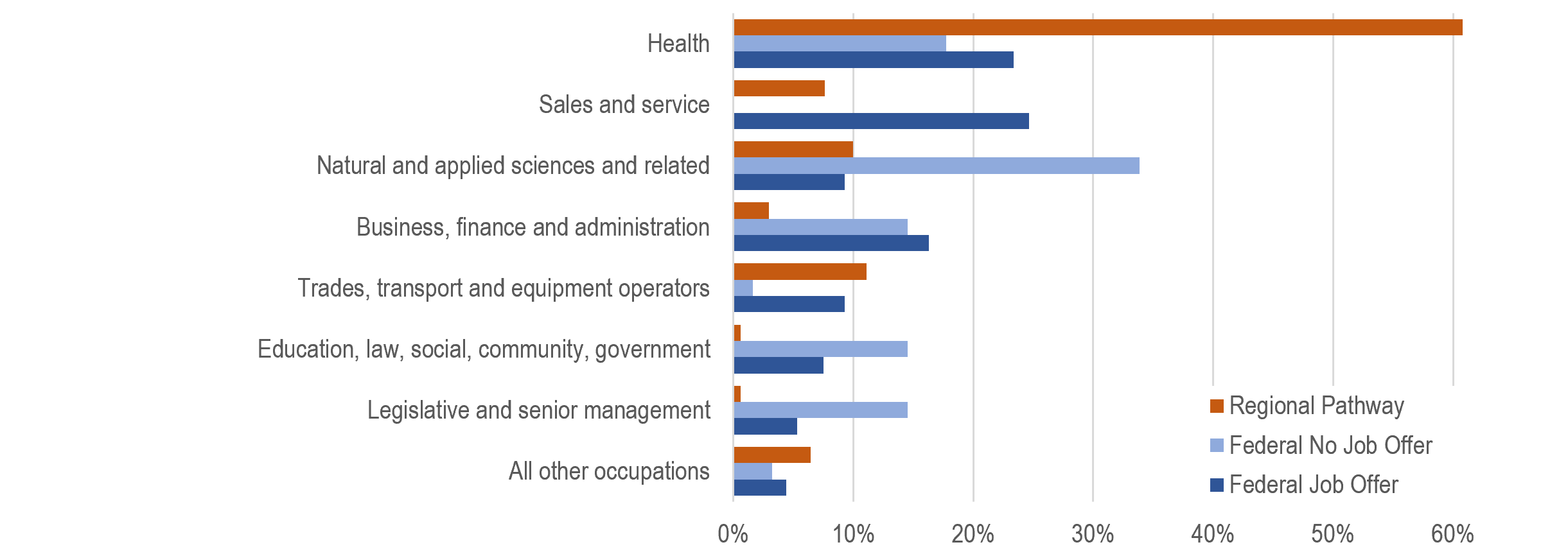
Occupational category varied by EMPP Pathway and stream. PAs in the Job Offer stream had job offers primarily in the Sales and service (24.7%) and Health (23.3%) sectors. PAs in the No Job Offer stream intended to work in the Natural and applied sciences (33.9%) sector, but there was no information on whether they were able to secure a job in their intended field. Many PAs under the Regional Pathway had a job offer in the Health sector (60.8%) (Figure 2).Footnote 2
Text version of figure 2
The bar chart shows the proportion of PAs with a job offer or intending to work in broad occupational categories, disaggregated by Regional Pathway, Job Offer stream, and No Job Offer stream. The y-axis lists broad occupational categories while the x-axis shows the percentage of PAs by stream.
| Occupational category | Job Offer | No Job Offer | Regional Pathway |
|---|---|---|---|
| All other occupations | 4% | 3% | 6% |
| Legislative and senior management | 5% | 15% | 1% |
| Education, law, social, community, government | 7% | 15% | 1% |
| Trades, transport and equipment operators | 9% | 2% | 11% |
| Business, finance and administration | 16% | 15% | 3% |
| Natural and applied sciences and related | 9% | 34% | 10% |
| Sales and service | 25% | 0% | 8% |
| Health | 23% | 18% | 61% |
Evaluation
Need and feasibility
Finding 1: There is a need for economic immigration pathways for refugees and displaced people, as well as clear evidence that such pathways are feasible with appropriate levels space and processing times.
Need for labour mobility pathways
Reviewed documents highlighted rising global displacement, shrinking protection space, and the limited capacity of traditional resettlement programs as key drivers of demand. For example, the United Nations High Commissioner for Refugees (UNHCR) estimated 117 million forcibly displaced and stateless people globally as of June 2025 (Figure 3).Footnote 3 Documents emphasized the value of complementary economic pathways that support the principle of additionality, shift narratives on refugee mobility, attract skilled labourers and provide early access to economic opportunities for resettled refugees.

Text version of figure 3
Column chart showing the global number of forcibly displaced people rising steadily from 2018 to June 2025, with years marked along the x-axis. In 2018 there were 73.31 million, 79.44 million in 2019, 82.44 million in 2020, 89.27 million in 2021, 108.37 million in 2022, 117.31 million in 2023, and peaked at 123.2 million in 2024. As of June 2025, there were 117.27 million forcibly displaced people globally.
Internal and external interviewees consistently described the EMPP as a necessary and timely policy response, aligning with both economic and protection-oriented objectives. They highlighted the program’s role in responding to global displacement pressures and its contribution to Canada’s humanitarian commitments (e.g., Global Compact for Refugees, UNCHR’s Three Year Strategy and Roadmap 2030) by offering an alternative route to safety that does not draw from limited resettlement spaces. Internal stakeholders also emphasized that the EMPP positions Canada as an international leader and innovator in refugee labour mobility, with other countries now exploring similar models.
Further, employers described ongoing and unmet labour needs in sectors, such as healthcare and hospitality, as well as in rural and smaller communities, areas repeatedly noted in the document review and internal interviews as suffering from chronic labour shortages.
Feasibility of the EMPP
Evidence showed that the EMPP was a viable initiative in the beginning. NGO partnerships were established and employers engaged. While EMPP uptake was slow in the beginning, efforts to scale up the pilot were successful, resulting in increased interest and applications. A total of 1,119 newcomers were admitted between 2018 and June 2025 through the EMPP, with over half of applications processed within the six-month processing commitment.
At first, EMPP levels space was sufficient, but then the immigration landscape changed with PR levels reductions, and the pilot’s allocated space was decreased. Applications must be processed as per targets set based on the Immigration Levels Plan. If an inventory is misaligned with its levels space, some applications will have to wait to be processed, inflating processing times.
Evidence highlighted various challenges associated with increased processing times for the EMPP. For example, employers cited losing access to needed talent, having to rescind job offers in order to meet time-sensitive demands, releasing resources (e.g., living accommodations) planned for supporting future newcomer settlement, and having business plans disrupted and resulting economic loss. External interviewees emphasized that predictable, timely processing is the cornerstone of employer engagement, and that long or unpredictable waits can erode employer trust or engagement.
For EMPP candidates, prolonged waits in host countries increase their exposure to displacement-related risks and costs, including maintaining documentation validity, restrictions on travel, threats to physical safety, and deportation. It was noted in the employer focus groups that unpredictability can be detrimental to candidates’ mental health, with them feeling forgotten during long waits. Newcomer survey data showed that 30.1% of PA respondents experienced long processing times as a challenge.
Many stakeholders highlighted concerns about the long-term feasibility of the EMPP if processing performance and levels constraints were not addressed. It was also noted that Canada’s refugee labour mobility program has become less competitive globally as other countries have introduced complementary pathways and can settle candidates faster.
Why this matters: When application intake outpaces levels space, processing times increase, negatively affecting access for refugees, employer engagement, and Canada’s competitiveness for skilled displaced talent. Thus, ensuring alignment is critical to maintaining EMPP effectiveness, credibility, and sustainability.
Alignment with objectives and priorities
Finding 2: The EMPP is aligned with GOC and IRCC priorities related to humanitarian protection and economic immigration. However, shifts in labour market profile, expanded eligibility criteria and additional program expectations have introduced uncertainty about the pilot’s core purpose and scope.
Alignment with objectives and priorities
Across lines of evidence, the EMPP demonstrated strong alignment with Government of Canada (GOC) and IRCC objectives. The EMPP provides unique strategic value to Canada’s immigration and protection ecosystem. It supports humanitarian protection, strengthens Canada’s international leadership in migration innovation, and reinforces a narrative of refugees as skilled workers who positively contribute to Canadian communities.
The document review, internal and external interviews showed strong and consistent alignment between EMPP’s foundational design and federal commitments to complementary pathways and refugee protection. The EMPP directly supports Canada’s international objectives by expanding safe pathways and easing the burden on traditional resettlement systems.
Interviewees further noted that EMPP matches the GOC’s priorities of supporting refugees and other displaced people while responding to labour market needs and supporting economic immigration. The EMPP also showcases the diverse skills of refugees and provides a dignified, employment‑based route to safety that aligns with Canada’s broader integration, protection, and immigration strategies.
Areas of ambiguity
Shift in labour-market profile
Internal interviews and administrative data depicted early cohorts that featured more PAs tied to high-skilled jobs (e.g., healthcare, trades), but more recent intake following the introduction of the Federal Pathway was more concentrated in occupations with lower-skilled training, education, experience and responsibilities (TEER 4–5) (Figure 4).

Text version of figure 4
Stacked column chart shows the proportional distribution of TEER 0-5 among all EMPP PA applications by application year from 2018 to the first six months of 2025. The x-axis shows the year, while the y-axis shows the percentage of applications with the columns using colour to disaggregate TEER. Early years are dominated by TEERs 1, 2, and 3, while the share of TEER 4-5 began increasing in 2023 and represents two-thirds of applications submitted in 2025.
| TEER | 2018 | 2019 | 2020 | 2021 | 2022 | 2023 | 2024 | 2025 |
|---|---|---|---|---|---|---|---|---|
| TEER 0 | 0% | 0% | 0% | 0% | 2% | 4% | 6% | 5% |
| TEER 1 | 25% | 25% | 10% | 0% | 16% | 19% | 16% | 11% |
| TEER 2 | 50% | 50% | 30% | 89% | 20% | 9% | 14% | 9% |
| TEER 3 | 25% | 25% | 60% | 0% | 63% | 51% | 20% | 8% |
| TEER 4 | 0% | 0% | 0% | 0% | 0% | 8% | 24% | 26% |
| TEER 5 | 0% | 0% | 0% | 11% | 0% | 10% | 19% | 41% |
Overall, there were mixed perspectives about the impact of this profile shift. Some internal and external interviews emphasized that the pilot effectively fills labour market needs across skill levels and the presence of TEER 4–5 roles is not misaligned with Canada’s economic objectives, as employers in multiple sectors and regions report persistent labour needs. They felt that broader eligibility and occupational diversity simply reflect genuine labour market realities, and saw the EMPP as a pragmatic labour-matching program that should respond flexibly to employer needs regardless of skill level.
However, multiple lines of evidence indicated that this broader occupational profile has created uncertainty around program identity and has potential implications for EMPP’s mandate related to skilled refugee labour mobility, economic security, and labour market additionality. Some stakeholders continued to view the EMPP as a talent-driven, globally visible model meant to highlight the high-skilled contributions of refugees. This ambiguity has led to mixed messaging, internal confusion, and questions about the purpose of the pilot.
Expansion of eligibility criteria
Protection criteria became less restrictive over the life of the EMPP, driven by ministerial direction to scale up the pilot and sustained advocacy from external partners. Internal interviews and document review indicated that the resulting eligibility has become increasingly complex and extends beyond the traditional refugee requirements to include other types of displacement documents (e.g., Temporary Protected Status, trusted partner referral letters).
Stakeholders expressed concern that frequent policy shifts and evolving documentation standards have created uncertainty around eligibility and may be moving the EMPP away from its original purpose as a complementary pathway for skilled refugees, toward facilitating access for individuals who may not otherwise meet resettlement or economic immigration criteria.
Additional pilot expectations
Evidence indicated that the EMPP has been positioned and, at times, used as a mechanism to respond to emerging international crises (e.g., Afghanistan) and to advance Canada’s geopolitical commitments (e.g., Latin America).Footnote 4 However, document review and interviews consistently showed that EMPP’s design, Immigration Levels space, and partner capacity have not been aligned with large‑scale or rapid crisis response, and that using the Pathway for these purposes contributed to operational strain, eligibility complexity, and mandate drift that shifted the EMPP away from its original mandate.
Further, while internal interviewees acknowledged that expanding EMPP into new geographic regions, such as Latin America, demonstrated the program’s flexibility and ambition as a complementary pathway, there were several challenges. These included limited NGO partnerships in the region, misalignment between eligibility requirements and the target population (e.g., the population had limited English or French and did not meet EMPP requirements) and misalignment with regional protection contexts (e.g., the target population was transient, and did not meet traditional refugee requirements). Several internal participants cautioned that regional expansion driven by political priorities rather than program suitability risks weakening strategic alignment with humanitarian and economic goals.
Why this matters: While the EMPP remains broadly aligned with GOC and IRCC priorities, emerging ambiguity around the program’s core purpose and limits may undermine consistent policy messaging, operational coherence, and the program’s ability to demonstrate results against its objectives.
Labour market alignment
Finding 3: While the job profile of applicants in the inventory has evolved since the introduction of the Federal Pathway, the EMPP’s model driven by employer demand supports regional labour markets and is mostly aligned with national labour market needs.
Employer labour demand
Multiple lines of evidence showed that the EMPP was driven primarily by employer labour demand, rather than by internal analysis of labour market needs. Interviewees highlighted that external stakeholders, including employers, NGO partners, provinces, and industry associations, identified labour market needs in particular sectors and regions that EMPP candidates could help address. In particular, documents and interviewees pointed to labour shortages in healthcare, trades, and construction sectors. Overall, this employer demand-driven approach was felt by stakeholders to be highly responsive.
Regional labour market benefits
The approach based on employer demand allowed the EMPP to address regional labour market needs. Multiple lines of evidence noted that smaller and rural communities may face more acute recruitment challenges and have unique needs not reflected in nation-wide labour shortage data. External interviews and focus groups highlighted that employers have used the EMPP to fill positions that may not align with national labour market shortages but are difficult to staff locally (e.g., hospitality positions in rural tourism communities), and that these communities have experienced economic and social benefits from hiring through the EMPP.
Regional benefits were reflected in administrative and newcomer survey data. Although one-third of admitted PAs intended to live in Toronto (11.5%), Mississauga (9.4%), Guelph and St John’s (4.3% each), and Thunder Bay (4.1%), the remaining two-thirds were spread across 79 municipalities. Notably, the No Job Offer stream showed a higher level of geographic concentration of PAs, with 36.4% intending to live in Toronto. Further, the newcomer survey found that the majority (89.1%) of respondents were still living in the same community to which they had been destined, though most were admitted to Canada in 2024 or 2025. Of those that had moved, employment-related factors were the most commonly cited reasons for relocating.
Current alignment with labour shortages
COPS data suggested that EMPP PAs have filled some nation-wide labour market shortages, with most admitted PAs attached to occupations showing signs of labour shortage (50.1%) or being in balance (49.7%), and 0.2% showing signs of labour surplus. Notably, 31.3% of PAs were attached to Nurse aides, orderlies and patient services associates jobs, which showed strong signs of shortages.
Forward‑looking labour market alignment
However, COPS forward-looking data suggested that the jobs of PAs in EMPP’s processing inventory will be less aligned with labour market needs, with 77.7% of inventory PAs attached to occupations expected to be in balance,Footnote 5 and 20.8% of those expected to be in shortage. This shift was driven primarily by an increase in applications under the Federal Pathway, with 21.9% of Federal Pathway applications being attached to occupations showing signs of shortage compared to 73.3% of Regional Pathway applications.
Why this matters: EMPP newcomers contribute to employer and regional labour market needs across Canada. However, reduced alignment between future cohorts and labour‑market shortages could undermine the program’s intended impact, introducing risks related to labour market misalignment and public perception.
Employment and economic establishment
Finding 4: The EMPP facilitates early attachment to the labour market, contributing positively to retention and community integration. However, credential‑recognition barriers, skills matching, and financial challenges may limit longer‑term economic outcomes.
Attachment to labour market
At the time of the evaluation, 538 PAs had arrived in Canada with job offers. Administrative data showed that 77.0% were attached to higher‑skilled occupations (TEER 0-3) on their applications and 23.0% were attached to lower-skilled occupations (TEER 4-5). However, this varied across EMPP streams:
- In the Job Offer stream, 55.1% had job offers in higher‑skilled occupations, while
- 98.8% of the Regional PNP stream and 96.8% of Federal No Job Offer stream were attached to higher‑skilled occupations, though those without job offers did not all necessarily obtain jobs at these skill levels.
Survey data showed that 87.7% of PAs with job offers started working in the offered position, and at the time of the survey 90.8% of all PAs admitted with job offers were employed. In contrast, 67.4% of PAs without a job offer were employed. Of all PAs currently employed, 90.1% reported working full time, with 39.4% working in TEER 3 positions. Additionally, 51.7% of those without job offers reported higher-skilled employment, compared to 18.8% of those with job offers.
Newcomer survey results also suggested good job retention, as 67.9% were still working in their original position, many for more than a year. Of the 24 respondents who left their position, only 7 reported leaving the position before one year. While the most common reason for leaving was career advancement or a new opportunity, only 25.0% moved to a higher skilled job, while the rest obtained employment at either the same skill level or lower.
Community integration and retention
Multiple lines of evidence highlighted that workplaces are one of the strongest sources of connection and support for EMPP newcomers. Employers consistently reported that EMPP newcomers integrate well into the work environment, develop strong relationships with colleagues, and contribute positively to workplace culture. External interviewees described positive "ripple effects" of hiring through the EMPP, including community and workplace events to welcome EMPP newcomers, and increased interest in hiring refugees from local businesses. Newcomer survey results demonstrated the impact of this enthusiasm, with 86.7% of respondents who worked reporting a strong sense of belonging to their workplace community.
Employment opportunities, job quality, and the ability to find meaningful work are major determinants of whether immigrants stay in a community.Footnote 6 Since arriving in Canada, 89.1% of EMPP newcomers surveyed have stayed in the same community and 78.2% reported developing a strong sense of belonging to their community.
Challenges to economic independence
Multiple lines of evidence showed signs of relative economic stability in terms of attachment to the workforce, Windmill loan repayment, and accessing settlement services. However, external interviewees stressed that financial and cost‑of‑living challenges in Canada can hinder EMPP newcomers’ economic independence, especially for larger families.
Approximately two thirds of surveyed newcomers reported a current salary under $50,000, which is low relative to the Canadian income median,Footnote 7 suggesting that many may struggle to absorb financial shocks or rising living costs (Figure 5).

Text version of figure 5
Column chart shows the distribution of reported salary ranges among working principal applicants, split by whether the survey respondent had or did not have a job offer. Salary ranges are marked along the x-axis, while the percentage of PAs is marked along the y-axis with the two groups differentiated by different colour columns. For those with a job offer, most reported salaries under $50,000. For those without a job offer, salaries still clustered under $50,000 to some extent but were more disbursed among the ranges, and more were in the $80,000 and above ranges.
| Salary range | PA with job offer | PA without job offer |
|---|---|---|
| Under $30,000 | 26% | 21% |
| $30,000 to less than $40,000 | 24% | 17% |
| $40,000 to less than $50,000 | 19% | 21% |
| $50,000 to less than $60,000 | 10% | 3% |
| $60,000 to less than $70,000 | 4% | 7% |
| $70,000 to less than $80,000 | 3% | 3% |
| $80,000 to less than $90,000 | 3% | 7% |
| $90,000 to less than $100,000 | 1% | 7% |
| $100,000 and over | 3% | 14% |
Further, survey results underscored the extent of financial strain experienced by EMPP newcomers:
- 31% of respondents did not feel financially independent when they arrived in Canada.
- 25.9% reported not feeling financially independent at the time of the survey.
- 47.6% reported having experienced financial challenges, most commonly: high cost of living, low income, and difficulty saving or building financial security.
Notably, over 70% of those experiencing financial challenges reported that these challenges persist today, most even after a year of living in Canada. Interviewees reflected on strategies to support EMPP newcomers, such as supporting informed decision‑making about job offers, potential affordability of smaller or rural municipalities, and a dual‑income strategy, such as spouses/partners securing employment alongside PAs. They also suggested that design features of the EMPP (e.g., expanded TEERs and facilitation measures) may exacerbate economic challenges through entry‑level placement patterns and potential licensing barriers.
Skills matching
In addition to a shift over time toward TEER 4–5 positions, the document review noted an increase in applicants with post-graduate degrees accepting lower‑skill job offers, a pattern echoed by internal interview accounts of engineers and other highly trained candidates entering lower‑wage roles (e.g., cleaning, retail, delivery) at admission.
Administrative data showed that a strong majority (91.7%) of PAs had some post‑secondary education at admission, including 17.0% with post‑graduate studies, yet 21.4% of those with post‑secondary education were attached to occupations requiring little or no post‑secondary education. This misalignment was more pronounced in the Job Offer stream.
Newcomer survey data tempered this picture slightly, as many respondents indicated that their current position aligned with their education (68.8%) and work experience (76.1%) to a moderate or large extent (Figure 6).

Text version of figure 6
The first bar shows alignment with their previous work experience: 4% don’t know/prefer not to say; 8% not at all aligned; 12% aligned to a small extent; 30% aligned to a moderate extent; and 46% aligned to a large extent. The second stacked bar shows newcomer’s self-reported alignment of their current job with their education: 3% don’t know/prefer not to say; 12% not at all aligned; 16% aligned to a small extent; 28% aligned to a moderate extent; and 40% aligned to a large extent.
Professional credential recognition
While professional credential recognition is a common barrier for economic immigrants, EMPP newcomers face additional challenges linked to the specific conditions of the Pathway and their displacement context. Just under half of surveyed PAs reported engaging in some form of credential assessment for their current role. Qualitative evidence indicated that EMPP newcomers may accept lower‑paid positions (e.g., foreign‑trained nurses working as nurse aides or personal support workers) with the intention of completing Canadian credential requirements after arrival. In addition to typical barriers associated with regulated professions, EMPP newcomers encountered unique constraints, including limited access to required documentation due to displacement, financial constraints that hindered participation in assessment and training processes, and limited time for required training while balancing full‑time work, particularly when employer support was unavailable.
Why this matters: EMPP has been successful in promoting early employment and community integration and retention, however EMPP newcomer’s unique challenges related to early economic establishment may diminish EMPP’s ability to meet its objectives to deliver both humanitarian and economic value.
Facilitation measures and access
Finding 5: The EMPP addresses displacement-related barriers through comprehensive and effective facilitation measures. However, structural barriers to language testing continue to limit access.
Facilitation measures
Documents and interviews showed that the EMPP was specifically designed to be a highly facilitative pathway, and that without these facilitation measures, most refugees would be unable to meet the standard requirements of economic programs due to financial constraints, lack of documentation, or limited mobility within host countries.
It was generally reported that all facilitation measures are important and were routinely used by EMPP applicants. Results from the newcomer survey reinforced this point, with only 5 respondents reporting not having received some form of application support or facilitation measure (Figure 7).
Loans and financial support
Evidence on financial supports showed that these measures were widely used, highly valued and addressed major barriers to accessing economic immigration pathways for the target population. Internal interviewees emphasized the importance of waived biometrics and PR application fees, access to loans through the ILP, and settlement fund flexibility, including access to Windmill Microlending loans to meet settlement fund requirements and/or access financial support.
Newcomer survey results were consistent, with 93.3% of respondents indicating that waived fees were helpful to a large or moderate extent. In addition, administrative data showed that EMPP newcomers used loans to access the Pathway, with 28.0% of approved PAs accessing at least one type of ILP loan (20.0% used a Right of PR Fee loan; 18.0% used a transportation loan; 1.7% used an assistance loan). Further, Windmill Microlending loan dataFootnote 8 indicated that 836 EMPP candidates applied for a loan, 818 were approved and 161 loans were dispersed with an average of $11,883 per loan.

Text version of figure 7
Horizontal bar chart shows the proportion of survey respondents who reported using each facilitation measure: Assistance with travel arrangements provided by the IOM (58.5%); Pre-departure orientation on Canada "Canadian Orientation Abroad" (56.9%); Loan to pay for transportation to Canada (50.0%); Loan to help with initial settlement expenses in Canada (40.0%); IFHP medical coverage while abroad (35.4%); Reimbursement of medical exam fees (33.8%); Flexibility with travel documents (e.g., expired passports) (26.2%).
Interim federal health program and medical reimbursement
The Interim Federal Health Program (IFHP) provided important coverage for pre departure medical services (PDMS) for EMPP candidates, helping to reduce upfront cost barriers to immigration. While PDMS are typically covered by the IFHP without requiring out-of-pocket payment from clients, interview evidence suggested that some clients encountered challenges and reimbursement based delivery. Further, impacts related to lack of post arrival coverage and delays in access to provincial health care were described as a "blind spot" for the pilot in internal interviews. EMPP clients did not have IFHP coverage in Canada by design, as they are economic immigrants who are not entitled to refugee resettlement assistance including the IFHP.
Documentation flexibility
The EMPP accepted alternative evidentiary documentation from applicants to prove their work experience, education background, identity and protection status. All interviewee groups agreed that this flexibility is critical in contexts where refugees lack access to traditional documentation due to political or geographical context and face barriers to obtaining records and accessing test centers.
While administrative data showed that only a minority (10.6%) of applications included a Trusted Partner Letter, more than half of all EMPP PAs used visa or travel document exemptions (54.9% passport exemptions; 14.6% travel document exemptions), illustrating the centrality of documentation flexibility to EMPP access.
Ongoing EMPP specific barriers
Stakeholders consistently described access to language testing as an ongoing challenge for EMPP candidates. Refugees pay the same commercial test fees as other applicants, yet often lack the financial resources to enroll in training and tests, retake failed exams, or travel to testing centers. The EMPP offered The One Skill Retake as a language‑testing accommodation to allow candidates to retake sections of their language test at a reduced cost, which was highly used by applicants. External administrative sources reported approximately 3,200 uses by EMPP candidates between January 2024 and July 2025, potentially reducing some financial burden.
External interviews added an important nuance, emphasizing that the degree of barrier depends heavily on conditions in the host environment. Refugees living in camps or unstable temporary housing face profound barriers to mobility, making it difficult or dangerous to travel to test centers. The same logistical barriers apply to biometrics and medical exams where travel to biometric facilities or government offices create upfront costs and risks that can delay or derail applications.
Why this matters: Facilitation measures are foundational to the EMPP’s accessibility and effectiveness. Without them, most refugees would be unable to meet economic immigration requirements. At the same time, persistent barriers continue to shape who can access the pathway, raising concerns and limiting the ability to consistently reach the intended population across different displacement contexts.
Post-arrival supports including settlement services
Finding 6: Post‑arrival support for EMPP newcomers is generally effective but uneven, relying more on engaged employers and NGOs than on a formalized approach.
Challenges in Canada
EMPP clients and their families are classified as economic immigrants but many arrive with issues similar to those of resettled refugees, including limited financial resources, trauma histories, and disrupted access to healthcare. Newcomer survey data reinforced the presence of these underlying pressures with financial (47.6%), housing (40.8%), and transportation (36.1%) challenges commonly reported across pathways, and heightened employment‑related challenges among PAs with no job offer (Figure 8).

Text version of figure 8
Horizontal bar chart shows the share of surveyed PAs who reported experiences a range of challenges when they arrived in Canada, split by those who with and without a job offer. Challenges are marked along the y-axis, and the proportion of PAs along the x-axis with those who had a job offer represented by the blue bars, and those without a job offer represented by the orange bars. Financial and housing were the top two challenges for both groups, while those with a job offer also reported transportation challenges and those without a job offer reported difficult finding employment as their third most common challenges.
| Challenge | PA with job offer | PA without job offer |
|---|---|---|
| Other | 3% | 5% |
| Challenges helping child(ren) settle | 7% | 7% |
| Difficulty accessing settlement services | 10% | 5% |
| Language barriers | 6% | 9% |
| Difficulty adjusting to workplace | 10% | 12% |
| Gaps in employment | 7% | 12% |
| Culture shock | 16% | 9% |
| No challenges | 15% | 16% |
| Difficulty finding employment | 11% | 42% |
| Access to healthcare | 25% | 23% |
| Social isolation, difficulty making friends | 29% | 23% |
| Transportation | 44% | 21% |
| Housing | 43% | 47% |
| Financial | 45% | 53% |
Supports in Canada
There was strong consensus across all lines of evidence, that most EMPP newcomers benefit from a range of settlement supports from IRCC‑funded SPOs, NGOs, employers, and community services. The majority (84.4%) of EMPP newcomers surveyed reported feeling supported to a moderate or large extent when they arrived in Canada. Primary sources of support varied by stream: PAs with job offers relied heavily on employer assistance, PAs without job offers more on friends, and spouses more on NGOs (Figure 9).

Text version of figure 9
Column chart shows the proportion of PAs with job offers (represented by blue columns), PAs without job offers (represented by orange columns), and spouses (represented by grey columns) who reported receiving support from a variety of sources. Sources of support are marked along the x-axis, while percentages are marked along the y-axis. PAs with a job offer most commonly relied on employers and NGO partners, those without a job offer relied most on friends, and spouse relied heavily on NGO partners.
| Source of support | PA with job offer | PA without job offer | Spouses/Partners |
|---|---|---|---|
| Friends | 49% | 60% | 18% |
| NGO partner | 56% | 42% | 71% |
| Employer | 63% | 33% | 35% |
| Family | 30% | 33% | 18% |
| Community | 24% | 30% | 35% |
| Internet/online community | 15% | 26% | 29% |
| Another immigrant-serving organization | 16% | 21% | 24% |
| Other newcomers to Canada | 21% | 16% | 29% |
| Other | 7% | 5% | 12% |
NGO Partner and employer settlement support
External interviews highlighted that many NGOs provided multiple post‑arrival supports (e.g., housing, transportation, inclusive‑hiring training for employers, and ongoing check‑ins), though the depth and duration of these supports varied considerably.
Employers also reported providing significant wrap‑around support, particularly during the initial weeks after arrival, often going beyond typical employer responsibilities. Examples included arranging transportation, housing, purchasing groceries, registration for government or community services (e.g., health insurance, driver’s license, bank accounts), as well as offering structured onboarding and mentorship at work (Figure 10).

Text version of figure 10
Horizontal bar chart shows the proportion of surveyed newcomers who reported receiving each type of support from NGOs and from employers. Types of support are listed along the y-axis, while percentages are marked along the x-axis. Help finding a place to live was the most common provided support by both NGOs and employers, though NGOs at a higher rate. NGOs also helped newcomers adjust to life in Canada and connect with other newcomers, while employers helped newcomers sign up for employer health benefits.
| Type of Support | NGO | Employer |
|---|---|---|
| Other | 11% | 5% |
| No supports | 14% | 7% |
| Connection to other newcomers in Canada | 33% | 7% |
| Connection to other Canadians | 16% | 12% |
| Adjusting to life in Canada | 34% | 17% |
| Finding or purchasing essentials | 16% | 21% |
| Help with government and community services | 24% | 27% |
| Transportation in Canada | 24% | 27% |
| Help signing up for employer health benefits | 0% | 30% |
| Finding a place to live in Canada | 67% | 38% |
Despite most newcomers reporting having received adequate levels of support, post-arrival supports rely on the goodwill of engaged NGOs and employers, rather than on a formalized approach. For example, only a small number of NGO partners had formal post‑arrival obligations under their agreements, and employers received only suggested guidance rather than formal requirements. Further, IRCC does not conduct post-arrival monitoring for EMPP newcomers to ensure adequate supports are provided, as is the case for resettled refugees.
Evidence suggested that the lack of a post-arrival support framework resulted in a wide variation in the type and level of assistance provided. NGOs and employers expressed concern that variability in support approaches leaves some newcomers at risk of "falling through the cracks," and several emphasized the need for clearer expectations or greater consistency, particularly in the first three months after arrival in Canada.
IRCC-funded settlement services
Documents noted that EMPP newcomers access IRCC-funded settlement services at a higher rate than those in other economic streams, such as traditional PNP and RNIP. Administrative data showed that 73.3% of admitted PAs and 77.6% of admitted spouses/partners accessed at least one IRCC-funded in-Canada settlement service (as of March 31, 2025). The most commonly accessed services were Information and Orientation (66.1% for PAs and 73.2% for spouses/partners) and Needs Assessments (42.6% for PAs and 51.7% for spouses/partners). For PAs, the next most frequent service type was Employment Counselling (32.6%), but for spouses/partners, it was Language Assessment (41.0%).
Although pre‑arrival SPOs are intended to facilitate referrals, the transition to post‑arrival services was uneven. Service uptake varied considerably by stream and by newcomer characteristics. PNP stream newcomers accessed the highest volume and diversity of services, while newcomers in the Federal Job Offer and No Job Offer streams accessed services at lower rates. Younger PAs, those with lower levels of education, and those in certain occupation groups (TEER 0, 4, 5; sales and service; manufacturing) also accessed services at lower rates, suggesting potential inequities in awareness or ability to engage.
EMPP newcomers do not qualify for the Resettlement Assistance Program that provides time‑limited income support and essential settlement services for refugees to address early settlement needs. Interviews noted that without these services, EMPP newcomers are at risk of gaps in health coverage, dependence on loans and inconsistent support from employers or NGOs to bridge basic needs.
Why does this matter: Post-arrival supports are generally effective. However, outcomes can be uneven and depend on individual circumstances, rather than program design. Continued reliance on discretionary employer and NGO support increases the risk of gaps in settlement assistance.
Program integrity
Finding 7: Complex and evolving eligibility criteria, limitations in officer training and guidance, and outsourced protection assessments have introduced program integrity and quality assurance risks.
Evolving eligibility
Evidence showed that the expansion of eligibility criteria, particularly related to protection needs and alternative forms of evidence, presented some integrity risks. Internal interviews and document review indicated that additions to documentation accepted (e.g., Temporary Protected Status, United Nations Relief and Works Agency documents) and an increasingly facilitative design augmented processing complexity. Correspondingly, some surveyed officers reported difficulty assessing protection eligibility, verifying work experience and education credentials using alternative documentation, as well as managing multiple pathways with differing eligibility requirements to a moderate or large extent.
Challenges in verification and monitoring
Challenges related to assessing eligibility criteria were compounded by limited officer training and guidance. Some surveyed processing officers reported difficulty validating employer legitimacy and job offer terms to a large extent, citing constrained time, tools, and guidance. Long processing times were also noted to complicate verification, as employers may rescind or alter offers before application decisions are finalized. While on‑the‑job training and functional guidance were viewed as moderately effective by some surveyed officers, only half felt adequately trained. Frequent policy changes and multiple iterations reduced the usability of Program Delivery Instructions (PDIs), and very few surveyed officers found PDIs easy to use. Many reported spending a lot of time seeking clarification or relying on informal workarounds.
Further, interviews highlighted the absence of systematic post‑arrival monitoring of EMPP clients, as well as limited data on Trusted Partner‑led screening, employer vetting and application support, constraining the department’s ability to verify processes, attribute partner contributions, or identify emerging risks, and requiring it to rely on anecdotal information from partners.
Trusted partner model
The Trusted Partner Model was introduced to expand access to the EMPP and reduce processing burden by allowing select NGOs to issue referral letters attesting to candidates’ protection needs. Administrative data showed that only 10.6% of applications used a referral letter, and documents noted that only two of six Trusted Partners had issued them at the time of the Evaluation.
Evidence showed that outsourcing the eligibility protection assessment to partners raised quality assurance concerns. Interview and officer survey results revealed that Trusted Partner assessment processes were opaque and inconsistent across partners, and subject to variable interpretation. It was noted that Trusted Partners did not have the same training and resources as IRCC officers, and lacked the necessary expertise and capacity to conduct assessments. Further, evidence showed that implementation of the model was resource-intensive, duplicating processing efforts and requiring IRCC to invest in capacity-building and an audit framework.
Documents also highlighted potential conflicts of interest and risks of program misuse with the model, and highlighted uncertainty related to IRCC’s authority to overturn partners’ eligibility decisions and enforce audit recommendations to improve the process. Overall, interviewees felt that the protection eligibility assessment was best conducted by IRCC officers and expressed support for dissolving the Trusted Partner Model.
Why this matters: Inadequate processing guidance, as well as challenges in job offer verification, eligibility assessments, and Trusted Partner oversight introduce risks that can lead to misuse and undermine confidence in the EMPP. Risks are compounded by data gaps that limit IRCC’s ability to monitor issues and outcomes.
Timeliness of application processing
Finding 8: While efforts to scale up the EMPP were successful, growing application volumes coincided with a change in government direction to reduce Immigration Levels space for PRs, resulting in a large inventory and increased processing times.
Pilot design and uptake
While early uptake was slow, interviews and document review highlighted aggressive departmental and ministerial efforts to scale up the EMPP through introducing a Federal Pathway, expanded eligibility, new partnerships, and promotional activities. Administrative data showed rapid growth in uptake starting in late 2023 corresponding to the introduction of the Federal Pathway, with 49.5% of all EMPP applications submitted in the first seven months of 2025 (Figure 11).Footnote 9

Text version of figure 11
Figure depicts the total number of applications received, newcomers admitted, and PAs admitted per year. Years 2018 to June 2025 are marked along the a-axis, while totals are marked along the y-axis. Columns show that applications received grew year-over-year, rising sharply in 2024 and peaking in the first six months of 2025. Two lines show that the number of total newcomers and PAs admissions also rose over time, with both peaking in 2024.
| Year | 2018 | 2019 | 2020 | 2021 | 2022 | 2023 | 2024 | 2025 |
|---|---|---|---|---|---|---|---|---|
| Applications Received | 4 | 4 | 10 | 11 | 52 | 219 | 808 | 1087 |
| PAs Admitted | 0 | 3 | 4 | 16 | 20 | 47 | 220 | 159 |
| Newcomers Admitted | 0 | 8 | 12 | 44 | 52 | 103 | 548 | 352 |
Evidence suggested a preference among stakeholders and clients for the Federal Pathway, noting it as streamlined and easier to access, compared to the Regional Pathway (PNP, RNIP, AIP) which was more burdensome and relied on interest from regional partners. This was further supported by administrative data, which showed uptake for the Federal Pathway far outpacing that of the Regional Pathway since its introduction. Notably, application volumes growth shifted almost entirely to the Federal Pathway which accounted for 94.9% of all PAs, with 81.0% being under the uncapped Job Offer stream. Documents highlighted that this surge in applications led IRCC to begin exploring intake control measures on the growing Job Offer stream. However, no intake measures were implemented until June 2025.
Processing times and levels space
Expedited processing was one of the key facilitation measures for the EMPP. Administrative data showed that 60.4% of finalized applications were processed within the six-month standard, and 92.9% were processed within 12 months.
However, scaling efforts quickly outpaced the EMPP’s Immigration Levels space. The EMPP is allocated a portion of PR admission spaces under the Federal Economic Pilots category of the Immigration Levels Plan. While spaces were modest in the early years (500 spaces spread across 2021–23), IRCC’s efforts to scale up the EMPP projected high-end ranges of 1,800 spaces in 2023, 3,750 in 2024, and 4,750 in 2025. However, in line with overall PR levels reductions, EMPP’s spaces were reduced to 500 annually in the 2025–27 Immigration Levels Plan.
Internal interviews pointed to levels space reductions coinciding with rising demand, resulting in a growing inventory even among applicants with valid job offers. NGOs indicated being unable to continue recruitment due to a lack of levels space and unpredictable processing times. As of August 2025, the EMPP inventory was the largest in its history, and reviewed documents noted that the projected processing time for new applications at the end of the evaluation period was four to six years, inconsistent with the EMPP’s design as a rapid pathway.
Why this matters: Reasonable processing times depend on a balance of measures to manage application intake and available Immigration Levels space.
Partnerships
Finding 9: NGOs and partnerships are central to the effective delivery of the EMPP; however, effectiveness is uneven and dependent on NGO capacity and the stability of program conditions established by IRCC.
NGOs and partnerships
Role and effectiveness of NGOs
The EMPP engaged different NGOs and Trusted Partners that each provided a variety of supports for newcomers and employers, including candidate identification, employer outreach, job interview logistics, application guidance, and onboarding coordination. By early 2025, NGO partners had interviewed 1,496 candidates, secured over 1,000 job offers, and supported the submission of more than 550 applications, underscoring the central role of NGOs in moving candidates through the EMPP pipeline. Correspondingly, newcomer survey data showed that 76.2% of respondents were supported by an NGO, and 72.3% did not perceive the application process as difficult, suggesting that NGOs played an essential role in candidates’ experiences and provided effective supports during the application stage.
Employer focus groups highlighted that NGO partnerships streamlined recruitment, reduced administrative burden, supported candidates during the hiring process, and improved hiring outcomes. However, document review noted variation in the capacity and effectiveness of NGOs, with some consistently generating higher referral volumes, and others falling short of targets or requiring substantial IRCC support. External interviewees noted that limited job availability and coordination challenges constrained referral volumes, particularly for partners working with job matching intermediaries.
According to NGO data, the International Organization for Migration (IOM) provided 765 Canadian Orientation Abroad (COA) sessions and arranged 645 movements for EMPP clients from 2023 to 2025. Newcomer survey results showed that IOM travel assistance and COA orientation were among the most common and highly valued pre‑arrival supports, with over 92.1% of respondents rating them as helpful to a moderate or large degree.
NGO partner collaboration
Interviews described relationships between IRCC and NGOs as generally collaborative. IRCC developed formal agreements for program implementation, training and resources to build partner capacity around protection. Further, IRCC regularly convened with partners through one-on-one meetings, consultations, conferences, and working groups. Outside of IRCC-led initiatives, multiple NGOs noted that they collaborated with each other, holding community of practice meetings to share information and lessons learned.
Challenges related to pilot instability
Evidence showed that NGO partners had to navigate relationships with employers and other stakeholders, and that maintaining confidence in the Pathway was difficult when there was instability. NGOs highlighted that building new employer partnerships is labour intensive, and that pauses and long timelines make it harder to maintain momentum, and diminish the pilot’s attractiveness. IRCC staff recognized the unpredictable shifts in the EMPP, such as changes to levels space, intake pauses and uncertainty about the future of the pilot, as straining relationships with NGOs and employers who had already invested time in identification, engagement, recruitment and onboarding plans.
While EMPP volatility was reported to affect all NGO partners, it was noted to disproportionately impact smaller organizations and those onboarded later in the pilot. These conditions limited their ability to build capacity, maintain employer engagement, and establish stable referral pipelines, reinforcing uneven partner outcomes across the program.
Why this matters: EMPP’s effectiveness is fundamentally dependent on partnerships with NGOs, but is also highly sensitive to the policy and operational context. Instability in this context affects the ability of NGOs to build capacity, maintain employer trust, and support candidates through the pathway.
Conclusions and recommendations
Conclusions
The EMPP demonstrated that economic immigration pathways for refugees and displaced people can add value as a complementary approach to Canada’s humanitarian and economic objectives. Evidence showed that, when refugees were supported by facilitation measures, EMPP enabled early labour‑market attachment, supported retention and community integration, and responded to labour market needs in certain sectors and regions.
At the same time, the evaluation identified factors that constrained EMPP’s effectiveness. Changes in applicant occupational profiles, the expansion of eligibility criteria, and the introduction of additional program expectations contributed to misalignment with the pilot’s original intent. Furthermore, while most newcomers reported feeling supported after arrival, post‑arrival assistance was uneven and largely dependent on employer and NGO engagement rather than standardized program mechanisms. Integrity and quality assurance challenges reflected broader issues related to program complexity, delegated assessments and officer capacity.
While efforts to scale up the EMPP were successful, growing application volumes coincided with a change in government direction to reduce Immigration Levels space for PRs, resulting in a large inventory and increased processing times. Despite having an expedited processing commitment of six months, projected processing times for new applications reached four to six years by the pilot’s closure.
Long and unpredictable processing times negatively impacted pilot stakeholders and undermined the intent of the EMPP. Employers reported losing access to global talent, having to rescind valid job offers, and having business plans disrupted as a result of longer than expected waits, while prolonged waits for applicants increased their exposure to displacement-related risks. For NGO partners, unpredictable processing times limited their ability to build capacity and maintain employer engagement, as well as undermined partner investments and trust in the pilot.
Overall, evaluation findings indicated that the EMPP has potential as a complementary pathway; however, its longer‑term effectiveness depends on clearer alignment between program design, processing and levels capacity, and the operational conditions required to support consistent outcomes for applicants, employers, and partners.
Recommendations
Recommendation 1: To uphold the objectives of the Pathway, maintain trust and collaboration with partners, and restore predictable processing times, IRCC should develop and implement a strategy to manage the remaining pilot inventory, and communicate this strategy, with timelines, to NGO partners, employers, and applicants.
Recommendation 2: Given that the Pilot demonstrated potential as a viable pathway, IRCC should consider moving forward with a permanent economic immigration pathway for refugees and other displaced persons, taking into consideration EMPP attributes and the lessons learned described below.
Lessons learned
The EMPP provided valuable insights into the feasibility and operationalization of complementary pathways for refugees and other displaced persons. Six lessons learned were identified from the evaluation, which should be taken into consideration for future complementary pathway initiatives.
- Economic complementary pathways for refugees and displaced people are feasible, but dependent on managing application intake with available Immigration Levels space and processing capacity in order to maintain predictability for employers, NGOs, and EMPP applicants.
- There was a clear preference for the Federal Pathway because of its simple program design that benefitted both processing efforts and program accessibility.
- The approach based on employer demand was effective in addressing labour market needs and supporting early labour market attachment and community integration. However, future program designs should include eligibility criteria that ensure more alignment between skills and job offers and support economic outcomes, as well as exploring pathways to credential recognition.
- Facilitation measures, such as those used in the EMPP, would be essential to promoting access and alleviating administrative and financial barriers to economic immigration for skilled refugees and displaced people in a future pathway design.
- Employers and NGOs are important sources of support for newcomers. Clear roles, accountabilities and minimum standards for post-arrival support would affirm responsibilities and prevent potential newcomer support gaps.
- Throughout the evaluation, the Evaluation and Program Policy teams worked collaboratively to ensure that evaluation evidence was informing the program policy decision-making process in a timely way. They should continue this collaborative work in the development and implementation of a future program to support ongoing performance measurement and future evaluation work.Annex A: EMPP Expected Outcomes
Annex A: EMPP expected outcomes
The following are expected outcomes for the EMPP as per the 2023 Performance Information Profile (PIP):

Text version
Immediate Outcomes:
- Pilot participants are identified, or find the Pilot independently, and apply to economic immigration
- Pilot participants have access to pre-arrival facilitation measures
- Pilot participants are employed
- Pilot participants have access to settlement services
Intermediate Outcomes:
- Pilot participants contribute to filling labour needs
- Pilot participants are economically independent
Ultimate Outcome:
- Economic benefits to Canada from refugees and other displaced persons immigrating through the EMPP
Annex B: EMPP eligibility criteria
Regional EMPP
Must meet economic criteria under one of the following regional economic programs:
- Provincial Nominee Program (PNP)
- Atlantic Immigration Pilot (AIP)
- Rural and Northern Immigration Pilot (RNIP)
Economic criteria vary by stream
Federal EMPP
Job offer stream
- Has a job offer that is: full-time and non-seasonal, for at least one year, and for an occupation listed in any TEER Category.
- Has accumulated, over any period of time, one year (1,560 hours) of paid work experience.
- Has acquired training, education, or experience aligned with the TEER Category of the job offer.
- For a TEER 0-3 job offer, has attained at least benchmark 5 level of proficiency in either official language for each of the four language skill areas. For a TEER 4-5 job offer, has attained at least a benchmark 4.
No job offer stream
- Has accumulated, over the last three years, one year (1,560 hours) of paid work experience in a TEER 0, 1, 2, or 3 occupation that does not include self-employment.
- Hold a Canadian secondary school or foreign equivalent credential.
- Has attained at least benchmark 7 level of proficiency in either official language for each of the four language skill areas.
- Has available funds, equal to one half of the low-income cut off published by Statistics Canada, to demonstrate the ability to settle in Canada.
Additional requirements for all streams
- Be outside of Canada at the time the application for permanent residence is received.
- Successfully pass all medical, security and criminality checks.
- Intend to reside in a province or territory other than Quebec.
Have been issued one of the following protection documents:
- a positive Refugee Status Determination (RSD) from either the United Nations High Commissioner for Refugees (UNHCR), or a refugee hosting state;
- proof of being registered or recorded as a person of concern by the UNHCR, if a positive RSD has not been obtained yet or is not available in the state where the foreign national is residing at the time of its application;
- a refugee certificate from the United Nations Relief and Works Agency for Palestine Refugees in the Near East (UNRWA);
- proof of being registered or recorded as a person of concern by the UNRWA, if a refugee certificate has not been obtained yet;
- a Temporary Protected Status (TPS) document issued by the hosting sate where the foreign national is residing at the time of their application for permanent residence and demonstrate that the foreign national has no reasonable prospect of a durable solution;
- valid Trusted Partner Referral Letter issued by a Trusted Partner that has a signed Trusted Partner Arrangement with IRCC.
Annex C: list of facilitation measures
Various pre-arrival facilitation measures are used to address displacement-related barriers of EMPP candidates. They include:
- Expedited processing with a 6-month processing commitment;
- Online and paper application formats;
- Waived biometric and permanent residence application fees;
- Flexibility in economic eligibility requirements under the regional economic programs;
- Flexibility in work experience requirement;
- Flexibility in Educational Credential Assessment (ECA) requirement;
- Flexibility in identity and travel documents and access to a Single Journey Travel Document;
- Alternative protection documents, including TPS and Trusted Partner Referral Letters;
- One-skill retake language testing and limited access to free language testing;
- Immigration Loans Program, including: right of permanent residence loan, travel loan, assistance loan;
- Flexibility in settlement funds requirements, including access to and ability to use Windmill Microlending to prove settlement funds (Regional Pathway), waiving of requirement (Job Offer stream), and ability to use grants/gifts/donations (No Job Offer stream);
- Interim Federal Health Program to cover pre-departure medical services and immigration medical exam;
- Access to International Organization for Migration (IOM) services abroad, including assistance with application and securing exit permits, cost and facilitation of travel to Canada, on-forwarding services;
- EMPP Canadian Orientation Abroad Program.
- Assistance from an NGO Partner including: Aman Lara, Archdiocese of Toronto - Office for Refugees, TalentLift, Talent Beyond Boundaries, Jumpstart Refugee Talent, RefugePoint, Hebrew Immigrant Aid Society (HIAS), FOCUS Humanitarian Assistance, International Rescue Committee, and World University Service of Canada.