
Radon gas survey in homes built after 2000: Halifax region
On this page
Purpose
Health Canada surveyed residents in homes built after 2000 in the Halifax Regional Municipality about their radon gas concentrations. We wanted to compare radon levels in homes built 10 years before and after the 2010 National Building Code. This building code required radon control measures.
Background
Radon is a radioactive gas that comes from the breakdown of uranium that occurs naturally in soil and rock. It can enter a home any place it finds an opening where the house is in contact with the ground.
Radon gas is the leading cause of lung cancer for people who live in non-smoking households. Homes with high radon levels are found across Canada, even in regions where radon is typically low. For this reason, Health Canada recommends that all residents test their home and take action to reduce their radon level if theirs is higher than 200 Bq/m3 (Becquerels (Bq) per cubic metre).
The 2010 National Building Code requires buildings to install measures to reduce the level of radon entering homes from the ground. The measures also make it easier to put in a radon mitigation system (known as an active soil depressurization system) later. These measures include installing:
- a sealed radon gas barrier above the gravel layer and below the concrete slab to reduce the entry of radon
- a capped pipe stub through the slab into the gravel layer to make it easier to put in a radon mitigation system if action has to be taken later to reduce radon levels
Nova Scotia adopted the 2010 National Building Code in 2011 and homes built since then include these newer radon control measures. We wanted to test the impact of the 2010 building code on radon levels in newer homes in the Halifax region. We focused on areas that have some of the highest naturally occurring radon levels in Canada.
Survey
Through our National Radon Laboratory, we recruited over 300 residents in the Halifax region in November 2021. We recruited by sending postcards to residents living in homes built in 2001 to 2010 or 2012 to 2021. We excluded homes built in 2011, the year that Nova Scotia adopted the building code, to avoid accidentally choosing a home that had not been built to this code. Figure 1 shows the communities in the region where most participants were recruited.
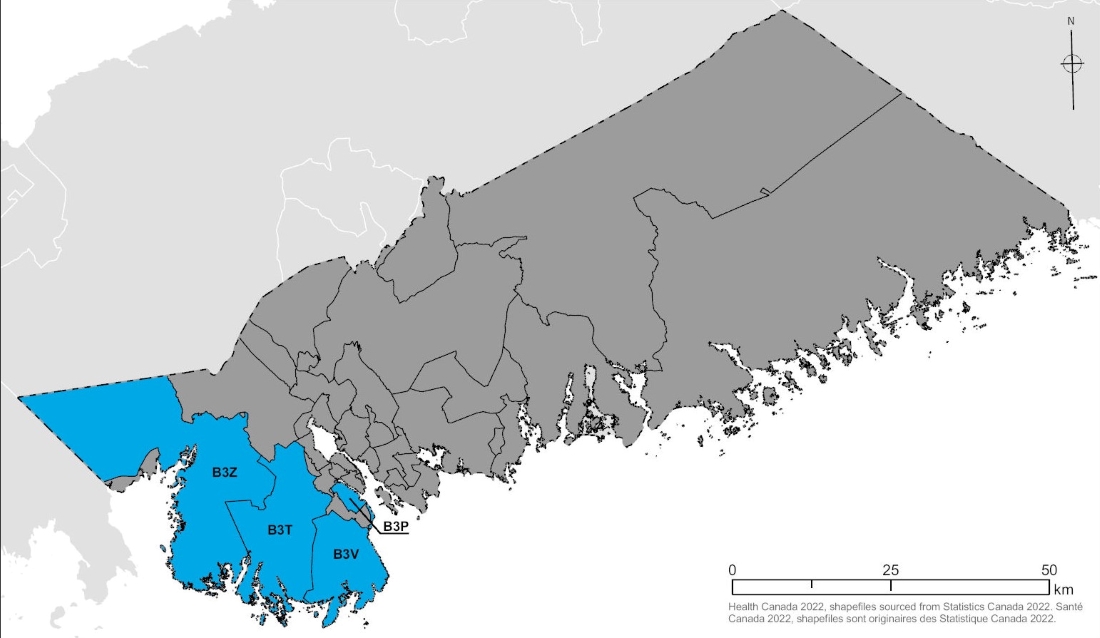
Figure 1 - Text description
This figure is a map of Halifax. We recruited most of the survey participants from the areas highlighted. These 4 areas in the western region of Halifax are: B3Z, B3T, B3V and B3P. Areas with only a few participants are not shown.
Each participant received a radon test kit with an alpha-track detector. We gave advice on where to put the detector and how long the test period should be (typically 91 days).
We also asked participants to fill out an online questionnaire, which asked about:
- size of home
- type of home
- for example, detached, semi-detached, row home
- type of heat source and delivery
- placement of detector in the home
- for example, basement, first floor
The questionnaire also asked if radon mitigation measures had taken place in the home previously.
Participants gave their detectors back to Health Canada at the end of the test period. We analyzed the detectors in a lab and sent the test results to participants within 3 to 5 weeks.
Results
Table 1 compares radon levels between homes built in 2001 to 2010 and 2012 to 2021. This comparison features 216 homes that met the following criteria:
- home construction year in this range
- radon detector placed in basement or first floor
- house type was one of the following:
- single detached
- for example, bungalow, split-level, 2 storey, 3 storey
- semi-detached
- row home
- home had not previously been mitigated for radon
- for example, in homes built in 2012 to 2021, the pipe stub through the slab into the gravel layer had not yet been used to install an active soil depressurization system
Radon level (Bq/m3) |
Home construction period |
|||
|---|---|---|---|---|
2001 to 2010 |
2012 to 2021 |
|||
| Number of homes | Percentage (%) | Number of homes | Percentage (%) | |
| under 200 | 55 | 44 | 30 | 33 |
| 200 to 600 | 53 | 42 | 36 | 40 |
| over 600 | 18 | 14 | 24 | 27 |
| Total | 126 | 100 | 90 | 100 |
Radon tests took place between November 2021 and April 2022. The average test took 95 days. All radon tests were analyzed by July 4, 2022.
Conclusion
The results of this survey show that radon levels in homes built following the 2010 National Building Code have not decreased. In fact, more homes built in 2012 to 2021 (67%) are above the 200 Bq/m3 level than homes built in 2001 to 2010 (56%).
As shown in Table 1:
- 33% of homes built in 2012 to 2021 had radon levels below 200 Bq/m3 compared to 44% of those built in 2001 to 2010
- the percentage of homes with radon levels in the 200 to 600 Bq/m3 range is similar at 42% (2001 to 2010) and 40% (2012 to 2021)
- almost twice as many homes built in 2012 to 2021 (27%) had radon levels above 600 Bq/m3 compared to homes built in 2001 to 2010 (14%)
Scientific studies have identified several factors associated with higher radon levels in newer homes:
- size of the building
- quality of the sealing of the radon barrier under the slab
- air tightness of doors and windows (energy-efficiency measures)
These results support the need to educate homeowners on the need to test for radon and how they can reduce radon levels. This includes homeowners living in homes built after the 2010 National Building Code came into force.
The results also indicate that requiring a radon gas barrier may not be enough to reduce radon levels in new homes in some areas. This supports the need to improve and strengthen radon control measures in future building codes.
While the survey results do not show a reduction in radon levels, the installation of radon barriers and pipe stubs in new homes makes future radon mitigation less invasive and less costly. These measures, which are featured in the 2010 building code, make radon mitigation more accessible to homeowners at risk of lung cancer from radon exposure in their homes.