
Iron: A Powerhouse Nutrient for Your Health
Download the alternative format
(PDF format, 1.04 MB, 2 pages)
Organization: Health Canada
Date published: August 2025
Cat.: H164-398/2025E-PDF
ISBN: 978-0-660-78414-4
Pub.: 250202
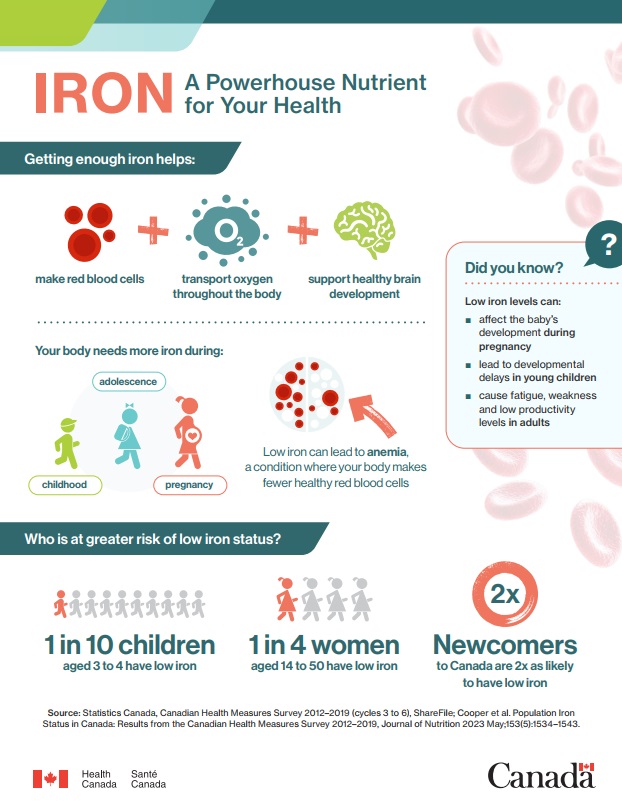
Getting enough iron helps:
- Make red blood cells
- Transport oxygen throughout the body
- Support healthy brain development
Your body needs more iron during:
- Childhood
- Adolescence
- Pregnancy
Low iron can lead to anemia, a condition where your body makes fewer healthy red blood cells.
Did you know?
Low iron levels can:
- Affect the baby's development during pregnancy
- Lead to developmental delays in young children
- Cause fatigue, weakness and low productivity levels in adults
Who is at greater risk of low iron status?
- 1 in 10 children aged 3 to 4 have low iron
- 1 in 4 women aged 14 to 50 have low iron
- Newcomers are twice as likely to have low iron
Source: Statistics Canada, Canadian Health Measures Survey 2012–2019 (cycles 3 to 6), ShareFile; Cooper et al. Population Iron Status in Canada: Results from the Canadian Health Measures Survey 2012–2019, Journal of Nutrition 2023 May; 153(5):1534–1543.
Where can you get iron?
- Lean red meat, including wild game
- Eggs (yolk)
- Beans, peas, and lentils
- Dark green vegetables
- Nuts and seeds
- Fish and shellfish
- Enriched pasta/bread or whole grains
During pregnancy you should take a daily multivitamin containing iron.
Text description
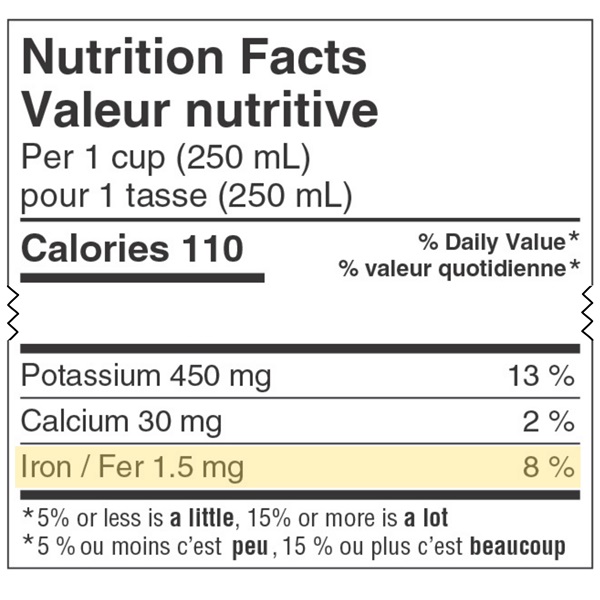
Truncated nutrition facts table in English and French for a food product. The serving size is 1 cup (250 mL). Contains 110 calories, 450 mg (13% daily value (DV)) of potassium, 30 mg (2% DV) of calcium, and 1.5 mg (8% DV) of iron. The iron information is highlighted in yellow. There is a %DV footnote at the bottom indicating: "5% or less is a little, 15% or more is a lot" / "5 % ou moins c'est peu, 15 % ou plus c'est beaucoup".
Quick tips to improve iron absorption:
- Include a source of vitamin C, like vegetables and fruits. Iron from plant-based foods is harder to absorb than iron from animal sources such as meat, poultry, fish or shellfish.
- Wait 1 to 2 hours after a meal to drink tea or coffee or take calcium supplements such as antacids. Tea, coffee, and large amounts of calcium reduce iron absorption.
Acknowledgement: This data was made possible by a collaboration between Health Canada and Statistics Canada.
For more information, visit: Learn about iron.
Talk to our doctor if you are concerned about your iron status.