
About radiological and nuclear emergencies
A nuclear or radiological emergency is an event that has led, or could lead, to a radiological threat to public health and safety, property, or the environment.
On this page:
- How Canadians could be affected
- International Nuclear Event Scale
- Classifying a nuclear emergency
- More information
How Canadians could be affected
Nuclear or radiological emergencies that could affect Canadians include:
- an emergency at a nuclear facility, such as a nuclear power station, in Canada, in the United States, or abroad;
- an emergency involving a nuclear-powered vessel in a Canadian port;
- a transportation accident involving the shipment of radioactive material;
- an emergency involving the loss, theft, or discovery of radioactive material;
- a terrorist attack utilizing radioactive materials, such as a "dirty bomb"; or
- other events involving the uncontrolled release of radioactivity or radioactive material, such as the 1978 crash in the Northwest Territories of COSMOS 954, a Soviet nuclear-powered satellite.
Canada prepares for nuclear or radiological emergencies to protect the public from immediate or delayed health effects due to exposure to uncontrolled sources of ionizing radiation, and to mitigate the impacts of the emergency on property and the environment. In Canada, every level of government has responsibility in the event of a nuclear or radiological emergency. Response begins at the local or municipal level, and progresses to the provincial and federal levels, depending upon the location, type, and size of the emergency. As a signatory country on two international emergency conventions under the International Atomic Energy Agency (IAEA), Canada also has a responsibility to notify other countries if it has had a nuclear emergency, and to assist other countries with their own emergency response to a nuclear emergency if requested to do so.
International Nuclear Event Scale
The International Nuclear Event Scale (INES) was developed by the International Atomic Energy Agency (IAEA) and the Nuclear Energy Agency (NEA) of the Organisation for Economic Co-Operation and Development (OECD) in order to communicate the magnitude and safety significance of nuclear emergencies between countries around the world, including Canada.
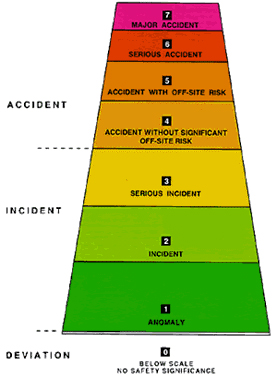
According to the INES system, a nuclear emergency is classified on the scale at one of seven levels. In general, the higher the classification level, the greater and more widespread is the safety significance. The categories are grouped as follows:
- Level 0/below scale: emergencies with no safety significance (which means that the emergency has no actual, or potential for degradation of safety systems of the facility);
- Levels 1 to 3: emergencies of significance for workers at the emergency site but not for the public; and
- Levels 4 to 7: emergencies with significance for workers and the public.
Graphic of the International Nuclear Event Scale:
Text description
Figure shows the International Nuclear Event Scale where nuclear emergencies are classified on a scale of 1 to 7. At the bottom of the scale is level 0 where there is no safety significance, this is categorized as a deviation. Continuing up the scale, level 1 is considered an anomaly, level 2 is an incident, level 3 a serious incident. Levels 1 to 3 are grouped into the incident category. Level 4 is an accident without significant off-site risk, level 5 is an accident with off-site risk, level 6 is a serious accident, and level 7 is a major accident. Level 4 to 7 are grouped into the accident category.
Both the 2011 Fukushima Daiichi nuclear disaster and the 1986 accident at the Chernobyl nuclear power plant are classified as level 7 on the INES scale. The 1979 accident at Three Mile Island is classified as level 5.
Classifying a nuclear emergency
The Canadian Nuclear Safety Commission, in consultation with the company affected, sets the INES level for emergencies in Canada. The level will not be available immediately when the emergency occurs because it takes time to collect and review all of the necessary information. It is also possible that with further information, the emergency level may change. For example, while an emergency might initially be classified as low on the INES scale, subsequent complications may result in an INES classification to a higher level.
Emergencies are not classified on the INES scale if they are not of nuclear or radiological significance. For example, a fire at a nuclear power station is not classified if it does not involve radiological material. The INES classification should not be confused with emergency classification systems used at nuclear facilities to tell staff and local authorities what to do in response to an emergency.