Improving our monitoring of pesticide residues with innovative technologies
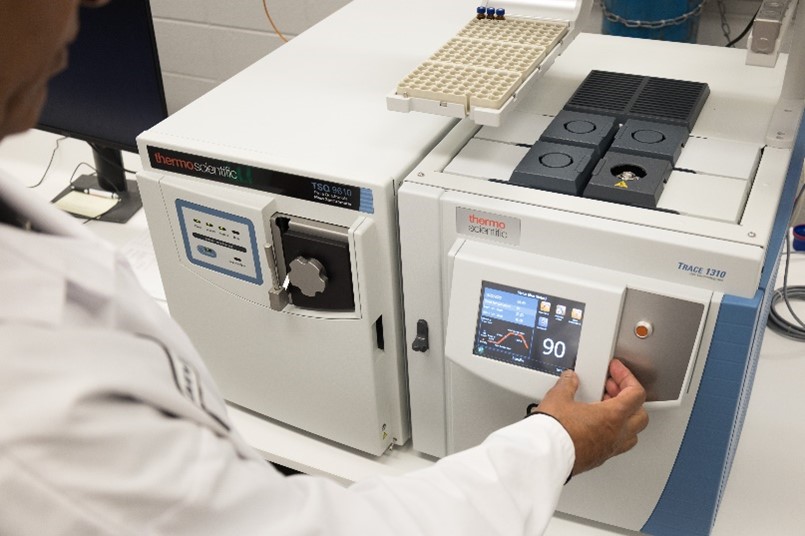
Daniel using the gas chromatography triple mass spectrometry equipment
Suresh Patel, a chemist with our Trace Organics and Trace Elements program, has been working on implementing a technology that will help improve the sensitivity and selectivity of our pesticide residue analysis.
Gas chromatography triple quadrupole mass spectrometry is a new way for our Grain Research Laboratory to monitor for multiple pesticide residues at the same time. While the technique isn’t new to the scientific community, its sensitivity and efficiency have improved over time. It’s important to use instruments with increased sensitivity for monitoring pesticide residues, as some regulatory bodies and countries lower their maximum residue levels (MRLs) for pesticides when supported by new research.
This improved technology will also increase our throughput and efficiency as it helps optimize the instrument for multiple analytes at the same time.
Our Grain Research Laboratory also employs a different type of triple quadrupole mass spectrometry technology integrated with liquid chromatography (LC-MS/MS). The combination of gas chromatography with triple quadrupole mass spectrometry (GC-MS/MS), was not available to our team until now.
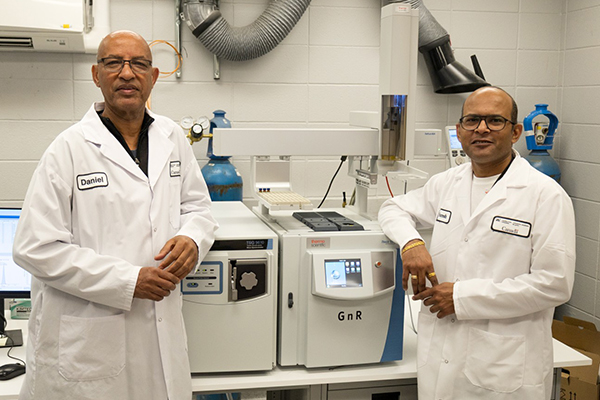
Daniel Bockru, Laboratory Technician, and Suresh Patel, Chemist
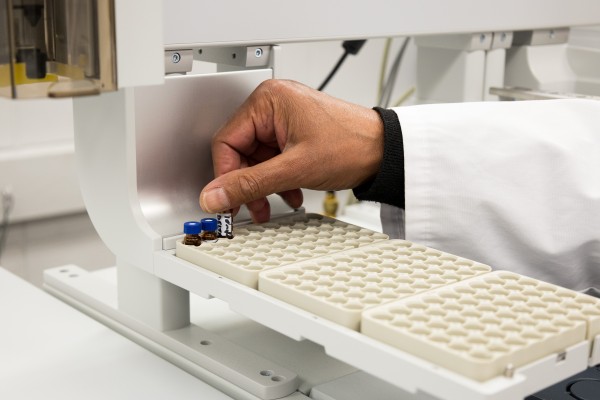
Samples used in the gas chromatography with triple quadrupole mass spectrometry equipment
The nature and chemical properties of pesticides determine which of these methods is suitable to analyze pesticide levels. We monitor over 150 different pesticides in grain. These 150 chemicals have different structures and different properties, so we need different tools to be able to measure them all. LC-MS/MS works best for some chemicals, while GC-MS/MS works better for others. Having both options gives our team greater analytical capabilities.
Using new technologies, like the improved triple quadrupole mass spectrometry, is part of the Canadian Grain Commission’s Science Strategy for ensuring that science and research continue to underpin Canada’s grain quality assurance system. These advancements help us support domestic and international market access by ensuring the safety and quality of Canadian grain.
Quote:
“This new technology allows our team to monitor pesticide levels in grains to assess trends and ensure the continued safety of Canadian grain. This will enhance the capacity of the Grain Research Laboratory to monitor pesticide residues at even lower levels than we could before and ensure alignment with both the current and future changes in MRLs.”