
Dermestids
Classification
Grain feeders and scavengers; khapra beetle is a primary pest, remainder are secondary pests
Order: Coleoptera
Family: Dermestidae
Acronym: Various, depending on species
Description
- Larvae are distinctive in appearance. They are generally elongate and distinctively covered with a mixture of long and short setae (hairs).
Images


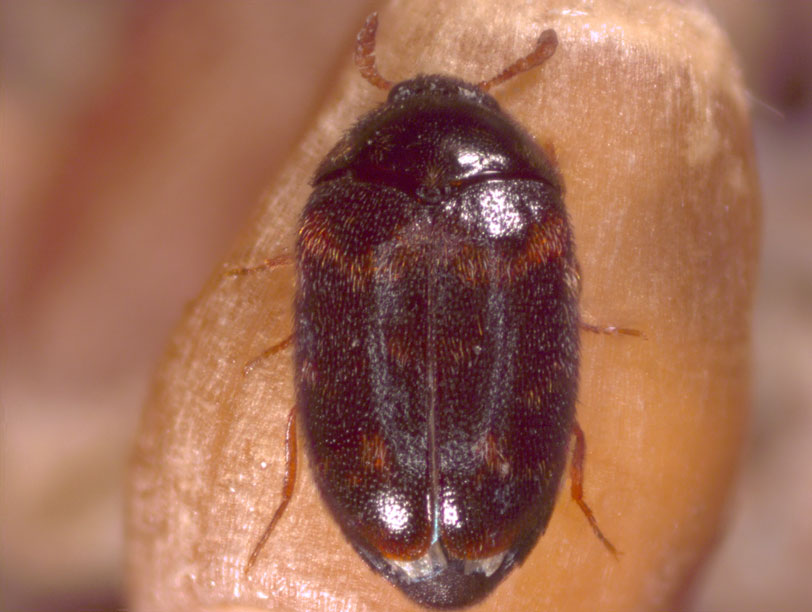

Common names
- Dermestid beetles, dermestids, black carpet beetles, hide beetles, larder beetles, glabrous cabinet beetle, ornate carpet beetle, warehouse beetles, European larger cabinet beetle, Khapra beetle
Scientific names
- Various. Including but not limited to: Attagenus unicolor, Dermestes lardarius, Trogoderma glabrum, Trogoderma granarium, Trogoderma inclusum, Trogoderma variabile, Trogoderma ornatum, Trogoderma versicolor
Similar species
- Many dermestids are confused for one another.
Commodities affected
- Scavenging species feed on a tremendous variety of material.
Signs of infestation
- Cast larval skins are the most common sign of infestation.
Damage
- Dermestids are generalist feeders and damage is not distinctive.
How to control
Geographic range
- Various according to species
Where found
- Are found in museums, elevators, warehouses, mills, food processing plants
- Trogoderma species are the most important species in storage situations
- Are also pests of households and structures (Dermestes spp., Attagenus spp.)
Life history
- Dermestidae is a very large family containing over 1000 described species.
- Other than Trogoderma, most species are mainly scavengers.
- Larvae are most commonly encountered in storage situations.
- Females generally lay eggs in cracks and crevices in the infested material.
- Shed larval skins are often found in infested material and may be mistaken for live larvae.
- Most species of Dermestidae breed better under conditions of moderate to high humidity, but khapra beetle is the opposite. It thrives in hot, dry grain.
Not what you're looking for?
Start over again from the Insect identification key page.