
Laboratories and research support: nanomaterials research laboratory
| Article Title |
|---|
Nanomaterials Research Laboratory |
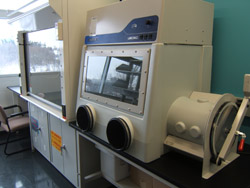
Nanotechnology research is a rapidly emerging field with diverse applications, and while some nanomaterials may be benign, others may pose unknown risks to Canadians and their environment.
The unique nature of nanomaterials requires the development of new scientific risk assessment techniques and standards to assess and manage potential impacts nanomaterials may have on the environment.
The Nanomaterials Research Laboratory, located at the National Wildlife Research Centre in Ottawa, Ontario, aims to support Environment Canada’s capacity to conduct risk assessments or appropriately manage risks, though the provision of chemical and toxicological characterization of data for substances where this information is lacking from a soil exposure perspective.
Current research and methodology
Initial research encompasses soil effects and bioaccumulation testing using priority reference nanomaterials like nano-silver and titanium dioxide. This work focuses on different approaches for test sample preparation and exposure to test organisms, while using accredited soil test methods.
Collaboration
The Nanomaterials Research Laboratory works collaboratively with the Soil Toxicology Laboratory. Collaborative efforts within Environment Canada, as well as future collaboration with academic institutions, will ensure the use of appropriate and standardized test methods, and build on the success of the Biological Test Method publication series.

Through collaboration, expertise within the different facets of nanotechnology will help provide insight into the characterization, fate and effects of nanomaterials within the terrestrial environment, and provide scientifically sound information for decision-making.
Experts in laboratory
- Juliska Princz
- Jessica Velicogna
Further reading
- Proposed Regulatory Framework For Nanomaterials Under TheCanadian Environmental Protection Act, 1999, Environment Canada and Health Canada
- Nanomaterials, Environment Canada
- Canadian Association for Laboratory Accreditation (CALA)