
Ice shelves overview
An Ice Shelf is a floating ice sheet of considerable thickness (20 m and more) showing 2 m or more above sea level, attached to the coast. They usually have great horizontal extent (many square km) and a level or undulating surface.
Canadian Ice Shelves
All of Canada's ice shelves are within the bays and fjords along the northern coast of Ellesmere Island in Nunavut.
During the early part of the 20th century, a large continuous ice shelf extended along 450 km of the northern Ellesmere Island coastline with an area of 8597 km2 in 1906 (Vincent et al., 2001).
By 1959, the Ellesmere Ice Shelf had broken apart, leaving behind 15 individual ice shelves with a total area of 2168 km2 (Mueller et al., 2017). This area later decreased down to 1037 km2 by 2003, leaving behind nine ice shelves. By 2015, the total ice shelf area halved again, bringing the total area down to 535 km2 and punctuated by the following changes:
- the Ward Hunt Ice Shelf (45% of the ice shelf area was lost during major calving events in 2008 and 2010; 20 km2 of the central portion disintegrated in 2011 and 2012 splitting the ice shelf into two separate pieces),
- the Ex-Markham Ice Shelf (collapsed August 2008),
- the Ex-Ayles Ice Shelf (entire ice shelf calved to form a 66 km2 ice island on August 13, 2005),
- the Petersen Ice Shelf (has lost over 60% of its area between 2003 and 2015),
- and the Serson Ice Shelf (80% of the shelf calved off in summer 2008 and decreased by an additional 27 km2 between 2011 and 2012).
No further major calving events were recorded until late July 2020, when the Milne Ice Shelf calved away 43% of its total area, releasing several ice islands including two large ice islands measuring 55 km2 and 24 km2.
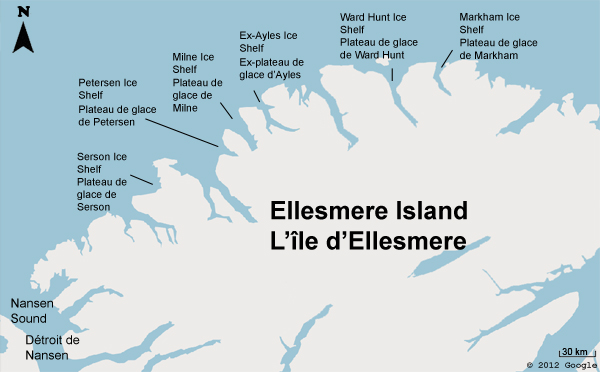
Ellesmere Island's ice shelves: Serson, Petersen, Milne, Ayles, Ward Hunt, and Markham.
How Ice Shelves Develop
Arctic ice shelves form through the seaward extension of one or more glaciers and/or through the formation of multiyear landfast sea ice. The floating ice mass thickens further through snow accumulating on the surface and by accretion at the base of the ice shelf. An ice island forms when the margin of the ice shelf detaches and becomes free floating in a process called calving.