
Sea ice dynamics
There are two primary forces that affect the motion of pack ice:
- wind stress (at the top surface of the ice), and
- water stress (at the bottom of the ice).
Wind Stress
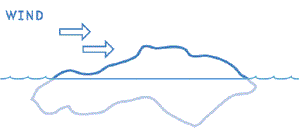
The wind exerts a force on the surface of the ice pack, causing it to move. Furthermore, ridges and hummocks in the pack present a sail area to the wind. This means that ice having an uneven ("rough") surface will move faster than smooth ice. In the absence of other forces, open pack ice will typically move at a speed equivalent to 2% of the wind speed.
Water Stress
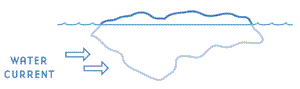
If the pack ice is being blown across otherwise still water, the water will exert a drag on the bottom surface of the ice tending to slow it down. The rougher the bottom surface, the greater will be the drag. Similarly, if the water is in motion because of a current, it will drag the ice along with it.
There are three main types of current:
- permanent currents, such as the Labrador Current
- periodic currents, such as tides
- temporary currents, which are wind induced
It is essential to consider the presence of sea currents when estimating the ice drift. For example, if a given region has a permanent current of 0.5 knots, you would then expect a wind of at least 25 knots to move the ice against the current (assuming the ice will move at 2% of the wind speed).
As a general rule, the speed of sea currents gradually decreases with depth. Therefore the greater the depth of the ice, the slower its movement. This explains why icebergs generally move slower than the surrounding ice pack.