
Sea ice distribution factors
Where and when ice occurs in Canadian waters, that is, its distribution, is influenced by many parameters. Here are some of these:
Meteorological
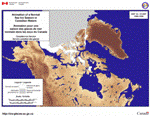
Animation of a normal ice season in Canada
Temperature
This is the most important factor determining the amount and extent of ice formation and the subsequently deterioration of ice. The amount and extent of ice formed or melted in a given region is directly related to the number of days where mean temperatures are below or above freezing.
Wind
Rapid changes in ice conditions are generally wind produced. Remember also that smaller ice floes move faster than larger ones under the same wind conditions. The greater the ice concentration, the slower will be the wind-induced ice drift for equal wind speeds.
Oceanographic
Currents
The movement of ice, which is submerged for the most part (from 80 to 90% of its mass) in water, is greatly influenced by water currents. Tidal currents and coastal run-off currents also affect ice motion. The presence or absence of ice in some areas is directly related to currents.
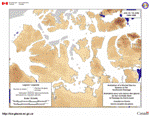
Animation of a normal ice season in the Northwest Passage.
Bathymetry
The presence of any land mass will restrict freedom of the ice to move; for instance, among the Arctic Islands ice motion is hampered. The bathymetry can affect currents and, in unique conditions, cause upwelling, which also affects ice formation. Ice normally forms and decays in shallow water first where it also tends to become grounded.
Salinity
The amount of salts dissolved in a body of water has considerable influence on the formation and melting of ice. All other conditions being equal, ice forms first in water having the lowest salinity. Temperature of maximum density varies with salinity. Therefore there is a difference in vertical mixing of water masses of salinity less than 24.7 parts per thousand as compared to salinity greater than 24.7 parts per thousand.