
Canadian Environmental Protection Act annual report 2015 to 2016: chapter 1
1 Introduction
This annual report provides an overview of the activities conducted and results achieved under the Canadian Environmental Protection Act, 1999 (CEPA) from April 1, 2015, to March 31, 2016. This report responds to the statutory requirement in Section 342 of the Act to provide annual reports to Parliament on the administration and enforcement of the Act.
CEPA provides authority for the Government of Canada to take action on a wide range of environmental and health risks--from chemicals to pollution to wastes. For the most part, it functions as an enabling statute, providing a suite of instruments and measures for identifying, assessing and addressing the risks. The Minister of the Environment and the Minister of Health jointly administer the task of assessing and managing the risks associated with toxic substances.
The general steps followed to address each risk can typically be organized into a management cycle: information is collected to understand risks and inform decisions; risks are assessed to determine if action is required; risk management instruments are put in place to reduce or eliminate risks to the environment and/or human health; these instruments may require compliance promotion and enforcement; and information is once again collected to monitor progress and determine if additional action is required. At each stage in the cycle, stakeholders are engaged, the public has the opportunity to be involved, the government works closely with provincial, territorial and Aboriginal counterparts, and information is reported to the public.
Figure 1: The CEPA management cycle
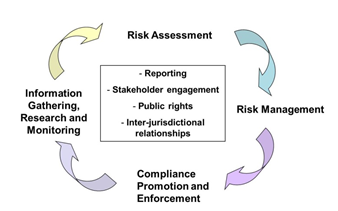
This report provides information on all stages of the CEPA cycle. Section 2 - Addressing Key Risks covers information gathering, research and monitoring, risk assessment, and risk management for toxics, air pollution and greenhouse gases, water quality, and waste. Section 3 - Administration, Public Participation, and Reporting covers reporting, stakeholder engagement, public rights and inter-jurisdictional relationships. Section 4 - Compliance Promotion and Enforcement describes compliance promotion and enforcement activities.
The CEPA Environmental Registry is also a comprehensive source of information about activities taking place under the Act, including proposed and existing policies, guidelines, codes of practice, government notices and orders, agreements, permits, and regulations.