
Intersectionality overview
This intersectionality overview provides a visual representation of intersectionality, which is a framework that helps describe how people and communities are impacted by various social identity factors as they interact with each other, and:
- with society (in the context of group membership)
- with organizations (in the context of institutional power, such as policies and practices)
- with systems of power (including prejudice and discrimination)
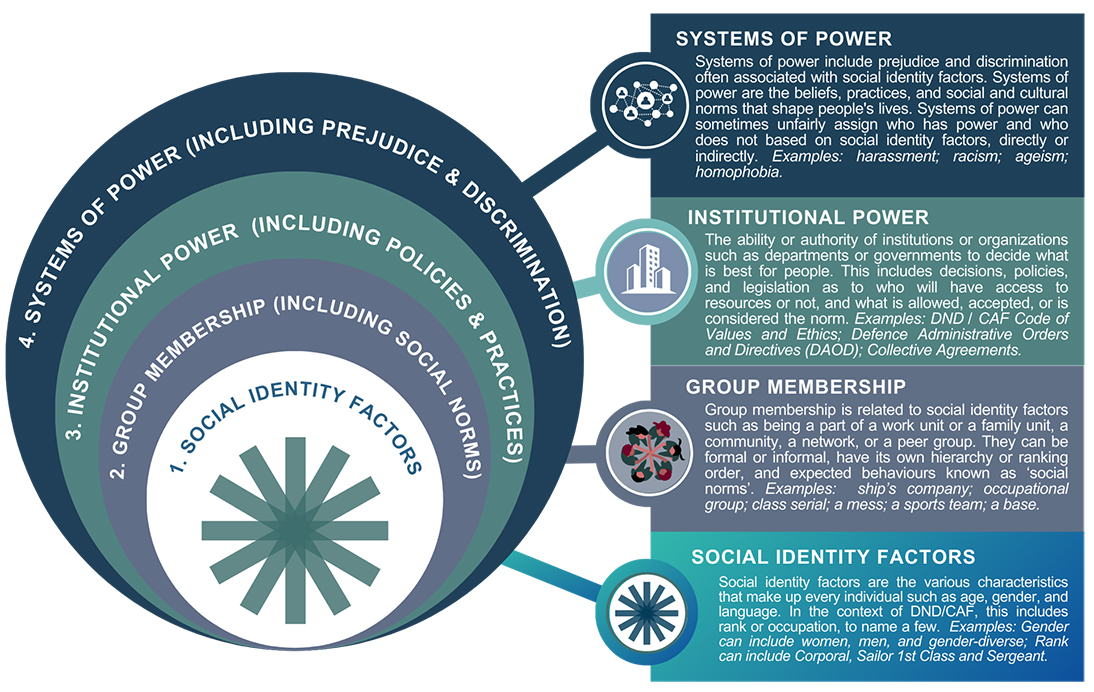
Image description
Eccentric circles showing social identity factors overlapping with:
- group membership, including social norms
- institutional power, including policies and practices
- systems of power, including prejudice and discrimination
Social identity factors are the various characteristics that make up every individual, such as age, gender and language. In the context of the Department of National Defence (DND) and the Canadian Armed Forces (CAF), this includes rank or occupation, to name a few.
Examples:
- Gender can include women, men and gender-diverse
- Rank can include Corporal, Sailor 1st Class and Sergeant
Group membership is related to social identity factors, such as being a part of a work unit or a family unit, a community, a network, or a peer group. They can be formal or informal, have its own hierarchy or ranking order, and expected behaviours known as ‘social norms’.
Examples:
- Ship’s company
- Occupational group
- Class serial
- A mess
- Sports team
- A base
Institutional power is the ability or authority of institutions or organizations such as departments or governments to decide what is best for people. This includes decisions, policies, and legislation as to who will have access to resources or not, and what is allowed, accepted, or is considered the norm.
Examples:
- DND/CAF Code of Values and Ethics
- Defence Administrative Orders and Directives
- Collective Agreement
Systems of power include prejudice and discrimination often associated with social identity factors. Systems of power are the beliefs, practices, and social and cultural norms that shape people's lives. Systems of power can sometimes unfairly assign who has power and who does not based on social identity factors, directly or indirectly.
Examples:
- Harassment
- Racism
- Ageism
- Homophobia