
Expectation and Reality in the Naval Reserve
July 8, 2026 - Royal Canadian Navy
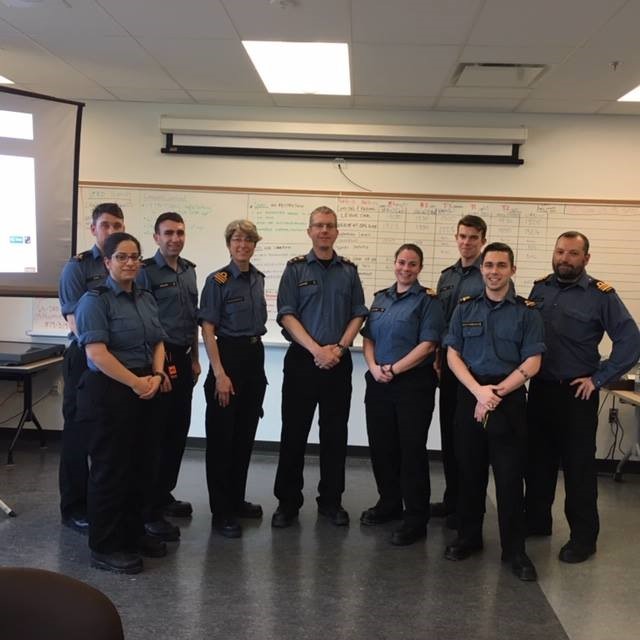
Caption
Sailors from HMCS Carleton stand inside the unit’s operations room. Lt(N) Park is pictured third from the right.
When people think about the Naval Reserve, they often assume it functions much like the Regular Force, with sailors ready to step into operational roles at a moment’s notice. For Lieutenant (Navy) Ross Park, those assumptions are understandable, but they do not always reflect how Reserve service works in practice.
Lt(N) Park joined the Royal Canadian Navy (RCN) in 2016 as a Naval Warfare Officer with HMCS Carleton in Ottawa. Since then, he’s built a career in the Navy alongside full-time work in the federal public service, most recently with the Canadian Coast Guard’s National Command Centre. That dual experience has shaped how he sees the Naval Reserve, not as a mirror of the Regular Force, but as a distinct model built around flexibility, commitment, and competing priorities.
Lt(N) Park highlights one of the most common misconceptions relates to how quickly Reservists reach operational readiness.
“Reservists and Regular Force personnel receive the exact same training, but after that point, skill levels can diverge quite significantly,” he explains.
For many Class A Reservists, trade development happens on evenings, weekends, and during limited training periods, rather than as a full-time professional focus. That structure produces sailors who are trained and adaptable, but whose experience may not always align with those working in their trade every day. As a result, additional mentorship or workups are often required before reaching full operational readiness.
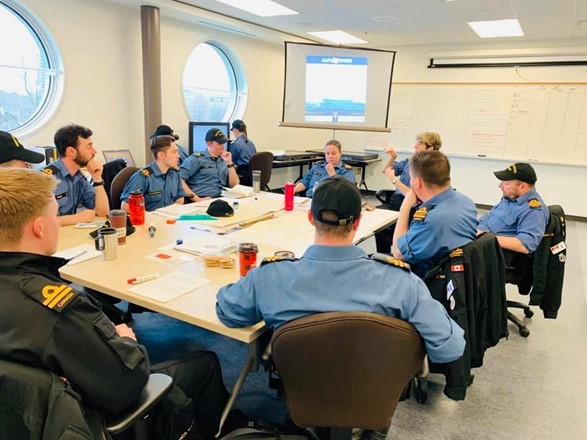
Caption
Sailors from HMCS Carleton meet in the unit’s operations room during flood‑response planning and coordination activities.
The structure of the Reserve reflects this reality. It is designed to allow Canadians to serve alongside civilian careers, not replace them.
“The institution is fundamentally staffed by a coalition of the willing” he says.
However, that balance is not always straightforward. While there are mechanisms in place to support Reservists, he adds that civilian employers do not automatically accommodate Reserve commitments. In practice, participation often depends on communication, flexibility, and personal trade-offs.
Balancing those competing demands can be one of the most challenging aspects of service. Evening training, weekend exercises, and leadership responsibilities often come on top of full-time work, leaving little downtime between commitments.
“It’s an extremely demanding schedule to maintain year in, year out,” he explains.
Despite those pressures, Reservists consistently deliver results. Public-facing activities, such as ceremonies and community events, are executed to a high standard, often without the effort behind them being visible.
The Naval Reserve’s contribution is often most visible in domestic contexts, where flexibility and responsiveness are critical. At HMCS Carleton, Lt(N) Park saw this firsthand during Operation LENTUS, when Reservists supported flood response efforts along the Ottawa River.
“We provided an operations centre, multiple small boats, and capable personnel seven days a week,” he says. “That really showcased the dedication and resiliency of our ship.”
Experiences like this highlight where the Reserve model is particularly effective. It provides the Navy with trained personnel who can be mobilized for domestic operations, while also maintaining a connection to communities across the country. It also offers Canadians an opportunity to serve who might not otherwise be able to commit to full-time military careers.
For Lt(N) Park, the Naval Reserve works best when it is understood on its own terms. It is not intended to replicate the Regular Force, but to complement it by providing a flexible, capable, and motivated force.
“Don’t expect Reservists to step in fully versed in everything, but do expect motivated, professional individuals who want to be there,” he says.
That understanding matters. When expectations align with reality, the strengths of the Naval Reserve become clearer, from supporting operations and strengthening recruitment, to building a broader awareness of the RCN across Canada.