
“The bravest thing I ever did was join the Navy”: Agnes Richardson’s service as a Wren
April 24, 2026 - Royal Canadian Navy
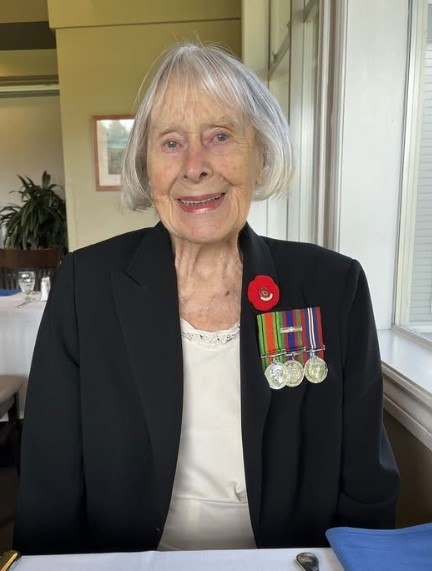
Caption
Agnes Stewart Richardson, a Second World War veteran and former member of the Women’s Royal Canadian Naval Service, poses for a portrait wearing her service medals.
On March 4, 2026, the Royal Canadian Navy mourned the loss of an incredible sailor. Agnes Richardson was one of the final surviving members of the Women’s Royal Canadian Naval Service (WRCNS) from the Second World War.
Born on April 16, 1923, in Vancouver and raised in Oak Bay, B.C., Agnes Stewart Richardson grew up in a close-knit family alongside her sister Audrie. She later attended Victoria College and worked at the Canadian Imperial Bank of Commerce, where she gained experience in accounting and financial administration. In 1943, she enlisted in the RCN alongside her sister, joining the WRCNS, commonly known as the Wrens. At the time, German U-boats were inflicting heavy losses on Allied shipping in the North Atlantic, placing sustained pressure on the Royal Canadian Navy’s ability to generate and support forces. The WRCNS, established in 1942, helped address these demands, enabling women to take on essential shore-based roles that supported operations and allowed more sailors to serve at sea.
Her service included postings to His Majesty’s Canadian Ship (HMCS) York in Toronto and later to HMCS Avalon in St. John’s, N.L., a critical operational hub during the Battle of the Atlantic. She spent more than a year in St. John’s during a key period of the war. At the time, the city served as a central staging point for Allied convoys crossing the North Atlantic, with ships regularly departing to escort merchant vessels carrying vital supplies to Europe while facing a persistent threat from German U-boats.
Seeing the submarine up close left a lasting impression. Despite its role in the conflict, Agnes recalled being struck by how small it was, a reminder of the confined and dangerous conditions faced by those who served beneath the surface. The moment also reflected the broader realities of the war at sea, where losses were sustained on both sides and the risks to sailors were constant.
Experiences such as these reinforced the significance of the work being carried out ashore. The administrative and logistical support provided by Wrens ensured that personnel were accounted for, paid and ready to deploy, directly contributing to the Navy’s ability to sustain operations throughout the Battle of the Atlantic.
Reflecting on her service years later, Agnes described her time in the Navy with characteristic humility. “It was just a fabulous experience. I have nothing to say against it.”
It was also during her time at HMCS Avalon that she met fellow naval officer Mac Richardson, whom she later married. Their relationship developed during the war as they served within the same operational environment, shaped by their shared experience in uniform.
Throughout her life, she held firmly to a simple belief. “Love rules the world.”