
Royal Canadian Navy flies its first uncrewed helicopter
September 28, 2026 – Defence Stories
Estimated read time: 1:11

Caption
A Royal Canadian Navy operator remotely controls the CU179 Peregrine drone during its first flight.
As technology advances, naval air capabilities continue to evolve. From seaplanes and shipborne helicopters to autonomous and remotely piloted systems, seamless surveillance across the sea and air is more achievable and more necessary than ever to protect Canadian sovereignty from emerging threats.
On September 1, the Royal Canadian Navy (RCN) conducted the inaugural flight of its first uncrewed aircraft system, the CU179 Peregrine, at the Canadian Forces Maritime Experimental and Test Ranges (CFMETR) near Nanaimo, British Columbia.
Operated by the Advanced Naval Capabilities Unit, the successful launch and recovery of the CU179 Peregrine validate years of planning, collaboration, and testing to deliver the RCN’s maritime drone capability.
Based on the Schiebel S-100 helicopter drone, an internationally proven platform, the CU179 Peregrine is designed to operate from warships. It will initially be integrated aboard Halifax-class frigates before transitioning to River-class destroyers as they enter service, extending surveillance beyond the ship’s horizon.
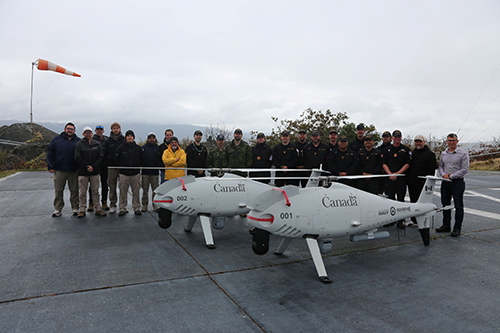
Caption
Recognizing the team effort across Canadian industry and defence partners to develop the CU179 Peregrine.
Equipped with advanced sensors, wide-area surveillance payloads, and long-range radar, the CU179 Peregrine will improve the RCN’s maritime situational awareness and support more informed decision-making. Adding uncrewed aircraft to the fleet will strengthen the RCN’s ability to secure Canada’s waterways and conduct search and rescue missions while reducing risk to personnel.
The flight reflects the collaboration and commitment of sailors, engineers, aviation specialists, and defence scientists across the RCN, defence partners, and Canadian industry. It also advances the operational techniques and airworthiness knowledge needed to conduct uncrewed aviation activities at sea safely and effectively.
With the addition of the CU179 Peregrine, the RCN joins a growing number of Allied navies using uncrewed aviation systems to maintain maritime security and operational effectiveness. The system will also support closer interoperability with Canada’s defence partners.