
Welcome Package for the Senior Associate Deputy Minister of National Defence, Commissioner of the Canadian Coast Guard, and Canada’s Fentanyl Czar - March 2026 - Supplemental
On this page
- Ministerial Direction
- Legislation & Authorities
- Key Messages
- The Defence Team
- Defence Investments, Priorities, and Departmental Reporting
- Meeting Canada’s Defence Spending Commitments – Semi-Annual Report (December 2025) [Redacted]
- Mission 5 Results Report (January 2026)
- DM Priorities, Planning, and Strategy Committee Meeting – Defence Investments (February 2026)
- 4 Corners Meeting – Defence Investments (March 03 & 10 March 2026)
- A proposal for a ███████████████████████████████████████████████
- Discussion Paper on Authorities and Measures to Accelerate Defence Spending (Draft)
- Comprehensive Expenditure Review
- Canada’s Defence Policy
- Introduction to the Department of National Defence’s Civilian Workforce
- Introduction to the Canadian Armed Forces
- Defence Investments, Priorities, and Departmental Reporting
- Canadian Armed Forces Operations
- Major Defence Procurements & Canadian Industry Relations
- Canadian Forces Morale And Welfare Services (CFMWS)
- Communications Security Establishment (CSE)
Ministerial Direction
Ministerial Mandate Letter █████████ (2025)
Dear Colleagues:
Last month, Canadians elected a new Government to stand up for our country and to build a strong economy that works for everyone. As members of the 30th Ministry, we must fulfill this mandate with purpose and force. We must meet a series of unprecedented challenges with both a disciplined focus on core priorities and new approaches to governing.
The Context: A Generational Challenge
Canada faces a series of crises. In a more dangerous and divided world, geopolitical risks are rising, threatening our sovereignty. The global trading system – which has helped power Canada’s prosperity for decades – is undergoing the biggest transformation since the fall of the Berlin Wall. At home, our longstanding weak productivity is straining government finances, making life less affordable for Canadian families, and threatening to undermine the sustainability of vital social programs on which Canadians rely.
The new federal Government has an immense responsibility to address these challenges head on with focus, determination, and fundamentally different approaches to governing.
We must redefine Canada’s international, commercial, and security relationships. In the process, we need to develop a defence industrial policy that secures Canada, fulfills our responsibilities to our allies, and helps build our economy.
Canada must build an enormous amount of new infrastructure at speeds not seen in generations. This includes the infrastructure to diversify our trading relationships; to become an energy superpower in both clean and conventional energies; to restore affordability to housing; and to secure our borders and our communities.
The combination of the scale of this infrastructure build and the transformative nature of artificial intelligence (AI) will create opportunities for millions of Canadians to find new rewarding careers – provided they have timely access to the education and training they need to develop the necessary skills.
Government itself must become much more productive by deploying AI at scale, by focusing on results over spending, and by using scarce tax dollars to catalyse multiples of private investment.
Our Priorities
We will focus on seven priorities:
- Establishing a new economic and security relationship with the United States and strengthening our collaboration with reliable trading partners and allies around the world.
- Building one Canadian economy by removing barriers to interprovincial trade and identifying and expediting nation-building projects that will connect and transform our country.
- Bringing down costs for Canadians and helping them to get ahead.
- Making housing more affordable by unleashing the power of public-private cooperation, catalysing a modern housing industry, and creating new careers in the skilled trades.
- Protecting Canadian sovereignty and keeping Canadians safe by strengthening the Canadian Armed Forces, securing our borders, and reinforcing law enforcement.
- Attracting the best talent in the world to help build our economy, while returning our overall immigration rates to sustainable levels.
- Spending less on government operations so that Canadians can invest more in the people and businesses that will build the strongest economy in the G7.
Working Together
We must deliver for Canadians as a team committed to real Cabinet government. The attainment of these objectives will require collaboration and coordination within Cabinet. I expect each Cabinet committee, led by their Chair, to drive and monitor our progress, with oversight from the Priorities, Planning and Strategy Committee, and direction from the full Cabinet.
While fulfilling your core responsibilities as a member of the Ministry, you should identify how specifically you can contribute to these missions. You will be expected and empowered to lead, and to bring new ideas, clear focus, and decisive action to your work. Over the coming weeks, I will look to each of you to identify the key goals and measures of success on which to evaluate the results you will achieve for Canadians as a member of the Ministry.
We will work together with Parliamentarians and the public service. We will work in true partnership with provinces, territories, and Indigenous Peoples. And we will bring together labour, business, and civil society to build a Canada worthy of our children and grandchildren.
In addressing the tasks before us, we must remain true to Canadian values. Canada is a dynamic country that celebrates our diversity, cares for the most vulnerable among us, and strives for a better future for all. The new federal Government will continue the vital work of advancing reconciliation with Indigenous Peoples. We will fight climate change. We will uphold the rule of law, protect our democratic institutions, and reinforce the unity of our country.
Canada’s challenges are not small, but we can more than meet them with vigour and a constructive approach. That is how Canadians have built the best country in the world. That is how we will build it to be even better.
In partnership,
The Rt. Hon. Mark Carney,
Prime Minister of Canada
Budget Letter (2025)
[Redacted]
Legislation & Authorities
National Defence Act: Legal Framework and Authorities
Summary
An overview of the National Defence Act, including the main duties and authorities of the Minister of National Defence under that Act.
Background
- The National Defence Act (NDA) is structured in seven parts:
- Part I of the NDA establishes the Department of National Defence (DND) and stipulates that the Minister of National Defence (MND) holds office during pleasure and has the management and direction of the Canadian Armed Forces (CAF) and provides authority for a Deputy Minister (DM) and the Judge Advocate General (JAG). It also sets out the regulation making authorities of the Governor in Council (GiC) (for the organization, training, discipline, efficiency, administration and good government of the CAF), and the MND (for the organization, training, discipline, efficiency, administration and good government of the CAF) and the Treasury Board (for matters such as pay, allowances and reimbursement, including forfeitures and deductions). Part I also addresses the sale or disposal of materiel that has not been declared surplus and is not immediately required for the use of the CAF or for any other purpose under the NDA;
- Part II of the NDA names the CAF and provides for the appointment of the Chief of the Defence Staff (CDS). It provides for numerous matters relating to the functioning and governance of the CAF including enrolment, promotion, release, active service, non-public property, pay and allowances, service estates and boards of inquiry. Part II also deals with grievances and establishes the Military Grievances External Review Committee (MGERC), which is mandated to provide findings and recommendations on defined types of grievances to the final authority in the CAF grievance process, the CDS or their delegate;
- Part III of the NDA is the Code of Service Discipline (CSD). The CSD sets out the foundation of the military justice system including disciplinary jurisdiction, declaration of victims’ rights, service offencesFootnote 1, punishments, arrest and pretrial custody, organization and procedures of summary hearings (jurisdiction, sanctions, and review) and courts martial, sentencing appeals, and post-trial review;
- Part IV of the NDA deals with complaints about or by military police. It establishes the right to make complaints about the conduct of military police, and the right of military police to make complaints about improper interference with an investigation. It establishes the Military Police Complaints Commission (MPCC), and it sets out the roles and responsibilities of the Canadian Forces Provost Marshal and the MPCC receiving, reviewing and responding to complaints;
- Part V is entitled, "Miscellaneous Provisions having General Application." It includes the ministerial powers to authorize military manoeuvres in Canada, to authorize the CAF to perform any duty involving public service, and to authorize CAF assistance in federal law enforcement matters;
- Part V.1 of the NDA, which previously pertained to the Communications Security Establishment (CSE), has been repealed and the authorities and the accompanying accountability and transparency measures for the CSE now reside in the Communications Security Establishment Act;
- Part VI of the NDA governs CAF service in aid of the civil power. The CAF, or any part of it, is liable to be called out for service in aid of the civil power by the Attorney General of an affected province if there is a riot or disturbance of the peace that occurs or is likely to occur and is beyond the powers of the civil authorities to suppress, prevent or deal with; and
- Part VII of the NDA prescribes certain offences, relating to the defence of Canada, which are capable of being committed by members of the public as well as by CAF members and which are triable by civil courts.
Considerations
Ministerial Duties
- The NDA provides that the MND:
- Presides over the DND (NDA, section 3);
- Has the management and direction of the CAFFootnote 2 and all matters relating to national defence;
- Is responsible for the construction and maintenance of all defence establishments and works for the defence of Canada; and
- Is responsible for research relating to the defence of Canada and to the development of and improvements in materiel (NDA, section 4).
- In addition, the NDA assigns the MND specific responsibilities that include:
- Tabling in Parliament the annual reports of:
- the JAG on the administration of military justice (NDA, subsection 9.3(3));
- the Chairperson of the MGERC on grievance committee activities (NDA, subsection 29.28(2));
- the CDS in relation to the national sex offender registry (NDA, subsection 227.171(2)); and
- the Chairperson of the MPCC on the Complaints Commission’s activities (NDA, subsection 250.17(2)).
- Causing an independent review of specific provisions of the NDA which includes the military justice system, the military police, the MPCC, and the CAF grievance system, and to table the report before both houses of Parliament (NDA, subsections 273.601(1) and (2));
- Reviewing a MPCC report if the CDS or the DM is the subject of the complaint, and notifying the MPCC of any action taken (NDA, subsection 250.5(2) and section 250.52); and
- Regarding military judges:
- recommending their appointment by GiC (NDA, section 165.21);
- nominating one member of the Military Judges Compensation Committee, which reviews the remuneration of military judges (NDA, paragraph 165.33(1)(b)); and
- commencing an inquiry into the removal of a military judge from office (NDA, subsection, 165.32(1)).
- Tabling in Parliament the annual reports of:
Key Advisors to the Minister of National Defence
- The NDA provides for other key appointments:
- The DM, who leads the department. The DM also has other duties under other statutes – for example, he or she is responsible for the civilian staff, all property, both real and personal, and all funds appropriated to the DND (NDA, section 7);Footnote 3
- The CDS who, subject to the regulations and under the direction of the MND, is charged with the control and administration of the CAF. Unless the GiC otherwise directs, all orders and instructions to the CAF that are required to give effect to the decisions and to carry out the directions of the Government of Canada or the MND shall be issued by or through the CDS (NDA, subsections 18(1) and 18(2));
- Up to three Associate Deputy Ministers, who, under the MND and DM, may exercise such powers, duties and functions as Deputy of the MND and otherwise as the MND specifies (NDA, section 8);
- The Vice Chief of the Defence Staff (VCDS), who is appointed by the CDS, and has the control and administration of the CAF in the event of the absence or incapacity of the CDS (NDA, sections 18.1 and 18.2); and
- The Judge Advocate General, who acts as legal advisor to the Governor General, the MND, DND and the CAF in matters relating to military law and who has the superintendence of the administration of military justice in the CAF (NDA, section 9.1 and subsection 9.2(1)).Footnote 4
Ministerial Authorities
- The NDA grants authorities to the MND in relation to several matters, including:
- Regulations: May make regulations for the organization, training, discipline, efficiency, administration and good government of the CAF, and generally for carrying out the purposes and giving effect to the provisions of the NDA – except for regulations made by or expressly placed within the regulation-making authority of the GiC or Treasury Board or for which the GiC has already made regulations (NDA, subsection 12(2) and section 13);
- CAF and related organizations:
- organizing the elements of the CAF (NDA, section 17);
- authorizing the formation of cadet organizations (NDA, subsection 46(1)); and
- prescribing the manner in which DND and CAF educational institutions are governed and administered (NDA, subsection 47(2)).
- MGERC: Authorizing a Vice-Chairperson of the MGERC Committee to exercise the powers and perform the duties and functions of the Chairperson, in the event of an absence or incapacity of the Chairperson (NDA, subsection 29.17(2));
- Military police complaints: Authorizing a member of the MPCC to exercise the powers and perform the duties and functions of the MPCC Chairperson, in the event of the absence or incapacity of the Chairperson (NDA, subsection 250.11(2));
- Boards of inquiry: Convening a board of inquiry to investigate and report on any matter connected with the government, discipline, administration or functions of the CAF or affecting any CAF member (NDA, subsection 45(1));
- Military justice system roles include:
- appointing the Director of Military Prosecutions and the Director of Defence Counsel Services (NDA, section 165.1 and subsection 249.18(1));
- taking certain actions regarding a person’s petition for a new trial (NDA, section 249); and
- appealing against a decision of the court martial to the Court Martial Appeal Court or against a decision of the Court Martial Appeal Court of Canada to the Supreme Court of Canada (NDA, sections 230.1 and 245(2));
- Operations:Footnote 5
- authorizing military exercises or movements ("manoeuvres") over and on such parts of Canada and during such periods as are specified (NDA, section 257);
- authorizing the CAF to perform any duty involving public service (NDA, subsection 273.6(1));
- on the request of another federal minister, authorizing the CAF to provide assistance in respect of any law enforcement matter (NDA, subsection 273.6(2)); and
- providing directions regarding the CDS’s response to a provincial attorney general’s requisition for CAF assistance to suppress or prevent a riot or disturbance (NDA, section 278);
- CSE: The recent passing of Bill C-59 has removed all sections regarding the CSE from the NDA. The authorities and the accompanying accountability and transparency measures for the CSE now reside in the Communications Security Establishment Act; and,
- Offences triable by civil courts: Authorizing the prosecution of the offence of unlawful usage of the CAF picture or mark in advertising, trade or service after having been requested to cease such unlawful usage (NDA, section 291).
Conclusion
In the legislative sphere, the NDA provides the legal basis for numerous matters relating to the DND and the CAF. It establishes duties and grants authority to the minister and other actors to deal with a variety of matters. Authority is also found in several other statutes. Domestic CAF operations, such as those involving public service support to civil authorities or assistance to law enforcement will generally find their domestic legal authority in the NDA. However, certain types of domestic operations, and nearly all international operations, find their domestic legal authority in an exercise of the Crown Prerogative by the executive, rather than via legislative authority in the NDA.
Annex A: Crown prerogative
Summary
- The Crown Prerogative is a source of executive legal authority vested in the Crown and exercised by the political executive: Cabinet, Cabinet Committee, the Prime Minister, and certain Ministers, including the Minister of National Defence.
- The Crown Prerogative is a long-standing, constitutionally founded and legally recognized source of executive authority – separate and distinct from authorities granted to the Crown by statute. Its scope and content have been shaped by the common law through judicial decisions.
- It is the principal source of domestic legal authority for the international operations of the Canadian Armed Forces, and also provides authority for certain operations in Canada. It is also a source of authority for some activities conducted by other Government of Canada entities, such as the Privy Council Office and Global Affairs Canada.
- Canada’s closest allies, including the United Kingdom, Australia, and the United States, all retain a strong role for the political executive in authorizing the deployment and/or employment of their armed forces and other defence capabilities.
- The exercise of the Crown Prerogative is subject to judicial review and democratic accountability within Canada’s system of responsible government.
███████████████████████████████████████████████████████████████████████████████████████████████████████████████████████████████████████████████████████████████████████
█████████████████████████████████████████████████████████████████████████████████████████████████████████████████████████████████████████████████████████████████████████████████████████████████████████████████████████████████████████████████████████████████████████████████████████████████████████████
Authorities for Canadian Armed Forces operations generally
- All Canadian Armed Forces (CAF) operations and activities must be:
- authorized by law, and,
- conducted in accordance with applicable Canadian and international law.
- The specific laws that apply to a given CAF operation will depend on the nature of that operation, its location, the context in which it is being conducted (e.g. during armed conflict vs. peacetime), and Canada’s role (e.g. as a party to the conflict or supporting others).
- CAF operations in Canada: require a Canadian domestic legal authority, which will be found in one or both of the following sources:
- An exercise of the Crown Prerogative (e.g. Order in Council, Cabinet/Prime Ministerial/Ministerial direction, etc.); and/or,
- Legislation (e.g. National Defence Act (NDA) s.273.6(1) public service or s.273.6(2) assistance to law enforcement).
- International CAF operations: require both a Canadian domestic legal authority (as set out above) as well as a separate authority in international law. International legal authorities may generally be found in one or more of the following sources:
- United Nations (UN) Security Council Resolution(s) authorizing the use of military force;
- An exercise of Canada’s right of individual or collective self-defence consistent with article 51 of the UN Charter; and/or,
- The consent of the foreign state, on whose territory the operation takes place, to the presence and operations of the CAF.
What is the Crown Prerogative?
- The Crown Prerogative consists of, "the powers and privileges accorded by the common law to the Crown."Footnote 6 It is a long-standing and legally valid source of executive authority – separate and distinct from authorities granted to the Crown by statute. The Crown Prerogative has a foundation in Canada’s constitutional framework and its scope and content have been shaped through judicial decisions.
- The Crown Prerogative is exercised by the executive to carry out a range of government functions, from routine daily business to the most fundamental matters of state. Over time, Canadian courts have determined the scope of the Crown Prerogative to include the following matters:
- "Foreign affairs, war and peace, treaty-making, other acts of state in matters of foreign affairs, and defence and the armed forces. Other powers and privileges considered Crown prerogatives include those respecting passports, power of mercy, diplomatic appointments, public inquires, hiring and dismissal of public servants, the administration and disposal of public lands, copyright, armorial bearings, and honours and titles."Footnote 7
- Canada’s system of government, with legal authorities and responsibilities constitutionally shared amongst the legislative, executive, and judicial branches, clearly recognizes that there are a number of powers that remain properly vested in, and exercised by, the Crown for valid and important reasons.
The Crown Prerogative in Matters of Defence
- The most relevant source of prerogative authority for the Department of National Defence (DND) and the CAF is the Crown Prerogative relating to Defence, which provides the legal basis for nearly all Government of Canada (GC) direction for the conduct of international military operations, as well as authority for certain operations in Canada.Footnote 8 As noted above, the executive exercises the Crown Prerogative in matters of "war and peace" and "defence and the armed forces" (which includes the employment and deployment of the CAF), and is therefore empowered to make decisions about where and when to deploy the military. Depending on the nature and location of a proposed CAF operation, the Crown Prerogative for Foreign Affairs may also be implicated.
- In Canada, Parliament has no legal role to play in the exercise of the prerogative regarding deployment decisions. Although governments may occasionally hold a "take note" debate or otherwise engage Parliament on proposed military deployments, there is no requirement to obtain Parliamentary approval, nor has it been established that a constitutional convention exists to consult Parliament on such matters. That being said, it is important to recognize that Parliament has the exclusive authority to pass legislation related to defence (for example, the NDA), establishing the framework and structure of the military, and addressing matters of materiel and supply. This can be a factor when considering accountability for the responsible exercise of the Crown Prerogative, discussed in greater detail below.
Who Can Exercise the Crown Prerogative?
- By law and convention, the Crown Prerogative is exercised by Cabinet (being the operative part of the constitutionally mandated Privy Council), by Cabinet committee, by the Prime Minister (PM) individually (having the authority to determine the consensus of Cabinet), or in certain cases as appropriate, by individual Ministers of the Crown having responsibility for particular matters such as defence and foreign affairs (acting either alone or in combination with each other). Generally, the Crown Prerogative cannot be exercised or delegated below the Ministerial level.
The question of who can exercise the Crown Prerogative to authorize a particular military operation is highly dependent on the context, and is generally a matter of internal policies, practices or understandings within Cabinet itself. ██████████████████████████████████████████████████████████████████████████████████████████████████████████████████████████████████████████████████████████████████████████████████████████████████████████████████████████████████████████████████████████████████████████████████████████████████████████████████████████████████████████████████████████████████████████████████████████████████████████████████████████████████████████████████████████████████████████████████████████████████████
- Crown Prerogative decisions regarding the deployment or employment of the CAF will typically be communicated to MND if made by the PM, shared with MND following Cabinet meetings in which MND participated, or will originate from MND if the prerogative is being exercised at the Minister’s level. In any event, MND will subsequently authorize the Chief of the Defence Staff (CDS)Footnote 9 and the Deputy Minister (DM) to issue the necessary directions to military commanders and departmental officials (respectively) for the implementation of those decisions. Subordinate military commanders will then issue their own direction down the chain of command, all of which is subject to legal and policy review to ensure that the ultimate orders received by CAF members conducting operations are fully compliant with government direction and the law.
███████████████████████████████████████████████████████████████████████████████████████████████████████████████████████████████████████████████████████████████████████████████████████████████████████████████████████████████████████████████████████████████████████████████████████████████████████████████████████ Regardless of whether the military is deployed under executive or legislative authorities, though, all operations must comply with applicable domestic laws, including – among others – those related to criminal and disciplinary matters, use of force, funding of operations, as well as contracting and procurement.
Accountability for Exercise of the Crown Prerogative
- Decisions made in the executive’s exercise of the Crown Prerogative are subject to judicial review.Footnote 10
██████████████████████████████████████████████████████████████████████████████████████████████████████████████████████████████████████████████████████████████████████████████████████████████████████████████████████████████████████████████████████████████████████████████████████████████████████████████████████████████████████████████████████████████████████████████████████████████████████████████████████████████████████████████████████████████████████████████████████████████
- Cabinet ministers, in their roles as elected members of Parliament, are fully subject to democratic accountability with respect to their exercise of the Crown Prerogative. The constitutional conventions defining responsible government (where cabinet ministers are drawn from the body of elected members of Parliament, and remain accountable to that body for their actions) ensure all executive activities are subject to Parliamentary scrutiny. Ministers are subject to questions from opposition members in the House of Commons, the government must maintain the confidence of the House with respect to key government decisions and policies (including the budget), and, ultimately, the government is subject to the will of the Canadian public at election time should government decisions prove controversial or unpopular. As such, Canada’s constitutional system of responsible government ensures that the exercise of the Crown Prerogative is always subject to democratic control.
██████████████████████████████████████████████████████████████████████████████████████████████████████████████████████████████████████████████████████████████████████████████████████████████████████████████████████████████████████████████████████████████████████████████████████████████████████████████████████████████████████████████████████████████████████████████████████████████████████████████████████████████████████████████████████████████████████████████
Relationship Between the Crown Prerogative and Legislation
- As a basic principle, the legislature may pass laws in areas occupied by the Crown Prerogative, subject to the legislature’s constitutional competency to do so.Footnote 11 The specific legal effect of such legislation will depend on the nature of the powers in question, the express intent, scope, and wording of the proposed legislation, and potentially broader constitutional considerations.Footnote 12 Legislation must typically be drafted with the express intent of displacing the Crown Prerogative in order to have that effect, although there may be an argument that the doctrine of "necessary implication" could also operate to displace prerogative powers when the right factors are present.
███████████████████████████████████████████████████████████████████████████████████████████████████████████████████████████████████████████████████████████████████████████████████████████████████████████████████████████████████████████████████████████████████████████████████████████████████████████████
█████████████████████████████████████████████████████████████████████████████████████████████████████████████████████████████████████████████████████████████████████████████████████████████████████████████████████████████████████████████████████████████████████████████████████████████████████████████████████████████████████████████████████████████████████
█████████████████████████████████████████████████████████████████████████████████████████████████████████████████████████████████████████████████████████████████████████████████████████████████████████████████████████████████████████████████████████████████████████████████████████████████████████████████████████████████████████████████████████████████████████████████████████████████████████████████████████████████████████████████████████████████████████████████████████████████████████████████████████████████████████████████████████████████████████████████████████████████████████████████████████
Conclusion
- The executive’s exercise of the Crown Prerogative to authorize important defence activities, including the defence of Canada and North America as well as the international deployment and employment of the CAF, has been consistently recognized and accepted by all branches of Canada’s government. Constitutionally founded and legally recognized, the scope and content of the Crown Prerogative has been shaped by the common law through judicial decisions, and its exercise is subject to judicial review and democratic accountability within Canada’s system of responsible government.
█████████████████████████████████████████████████████████████████████████████████████████████████████████████████████████████████████████████████████████████████████████████████████████████████████████████████████████████████████████████████████████████████████████████████████████
Annex B: Domestic Operations - Authorities Matrix
Category |
Type of Assistance |
Legal Instrument |
Requesting Authority |
Requesting Process |
Approval Authority |
Examples |
|---|---|---|---|---|---|---|
Domestic Emergency (Public Welfare Emergency) - Federal |
Emergencies Act |
Governor in Council |
Public Health Crisis |
|||
Aid of the Civil Power - Provincial |
Call out of the CAF to suppress or prevent a riot or disturbance of the peace |
NDA Part VI |
Provincial Attorney General |
Directly from Provincial Attorney General |
CDS after receiving direction from MND |
Oka Crisis |
Assistance to Federal Law Enforcement Agencies (ALEA) |
ALEA |
NDA 273.6 (2) |
MPS |
MPS to MND |
MND |
OP PODIUM (CAF support to Vancouver Olympic Games security operations) |
Canadian Forces Armed Assistance Directions (OIC) |
MPS |
MPS to MND |
MND |
JTF-2 CT Support to RCMP |
||
NDA 273.6 (2) and OIC 1975 (Penitentiary Assistance Order) |
MPS or Comm of Penitentiaries |
MPS or CSC to CDS (OIC) CSC to MPS to MND (NDA s.273.6(2)) |
MND or CDS (depending on instrument – NDA is preferred as it involves MND) |
CSC Strike / Prison Riot |
||
NDA 273.6 (2) and MOU (DFO/DND) |
DFO |
DFO to MND |
MND |
Fisheries Patrol |
||
NDA 273.6 (2) and MOU Vessel Escort |
Asst/Comm RCMP |
Asst/Comm RCMP to Comd CJOC |
Comd CJOC (refer to MOU for delegated authority) |
Vessel Escort |
||
NDA 273.6 (2) and MOU Chemical, biological, radiological, nuclear and explosive (CBRNE) |
Asst/Comm RCMP |
Asst/Comm RCMP to Comd CJOC |
Comd CJOC (refer to MOU for delegated authority) |
Canadian Joint Incident Response Unit support to RCMP |
||
NDA 273.6 (2) and MOU (CAF/RCMP – CD Ops) |
Asst/Comm RCMP |
Asst/Comm RCMP to Comd CJOC |
Comd CJOC (refer to MOU for delegated authority) |
OP SABOT (CAF support to RCMP against illegal growing of marijuana) |
||
ALEA - Air Security Incident |
NDA 273.6 (2) and OIC |
RCMP |
Per OIC |
Per OIC |
Passenger Disturbance, Criminal Hijacking |
|
Assistance to Provincial Law Enforcement Agencies (ALEA) |
ALEA |
NDA 273.6 (2) |
Minister Responsible for Provincial Policing |
Minister Responsible for Provincial Policing to MPS; MPS to MND |
MND |
|
Public Service |
Humanitarian Assistance / Disaster Response |
NDA 273.6 (1) |
Provincial Minister or Officials responsible for Public Safety (Emergency Management Office at PS) |
Provincial Minister/Officials to MPS or CAF direct, MPS to MND (coordinated by the Government Operations Centre) |
MND |
OP LENTUS (CAF support to natural disasters in Canada, including forest fires, floods and ice storms) Support to Government’s COVID-19 pandemic response (OP LASER) and vaccination effort (OP VECTOR) OP ELEMENT (CAF support to Government’s response to influx of asylum seekers) |
Provision of Service |
General |
B-GS-055-000/AG-001 Provision of Services Policy (via underlying MND direction) |
Civilian Authority |
Directly to OP-level HQ |
OP-level Commanders |
Lower level support to non-defence agencies |
Civilian Authority |
Directly to Unit or Base |
Unit or Base Commanding Officer |
||||
Defence of Canada |
Operation Noble Eagle |
OIC |
NORAD |
Per OIC |
Per OIC |
Table of Acronyms
- ALEA
- Assistance to Law Enforcement Activities
- Asst/Comm RCMP
- Assistant Commissioner of the RCMP
- CJOC
- Canadian Joint Operations Command
- CAF
- Canadian Armed Forces
- Comd
- Commander
- CDS
- Chief of the Defence Staff
- CSC
- Correctional Services Canada
- DFO
- Department of Fisheries and Oceans
- HQ
- Headquarters
- MOU
- Memorandum of Understanding
- MND
- Minister of National Defence
- MPS
- Minister of Public Safety
- NDA
- National Defence Act
- NORAD
- North American Aerospace Defense Command
- OP-level
- Operations Level
- OIC
- Order in Council
- RCMP
- Royal Canadian Mounted Police
Annex C: International Deployments - Authorities Matrix
Category |
Requestor |
International Authority |
Domestic Authority |
Approval Authority |
Examples |
|---|---|---|---|---|---|
Non-Combatant Evacuation |
MINA to MND |
Protection of Nationals Abroad or One or more of:
|
Exercise of Crown Prerogative by the Executive NDA s 273.6(1) |
Cabinet (as reflected in Record of Decision) or PM or MND & MINA or MND |
OP LION (Assistance to then-Department of Foreign Affairs and International Trade (DFAIT) mission to evacuate Canadian entitled persons from Lebanon in 2006) OP AEGIS (Assistance to Government of Canada efforts in Afghanistan in 2021) |
Humanitarian Relief / Disaster Response |
MINA to MND |
One or more of:
|
Exercise of Crown Prerogative by the Executive |
Cabinet (as reflected in Record of Decision) or PM or MND & MINA or MND |
OP RENAISSANCE (Disaster response operations including Philippines 2013, Nepal 2015) OP HESTIA (Humanitarian relief post Haiti earthquake 2010) |
Support for Unilateral or Multilateral Missions |
Foreign Government, International Organization, Government of Canada |
One or more of:
|
Exercise of Crown Prerogative by the Executive |
Cabinet (as reflected in Record of Decision) or PM or MND & MINA or MND |
OP ATHENA (Peace support and combat forces in Afghanistan) OP MOBILE (CAF role in international response to uprising in Libya) OP IMPACT (CAF role in international coalition fighting Daesh in) Iraq and Syria in collective self-defence of Iraq |
UN / NATO Missions |
International Organization |
One or more of:
|
Exercise of Crown Prerogative by the Executive |
Cabinet (as reflected in Record of Decision) or PM or MND & MINA or MND |
OP REASSURANCE (Assurance and deterrence measures to reinforce NATO collective defence) OP CROCODILE (UN Stabilization Mission in the Democratic Republic of Congo) |
Training / Exercise |
DND / CAF, International Organization, Foreign Government or Military Force |
Host Nation Consent |
NDA s 18 (1) or C.P. |
CDS or delegate Possibly require GoC Authorities as noted above if high risk / operational activity involved |
RIMPAC, JOINT EX. Note: Capacity Building / Training Foreign Forces may be operational activity requiring GoC Authorities. |
Outside of Canada Programme (OUTCAN) Postings |
DND / CAF, International Organization, Foreign Government or Military Force |
Host Nation Consent |
NDA s 18 (1) or C.P. |
CDS or delegate Possibly require GoC Authorities as noted above if high risk / operational activity involved |
Secondment to the United Nations Headquarters (UN HQ), exchange positions with allies and national authorities to deploy ("NAD") with them |
Table of Acronyms
- C.P.
- Crown Prerogative
- CAF
- Canadian Armed Forces
- CDS
- Chief of the Defence Staff
- DND
- Department of National Defence
- GoC
- Government of Canada
- MINA
- Minister of Foreign Affairs
- MND
- Minister of National Defence
- NATO
- North Atlantic Treaty Organization
- NDA
- National Defence Act
- OP
- Operation
- PM
- Prime Minister
- UN
- United Nations
- UNSCR
- United Nations Security Council Resolution
Accountabilities of the Minister, the Deputy Minister and the Chief of the Defence Staff
Summary
- An overview of the accountabilities of the Minister of National Defence, as well as two key advisors: the Deputy Minister and the Chief of the Defence Staff.
- Describe how the integrated National Defence Headquarters supports the Deputy Minister and Chief of the Defence Staff in managing the Department of National Defence and the Canadian Armed Forces in carrying out their respective responsibilities and executing the Defence mandate.
Context
- The National Defence Act (NDA) provides for the appointment of the Minister of National Defence (MND), Deputy Minister (DM) and Chief of the Defence Staff (CDS), with the latter two accountable to the MND. The MND, DM and CDS are responsible and accountable, in both legal and practical terms, for the use of the authorities and resources entrusted to them. This is expressed in terms of ministerial control over the Department of National Defence (DND) and the Canadian Armed Forces (CAF), and effective Parliamentary oversight over defence programs and activities of the DND.
Considerations
Minister of National Defence
- The MND has legal responsibility and is accountable to Parliament for the Visiting Forces Act, the Aeronautics Act (in relation to defence), the Canadian Forces Superannuation Act, the Garnishment, Attachment and Pension Diversion Act as it applies to the CAF, and the Pension Benefit Division Act as it applies to the Canadian Forces Superannuation Act.
- Under the NDA, the Minister presides over the DND and has the management and direction of the CAF and of all matters relating to national defence. The Minister is also responsible for the construction and maintenance of all defence establishments and works for the defence of Canada, as well as research relating to the defence of Canada.
The Minister as a Member of Cabinet
- In Canada’s Westminster system of Cabinet government, the Minister is obliged to publicly support all of the policies of the Government, and to ensure that current and proposed defence activities reflect the Government’s overall policy priorities and national objectives. Among the most important responsibilities of the Minister is the development and articulation of Canada’s defence policy. This includes bringing major defence proposals (equipment projects, operations, etc.) to Cabinet for discussion and decision.
Domestic Deployment and Employment of the CAF
- Under the NDA, the Minister may authorize the CAF to perform any duty involving public service, such as support to civilian authorities in response to the 2024 wildfires in Newfoundland and Labrador, Alberta and Manitoba. The Minister may also, on the request of the Minister of Public Safety and Emergency Preparedness or any other minister of the federal Crown, issue directions authorizing the CAF to provide assistance in respect of any law enforcement matter. To do so, the Minister must believe that the assistance is in the national interest, and that the matter cannot be effectively addressed without the assistance of the CAF.
- There are also several Orders in Council made pursuant to Crown Prerogative powers that authorize the CAF’s assistance to the Royal Canadian Mounted Police, Correctional Service Canada or a provincial police force under specified circumstances.
International Deployment and Employment of the Canadian Armed Forces
- All international deployment and employment of the CAF must find authority in both international and domestic law. In the case of all international (and some domestic) deployments, the domestic legal authority will flow from the exercise of the Crown Prerogative in respect of national defence and national security. The manner in which the Governor in Council exercises the Crown Prerogative will depend upon the circumstances. In some cases, a deployment decision will be made by Cabinet, in others by the Prime Minister (PM) or MND alone.
The Deputy Minister and the Chief of the Defence Staff
- The DM and the CDS are the Minister’s principal advisors, providing the day-to-day leadership of DND and CAF respectively. They also ensure that the Minister is fully informed and, in a position to take and direct all action required in fulfilling the defence mandate. That said, their separate and respective authorities give rise to different responsibilities.
- Deputy Minister. The DM is authorized by law to undertake, on the Minister’s behalf, any of their duties, except making regulations or exercising other powers the Minister must exercise personally. In so doing, the DM is subject to the Minister’s direction. However, the DM does not act for the Minister in relation to the CAF.
- Specific authorities and responsibilities for the control and spending of funds and the management of property, both real and personal, are conferred to the DM by the Financial Administration Act. The DM is an "accounting officer" under the Financial Administration Act and is accountable before parliamentary committees to provide explanations on matters for which the DM is responsible. The DM is also responsible for establishing an independent departmental audit committee and for ensuring that an adequate financial oversight regime is in place.
- The DM exercises certain other powers assigned by law, which are delegated or set out in policies and directives by the Public Service Commission and the Treasury Board, relating to human resources and staff relations regarding DND employees, official languages and ethics. The line of departmental authority extends from the DM to every member of the DND and the CAF who exercises financial, human resources, contracting or other authorities on behalf of the DM or the Minister.
- The DM is responsible for the day-to-day management of the department on behalf of the Minister and for formulating advice for the Minister on policy matters. More specifically, within the priorities, objectives and standards established by the Government, the DM must provide advice on the possible impact of initiatives on the public, the department, and the government. In managing the department, the DM is responsible for interdepartmental coordination in policy development and decision-making, public service renewal, and conducting international defence relations and the non-military aspects of engagement with multilateral organizations (e.g., the United Nations, the North Atlantic Treaty Organization and the North American Aerospace Defense Command).
- In accordance with the NDA, the Governor in Council may appoint not more than three Associate DMs of National Defence, each of whom shall have the rank and status of a deputy head of a department and as such shall, under the Minister and the DM, exercise and perform such powers, duties and functions as deputy of the Minister and otherwise as the Minister may specify. To date, Associate DMs have had responsibilities for files related to procurement, information management and technology, defence renewal, search and rescue, and other files as may be assigned by the DM. The Associate DM acts as the DM in their absence or incapacity.
- Chief of the Defence Staff. The CDS serves as the primary military advisor to the PM and is the most senior officer of the CAF. Subject to the regulations and under the direction of the Minister, the CDS is charged with the control and administration of the CAF. Unless the Governor in Council otherwise directs, all orders and instructions to the CAF that are required to give effect to the decisions and carry out the directions of the Government of Canada or the Minister shall be issued by or through the CDS.
- The CDS is also the commander of the CAF, while the Governor General of Canada is the Commander in Chief – which is largely a ceremonial role. In this role, the CDS is responsible for all CAF operations and readiness, as well as the CAF’s ability to fulfill the military commitments and obligations of the Government. The CDS advises the Minister on all these matters. When required, the CDS directly advises the PM and Cabinet on major military developments.
- The CDS has a role in international defence and military-to-military relations. The CDS also has a role in advising other departments on the military implications of decisions within the security and defence sphere, and through enhancing coordination between the military and other government departments within the national security community.
- Under the NDA, the CDS must also respond to a written requisition from a provincial Attorney General for aid of the civil power (assistance to civilian authorities in the event of a riot or a disturbance of the peace that is beyond the powers of the province to address), subject to direction from the Minister.
- In accordance with the NDA, the Vice Chief of the Defence Staff (VCDS) acts as the CDS in their absence or incapacity. On behalf of the DM and CDS, the mandate of the VCDS is, as a Chief of Staff, to coordinate and, when appropriate, direct the activities necessary to ensure departmental defence policy and strategic objectives are achieved. In executing the role of the Chief of Staff of National Defence Headquarters (NDHQ), the VCDS has both a coordinating and a directive role in working with all senior advisors. In addition, the VCDS is also assigned functional authorities, including joint capability-based planning and program management.
Integrated Defence Team
- The integrated NDHQ supports the DM and CDS in the execution of their duties, and senior advisors have accountabilities to the DM and the CDS for the activities they perform.
- Defence Team support to senior leadership takes many forms, including:
- providing well-considered and coordinated advice to the Minister and Cabinet on defence issues, CAF matters, and related Government priorities, policies and programs;
- ensuring that military tasks and defence activities ordered by the Minister and Cabinet are carried out promptly, effectively, and efficiently;
- providing a cost-effective organization for the acquisition and provision of materiel and other resources to the CAF;
- ensuring that government-wide policies, regulations, practices and standards are followed in the management of Defence; and
- providing assistance to the Minister in consulting and informing Parliament and Canadians, and in advancing Canada’s defence relations and other interests around the world.
- The DM may delegate financial, administrative, or civilian human resources authorities to members of the CAF. Nevertheless, this does not mean that the DM may issue orders to military personnel; nor does the issuing of directives by the DM somehow "civilianize" members of the CAF. It means that the DM has the authority to:
- delegate to both civilian and CAF personnel the exercise of certain administrative or other authorities;
- give direction on how those authorities are to be exercised; and,
- hold military and civilian personnel responsible and accountable for the exercise of these delegated authorities.
- Similarly, the support that DND civilian employees provide to the CDS does not put them in the military chain of command. It means that they must respond to the Chief’s requirements for advice and support. Specifically, it means that the CDS may:
- call upon senior civilian advisors and their staff to provide advice on matters within their purview;
- call upon civilians in NDHQ and elsewhere to provide support to those in the military chain of command; and,
- take steps to hold them accountable for the manner in which they have executed these duties.
- Both military and civilian personnel can occupy positions in the integrated structure that operates within NDHQ and elsewhere. Only military personnel, however, can be in the military chain of command.
Key Messages
Key Messages
Middle East
- Canada was not consulted, did not participate, and has no plans to participate in the offensive operations that are being undertaken against Iran.
- The Canadian Armed Forces (CAF) have approximately 200 personnel in the Middle East, deployed on six named operations. Based on events since February 27, 2026, efforts have focused on the force protection of CAF members, including relocating some within the region, staying in their location if force protection is appropriate, and where applicable, redeploying some back to Canada.
- All CAF members currently serving in the region are safe and accounted for.
- In accordance with established contingency planning and force protection procedures, the CAF continuously assesses threats and adjusts its posture, presence, and protective measures as required.
Canadian Armed Forces members stationed outside Canada (OUTCAN)
- Members of the Canadian Armed Forces (CAF) participate in exchanges with foreign militaries via the Military Personnel Exchange Program. If a CAF member is asked to deploy on operations with their host nation, they require a National Authority to Deploy which is based on the recommendation of the Chief of the Defence Staff and requires approval by the Minister of National Defence.
- CAF members cannot be involved in operations with foreign militaries without the approval of the Government of Canada. At this time, no such request for approval has been made as it pertains to Operations EPIC FURY and ROARING LION.
Defence Industrial Strategy
- Security, Sovereignty and Prosperity: Canada’s Defence Industrial Strategy sets a new direction for how Canada will develop and sustain the capabilities needed to protect Canadians and support its allies and partners.
- The Defence Industrial Strategy establishes the rebuilding of Canadian Armed Forces (CAF) capability and the reinforcement of Canada’s defence industrial base as essential pillars of national and economic security.
- It aligns defence investments with industrial capability, so Canada is well positioned to provide the CAF and our allies and partners with timely, secure, and reliable access to the capabilities required to defend, deter, and defeat current and future threats. More importantly, the Defence Industrial Strategy will deliver a modern defence industrial base that provides critical capabilities to the CAF and its allies, while also driving innovation, investment, good paying jobs and economic growth for all Canadians.
North Atlantic Treaty Organization (NATO)
Meeting NATO’s 2% of Gross Domestic Product (GDP) Defence Investment Target in FY 2025–26
- Canada rapidly increased defence investments by over $9 billion in cash this year (FY 2025-26) to bring our defence investment to 2% of our GDP.
- The Government of Canada will protect Canada’s sovereignty by rebuilding, rearming, and reinvesting in the Canadian Armed Forces (CAF). We are investing in operational readiness, new and emerging military capabilities, a strong defence industrial base, and stronger defence partnerships.
- The Government is making foundational investments in the CAF, expanding and enhancing existing and emerging military capabilities, strengthening Canada’s relationship with the defence industry and diversifying our defence partnerships.
- This is a generational investment in defending Canada and Canadians, which is foundational to Canada’s continued prosperity and ability to act as a leader on the global stage.
NATO Defence Investment Pledge (5% of GDP)
- At the NATO Summit in June 2025 Prime Minister Mark Carney announced that Canada and its North Atlantic Treaty Organization (NATO) Allies agreed, to a new Defence Investment Pledge of investing 5% of annual GDP by 2035 for the Alliance’s individual and collective security. The commitment aligns with Canada’s own strategic defence and security goals.
- As part of this 5% pledge, Canada will invest 3.5% of GDP in core military capabilities, expanding on recent investments. That means further investments in our Canadian Armed Forces, modernizing military equipment and technology, building up Canada’s defence industries, and diversifying defence partnerships.
- An additional 1.5% of GDP will be dedicated to investments in critical infrastructure and other defence-related expenditures such as new airports, ports, telecommunication, emergency preparedness systems, and other dual-use priorities that serve defence and civilian readiness. Importantly, the progress of this pledge will be reviewed in 2029 so that Allies’ expenditures align with the global security landscape.
- Budget 2025 further increased Canada’s defence expenditures, putting Canada on a pathway to meet the 5% NATO Defence Investment Pledge by 2035.
NATO Deterrence and Defence
- A credible NATO deterrence and defence posture is essential to safeguard the freedom and security of all its member states, and the Alliance must be ready to adapt and overcome current and future challenges.
- Canada is unwavering in its commitment to NATO. This is why Canada supports and actively participates in the development of deterrence and defence initiatives.
- In this work we must continually seek to avoid unintended escalation.
- Canada’s investment domestically and to North American defence, including by modernizing North American Aerospace Defense Command (NORAD), are key contributions to strengthening NATO’s Western Flank. It will enable us to deploy forces from North America in support of Allies and partners during a crisis or conflict.
NATO Climate Change and Security Centre of Excellence (CCASOE) / Climate Change and Security
- The NATO Climate Change and Security Centre of Excellence (CCASCOE) opened its doors in October 2024 in Montreal.
- It exemplifies Canada’s leadership in NATO’s efforts to address the security impacts of climate change.
- As an Arctic nation, Canada contributes unique perspectives and best practices on climate change and security, including the essential perspectives of Indigenous communities.
- Climate change is a defining challenge for NATO and the global community, with significant implications for Canada’s foreign, defence and security interests, from the practical to the geostrategic.
NATO and Cyber
- At the request of our Latvian Allies, the Canadian Armed Forces (CAF), in collaboration with the Communication Security Establishment, is strengthening Latvia’s cyber defence capabilities by deploying a persistent Cyber Task Force to Riga to conduct bilateral defence cyber operations on Latvian government and non-government critical infrastructure since 2022.
- This close partnership with Latvia enables the CAF to gain significant combined operational experience in the cyber domain, bolster NATO cyber resilience and contribute to NATO strategic deterrence.
Venezuela
- The Government of Canada is closely monitoring the situation in Venezuela and remains in contact with relevant partners.
- Canada takes the safety and security of Canadians abroad very seriously.
- Any questions on this situation should be directed to Global Affairs Canada.
Greenland
- As stressed by Prime Minister Mark Carney, Canada supports the sovereignty and territorial integrity of Denmark, including Greenland, which must be respected in accordance with international law.
- Canada will continue to work with Denmark, Greenland, the United States and other partners to fulfil our shared responsibility for the security and resilience of the Arctic.
- Any questions on this topic should be directed to Global Affairs Canada.
Defence Mobilization
- Initial planning has begun to explore how the Canadian Armed Forces could contribute to greater national resilience, including leveraging increased readiness from an expanded Reserve Force for defence purposes, in times of crisis, or for natural disasters for example. Participation in an expanded Reserve Force would be entirely voluntary.
- The initial planning direction is an internal document that simply formalizes the initiation of planning efforts. Work is underway, building on this initial analysis, to inform future proposals. There has been no policy change, and no plan has been developed at this time.
Procurement
Future Fighter Capability Project (FFCP)
F-35 Review
- The review of the F-35 is still ongoing as Canada continues to consider our Defence Industrial Strategy and work to maximize economic benefits for our businesses and workers.
F-35 acquisition
- Following expenditure approval in 2022, Canada had the required funding to proceed with acquiring an initial tranche of 16 F-35 aircraft via the Production, Sustainment, and Follow-on Development Memorandum of Understanding (PSFD MOU). However, this was not a firm financial commitment to purchase all 16 aircraft, but an administrative reservation. Firm financial commitments have been made for production of the first four aircraft and to guarantee the delivery of long-lead items to support the future production of the first 12 aircraft. A firm financial commitment for the production of the remaining 12 aircraft of the initial tranche of 16 aircraft has yet to be made. These payments are being made in alignment with the PSFD MOU.
Canadian Patrol Submarine Project (CPSP)
- Submarines are the Royal Canadian Navy’s (RCN) most powerful asset for projecting power far from Canada’s shores, offering the flexibility and endurance needed for a wide range of missions. Their unique combination of stealth, persistence, and lethality enables the RCN to detect, track, deter and, if necessary, defeat adversaries in the oceans surrounding Canada.
- The Government of Canada plans to acquire up to 12 conventionally powered, under-ice capable new submarines to replace the Victoria-class fleet. Through the CPSP, the new fleet will strengthen Canada’s security, support trade stability and contribute to economic growth. Modern submarines will expand undersea presence and surveillance across Canada’s oceans; enhance interoperability with Allied naval forces, and broaden defence industry partnerships and supply chains.
- The RCN’s current submarine fleet has an operational service life into the mid-to late 2030s. For a smooth transition between classes without a capability gap, the RCN requires its first new submarine to be delivered no later than 2035.
- On August 26, 2025, the Government of Canada identified German-Norwegian company TKMS and Republic of Korea company Hanwha Ocean Co., Ltd. (Hanwha) as the two qualified suppliers for the CPSP.
- The Government of Canada received proposals from the two qualified suppliers, TKMS and Hanwha Ocean Co., Ltd on March 2, 2026. After evaluating the proposals, the Government of Canada will identify a preferred supplier with whom to conduct contract negotiations.
Northern Operational Support Hubs
- Climate, geopolitical, economic and technological change are making Canada’s Arctic and its approaches more accessible to a wide range of actors, driving greater demand for Arctic and Northern operations, related to sovereignty, emergency response, and search and rescue.
- The Northern Operational Support Hubs will provide scalable capabilities and multi-use infrastructure that supports northern operations while meeting the needs of the territories, Indigenous peoples, and Northern communities where possible.
- These hubs will strengthen the CAF’s responsiveness across the Canadian Arctic and North and enable greater year-round military presence.
- The Defence Team will work closely with our federal colleagues and other partners, rightsholders and stakeholders to support a strategic approach to infrastructure development.
River-class Destroyers (RCD)
- The River-class destroyers are being developed to replace the capabilities of the retired Iroquois-class destroyers (4 ships) and the Halifax-class frigates (12 ships) with a single modern platform, capable of countering a range of threats in in open oceans and along the coasts.
- Constructed with precision engineering and advanced technology, the River Class Destroyers will form the core combat power of the future fleet of the Royal Canadian Navy (RCN). Together with the Joint Support Ships and the Arctic and Offshore Patrol Vessels, they will strengthen the surface capabilities to detect, deter and defend against threats to our national and international security.
- The River Class Destroyers initiative strengthens Canada’s naval capabilities while driving economic growth and job creation. The Implementation contract is estimated to contribute $719.3 million annually to Canada’s GDP and create/sustain 5,250 jobs (directly and indirectly) annually between 2025 and 2039.
- Consumer spending by employees at the shipyard and its suppliers is estimated to contribute an extra $191 million annually toward the GDP and support another 1,545 jobs annually in the Canadian economy during the same 15-year period.
- he River Class Destroyers are being built in batches to help manage construction costs and schedules. The build and delivery of the first batch – three ships along with initial spares, training, maintenance and logistics support products required to support the ships in service, ammunition and associated contractor fees - is estimated at $22.2 billion.
- On April 25, 2025, the River Class Destroyers project formally started Full-Rate Production on the future His Majesty’s Canadian Ship (HMCS) Fraser, which is expected to be delivered in 2032/33. In November 2025, construction of the land-based test facility in Hartlen Point, Nova Scotia, officially began. Construction is expected to be completed in 2028.The goal is to deliver 9 River Class Destroyers by 2040 and, ultimately, all 15 River Class Destroyers by 2050.
Joint Support Ships (JSS)
- The Protecteur class Joint Support Ships will exceed the operational capabilities of the Royal Canadian Navy’s (RCN) former Auxiliary Oiler Replenishment vessels. Designed to replenishing fuel, food, ammunition, spare parts and other supplies, and to carry and maintain up to two maritime helicopters, the JSS will provide limited sealift and combat support, enabling the Naval Task Groups to deploy and operate at sea for extended periods of time.
- In addition to strengthening the RCN’s future operational readiness, the JSS project supports the revitalization of Canada’s shipbuilding industry under the National Shipbuilding Strategy (NSS) by developing the domestic expertise, skills, and technologies needed to design, build and sustain ships in Canada.
- The cost of the JSS project is currently valued at over $6.06 billion (including taxes). This includes the funding for the two new ships, as well as all the equipment, tools, and project oversight required to build and bring the ships into service.
- Over a 15-year period, the project is expected to generate 2,410 jobs annually at the shipyard and among Canadian suppliers and contribute an estimated $265 million per year to Canada’s GDP, supporting sustainable employment, economic growth, and national and global security.
- Delivery of the JSS has experienced incremental delays as the shipyard refines is construction practices. The Government of Canada is reviewing the revised construction and delivery timeline received in September 2025.
- Each ship is expected to be operational within one year of delivery to the RCN, with the first JSS planned to be fully operational by 2028 and the second in 2029, enabling both vessels to be in service as part of the RCN’s fleet in 2029.
Arctic and Offshore Patrol Ships (AOPS)
- Canada acquired six Arctic and Offshore Patrol Vessels (AOPV) for the Royal Canadian Navy (RCN). These new patrol ships will operate in the Arctic annually between June and October, providing a greater Canadian Armed Forces presence in the North.
- The AOPV can break through new and first-year ice and have anti-icing features to protect the ships’ equipment in the Arctic, enabling the RCN to maintain a presence and surveillance of our northern maritime approaches and to navigate, unescorted, previously inaccessible areas of the Arctic.
- The AOPV are contributing to coastal surveillance, search and rescue, drug interdiction, humanitarian assistance, and disaster relief operations, and can integrate with a range of international partners.
- Full operational capability of all six ships is expected by 2026. HMCS Harry DeWolf, the first ship, already circumnavigated North America, including a transit through the Northwest Passage.
Arctic & Polar Over the Horizon Radars (OTHR)
- The Defence Team continues to enable the rapid development and deployment of Canada’s Arctic-Over-the-Horizon Radar (A-OTHR) system, to be based in Southern Ontario, as part of its commitment to North American Aerospace Defense Command (NORAD) modernization.
- A-OTHR will provide early warning radar coverage from the Canada-United States (U.S.) border to the Arctic Circle, strengthening the Canadian Armed Forces and NORAD’s awareness of potential threats.
- Canada intends to work with the Government of Australia to further develop OTHR technology in support of the A-OTHR project and will work closely with the United States for the interoperability of Canadian and U.S. solutions to strengthen domain awareness in North America’s approaches.
A-OTHR in Southern Ontario (statement to media)
- In partnership with Indigenous and local communities, up to four sites will be selected in the Southern Ontario region to house the Arctic OTHR system’s transmitters and receivers.
- The Department of National Defence (DND) purchased two sites in southern Ontario: the Kawartha Lakes site, for a full, permanent transmit site, and the Clearview Township site for a preliminary receive site. Both sites were privately owned land parcels listed on the open market.
- The sites will be parcels of land ranging in size from a minimum of 100 hectares to 1,200 hectares and will be located south of the 46th northern parallel. As a frame of reference, this latitude roughly aligns with the Trans-Canada Highway within the provincial border of Ontario.
- While DND is exploring land acquisition strategies to support A-OTHR needs, DND is not currently working on plans to expropriate land.
Logistics Vehicle Modernization (LVM)
- This new fleet of light and heavy logistics vehicles, trailers, vehicle modules, and armour protection kits will be used to transport larger loads of personnel, equipment, and supplies, as well as interchangeable modules that can be used as mobile command posts or workshops.
- The Logistics Vehicle Modernization project is currently in the implementation phase. Two contracts, with the potential total value of over $2.5 billion for the acquisition and long-term in-service support for up to 25 years for the new vehicles and equipment, were awarded in May 2024 to General Dynamics Land Systems – Canada and Marshall Canada, in a joint venture.
- The contract was amended on December 10, 2025, to increase the total number of logistics vehicles to over 2,200, in addition to related ancillary equipment like armour protection kits and infrastructure. This amendment is valued at $532.8 million.
- Delivery of the new vehicles is expected to begin in fall 2027. Initial operational capability is currently expected in fall 2028, with full operational capability expected in fall 2030. These dates will be confirmed with the contractor as work progresses.
- This project is expected to support 1,900 jobs on an annual basis and generate over $350 million a year in economic activity across Canada. The Logistics Vehicle Modernization vehicles will be integrated and assembled in Ontario, mission modules will be manufactured in the Maritimes, and the trailers will be built in Alberta, British Columbia, and Quebec.
Armoured Combat Support Vehicle (ACSV)
- The Armoured Combat Support Vehicle (ACSV) project is providing an armoured combat support capability to the Canadian Armed Forces (CAF) with a new fleet of 360 armoured support vehicles employed in eight variants: Command Post; Mobile Repair Team; Maintenance and Recovery Vehicle; Ambulance; Electronic Warfare; Engineer; Troop Cargo Vehicle; and Fitter Cargo Vehicle.
- The new fleet of 360 Armoured Combat Support Vehicles are being procured through a $2.1 billion (taxes included) contract with General Dynamics Land Systems – Canada (GDLS-C).
- With the Government of Canada’s donation of 39 ACSVs to Ukraine in early 2023, changes were introduced to the ACSV production schedule. Instead of receiving the Troop/Cargo Variant first, the ambulance variant was the first ACSV delivered to the Canadian Army.
- The ACSV project is in the implementation phase and reached a significant milestone by achieving Initial Operational Capability on January 15, 2025. As of summer 2025, 109 vehicles have been delivered to the CAF; Full Operational Capability is expected by the end of 2028.
- The Industrial and Technological Benefits (ITB) Policy was applied to the contract, requiring General Dynamics to make investments into the Canadian economy equal to the value of the contract by providing opportunities for Canadian small and medium businesses and supporting innovation and skills development for Canadian workers. The total ITB obligation is $1.906 billion.
- 1,650 jobs will be supported annually at GDLS-C and approximately 8,500 across Canada over the 2019-2028 period.
Long Range Precision Strike (Land)
- The Long Range Precision Strike (Land) (LRPS(L)) project will s strengthen Canada’s ability to deter threats and protect critical areas like the Arctic, reinforcing the country’s ability to defend its borders and sovereignty against adversaries in an unpredictable global environment.
- In December 2024, Canada submitted a Letter of Request to the United States (U.S.) Government to request a potential purchase of High Mobility Artillery Rocket System (HIMARS) launchers, preliminary Operational Stock of munitions, spares, training, and support services under the Foreign Military Sales (FMS) program.
- With the Congressional Notification process now complete, the U.S. Government will provide a Letter of Offer and Acceptance (LOA) to the Government of Canada. Neither the receipt of Congressional Notification nor an LOA commits Canada to the purchase of the HIMARS.
- Once received, the Government of Canada will review the LOA and decide on a way forward.
- As part of the development process for acquisition strategies, Canada will continue to carefully consider various factors, including geo-political considerations, operational effectiveness, interoperability, and economic benefits to Canada.
Procuring from United States firms
- Canada is diversifying its defence partnerships. We will continue to leverage partnerships with the United States when it is in the country’s best interest to do so.
- Canada is considering all options to diversify equipment/components for its fleets so that it is not reliant on any one source for defence equipment.
Canadian Armed Forces (CAF) Recruitment and Retention
- In 2024-25, 6,710 new Canadian Armed Forces (CAF) recruits were enrolled into the Regular Force, surpassing the year’s target of 6,496 recruits. This represented the highest CAF recruit intake in ten years.
- The CAF is committed to achieving its recruiting goal of 6,957 Regular Force members for fiscal year 2025-26.
- Work is underway to reach the CAF’s authorized strength of 71.5K Regular Force members by March 31, 2029.
- The recruiting process is complex, involving medical assessments, reliability screening and suitability interviews. Efforts are focused on using digital technology to improve the applicant experience, speed up required screenings, and connect with new pools of applicants.
- In January 2025, Immigration, Refugees and Citizenship Canada began sharing information with the Defence Team to expedite security screening and enrollment for Permanent Residents, while exploring options for them to serve in a probationary period as they wait to be approved.
Continental Defence
United States Defence Relations
- Canada and the United States face common threats to security and prosperity and are uniquely positioned to continue addressing these threats together.
- Canada will continue to work with the United States to address mutual defence and security challenges when it is in the Canadian interest to do so.
- Canada and the United States have worked closely together for the shared air defence of North America through the North American Aerospace Defense Command since 1958, the only bi-national command of its kind.
- Canada continues to invest in and strengthen national defence capabilities to protect sovereignty and national interests, and to support collective security with Allies and partners.
- Canada and the United States’ (U.S.) longstanding security partnership is rooted in a shared responsibility for the defence of North America. This includes through the North American Aerospace Defense Command, and for collective security under the North Atlantic Treaty Organization. The Canadian Armed Forces have a long history of operating alongside the U.S. military, including through joint training and multinational operations.
Integrated Air and Missile Defence (IAMD)
- Canada’s 2024 Defence Policy, Our North, Strong and Free commits to further improving Canadian Integrated Air and Missile Defence, including by acquiring a fleet of airborne early warning aircraft, deployable maritime sensors, drones and counter-drone capabilities, and long-range missiles capabilities.
- Options for ground-based air defence systems to defend critical infrastructure are also being explored.
North American Aerospace Defense Command (NORAD) Modernization
- In June 2022, the Minister of National Defence announced Canada’s plan to invest of $38.6 billion (accrual) over twenty years to modernize NORAD.
- These investments will allow for modernized surveillance, communications, and command and control capabilities, new air weapon systems, and upgraded infrastructure across the country.
- Joint Canada-U.S. efforts to modernize NORAD’s capabilities will help meet evolving security challenges, reinforce the close cooperation between both countries, and further solidify NORAD’s central role defending North America from aerospace threats.
- Canada is also investing in Airborne Early Warning and Control aircraft and maritime sensors, which will further support NORAD’s mission set and expand our awareness of potential threats.
- Progress so far includes collaboration with the U.S. on Over-the-Horizon-Radar (OTHR) and other domain awareness solutions, air weapons systems, binational work on NORAD Cloud-Based Command and Control, and the Strategic Tanker Transport Capability (STTC) contract announced in July 2023.
- We are also engaging Northern partners including northern governments and municipalities, and the Nasittuq Corporation to advance significant upgrades to our Northern infrastructure to support NORAD operations.
Arctic Security
- Defending the Arctic and the North and safeguarding Canada’s sovereignty in the region is a top priority for the Government of Canada.
- The rapidly warming Arctic brings potential increased access to shipping routes, natural resources, and strategic footholds across the North, making the region more accessible to foreign actors who have growing capabilities and regional ambitions.
- Adversaries such as Russia and China are demonstrating a more assertive posture in the region and seeking to challenge the rules-based international order.
- Responding to these threats requires effective collaboration across all levels of government, with Northern and Indigenous partners, and among allies and partners.
- Canada has made the Arctic the focal point of its defence strategy recognizing the importance of doing more to detect, deter and defend against threats in the Arctic across all domains, and much more quickly.
- Canada is investing in new capabilities that will support the Defence Team’s northern presence, reach, mobility, and responsiveness. These include northern operational support hubs, airborne early warning and control aircraft, new cyber, space and satellite capabilities, specialized maritime sensors, under-ice capable submarines, ice-capable Arctic and Offshore Patrol Vessels, and more.
- Operation NANOOK, the Canadian Armed Forces’ signature Northern operation, aims to improve interoperability with allies and partners and enhance pan-domain awareness.
Arctic Foreign Policy
- Global Affairs Canada released Canada’s Arctic Foreign Policy in December 2024, which complements the initiatives outlined in Canada’s defence policy, Our North, Strong and Free.
- The Arctic Foreign Policy outlines Canada’s diplomatic strategy for engagement in and on the Arctic, with the aim of continuing to safeguard our sovereignty and promote a stable, prosperous, and secure Arctic region.
- The Arctic Foreign Policy is composed of four foreign policy pillars: asserting Canada’s sovereignty, advancing Canada’s interests through pragmatic diplomacy; leadership on Arctic governance and multilateral challenges; and adopting a more inclusive approach to Arctic diplomacy.
- A key strategic objective for Arctic security is strengthening cooperation and collaboration with domestic and international partners, including Indigenous communities, is key to Arctic security.
- Building relationships with Inuit and Northern Indigenous communities helps the Canadian Armed Forces (CAF) understand Inuit Nunangat and the North, strengthening its ability to safeguard Arctic safety, security, and defence.
- Local Inuit and Indigenous communities are at the forefront of safety and security in the Canadian Arctic and Northern regions. Their local experience and knowledge are unparalleled and are key in the planning of defence activities in the region.
Army Modernization
- The Canadian Army is undergoing a generational shift in how it is structured, equipped, trained, sustained, and integrated for major combat operations.
- The goal is to build a scalable, agile, and lethal force that is fully interoperable with partners and allies, and able to detect, deter and defeat threats across the full spectrum of operations.
- The restructuring shifts the Canadian Army from brigade-centric design to four major formations aligned to operational roles:
- The Defence of Canada Division is the homeland defence force and the foundation for national mobilization, providing a trained and equipped Army presence across the country.
- The Manoeuvre Division, as the Army’s primary combat force, is designed for rapid deployment and high-readiness operations.
- The Support Division is the backbone of Canadian Army base and institutional support with links to the national supply chain and defence industry initiatives.
- The Training Division will deliver individual and collective soldier training, integrating modern tools like simulation and digital platforms.
Operation REASSURANCE / Multinational Brigade Latvia
- Operation REASSURANCE is Canada’s contribution to NATO’s deterrence and defence efforts and is Canada’s largest international military commitment involving the deployment of land, sea, and air elements to Europe.
- The Canadian-led Multinational Brigade-Latvia is a combat-capable, credible, robust response to the security environment on NATO’s Eastern flank.
- The Multinational Brigade-Latvia is comprised of approximately 3,000 Allied military personnel, including up to 2,200 persistently deployed Canadians.
Assistance to Ukraine
- Canada remains ready and willing to contribute to the Coalition of the Willing in support of Ukraine’s just and lasting peace. We remain closely involved in military and political planning discussions alongside key allies and partners.
- Since February 2022, Canada has committed over $23.5 billion in overall multifaceted aid to Ukraine.
- Canada has committed $6.5 billion in military assistance to Ukraine since 2022. This includes critical equipment such as armoured vehicles, ammunition and explosives, drone and counter drone capabilities, winter gear.
- Previous donations include 8 Leopard 2A4 main battle tanks and an armoured recovery vehicle (ARV), a National Advanced Surface-to-Air Missile System (NASAMS), high-resolution cameras, satellite imagery and communications, and more.
- Canada will continue advancing its contributions to the Ukraine Defence Contact Group’s (UDCG) Armour, Drone, Air Force, and Information Technology Capability Coalitions, working closely with Allies and Ukraine to strengthen these key defence areas. The UDCG is a forum of over 50 countries that convenes routinely at the ministerial level to synchronize, consult, and coordinate military assistance donations to strengthen the capacity of the Armed Forces of Ukraine.
- Through Operation UNIFIER, launched in 2015, at the request of the Ukrainian government, the Canadian Armed Forces has trained over 47,000 members of the Security Forces of Ukraine (SFU), nearly 13,000 of which were trained since Russia’s full-scale invasion.
- The Defence Team’s Military Training and Cooperation Program’s Capacity Building program provides $8 million annually to support Defence Institution Building and Defence Capacity Building initiatives in Ukraine.
Canadian Coast Guard (CCG)
- On September 2025, the Canadian Coast Guard (CCG) was transferred from Fisheries and Oceans Canada to the Department of National Defence, reporting to the Deputy Minister of National Defence and accountable to Parliament through the Minister of National Defence.
- The transfer strengthens operational cooperation between the CCG and the Canadian Armed Forces.
- The CCG remains a separate, civilian, Special Operating Agency.
- This transfer also enables the use of CCG assets – its ships, helicopters, sensors, operational centres – to support security activities.
- With its extensive fleet and experience on the water, the CCG is well positioned to make a significant contribution to Canada’s security.
Bill C-12 – New security role for the Canadian Coast Guard
- Through the Strengthening Canada’s Immigration System and Borders Act (Bill C-12), the Government of Canada is proposing to expand Canadian Coast Guard (CCG) services to further support security.
- This would help contribute to the protection and sovereignty of Canada’s vast coasts and waterways, especially in remote Northern locations.
- This change would strengthen Canada’s security capacity by allowing the Government to leverage the CCG’s significant presence from coast to coast to coast, the Great Lakes and the St-Lawrence, to conduct security-related activities, making Canada stronger, more adaptable, and more responsive.
- These new security-related activities are not expected to impact the current services Canadians have come to expect from the CCG. The CCG would continue to provide search and rescue, icebreaking, and environmental protection, while ensuring safe navigation and supporting ocean science.
Aircraft Services Directorate transition
- Transport Canada’s aircraft services directorate will be transferred to the Canadian Coast Guard (CCG) and become part of the Department of National Defence.
- The aircraft services directorate will continue to provide the services that Canadians rely upon including pilots for CCG programs and in support of Transport Canada’s National Aerial Surveillance Program, which supports environmental and marine mammal protection.
- The transfer of the aircraft services and assets to the CCG will further bolster their aerial fleet and support its services, including the proposed security activities under the Strengthening Canada’s Immigration System and Borders Act.
Indo-Pacific
Indo-Pacific Strategy
- As a Pacific nation, Canada is committed to promoting a free, open, and inclusive Indo-Pacific.
- The region faces many challenges: the rise of authoritarian powers threatening democratic norms and principles; diplomatic, economic, and military coercion; the weaponization of trade; and the undermining of human rights and media freedom.
- Through Canada’s Indo-Pacific Strategy, we have increased our defence presence in the region, allowing for more engagement, cooperation, and collaboration with allies and partners.
- That includes the persistent deployment of three Royal Canadian Navy (RCN) ships per year in the region, increased Canadian Armed Forces (CAF) participation in regional and multinational exercises, tailored defence training, cyber defence cooperation, and more.
- These engagements directly support the promotion of peace, resilience, and stability in the region, and help uphold respect for international law.
- Operation HORIZON is Canada’s forward military presence mission to promote peace and stability in the Indo-Pacific and uphold respect for international law.
- As part of Operation HORIZON, the CAF conducts training, exercises, and engagements with foreign militaries and other international security partners.
- Operation NEON is Canada’s contribution to a coordinated multinational effort to support the implementation of United Nations Security Council (UNSC) sanctions against North Korea.
China
- Canada is concerned with China’s actions regarding Taiwan, its efforts to further militarize the South China Sea and challenge navigation and overflight rights, which harm Canada’s national interests.
- China has demonstrated that, at times, it is willing to engage in coercive behaviour that challenges stability in the Indo-Pacific.
- Canada will challenge China as required, including when it engages in coercive behaviour or undermines our national security interests and those of partners in the region.
- After several years of extremely difficult relations, Canada is recalibrating relations with China in a pragmatic and constructive manner.
- We will cooperate with regional partners, and work towards greater dialogue with China to find solutions to global issues while protecting and preserving the international order based on the rule of law.
Taiwan – Responsive Only
- Canada’s Taiwan Strait transits are a part of our routine naval activities in the region, including our warships sailing in the region between various ports and operating areas.
- Canadian Armed Forces operations re-affirm Canada’s commitment to maintaining the status quo across the Strait, in support of peace and stability in the region.
Responsive Only: Only if directly asked about Canada’s One China Policy.
- There has been no change to Canada’s One China Policy. We are clear and consistent: Canada does not support a unilateral declaration of Taiwanese independence.
Latin America and Caribbean
Operation CARIBBE
- The Canadian Armed Forces (CAF) has provided support to Operation CARIBBE since 2006, a contribution to United States Enhanced Counternarcotics Operations under Joint Interagency Task Force South (JIATF-South).
- The Defence Team continuously review operational engagements to confirm they remain consistent with Canada’s legal obligations and strategic interests.
- HMCS Yellowknife completed its mission on March 6, 2026, after a seven-week deployment.
Science and Technology
- Technology is reshaping global competition, and emerging capabilities are redefining the battlespace. Canada has a long history of leadership, recognized the world over for successful research and development in the defence space.
- The Defence Team’s Defence Research and Development Canada entity works across the organization to anticipate future challenges and develop advanced solutions. It also works closely with allies and partners, industry, and Canada’s research community.
- In June 2025, the Government of Canada announced the initiation of the Bureau of Research, Engineering and Advanced Leadership in Innovation and Science (BOREALIS). This will strengthen Canada’s capability in artificial intelligence, quantum computing, and other critical fields shaping the future of defence.
- Working with like-minded partners and allies is vital to success. Partnerships strengthen Canada’s ability to innovate, adapt, and stay ahead of evolving threats.
Emerging and Disruptive Technologies
- Technologies such as artificial intelligence, autonomous systems, quantum sensing and computing, and biotechnologies are impacting the nature of military operations and directly threatening economic security and measures to address climate change.
- Canada must rapidly pursue advancements in strategic critical technologies and integrate them into military capabilities. However, we must do so in a responsible, lawful and ethical manner.
- Maintaining technological superiority will necessitate increased investment in research security, protecting sensitive technology transfer and supply chains, and collaborating closely with industry and academia.
- The Canadian Armed Forces (CAF) recognizes the increasing value of uncrewed systems like drones in improving the effectiveness of its Forces for missions such as intelligence, surveillance, combat operations, logistics, engineering, security, and much more.
- Uncrewed systems are already in use in the CAF, with multiple ongoing projects aiming to significantly accelerate their adoption.
International Cyber Security
- Malicious cyber activity and threats are a significant and persistent risk to Canada’s national security. These risks are intensified by emerging technologies such as artificial intelligence and quantum computing.
- The Government of Canada has robust measures in place to protect our democracy and Canadians from malicious cyber activity. These measures are continually reviewed in the context of new and evolving threats.
- Canada’s 2024 Defence Policy, Our North, Strong and Free directed the Defence Team to expand its cyber capabilities, including through the creation of a Cyber Command and the establishment of a joint Canadian cyber operations capability. This entity formalizes the partnership between the Canadian Armed Forces and the Communication Security Establishment in the cyber domain.
Foreign Interference
- The Government of Canada has robust measures in place to protect our democracy and Canadians from foreign interference. These measures are continually reviewed in the context of new and evolving threats.
- Global Affairs Canada works closely with partners so that policies and activities are aligned, that we share lessons learned, and amplify joint approaches as they relate to foreign interference.
- Canada is well-resourced to be a world leader, alongside its Five Eyes partners, through work led by the Communications Security Establishment Canada, which plays a significant role with its capabilities in foreign intelligence, cyber security, active and defensive cyber operations, and technical and operational assistance to federal and international partners.
- Canada’s law enforcement agencies, including the Royal Canadian Mounted Police, are well positioned to combat foreign interference. These agencies leverage substantial tools and relationships, including with intelligence communities, at home and abroad, to address threats of foreign interference and national security.
Housing
- Housing affordability continues to be a challenge for many Canadians. Canadian Armed Forces (CAF) members face the added challenge of relocation, often moving to communities with higher housing costs than the one they leave behind.
- The Government of Canada is investing to better support CAF members navigating housing challenges — removing housing as a barrier to service.
- Through Canada’s 2024 Defence Policy, Our North, Strong and Free and Budget 2024, more than $1.4 billion in capital funding is allocated to the Canadian Forces Housing Agency to build 1,400 new residential housing units across Canada and renovate 2,500 military housing units over the next 20 years. In addition to the upcoming CAF Housing Strategy, this sets a plan to modernize housing policies, increase supply, and better support CAF members and their families.
- Financial supports, such as the Canadian Forces Housing Differential (CFHD), Separation Expense benefits, and limits on rental costs enable affordability and stability, particularly for CAF members posted to high-cost locations. In 2025, CFHD rates increased by more than 10% in 16 locations across Canada, helping CAF members keep pace with rising housing costs.
- CAF members’ compensation and benefits have evolved along with housing policies, so that service remains sustainable and rewarding. Modernized policies now include inclusive family definitions, updated priority rules favouring newer CAF members, and limits on occupancy costs for residential housing units.
- The Defence Team continues to pursue alternative solutions, including targeted acquisitions of existing properties near bases and wings across Canada to quickly expand capacity, working with owners to create a supply of reserve market rental units, and co-housing agreements. This includes most recently the acquisition of a 52-unit apartment building in Courtenay, British Columbia. This $19.1 million apartment complex will provide accommodations for Canadian Armed Forces (CAF) members working at 19 Wing Comox, with occupancy expected to begin in summer 2026.
Women, Peace and Security (WPS)
- Canada continues to play a leadership role in the Women, Peace and Security (WPS) agenda. We are committed to working with Allies to maintain a people-centered and gender-sensitive approach in NATO actions and activities.
- The Defence Team recognizes that armed conflict, natural disasters, and humanitarian crises affect women and girls differently. As noted in Canada’s 2024 Defence Policy, Our North, Strong and Free, integrating gender perspectives in military operations and institutions strengthens the operational effectiveness of our military forces.
- The Defence Team is committed to institutional change. Gender equality, gender-responsive operations, and increasing the meaningful participation of women in peace support operations are clear priorities for the future.
- On March 28, 2024, Canada released its third National Action Plan on WPS: Foundations of Peace: Canada’s National Action Plan on Women, Peace and Security – 2023 to 2029.The Action Plan and Defence Team Implementation Plan reflect Canada’s resolve to sustain its role as a global leader on WPS.
Conduct and Culture
Culture Change
- Creating a safe, respectful, and inclusive workplace for all Defence Team members is our top priority. This means eliminating harassment, discrimination, and harmful behaviours at every level.
- Our goal is to build a more inclusive institution where all members of the Defence Team have a sense of belonging and feel empowered to contribute fully to our mandate. This work will make the entire Defence Team stronger and our military forces more operationally effective and combat ready.
- We are taking deliberate, coordinated actions across the organization to prevent and address misconduct, racism, biases, and systemic barriers, ensuring real and sustained progress.
- Culture change is incremental and requires a systemic, sustained, and continuous effort. We continue to listen and learn from Defence Team members, external stakeholders, and partners as we work toward building a safer and more inclusive work environment.
- Achieving measurable and enduring cultural change is critical to supporting Defence Team members and maintaining public confidence in our ability to deliver defence and security for Canadians.
Hateful Conduct
- Providing all Defence Team members with a psychologically safe, inclusive, and respectful workplace—free from harassment, discrimination, and hateful conduct—remains a top priority for the organization.
- We are taking deliberate and coordinated action to eliminate misconduct, racism, discrimination, biases, harmful stereotypes, and systemic barriers.
- Hateful conduct, which can range from conduct deficiencies to criminal acts of a hateful nature, is prohibited. It is incompatible with CAF values and ethos, the Department of National Defence and Canadian Forces Code of Values and Ethics, and the Values and Ethics Code for the Public Sector. All allegations are taken seriously, investigated, and addressed in accordance with established policies and procedural fairness.
- The Defence Team upholds clear policies defining unacceptable behaviour, provides training to promote safe and respectful workplaces, and maintains processes to support reporting, assessment, and timely action. Efforts include strengthened recruitment and screening measures, such as a probationary period.
- We are responsible for fostering a cohesive, resilient, and ethically grounded culture that reflects Canadian values and supports a future‑ready force.
Military Justice Modernization Act (Bill C-11)
- In September 2025, the Minister of National Defence introduced An Act to amend the National Defence Act and other Acts (Military Justice System Modernization Act).
- The proposed amendments respond directly to key recommendations made in independent and external reviews conducted by former Supreme Court Justices Louise Arbour and Morris J. Fish, reinforcing the Department of National Defence and the Canadian Armed Forces (CAF) continued commitment of a transparent and trusted system of military justice.
- The proposed legislation would remove CAF jurisdiction to investigate and prosecute Criminal Code sexual offences committed in Canada.
- The proposed legislation seeks to change the appointment process for key military justice authorities (i.e., the Canadian Forces Provost Marshal, the Director of Military Prosecutions, and the Director of Defence Counsel Services) to become Governor-in-Council appointments.
- This legislation also seeks to expand the eligibility criteria for military judges to include non-commissioned members, diversifying the pool of potential candidates. Combined, these amendments aim to bolster the trust and confidence of CAF members, Defence Team members and Canadians in the military justice system.
- This legislative proposal continues the constant evolution and modernization of the Military Justice System to meet the CAF needs to maintain discipline, efficiency and morale.
- Bill C-11 concluded study stage at the Standing Committee on National Defence in early February 2026, and clause-by-clause consideration concluded on February 4.
- The final Report with proposed amendments was tabled back to the House on February 9. A timeline for debates and votes in the house has not yet been determined.
The Defence Team
Defence Investments, Priorities, and Departmental Reporting
Meeting Canada’s Defence Spending Commitments – Semi-Annual Report (December 2025)
[Redacted]
Mission 5 Results Report (January 2026)
Protecting Canadian sovereignty and keeping Canadians safe by strengthening the Canadian Armed Forces (CAF), securing our borders, and reinforcing law enforcement.
Key Actions
- Existing
█████████████████████████████████████████████████████████████████████████████████████████████████████████████████████████████████████████████████████
██████████████████████████████████████████████████████████████████████████████
█████████████████████████████
███████████████████████████████████████████████████████████████████████████
███████████████████████████████████████████████████████████████████████████████
-
█████████████████████████████████████████████████████████████████████████
████████████████████████████████████████████████████████████████████████████████████████████████████████████████████████████████████████████
- Proposed New Key Actions
█████████████████████████████████████████████████████████████████████████████████████████████████████████████████████████████████████████████████████████████████████████████████████████████████████████████████████████████████████████████████████████████████████████████████████████████████████████████████████████████████████████████████
███████████████████████████████████████████████████████████████████████████████████████████████████████████████████████████████████████████████████████████████████████████████████████████████████████████████████████████████████████████████████████████████████████████████████████████████████
█████████████████████████████████████████████████████████████████████████████████████████████████████████████████████████████████████████████████████████████████████████████████████████████████████████
█████████████████████████████████████████████████████████████████████████████████████████████████████████████████████████████████████████████████████████████████████████████████████████████████████████████████████████████████████████████████████████████████████████████████████████████████████████████████████████████████████████████████████████████████████████████████████████████████████████████████████████████████████████████████████████████████████████████████████████████████████████
████████████████████████████████████████████████████████████████████████████████████████████████████████████████████████████████████████████████████████████████████████████████████████████████████████████████████████████████████████████████████████████████████████████████████████████████████████████
Key Results
██████████████████████████████████████████████████████████████████████████████████████████████████████████████████████████████████████████████████████████████████████████████████████████████████████████████████████████████████████████████████████████████████████████████████████████████████████████████████████████████████████████████████████████████████████████████████████████████████████████████████████████████████████████████████████████████████████████████████████████████████████████████████████████████
█████████████████████████████████████████████████████████████████████████████████████████████████████████████████████████████████████████████████████████████████████████████████████████████████████████████████████████
████████████████████████████████████████████████████████████████████████████████████████████████████████████████████████████████████████████████████████████████████████████████████████████████████████████████████████████████████████████████████████████████████████████████████████████████████████████████████████████████████████████████████████████████████████████████████████████████████████████████████████████████████████████████████████████████████████████████████
███████████████████████████████████████████████████████████████████████████████████████████████████████████████████████████████████████████████████████████████████████████████████████████████████████████████████████████████████████████████████████████████████████████████████████████████████████████████████████████████████████████████████████████████████████████████████████████████████
(3) (DND) Hit 2% Defence Spending: As of 31 December, Defence has spent $29.75 billion, representing approximately 64% of the total $46.74 billion budget. ████████████████████████████████████████████████████████████████████████████████████████████████████████████████████████████████████████████████████████████████████████████████████████████████████████████████████████████████████████
███████████████████████████████████████████████████████████████████████████████████████████████████████████████████████████████████████████████████████████████████████████████████████████████████████████████████████████████████████████████████████████████████████████████████████████████████████████████████████████████████████████████████████████████████████████████████████████████████████████████████████████
██████████████████████████████████████████████████████████████████████████████████████████████████████████████████████████████████████████████████████████████████████████████████████████████████████████████████████████████████████████████████████████████████████████████████████████████████████████████████████████████████████████████████████████████████████████████████████████████████████████████████████████████████████████████████████████████████████████████████████████████████████████████████████████████████████████████████
███████████████████████████████████████████████████████████████████████████████████████████████████████████████████████████████████████████████████████████████████████████████████████████████████████████████████████████████████████████████████████████████████████████
(*) (DND) Defence Industrial Strategy: Through National Defence’s investments of over $3B in early initiatives, including the launch of BOREALIS innovation pilots and Innovation for Defence Excellence and Security (IDEaS) challenges, Canada is strengthening its industrial foundation as part of a whole-of-government approach. These efforts are designed to drive innovation, enhance long-term capabilities, and align with broader national economic and security objectives.
Areas Requiring Focus (monitoring)
███████████████ ████████████████████████████████████████████████████████████████████████████████████████████████████████████████████████████████████████████████████████████████████████████████████████████████████████████████████████
███████████████: (DND) Hit 2% Defence Spending: While National Defence is on track to meet the Prime Minister’s June 2025 commitment to increase Canada’s defence spending to 2% of GDP, close monitoring is required to ensure that spending is executed before the end of the fiscal year and that funding keep pace with a shifting GDP forecast. In December 2025, NATO increased the GDP forecast to $3,181B, raising the 2% target to $63.5B. While National Defence remains on track to meet the new $63.5B defence spending target, another increase in the NATO GDP forecast is expected before the June 2026 NATO Summit. There are indications this could increase the 2025 target to $64.8B. ███████████████████████████████████████████████████████████████████████████████████████████████████████████████████████████████████████████████████████████████████████████████████████████████████████████████████████████████████████████████████████████████████████████████████████████████████████████████████████████████████████████████████████████████████████████████████████████████████████████████████████████████████████████████████████████████████████████████████████████████████████████████████████████████████████████████████████████████████████████████████████████████████████████████████████████████████████████████████████████████████████████████████████████████
███████████████ ███████████████████████████████████████████████████████████████████████████████████████████████████████████████████████████████████████████████████████████████████████████████████████████████████████████████████████████████████████████████████████████████████████████████████████████████████████████████████████████████████████████████████████████████████████████████████████████████████████████████████████████████████████████████████████████████████████████████████████████████████████████████████████████████████████████████████████████████████████████████████████████████████████████████████████████████████████████████████████████████████████████████████████████████████████████████████████
███████████████ ████████████████████████████████████████████████████████████████████████████████████████████████████████████████████████████████████████████████████████████████████████████████████████████████████████████████████████████████████████████████████████████████████████████████████████████████████████████████████████████████████████████████████████████████████
███████████████ █████████████████████████████████████████████████████████████████████████████████████████████████████████████████████████████████████████████
███████████████████████████████████████████████████████████████████████████████████████████████████████████████████████████████████████████████████████████████████████████████████████████████████████████████████████████████████████████████████████████████████████████████████████████████████████████████████
████████████████████████████████████████████████████████████████████████████████████████████████████████████████████████████████████████████████████████████████████████████████████
███████████████ ████████████████████████████████████████████████████████████████████████████████████████████████████████████
███████████████████████████████████████████████████████████████████████████████████████████████████████████████
██████████████████████████████████████████████████████████████████████████████████████████████████████████████████████████████████████████████████████████████████████████████████████████████████████████████████████████████████████████████████████████████████████████████████████████████████████████
███████████████████████████████████████████████████████████
███████████████████████████████████████████████████████████████████████████████████████████████████████████████████████████████
███████████████████████████████████████████████████████████████████████████████████████████████████████████████████████████████████████████████████████████████████████████████████████████████████████████████████████████████████████████████████████████████████████████████████████████████████████████████████████████████████████████████████████████████████
███████████████ ███████████████████████████████████████████████████████████████████████████████████████████████████████████████████████████████████████████████████████████████████
███████████████████████████████████████████████████████████████████████████████████████████████████████████████████████████████████████████████████████████████████████████████████████████████████████████████████████████████████████████████████████████████████████████████████████████████████████████████████████████████████████████████████████████
Activities in Development and In Delivery
In Development
Hit 2% Defence Spending
███████████████████████████████████████████████████████████████████████████████████████████████████████████████████████████████████████████████████████████████████████████████████████████████████████████████████████████████████████████████████████████████████████████████████████████████████████████████████████████████████████████████████████████████████████████████████████████████████████████████████████████████████████████████████████████████████████████████████████████████████████████████████████████████████████████████████████████████████████████████████████████████████████████████████████████████████████████████████████████████████████████████████████████████████████████████████████████████████████████████████████████████████████████████████████████████████████████████████████████████████████████████████████████████████████████████████████████████████████████
█████████████████████████████████████████████████████████████████████████████████████████████████████████████████████████████████████████████████████████████████████████████████████████████████████████████████████████████████████████████████████████████████████████████████████████████████████████
███████████████████████████████████████████████████████████████████████████████████████████████████████████████████████████████████████████████████████████████████████████████████████████████████████████████████████████████████████████████████████████████████████████████████████████████████████████████████████████████████████████████████████████████████████
█████████████████████████████
██████████████████████████████████████████████████████████████████████████████████████████████████████████████████████████████████████████████████████████████████████████████████████████████████████████████████████████████████████████████████████████████
████████████████████████████████████████████
██████████████████████████████████████████████████████████████████████████████████████████████████████████████████████████████████████████████████████████████████████████████████████████████████████████████████████████████████████████████████████████████████████████████████████████████████████████████████
█████████████████████████████████████████████████████████████████████████████████████████████████████████████████████████████████████████████████████████████████████████████████████████████████████████████████████████████████████████████████████████████████████████████████████████
████████████████████████████████
████████████████████████████████████████████████████████████████████████████████████████████████████████████████████████████████████████████████████████████████████████████████████████████████████████████████████████████████████████████████████████████
Defence Industrial Strategy
█████████████████████████████████████████████████████████████████████████████████████████████████████████████████████████████████████████████████████████████████████████████████████████████████████████████████████████████████████████████████████████████████████████████████████████████████
- Release a Defence Industrial Strategy: A draft Defence Industrial Strategy is developed and pending approval, setting the foundation for Canada’s long-term defence industrial capability alignment.
- Establish a Structural Approach to Engagement: DND is developing a multi-year strategic engagement plan to institutionalize coordinated stakeholder engagement and streamline information-sharing across government and industry.
█████████████████████████████████████████████████████████████████████████████████████████████████████████████████████████████████████████████████████████████████████████████████████████████████████████
█████████████████████████████████████████████████████
████████████████████████████████████████████████████████████████████████████████████████████████████████████████████████████████████████████████████████████████████████████████████████████████████████
███████████████████████████████████████
███████████████████████████████████████████████████████████████████████████████████████████████████████████████████████████████████████████████████████████████████████
████████████████████████████████████████████████
███████████████████████████████████████████████████████████████████████████████████████████████████████████████████████████████████████████████████████████████████████████████████████████████████████████████████
███████████████████████████
██████████████████████████████████████████████████████████████████████████████████████████████████████████████████████████████████████████████████████████████████████████████████████████████████████████████████████████████████████████████████████████████████████████
In Delivery
█████████████████████████████
██████████████████████████████████████████████████████████████████████████████████████████████████████████████████████████████████████████████████████████████████████████████████████████████████████████████████████████████████████████████████████████████████████████████████████████████████████████████████████████████████████████████████████████████████████████████████████
████████████████████████████████████████████████████████████████████████████████████████████████████████████████████████████████████████████████████████████████████████████████████
████████████████████████████████████████████
██████████████████████████████████████████████████████████████████████████████████████████████████████████████████████████████████████████████████████████████████████████████████
███████████████████████████████████████████████████████████████████████████████████████████████████████████████████████████████████████████████████████████████████████████████████████████████████████████████████████████
███████████████████████████████████████████████████████████████████████████████████████████████████████████████████████████████████████████████████████████████████████████████████████████████████████████████████████████████████████████████████████████████████████████████████████████████████████████████████████████████████████████████████████████████████████████████████████████████████████████████████████████████████████████████████████████████████████████████████████████████████████████████████████████████████████████████████████████████████████████████████████████████████████████████████████████████████████████████████████████████████████████████████████████████████████████████████████████████████████████████████████████████████████
██████████████████████████████
█████████████████████████████████████████████████████████████████████████████████████████████████████████████████████████████████████████████████████████████████████████████████████████████████████████████████████████████████████████████████████████████████████████████████████████████████████████████████████████████████████████████████████████████████████████████████████████
████████████████████████████████
██████████████████████████████████████████████████████████████████████████████████████████████████████████████████████████████████████████████████████████████████████████████████████████████████████████████████████████
███████████████████████████
████████████████████████████████████████████████████████████████████████████████████████████████████████████████████████████████████████████████████████████████████████████████████████████████████████████████████████████████████████████████████████████████████████████████████████████████████████
███████████████████████████████████████████████████████████████████████████████████████████████████████████████████████████████████████████████████████████████████████████████████████████████████████████████████████████████████████████████████████████████████████████████████████████████████████████████████
███████████████████████████████████████████████████████
████████████████████████████████████████████████████████████████████████████████████████████████████████████████████████████████████████████████████████████████████████████████████████████████████████████████████████████████████████████████████████████████████
███████████████████████████████████████████████
████████████████████████████████████████████████████████████████████████████████████████████████████████████████████████████████████████████████████████████████████████████████████████████████████████████████████████████████████████████████
██████████████████████████████████████████████████████████████████████████████████████████████████████████████████████████████████████████████████
██████████████████████████████████████████████████
███████████████████████████████████████████████████████████████████████████████████████████████████████████████████████████████████████████████████████████████████████████████████████████████████████████████████████████
█████████████████████████████████████████████████████████████████████████████████████████████████████████████████████████████████████████████████████████████████████████████████████████████
█████████████████████████████████████████████████████████████████████████████████████████████████████████████████████████████████████████████████████████████████████████████████████████████████████████████████████████
██████████████████████████████████████████████
██████████████████████████████████████████████████████████████████████████████████████████████████████████████████████████████████████████████████████████████████████████████████████████████████████████████████████████████████████████████████████████████████
██████████████████████████████
█████████████████████████████████████████████████████████████████████████████████████████████████████████████████████████████████
███████████████████████████████████
████████████████████████████████████████████████████████████████████████████████████████████████████████████████████████████████████████████████████████████████████
█████████████████████████████████████████████████████████████████████████████████████████████████████████████████████████████████████████████████████████████████████████████████████████
██████████████████████████████████████████████████████████████████████████████████████████████████████████████████████████████████████████████████████████████████████████████████████████████████████
███████████████████████████████████████████████████████████████████████████████████████████████████████████████████████████████████████
██████████████████████████████████████████████████████████████████
████████████████████████████████████████████████████████████████████████████████
Annex A - Results Indicators
Defence Implementation
Phased Approach to Mission 5 Results
This submission includes a small, select set of key performance indicators, reflecting areas with mature data sufficient to provide a reliable view of Misson 5 implementation. Additional indicators may be presented over time, focusing on areas of strategic importance and relevance to strengthening the Canadian Armed Forces and operational readiness, including key capabilities such as personnel, training, equipment acquisition, and sustainment.
Outcome: The Canadian Armed Forces are ready, resilient, and relevant to defend Canada in an increasingly unpredictable security environment
- Objective: Hit 2% Defence Spending
-
National Defence is on track to meet the Prime Minister’s June 2025 commitment to increase Canada’s defence spending to 2% GDP by March 2026. █████████████████████████████████████████████████████████████████████████████████████████████████████████████████████████████████████████████████████████████████████████████████████████████████████████████████████████████████████████ Close monitoring is required to ensure that spending is executed before the end of the fiscal year and that funding keeps pace with a shifting GDP forecast.
Figure 1 (a): Proportion of GDP related to core defence spending (Target: 2% by March 2026)

Caption
A bar and line chart titled “Canada’s Defence Spending Trajectory” shows annual defence spending and its share of GDP from 2022–23 to 2025–26 (forecast). The horizontal axis lists fiscal years, and the vertical axis shows spending in CAD billions up to 80.
Four blue bars represent total Canadian defence expenditures:
- 2022–23: $33.7 billion
- 2023–24: $38.4 billion
- 2024–25 (estimate): $44.3 billion
- 2025–26 (forecast): $62.7 billion
A line above the bars shows defence spending as a percentage of GDP, increasing over time:
- 1.20% in 2022–23
- 1.33% in 2023–24
- 1.47% in 2024–25
- 2.00% in 2025–26
The chart illustrates a steady rise in both total defence spending and its share of GDP, with a notable increase projected in 2025–26.
-
As of 31 January, Defence has spent $33.11 billion, representing 70.83% of the total $46.74 billion budget.
Figure 1 (b): DND Spending Performance
[Redacted]
-
- Objective: Strengthen the Defence Team Enterprise
- Sustain Positive Recruitment and Retention Initiatives to Rebuild the CAF: The Canadian Armed Forces is seeing an increase in recruitment numbers and is on track to reach the Strategic Intake Plan this fiscal year.
- Regular Force Recruitment:
- Canada’s 2017 defence policy increased the CAF’s authorized strength to 71,500 Regular Force.
As of December 31, 2025, ███████████████████████████████████████████████████
████████████████████████████████████████████████████████████████████████████████████████████████████████████████████████████████████████████████████████████████████████████████████████████████████████████████████████████████████████████████████
████████████████████████████████████████████████████████████████████████████████████████████████████████████████████████████
██████████████████████████████████████████████████████████████████████████████████████████████████████████████████████████████████████████████████████████████████████████
- Primary Reserve Recruitment:
- The Primary Reserve average paid strength is at 24,655, representing an increase of 1,478 compared to the same point last year.
The percentage of Primary Reserve positions filled has been steadily increasing throughout FY 2025-26, █████████████████████████████████
Figure 2 (a): CAF Regular Force and Primary Reserve Force Strength
[Redacted]
Note: Projected strength numbers are subject to change and assume stability in the attrition rate.
- Regular Force Recruitment:
- Increase and improve housing supply for CAF members and their families: CAF housing investments are being delivered as planned and on schedule, with construction of new units on track and renovations exceeding targets.
- Construction Program:
- Multi-year construction is underway at nine priority locations (Borden, Edmonton, Esquimalt, Gagetown, Halifax, Kingston, Petawawa, Trenton, Valcartier).
- As of Q3 FY 2025-26, 48 units are under construction and the first 36 units in Edmonton remain on track for completion by fiscal year end. New unit completions directly expand available housing for CAF members, supporting retention and reducing pressure in high‑demand locations.
- Renovations:
- More than 1,250 residential housing unit (RHU) renovations are underway to improve condition, efficiency, and functionality.
- In FY 2024-25, 502 renovations were completed, significantly exceeding the annual target of 250.
Figure 2 (b): Annual CAF Residential Housing Units Construction Compared to Plan
[Redacted]
- Construction Program:
- Sustain Positive Recruitment and Retention Initiatives to Rebuild the CAF: The Canadian Armed Forces is seeing an increase in recruitment numbers and is on track to reach the Strategic Intake Plan this fiscal year.
- Objective: Close Capability Gaps and Defence Vulnerabilities Faster
-
Accelerate Canada’s defence acquisition and procurement processes - Major Capital Projects: Over 300 major capital projects will deliver modern interoperable maritime, land, air and sustainment capabilities. These investments strengthen Canada’s defence readiness, enhance sovereignty and deterrence, extend operational reach, and enable the Canadian Armed Forces to defend Canada, meet defence obligations, and contribute to NORAD, NATO, and allied operations in an increasingly complex threat environment. Through these projects, Canada is also strengthening alliances, diversifying defence partnerships, and creating opportunities for Canadian industry.
In Q3 FY 2025-26, several projects advanced to the next phase. Notably, the Canadian Patrol Submarine Project and Domestic and Arctic Mobility Enhancement moved from Options Analysis to Definition phase and Long Range Precision Strike (Land) and Cyber Defence Decision Analysis and Response moved from Definition to Implementation phase.
- Canadian Patrol Submarine Project: deliver a new submarine fleet deployable in the Arctic, with extended range and endurance, providing stealth, persistence and lethality as key capabilities.
- Domestic & Arctic Mobility Enhancement: deliver an amphibious, high-mobility vehicle capable of protecting its occupants from extreme environmental conditions. DND is committed to shortening the Definition phase to the maximum extent possible.
- Long Range Precision Strike (Land): deliver a long-range precision strike capability providing responsive, 24/7, all-weather, precision-guided indirect fire support to defend the continent, enable a combat-capable Canadian brigade within a NATO or FVEY-led Division to deter adversaries, or to neutralize and destroy adversary high pay-off targets.
- Cyber Defence–Decision, Analysis and Response: deliver defensive cyber capabilities that improve decision support and the security of DND/CAF networks, including the ability to detect, analyze and respond to threats.
Additionally, DND advanced the following two initiatives:
- Canadian Modularized Assault Rifle (CMAR): deliver modern assault rifles systems enhancing awareness, lethality and protection of deployed CAF operators.
- Instead of proceeding as a traditional project, CMAR was chosen as a pathfinder initiative to develop and prove an asset management acquisition pathway. CMAR’s procurement schedule accelerated and is proceeding as a direct acquisition with Canadian company Colt Canada.
- Airlift Capability Project – Multi-role Flight Service (ACP-MFS): deliver new aircraft increasing the capacity of the RCAF to support administrative flight services for senior Government of Canada leaders and provide utility flight services in support of CAF operations and missions.
- DND, in collaboration with the DIA advanced the procurement ACP-MFS and will acquire six aircraft on an accelerated schedule to replace the CC144 Challenger fleet through a streamlined non-competitive procurement with Canadian manufacturer Bombardier.
-
DM Priorities, Planning, and Strategy Committee Meeting – Defence Investments (February 2026)
Investing in the Defence of Canada Dashboard
Last Updated: 2026-02-23
2% of GDP Defence Spending Target: $63.5B (December 2025 GDP forecast)
DND Authorities to Date (Supplementary Estimates C): $47.83B
DND has spent $35.49B (74%) of the total budget (as of 20 February)
Planned Other Government Department Spend (including CCG Apr-Sep, DIS, BDC): $16.7B
Meeting the 2% of GDP Target: A Whole-of-Government Effort in Support of Canada’s NATO Commitments
Canada’s NATO Commitment
2% of GDP
(current benchmark)
5% by 2035
(new pledge)
Core Defence (3.5%)
Payments made by the Government of Canada specifically to meet the needs of the CAF, those of Allies, or of the Alliance:
- DND/CAF & OGD defence expenditures; Support to Veterans; Weapons control, peacekeeping, & humanitarian assistance; Intelligence activities; R&D for defence applications; Military assistance to partners; Stockpiling supplies, material, equipment; Industrial mobilization; Dual-use.
Defence- & Security-Related (1.5%)
Whole‑of‑government contributions that enhance national and allied security, including industrial capacity, resilience, cybersecurity/IT, preparedness, Arctic infrastructure, and other eligible security functions outside DND.
Other Government Departments (OGDs)
Overall, OGDs are on track to fully spend or overspend their defence-eligible allocations.
Percentage Forecast Expected to Materialize by Year-End (20 Feb.)
VAC: 100.00%
CSE: 100.00%
HICC: 89.05%
GAC: 100.90%
TBS: 100.15%
SSC: 115.97%
PHAC: 98.39%
PSPC: 97.15%
RCMP: 111.93%
ECCC: 99.53%
CSA: 99.78%
NRCan: 100.20%
ISED: 100.73%
NRC: 100.30%
NSERC: 100.01%
RDAs 98.80%
CSIS: 93.91%
(26% of Total Defence Spending)
Other: $16.7B
DND: $47.83B
Total Forecasted Spend: $64.5B
Plans For Additional Spending
Vote 1
██████████████████████████████████
███████████
█████████████████
████████████████████
███████████
████████████████████████
██████████████████████████████████████████
█████████████
██████████████████
Vote 5
█████████████████████
███████████
██████████████████
█████████████████████████
███████████
███████████████████████████████
TBD
███████████████████████
███
██████████████████
████████████████████████████████████████████████████████████████████████████████████████████████████████████████
Ensuring a Strong Contingency Plan: Clear Triggers & Coordinated Steps for Rapid Implementation
Contingency 1 – ████████████████████████████████████████████████████████████████████████████████████████████████████████████████████████████████████████████████████████████████████████████████████████████████████████████████████████████████████
Contingency 2 – ████████████████████████████████████████████████████████████████████████████████████████████████████████████████████████████████████████████████████████████████████████████████████████████████████
2 March
███████████████████████████████████████████████████
On or before 15 March
████████████████████████████████████████████████
On or before 15 March
██████████████████████████████
Up to 31 March
██████████████████████████████████████████
~ 31 March
████████████████████████████████████████████
Up to 30 April
█████████████████████████████████████
Delivering Results for the Canadian Armed Forces: A Stronger Defence Team Enterprise & Faster Closure of Capability Gaps
Sustain Positive Recruitment and Retention Initiatives to Rebuild the CAF
Authorized Force Strength
Target by 2029 (or sooner)
71,500 Regular Force Members
30,000 Primary Reserve Members
████████████
Regular Force Total Strength: ██████ (as of Jan.31, 2026)
Recruitment Numbers
Fiscal Year 2025-26
████████████████████████████
██████████████████████████████
████████████
Strategic Intake Plan Achieved for Regular Force Members
Increase and Improve Housing Supply for CAF Members and Their Families
Projected Number of Residential Housing Units (RHUs) starts and completions, expenditures (M$)
███████████████████████████████████
█████████████████████████████████████
█████████████████████████████████████
██████████████████████████████████████
████████████████████████████████████
████████████████████████████████████
Projects advancing from Options Analysis to Definition
Canadian Patrol Submarine Project
Domestic & Arctic Mobility Enhancement
Projects advancing from Definition to Implementation
Long-Range Precision Strike (Land)
Cyber Defence – Defence, Analysis, & Response
Accelerated / streamlined procurement initiatives
Canadian Modularized Assault Rifle (pathfinder, direct acquisition with Cold Canada)
Multi-role Flight Service (accelerated non-competitive procurement with Bombardier)
Canada’s Pathway to Spending 3.5% GDP on Core Defence
[Redacted]
███████████████████████████████████████████████████████████████████████████████████████████████████████████████████████████████████████████████████████████████████████████████████
███████████████████████████████████████████████████████████████████████████████████████████████████████████████████████████████████████████████████████████████████████████████████████████████
Updated Gross Domestic Product (GDP) forecasts will inform the available planning space, and a potential downturn in GDP forecasts in the future would reduce the actual 3.5% target.
Changes in forecasted other government departments’ defence-related spending will impact available planning space.
4 Corners Meeting – Defence Investments (March 03 & 10 March 2026)
Investing in the Defence of Canada Dashboard
Last Updated: 2026-02-27
2% of GDP Defence Spending Target: $63.5B (December 2025 GDP forecast)
DND Authorities to Date (Supplementary Estimates C): $47.83B
DND has spent $36.38B (as of 27 February)
Planned Other Government Department Spend (including CCG Apr-Sep, DIS, BDC): $16.7B
Civilian Compensation and Benefits 25-26 $3.02B 96% $3.15B
Civilian Compensation and Benefits 24-25 $2.29B 82% $2.80B
Fleet and Equipment Sustainment Program 25-26 $3.42B 67% $5.11B
Fleet and Equipment Sustainment Program 24-25 $2.31B 56% $4.15B
Grants and Contributions 25-26 $2.31B 55% $4.16B
Grants and Contributions 24-25 $0.63B 40% $1.59B
Health Services 25-26 $0.45B 79% $0.57B
Health Services 24-25 $0.31B 75% $0.42B
IM/IT 25-26 $0.43B 59% $0.73B
IM/IT 24-25 $0.30B 58% $0.51B
Incremental In-Service Support (ISS) 25-26 $0.64B 67% $0.95B
Incremental In-Service Support (ISS) 24-25 $0.48B 58% $0.83B
Infrastructure & Environment 25-26 $1.73B 76% $2.28B
Infrastructure & Environment 24-25 $1.33B 67% $1.99B
Major Projects 25-26 $9.69B 87% 11.12B
Major Projects 24-25 $5.74B 81% $7.13B
Military Compensation and benefits 25-26 $7.96B 89% $8.96B
Military Compensation and benefits 24-25 $6.47B 83% $7.84B
Military Operations 25-26 $0.57B 60% $0.96B
Military Operations 24-25 $0.55B 59% $0.94B
Other Operating / Minor Capital 25-26 $4.01B 69% $5.83B
Other Operating / Minor Capital 24-25 $2.22B 65% $3.43B
Statutory / Long Term Disability (SISIP) 25-26 $2.15B 76% $2.83B
Statutory / Long Term Disability (SISIP) 24-25 $1.76B 77% $2.29B
Upcoming Announcements
Indo-Pacific Visit: Minister is supporting the PM on visits to India, Australia and Japan. Focus is on trade and defence. (26 Feb-7 Mar)
Polar Max Construction kick-off: Chantier Davie will hold an event to highlight the start of construction of the Canadian Coast Guard’s Polar Icebreaker in Canada. (Québec, QC, 31 Mar)
Arctic Visit: Minister to accompany the PM on a potential infrastructure announcement (12 Mar; date and details TBC).
Contingency Plan Approach
Objective: Fully utilize the resources allocated in DND’s budget.
Actioned Spending Options
Vote 1
██████████████████████████████████
███████████████
Vote 5
█████████████████████
███████████████
Contingency: In the event spending is projected to fall below the target, DND will activate additional year‑end measures.
Plans for Additional Spending
Vote 1
███████████████████
███████████
████████████████████████
█████████████████████████████████████████
█████████████
██████████████████
Vote 5
█████████████████████████
███████████
███████████████████████████████
TBD
███████████████████████
███
██████████████████
Contingency 1 – ████████████████████████████████████████████████████████████████████████████████████████████████████████████████████████████████████████████████████████████████████████████████████████████████████████████████████████████████████████████████████████████████████████████████████████████████████████████████████████████████
Contingency 2 – ████████████████████████████████████████████████████████████████████████████████████████████████████████████████████████████████████████████████████████████████████████████████████████████████████████████████████████████████████████████████████████████████████████████████████████████████████████████████████████████
2 March
███████████████████████████████████████████████████
On or before 15 March
████████████████████████████████████████████████
On or before 15 March
██████████████████████████████
Up to 31 March
██████████████████████████████████████████
~ 31 March
████████████████████████████████████████████
3rd week of April
█████████████████████████████████
Up to 30 April
█████████████████████████████████████
Other Government Department Updates
OGDs are on track to fully spend or overspend their defence-eligible allocations.
Percentage Forecast Expected to Materialize by Year-End (20 Feb.)
VAC: 100%
CSE: 100%
HICC: 89%
GAC: 101%
TBS: 100%
SSC: 116%
PHAC: 97%
PSPC: 97%
RCMP: 109%
ECCC: 100%
CSA: 100%
NRCan: 100%
ISED: 101%
NRC: 100%
NSERC: 100%
RDAs: 100%
CSIS: 94%
(26% of Total Defence Spending)
Critical Path
█████████████████
██████████████
█████████████████████████
March
███████████████████████████████████████████████████████████
███████████████████████████████████
█████████████████████████████████████████████████████████████
April
█████████████████████████████████
May
████████████████████████████████████████████████████████████████████████████████████████████████████████████████████████████████████████████████████████████████████████████████████████████████████████████████████████████████████
██████████████████████████
█████████████████████████████████
██████████████████████████████
June
████████████████
███████████████████████
Investing in the Defence of Canada Dashboard
Last Updated: 2026-03-06
2% of GDP Defence Spending Target: $63.5B (December 2025 GDP forecast
DND Target Expenditures to Date (Supplementary Estimates C): $46.96B
DND has spent $37.86B (as of 06 March)
Planned Other Government Department Spend (including CCG Apr-Sep, DIS, BDC): $16.7B
Outstanding Expenditures By Vote (as of 06 March)
Vote 1: $26.08B
O&M: $10.20B (81%)
SWE & Mil: $11.00B
$4.88B (Remaining)
Vote 5: $14.89B
Accrual: $9.42B (81%)
A-Base: $2.59B
$2.88B (Remaining)
Stat: $2.25B
$1.77B (79%)
Vote 10: $3.15B
$2.40B (77%)
$0.75B (Remaining)
Vote 15: $0.59B
$0.47B (79%)
$0.12B (Remaining)
NATO 2% Spending Target Communications
Approach: Recommending a proactive approach with an MND or PM announcement event highlighting the Government’s success in reaching the NATO 2% target.
████████████████████████████████████████████████████████████████████████████████████
Next Steps:
- DND is developing a narrative to communicate the impact of defence investments for Canadians, with a focus on concrete and impactful results
Contingency Plan Approach
Objective: Fully utilize the resources allocated in DND’s budget.
Actioned Spending Options
██████████████████████████████████
███████████████
██████████████████████████████████████████
███████████████████████████
█████████████████████
███████████████
██████████████████████
███████████████
Contingency: If spending is projected to fall below the target, DND will activate additional year‑end measures.
Plans for Additional Spending
██████████████████████████
███████████
█████████████████████
██████████████████████████████████████████████████████
█████████████
██████████████████
Contingency 1 – ████████████████████████████████████████████████████████████████████████████████████████████████████████████████████████████████████████████████████████████████████████████████████████████████████████████████████████████████████████████████████████████████████████████████████████████████████████████████████████████████
Contingency 2 – ████████████████████████████████████████████████████████████████████████████████████████████████████████████████████████████████████████████████████████████████████████████████████████████████████████████████████████████████████████████████████████████████████████████████████████████████████████████████████████████
Key Dates
Month of March (weekly)
███████████████████████████████████████████████████
By 13 March
████████████████████████████████████████████████
By 13 March
██████████████████████████████████
~ 31 March
████████████████████████████████████████████
Up to 31 March
█████████████████████████████████████
3rd week of April
█████████████████████████████████
Up to 30 April
█████████████████████████████████████
Canadian ████████████████████████████████████
- NATO sets standard defence spending definitions and requires biannual reporting for consistency across Allies.
- Canada meets this requirement by consolidating Department of National Defence data with inputs from departments and agencies.
█████████████████████████████████████████████████████████████████████████
██████████████████████████████████
█████████████████████████████████████████████████████████████████████████████████████████
██████████████████████████████████████████████████████████████████████████████████████████████████████████████████████
██████████████████████████████████████████████
██████████████████████████████████████████████████████████████████████████████████████████████████████████████████████████████████████████████████████████████████████
██████████████████████████████████████████████████████████████████████████████████████████████████████████████████████████████████████████████████████████
Critical Path
█████████████████
██████████████
█████████████████████████
March
███████████████████████████████████████████████████████████
████████████████████████████████████████████████████████████
April
█████████████████████████████████
███████████████████████████████████
May
████████████████████████████████████████████████████████████████████████████████████████████████████████████████████████████████████████████████████████████████████████████████████████████████████████████████████████████████████
██████████████████████████
█████████████████████████████████
██████████████████████████████
████████████████
June
███████████████████████
A proposal for a ███████████████████████████████████████████████
███████████████████████████████████████████████████████████████████████████████████████
- In June 2025, the Prime Minister committed to NATO’s Defence Investment Pledge at the NATO Summit. This committed Canada to spend 5.0% of GDP on defence by 2035, including 3.5% of GDP on “core defence” and 1.5% of GDP on “defence- and security-related investments”.
- Core defence is defined by NATO as: “payments made by a national government specifically to meet the needs of its armed forces, those of Allies, or of the Alliance”.
- As a member of NATO, Canada must report its defence expenditures biannually using NATO’s standardized guidance, ensuring consistency and comparability across Allies. NATO’s definitions have been in place since the early 1950s and were most recently updated in 2018.
██████████████████████████████████████████████████████████████████████████████████████████████████████████████████████████████████████████████████████████████████████████████████████████████████████████████████████████████████████████████████████████████████████████████████████████████████████████████████████████████████████████████████████████████████████
██████████████████████████████████████████████████████████████████████████████████████████████████████████████████████████████████████████████████████████████████████████████████████████████████████████████████████████████████████████████████████████████████████████████████████████████████████████████████████████████████
████████████████████████████████████████████████████████████████████████████████████████████████████████████████████████████████████████████████████████████████████████████
█████████████████████████████████████████████████████████████████████████████████████████████████████████████████████████████████████████████████████████████████████████████████████████████████████████████████████████████████████████████████████████████████████████████████████████████████████████
██████████████████████████████████████████████████████████████████████████████████████████████████████████████████████████████████████████████████████████████████████████████████████████████████████████████████████████████████████████████████████████████████████████████████████████████████████████████████████████████████████████████████████████████████████████████████████████████████████████████████████████████████
████████████████████████████████████████████████████████████████████████████████████████████████████████████████████████████████████████████████████████████████████████████████████████████████████████████████████████████████████████████████████████████████████████████████████████████████████████████████████
Approach
███████████████████████████████████████████████████████████████████████████████████████████████████
Category 1: ██████████████████████████████████████████████████████
- Inclusions from the Ministry of Defence – all expenditures in the “Ministry of Defence” portfolio are included in NATO reporting. Canada’s equivalent is the Defence Portfolio: the DND (and Canadian Armed Forces), Communications Security Establishment, Military Grievance External Review Committee, and Military Police Complaints Commission.
████████████████████████████████████████████████████████████████████████████████████████████████████████████████████████████████████████████████████████████████████████████████████████████████████████████████████████████████████████████████████████████████████████████████████████████████████████████████████████████████████████████████████████████████████████████████████████████████████████████████████████████████████████████
████████████████████████████████████████████████████████████████████████████████████████████████████████████████████████████████████████████████████████████████████████████████████████████████████████████████████████
█████████████████████████████████████████████████████████████████████████████████████████████████████████████████████████████████████████████████████████████████████████████████████████████████████
██████████████████████████████████████████████████████████████████████████████████████████████████
██████████████████████████████████████████████████████████████████████████████████████████████████████████████████████████████████████████████████████████████████████████
███████████████████████████████████████████████████████████████████████████████████████████
█████████████████████████████████████████████████████████████████████████████████████████████████████
█████████████████████████████████████████████████████████████████████████████████████████████████████████████████████████████████████████████████████████████████████████████████████████████████████████████████████████████████████████████████████████████████████████████████████████████████████████████████████████████████████████████████████████████████████████████████████████████████████████████████████████████████████████████████████████████████████████████████████████████████████████████████████████████
Category 2: ██████████████████████████████████████████████████████████
█████████████████████████████████████████████████████████████████████████████████████████████████████████████████████████████████████████████████████████████████████████████████████████████████████████████████████████████████████████████████████████████████████████████████████████████████████████████████████████████████████████████████████████████████████████████████████
Category 3: ███████████████████████████████
████████████████████████████████████████████████████████████████████████████████████████████████████████████████████████████████████████████████████████████████████████████████████████████████████████████████████████████████████████████████████████████████████████████████████████████████
█████████████████████████████████████████████████████████████████████████████████████████████████████████████████████████████████████████████████████████████████████████████████████████████████████████████████████████████████████████████████████████████████████████████████████████████████████████████████████████████████████████████████████████████████████████████████████████████████████████████████████████████████████████████████████████████████████████████████████████████████████████████████████████████████████████████████████████████████
███████████████████████████████████████████████████████████████████████████████████████████████████████████████████████████████████████████████████████████████████████████████████████████████████████████████████████████████████████████████████████████████████████████████████████████
Current and Potential ‘Core Defence’ Inclusions
[Redacted]
Note: DND consulted NATO staff and Allies, including UK, France, Netherlands, Italy, Norway, as well as several other partners.
Discussion Paper on Authorities and Measures to Accelerate Defence Spending (Draft)
Purpose
This paper proposes changes to current authorities, policies and processes to fast-track defence spending. Global security challenges require greater agility for the Department of National Defence (DND) to rapidly implement this government’s direction to rebuild, rearm and reinvest in the Canadian Armed Forces (CAF). Reaching the 2% defence spending target in FY 2025-26, and growing the proportional spend in future years, requires a whole-of-government effort to accelerate approvals, allowing DND more flexible access to funding and efficient use of authorized resources. DND’s objective is to act quickly on decisions once made by the Prime Minister and Cabinet while ensuring transparency and maintaining central agency and Parliamentary oversight.
Context
███████████████████████████████████████████████████████████████████████████████████████████████████████████████████████████████████████████████████████████████████████████████████████████████████████████████████████████████████████████████████████████████████████████████████████████████████████████████████████████████████████████████████████████████████████████████████████████████████████████████████████████████████████████████████████████████████████████████████████████████████████████████████████████████████████████████████████████████████████████████████████████████████████████████████████████████████████████████████████████████████████████████████████████████████████████████████████████████████████████████████
There is an opportunity to build on the innovation that enabled rapid decision-making over the last eight months. With support from the Treasury Board Secretariat (TBS), the Privy Council Office (PCO), Finance Canada, and Public Services and Procurement Canada (PSPC), significant progress has already been made to break down institutional barriers and enable this year’s rapid increase in defence spending, including flexibility in accessing funding and spending authorities. In addition, there are already several measures underway within DND to increase efficiencies and enable faster delivery of the Defence mandate. For a more detailed list of measures, please see Annex A.
That said, further streamlining across the system is required, as is greater consideration of managed risk to ensure that controls and process do not cause delays that ultimately cost more than the value for money they are intended to assure. The proposals below outline changes to processes and authorities that could be executed in the near term to enable faster, more efficient delivery of the defence mandate. Recognizing process changes must be phased to match implementation capacity, the discussion paper ends with a list of additional recommendations that require further development.
Proposed Measures to Fast-Track Spending
High Impact Proposals to Enable Near-Term Spending
[Redacted]
Amplifying Ongoing Change Initiatives
[Redacted]
Proposals in Development
[Redacted]
Annex A: Measures Underway to Improve Efficiencies
Internal Measures to Improve Efficiencies
DND is undertaking internal efficiency measures to enable faster delivery of its mandate, including, but not limited to:
DND is implementing internal efficiency measures to enable faster delivery of the defence mandate, including: increasing internal delegations for contracting and other authorities; moving away from process-heavy, risk-averse governance; bundling projects; leveraging new procurement tools; and shifting to a more programmatic approach through the Continuous Capability Sustainment program. New capital acquisition governance pathways have also been added to the Capital Investment Programme policy suite, including programs (recently applied to Arctic Over-the-Horizon Radar) and direct acquisition (recently applied to the Canadian Modular Assault Rifle acquisition).
There are additional internal efficiency measures that DND will prioritize over the next year, including: increasing departmental costing capacity and greater use of programmatic procurement authorities (coordinating related projects under a single program) for infrastructure projects.
DND has also been working closely with TBS, Finance Canada, and PSPC to enable more flexible access to funding and to accelerate approvals and processes. TBS has created flexibilities in delegations, policies and processes to further expedite approvals.
In addition, DND is:
- Increasing internal delegations of contracting authority to improve efficiency;
- Moving away from process-heavy, risk-averse governance to outcome-focused, streamlined processes and governance;
- Working to rapidly adopt the new streamlined approach to Treasury Board (TB) submissions;
- Undertaking a Behaviour-Informed Approach to Optimizing Procurement for Defence Readiness, by the Privy Council’s Offices Impact and Innovation Unit, to identify process improvements within the department to accelerate the acquisition of equipment for the Canadian Armed Forces (CAF);
- Working with the newly created Defence Investment Agency (DIA) to adopt more flexible contracting models;
- Bundling minor capital infrastructure projects nationally to reduce contracting overhead;
- Initiatives to accelerate infrastructure delivery, such as new procurement tools through Defence Construction Canada (DCC) and rapid construction of multi-purpose assets;
- Through Continuous Capability Sustainment, shifting to a more programmatic approach to accelerate the operationalization of new capabilities and providing a more responsive incremental technology insertion for in-service platforms. Further work is required to determine a sustainable source of funds;
- Clarifying contracting practices to ensure agility and responsiveness in support of deployed operations;
- Strengthening governance for transfer payment programs;
- Implementing the Defence Digital Strategy for agile digital service delivery and adaptive funding and procurement processes; and
- Exploring the adoption of AI tools to reduce human workload across submission stages, including document processing, data validation, and initial compliance checks.
There are additional internal efficiency measures that DND will prioritize over the next year, including:
- Increasing departmental costing capacity, for example by ADM (Infrastructure and Environment) implementing in-house costing for projects $25-$100M; and,
- Greater use of programmatic procurement authorities for infrastructure projects, enabling multi‑year, multi‑phase site programs versus one‑off project approvals.
DND has also been working closely with TBS, Finance Canada and PSPC to enable more flexible access to funding and to accelerate approvals and processes.
TBS has created flexibilities in delegations, policies and processes, for example:
- Prioritizing high-risk items and delegating lower-risk approvals to departments, allowing Defence to move faster;
- Low and medium real property transactions are now within the Minister of National Defence’s authority;
- New advance contracting authorities have been used to support large capabilities, such as Arctic Over-the-Horizon Radar;
- TBS introduced a shorter TB submission template and is limiting reviews on low-risk submissions;
- TBS introduced changes in TB policy to reduce the costing estimates requirements and remove the requirement to seek project approval at the early definition phase; and,
- TBS has recently made inflation increases to contracting authority limits.
Further, DIA now has unlimited contracting authority for high risk and high complexity defence procurement subject to advance TB approval of the procurement and negotiation strategy and PSPC has expanded its risk-based contracting authorities.
Comprehensive Expenditure Review
ADM: Jonathan Moor, CFO
Unclassified
Memorandum to the Minister
For Decision
Subject
Comprehensive Expenditure Review
Summary
This memorandum seeks your approval of the Department of National Defence’s (DND) Comprehensive Expenditure Review (CER)implementation plan, which identifies $459 million in ongoing savings beginning 1 April 2026. Treasury Board Secretariat (TBS) requires Ministerial endorsement before briefing the Treasury Board (TB) and concluding the process. It is recommended that you approve and sign the Ministerial Attestation Letter (Annex B).
Time Frame
A decision is requested by 27 August 2025 to align with TBS’s government-wide CER exercise.
Background
In July 2025, the Government announced the CER, requiring all departments to identify ongoing savings beginning 1 April 2026. For DND, the target is $459 million in ongoing reductions, representing two percent of Vote 1 and Vote 10 reference levels. While most departments face reductions of 7.5 to 15 percent, DND’s more modest requirement reflects recognition of Defence priorities, including Canada’s NATO spending commitment.
To support enterprise-wide savings objectives, DND will also absorb the $2 million savings target assigned to the Military Police Complaints Commission (MPCC) and the Military Grievances External Review Committee (MGERC). Ministerial approval is required for DND’s plan to be submitted to the Treasury Board in Fall 2025.
Analysis
The Department’s CER plan achieves the required savings while protecting operational readiness and aligning with government priorities. ██████████████████████████████████████████████████████████████, providing flexibility to manage implementation risks. █████████████████████████████████████████████████████████████████████████████████████████████████████████████████████████████████████████████████████████████████████████████████████████████████████████████████████████████████████████████████████████████████████████████████████████████████████████████████████████████████████████████████████████████████████████████████████████████████████████████████████████████████████████████████████████████████████████████████████████████
Absorbing MPCC and MGERC’s reductions ensures their statutory mandates are protected. Both organizations face rising workloads and limited baselines, making direct cuts impractical without impacting service delivery.
████████████████████████████████████████████████████████████████████████████████████████████████████████████████████████████████████████████████████████████████████████████████████████████████████████████████████████████████████████████████████████████████████████████████████████████████████████████████████████████████████████████████████████████████████████████ This approach ensures the CER plan not only meets fiscal requirements, but also advances Defence priorities, supports NATO obligations, and contributes to the Government’s Build Canada Strong strategy.
Risks
There are three principal risks associated with this plan.
███████████████████████████████████████████████████████████████████████████████████████████████████████████████████████████████████████████████████████████████████████████████████████████████████████ Any one-time costs incurred can be managed within existing cash flow.
████████████████████████████████████████████████████████████████████████████████████████████████████████████████████████████████████████████████████████████████████████████████████████████████████████████████████████████
█████████████████████████████████████████████████████████████████████████████████████████████████████████████████████████████████████████████████████████████████████████████████████████████████████████████████████████████████████████████████████████████████████████████████████████████████ These risks can be managed through early engagement and transparent communication of long-term plans, and clear alignment with defence priorities and NATO commitments.
Recommendation
████████████████████████████████████████████████████████████████████████████████████████████████████████████████████████████████████████████████████████████████████████████████████████
Stefanie Beck
Deputy Minister
General M.A.J. Carignan
Chief of the Defence Staff
Attachment
- Annex A: CER Implementation Plan Placemat
- Annex B: Ministerial Attestation Letter
Comprehensive Expenditure Review: Proposed Savings
Organization: Department of National Defence
Submission to the President of Treasury Board and the Minister of Finance
I hereby submit an organizational context summary in Annex A, the proposal(s) listed in Annex B, with fiscal impacts listed in Annex C, to meet the targets for reducing spending that were communicated by the Treasury Board of Canada Secretariat for the organization.
I confirm that the organization undertook a thorough review of its programs and spending, giving due consideration to all credible evidence at its disposal, to identify where there might be duplication, lower value for money, or programs and processes that are not working as well as they should.
I also confirm that the organization’s:
- Chief Financial Officer (or equivalent) has affirmed the accuracy of the financial and human resource information included in the proposals
- Head of Evaluation and Head of Performance Measurement have been consulted on the supporting evidence presented in the proposals
I understand that a Cabinet committee will consider these proposals and make recommendations for the Prime Minister’s approval. I understand that each organization’s approved savings from the Comprehensive Expenditure Review will need to be reflected in their 2026-27 Main Estimates and Departmental Plans.
Minister’s signature / Date
The Honourable David McGuinty
Annex A: Organizational Context
As defence continues to be a priority area for investment, the Department of National Defence’s (DND) Comprehensive Expenditure Review (CER) implementation plan has been developed to respect the spirit and intent of the government-wide exercise while protecting operational readiness.
The plan identifies ongoing savings that can be reinvested within the Defence Programme to support Canadian Armed Forces (CAF) priorities, meet NATO’s two-percent commitment, and contribute to the Government’s Build Canada Strong strategy.
The CER implementation plan is structured in two parts.
Part I – CER Permanent and Ongoing Savings
DND will focus on:
- Divestment of older fleets that are costly to operate or no longer meet CAF capability requirements;
██████████████████████████████████████████████████████████████████████████
- Modernization of processes, tools, and business practices to streamline governance; and
- Real property efficiencies through divestiture, demolition, and energy performance contracts
In addition, DND will absorb the CER reductions assigned to the Military Grievances External Review Committee (MGERC) and the Military Police Complaints Commission (MPCC). These organizations face small baselines and growing oversight workloads. Absorbing their reductions within DND’s larger plan ensures their statutory mandates continue to be delivered without disruption.
████████████████████████████████████████████████████████
█████████████████████████████████████████████████████████████████████████████████████████████████████████████████████████████████████████████████████████████████████
████████████
██████████████████████████████████████
███████████████████████████
█████████████████████████████████████████████████████████████████
██████████████████████████████
█████████████████████████
In developing this plan, DND examined ███████████████████████████████████████████████████████████████████████████████████████████████████████████████████████████████████████████████████████████████████████████████████████████████████████████████████████████████████████████████████████████████████████████████████████████████████████████████████████████████████████████████████████████████████████████████████████████████████████████████████████████████████████████████████████████████████████████████
████████████████████████████████████████████████████████████████████████████████████████████████████████████████████████████████████████████████████████████████████████████████████████████████████████████████████████████████████████████████████████████████████████████████████████████████████████████████████████████████████████████████████████████████████████████████
Annex B: List of Saving Proposals
Organization: Department of National Defence
Proposals
- #1 Fleet Divestment Strategy
█████████████████████████████████████
- #3 Governance and Internal Services Optimization
- #4 Optimized Property Footprint Savings
- #5 Energy Performance Contracts Systems Efficiencies
Annex C: Summary of Fiscal Savings
2026–2027: ████████████
2027–2028: ████████████
2028–2029: ████████████
Total: ██████████████
Ongoing: ████████████
Target: ██████████████████████████████████████████████████████████████████████████
Total Existing Funds (saving): ██████████████████████████████████████████████████████████████████████████
Total Operating Spending and EBP: ██████████████████████████████████████████████████████████████████████████
Total Transfer Payments: $0 | $0 | $0 | $0 | $0
Total Capital Expenditures and EBP: ████████████████████████████████████████████████████████████████████
Fiscal Framework Savings: $0 | $0 | $0 | $0 | $0
Total: ██████████████████████████████████████████████████████████████████████████
█████████████████████████████████████████████████████████████████████████████████████████████████████████████████████████████████████████████████
Note 2 – Ongoing values are calculated as the average of target savings from FY30 to FY36.
Minister of National Defence
Ottawa, Canada K1A OK2
The Honourable François-Phillippe Champagne, P.C., M.P. Minister of Finance
Department of Finance Canada 90 Elgin Street
Ottawa, Ontario K1A 0G5
The Honourable Shafqat Ali, P.C., M.P. President of the Treasury Board
Treasury Board of Canada Secretariat 90 Elgin Street
Ottawa, Ontario K1A 0R5
Dear Colleagues:
On behalf of the Defence Team, I am providing the Comprehensive Expenditure Review (CER) proposals for the Department of National Defence (ONO), the Canadian Armed Forces (GAF), and the Communications Security Establishment Canada (CSE). A proposal from the Canadian Coast Guard (CCG) will follow within 60 days.
███████████████████████████████████████████████████████████████████████████████████████████████████████████████████████████████████████████████████████████████████████████████████████████████████████████████████████████████████████████████████████████████████████████████████████████████████████████████████████████████████████████████████████████████████████████████████████████████████████████████████████████████████████████████████████████████████████████████████████████████████████████████████████████████████████████████████
███████████████████████████████████████████████████████████████████████████████████████████████████████████████████████████████████████████████████████████████████████████████████████ Savings will be directed to priorities such as CAF housing, the small arms annual acquisition program, national procurement sustainment, priority military operations, and environmental remediation. This approach ensures the CER plan not only meets fiscal requirements, but also advances Defence priorities, supports NATO obligations, and supports Canadian civilian and defence industries.
█████████████████████████████████████████████████████████████████████████████████████████████████████████████████████████████████████████████████████████████████████████████████████████████████████████████████████████████████████████████████████████████
In support of CSE’s submission, I would also like to provide insight into the unique and critical role of the CSE in the Government of Canada. CSE’s work is integral to the security of the Government of Canada - and our success is reliant on other government organizations and partners domestically and internationally. As we seek to achieve the objectives of the GER, it is important not to lose sight of these key interdependencies and the ultimate objective of maintaining national security and sovereignty in an insecure world.
Due to its intelligence, cyber security, cyber operations, information assurance and technical assistance mandates, CSE’s reach is far and wide across the Government of Canada. CSE works closely with the Canadian Security Intelligence Service, Shared Services Canada, the Royal Canadian Mounted Police, the Canadian Border Services Agency, the Canadian Armed Forces, and Global Affairs Canada amongst others. CSE has an effect greater than its size - its capabilities, on a daily basis, empower military personnel in active operations, support officers to disrupt criminal activities, allow officials to use secure communications to exchange sensitive information and protect their insights from cyber-attack, enable Cabinet members to communicate their confidences, and inform decision-makers to make economic and national security decisions based on the best interests of Canada.
Across Canada, cyber security incidents have become increasingly disruptive, and CSE plays a critical role in protecting, informing and empowering critical infrastructure and organizations nation-wide. CSE responded to 1,400 cyber security incidents last year amongst critical infrastructure providers and sent pre-ransomware notifications to over 300 Canadian organizations, saving enterprises thousands of dollars, and as a result, supporting the Canadian economy. CSE is a unique trusted authority and capable leader in cyber security, relied upon by organizations within and outside the government to advise on cyber threats and respond to cyber incidents. For example, the upcoming FIFA World Cup is a type of high profile, multi stakeholder, complex event for which CSE leadership on cyber security is sought to ensure that Canada is, and appears to be, a safe sovereign capable nation state in the face of sophisticated adversaries and complex threats.
CSE is one of, if not the most, technologically driven organizations in the Government of Canada. It must be in order to deliver on its mandate. ███████████████████████████████████████████████████████████████████████████████████████████████████████████████████████
█████████████████████████████████████████████████████████████████████████████████████████████████████████████████████████████████████████████████████████████████████████████████████████████████████████████████████████████████████████████████████████████████████████████████████████████████████████████████████████████████████████████████████████████████████████████
Time after time, CSE has not awaited a review imperative to reprioritize, realign, seek efficiencies and leverage technology. Just last year, CSE received funding to expand Canada as a Cyberpower. █████████████████████████████████████████████████████████████████████████████████████████████████████████████████████████████████████████████████████████████████████████████████████████████████████████████████████████████████████████████████████████ The effectiveness of this initial capability was recognized in a new investment to enable an enduring and evolved capability. CSE also received funding to support the implementation of the Defense Policy Update (Our North, Strong and Free) in recognition of the need to enable military power into the future with signals intelligence capabilities of the future. This investment was based on a robust assessment that implementation was not possible within existing resources, and in light of the increasing cost of the hardware, software and talent required to develop the necessary capabilities.
██████████████████████████████████████████████████████████████████████████████████████████████████████████████████████████████████████████████████████████████████████████████ Across the departments who will continue to need to leverage large amounts of data in real-time to protect Canada, █████████████████████████████████████████████████████████████████████████████████████████████████████████████████████████████████████████████████████████████████████████████████████████████████████████████████████████████████████████████████████████████████████████████████████████████████████████████████████████████████████████
CSE continues to develop further opportunities to ensure that government operations are efficient, effective and able to counter evolving threats. ███████████████████████████████████████████████████████████████████████████████████████████████████████████████████████████, CSE supports the entirety of the Canadian national security and intelligence apparatus and seeks to improve it wherever and whenever possible. Currently, CSE is engaged with other organizations to ensure efficiency and effectiveness of responses to cyber incidents ██████████████████████████████████████████████████████████████████████████████████████████████████████████████████████████████████████████████████████████████████████████████████████████████████████████████████████████████████████████████████████████████████████████████████████████████████████████
██████████████████████████████, as well as to achieve CSE mandate objectives and intelligence priorities, CSE relies on the ability of key partners in government to be able to design, deliver and innovate without undue constraints. Procurement and Public Services Canada and Shared Services Canada are examples of departments integral to timely procurement of software and hardware needed to uplift our capabilities while supporting domestic industry. I hope that we will seek to ensure a post CER environment in which expenditure reductions do not undermine mandate aligned investments.
I provide this context not to limit the potential of the CER but to ensure the review is informed by operational necessities, an understanding of the evolving technological landscape and an appreciation of the threat environment in which we must navigate to succeed as a government. I appreciate your consideration of these matters.
Sincerely,
August 2025
The Honourable David J. McGuinty, P.C., M.P.
Minister of National Defence
Canada’s Defence Policy
Overview of Canada’s Defence Policy Framework
Canada’s defence policy is founded on three enduring roles for the Defence Team
Canada’s 2024 defence policy, Our North, Strong and Free (ONSAF), outlines investments that provide the Defence Team with the tools and capacity they need to:
- defend Canada and assert Canadian sovereignty in the Arctic
- defend North America
- advance Canada’s global interests and values while contributing to international security around the world, particularly in the Euro-Atlantic and Indo-Pacific regions
ONSAF
Strong at Home
- Maintain a military ready and able to defend Canada, assist Canadians, and respond whenever and wherever needed
Secure in North America
- Bolster our continental defences in partnerships with northern stakeholders, NORAD, and the United States
Engaged in the World
- Strengthen Canada’s contributions to a free and open, inclusive and stable international order, based on the rule of law
Defence policy is grounded in the threat environment and recognizes that the world has grown increasingly unstable and dangerous
A Changing World…
- The destabilizing impacts of climate change are increasing operational demands, and exposing our Arctic to new threats
- Possibility of conflict between major powers in critical regions of the world increases tension and risk
- New technologies have changed the character of conflict and complicate our national security interests
…Pulling Canada in Many Directions
- Defending Canada, the Arctic, and North America, in partnership with the US, remains our priority
- We must be ready to support our NATO Allies from a position of strength
- Stability and security of the Indo-Pacific will define Canada’s future prosperity and security
ONSAF places particular emphasis on defending the Arctic and its approaches – significantly improving Canadian Armed Forces awareness of threats, presence, mobility, reach and responsiveness across the region, and building striking power to deter adversaries and keep threats farther from our shores.
Our North, Strong and Free is focused on credible deterrence at home and in North America, with a particular emphasis on the Arctic and its approaches
Issues
A changing landscape, with increasing:
- Foreign commercial and military activity
- Foreign direct investment
- Espionage (sea and from space)
- Illegal shipping and fishing
- Climate change hazards to infrastructure and increasing operational demands
- Search and rescue
More interest from adversaries…
- China seeks to become a “polar great power” by 2030 and intends to play a larger role
- Russia continues to modernize and build up its military presence in their Arctic, investing in new bases and infrastructure
…and Allies and Partners
- US, Sweden, Finland, Denmark, Norway, UK are increasing their commitments to the Arctic
Key areas for investment:
- enforce our sovereignty
- control our waters and airspace, and manage our resources
- respond to natural disasters, search and rescue
- monitor and defend our territory
New investments deliver:
- Increased presence
- Enhanced reach in the North on land, sea, and in the air
- Improved communications and awareness across the region
- Better ability to respond to emergencies and disasters
Summary of initiatives in the North:
- A fleet of airborne early warning aircraft to detect, monitor and respond to incursions in our airspace
- A network of northern operational support hubs
- Underwater sensors to detect submarines and to conduct surveys of ocean floors
- A satellite ground station in the Arctic
- A more modern, mobile and effective tactical helicopter capability
- Submarines; new all-terrain vehicles adapted to snow, ice and tundra; and enabling the Arctic and Offshore Patrol Ships to operate helicopters at sea
It also commits to working with allies to defend the rules and principles that govern a peaceful and prosperous international order
Canada’s extensive relationships are a comparative advantage, and we will use this advantage to remain ahead of our adversaries.
Canada is committed to safeguarding an international system defined by freedom, openness, stability and the rule of law, by:
- Responding to climate change and its consequences for Canada’s sovereignty in our North
- Deterring aggression, wherever and whenever it emerges
- Addressing implications of the rapid evolution of technology.
Canada’s unique geography requires that we be capable of responding to threats across three regions: the Arctic, the Euro-Atlantic, and Indo-Pacific.
In partnership with our closest ally, Canada continues to modernize NORAD, and has invested $38.6B to ready NORAD for the 21st century.
Through Operation Reassurance, Canada works to deter Russia and defend NATO.
Under the Indo-Pacific Strategy, Canada is committed to presence and engagement with its partners in the region, in order to confront China’s disruptive behavior.
Our North Strong and Free is part of an evolution of Canada’s defence policies and strategies
- 2017 Strong Secure Engaged +$553B cash over 20 years
- 2022 NORAD Modernisation +$87B cash over 20 years
- 2024 Our North Strong and Free +$104B cash over 20 years
- 2025 – 2% of GDP in 25/26 with a commitment to 5% by 2035
- Prime Minister commitment to update Canada’s defence policy to reflect both today’s and tomorrow’s threats, informed by experts and the experience of allies and partners, including Ukraine (June 2025)
Since 2017, defence policies and strategies have funded over $250B in new capabilities and infrastructure
SSE 2017 (Cash over 20 Years)
F35 Fighter Jets × 88 ████████
River Class Destroyers up to 15 ████████
P8 Poseidon Multi-Mission Aircraft up to 16 ████████
CC330 Husky Tanker Transport Aircraft × 9 ███████
Light Armored Vehicles ████████
20 × Army Logistics Vehicle Projects ███████
Special Operations Equipment ███████
NORAD MOD 2022 (20 Years)
Northern Basing Infrastructure ████████
F35 Fighter Jet Infrastructure ███████
Modern Command & Control Info Systems ███████
Enhanced Surveillance from Space ███████
Enhanced Satellite Communications Project – Polar ████████
Long Range Air to Air Missiles ███████
Polar Over the Horizon Radar ███████
ONSAF (20 Years)
Tactical Helicopters ████████
Renewing Defence Infrastructure ████████
Halifax Frigate Sustainment ████████
30 Day Ammunition Supply ███████
Airborne Early Warning Aircraft ███████
Worldwide Satellite Comms ███████
Northern Operational Support Hubs ███████
2% 2025 (20 Years)
Arctic Over the Horizon Radar ████████
Counter Drone Program ███████
Land Long Range Precision Strike ███████
Land Armored Vehicles ███████
Joint Support Ships × 2 ████████
Light Utility Vehicles ███████
Ground Based Air Defence ███████
Overview of Defence Policy Pivot (DPP)
[Redacted]
Introduction to the Department of National Defence’s Civilian Workforce
Outline
- Public Service Overview
- PS Population overview
- Contributions to a ready, resilient, and relevant Defence Team
- Current & future growth
████████████████████
- Key Issues
- Defence Team Integration
- Dayforce Readiness
- Annexes
- Official Languages
- Employment Equity Diversity and Inclusion attainment
- Return to Office Compliance
- Collective Bargaining
Overview of Defence Public Servants

Caption
Demographic Highlights
34,640 Public Servant Population
92% Indeterminate Employees
47.3 Average Age of Indeterminate Employees
28% Public Servants Working in the Commands (CA, RCAF, RCN)
11% Public Servants Currently Eligible to Retire
Employment Equity Representation
43% Women
Percentage of Goal Met: 93%
11% Visible Minorities
Percentage of Goal Met: 57%
6% Persons with Disabilities
Percentage of Goal Met: 46%
3% Indigenous Peoples
Percentage of Goal Met: 92%
March 2024
Public Servant Volatility
Entries: 10.2%
Exits: 7.5%
Promotions: 7.8%
Transfers: 4.6%
5-year rates (Indeterminate Tenure)
1 | 42 | 3,072 | 1,820 | 196 | 908 | 4,653 | 3,683 | 190 | 1,092 | 3,708 | 12 | 15,263 (NCR)
44% of Public Servants work in the NCR
L1
CMP: 4,562 | 13%
RCN: 4,437 | 13%
ADM (MAT): 4,184 | 12%
CA: 3,616 | 10%
ADM (IE): 3,601 | 10%
Representation of Top 5 Largest
Classifications
AS: 7,522 public servants 22% of PS workforce
CR: 3,236 public servants 9% of PS workforce
IT: 3,023 public servants 9% of PS workforce
GL: 2,405 public servants 7% of PS workforce
GS: 2,336 public servants 7% of PS workforce
Union
PSAC: 19,663 57%
PIPS: 7,995 23%
DTLC: 1,489 4%
CAPE: 1,102 3%
ACFO: 902 3%
Indeterminate and term > 3 months
As of end of: February, 2026
DND Public Service: ‘3R’ Contributions
Across 26 DND/CAF L1 organizations, public service employees help to deliver CAF readiness, resilience, and relevance at home and abroad through:
Readiness
Fleet & facilities maintenance; administrative, intelligence, logistical, and policy support to training & operations
Resilience
Health services, cooking & cleaning services, transition support, personnel policy, IM/IT support
Relevance
Research & development, CAF force development & military procurement
… and much more
Current Growth Trends

Caption
31,289: Current Population
29,005: Baseline Pop. April 1, 2025
7.9% FYTD Growth
2,284 FYTD Growth Count
8.6% Annualized Growth
2,492 Annualized Growth Count
FYTD Progress Towards Hiring Goal
2,400 Net New Hires
Progress 95.2%
Remaining 4.8%
- Public service workforce growing ~3% annually
- DND growth of 7.9% to date this FY
- Recruiting 2,400+ new FTEs in FY 2025–26 to meet defence/NATO commitments
- 95.2% of hiring target met (2,284 indeterminate hires as of Feb 2026)
- Integrations into Defence portfolio
- 7,400+ CCG / DFO FTEs in September 2025 (not currently captured in population)
- Aviation Services from Transport Canada by April 2026 ~500 FTEs
- Leveraging digital tools, hiring flexibilities, Pathway to Mobility & talent inventories
██████████████████████████████████████████████████████████████████████
███████████████████████████████████████████████████████████████████████████████████████████████████████████████████████████████████████████████████████████████████████████████████████████████████████
██████████████████████████████████████████████████████████████████████████████████████████████████████████████████████████████████
████████████████████████████████████████████████████████████████████████████████████████████████████████████████████████
Future Growth & Workforce Needs
Public service workforce growth requests indicated major expansion to deliver 3.5% defence spending per GDP:
- Long‑term Future Structure Planning needs:
- Initial requests indicate upwards of 5,000 new FTEs over the next 3 years (≈20% growth by 2028–29).
- Long term planning forecast of 5,000–6,000 more civilians by 2030 and up to 9,000 above FY 2025–26 baseline by 2035
- Growth guided by disciplined planning, targeted talent strategies & collaboration across the public service
High‑demand areas
- Administrative services
- IT/cybersecurity
- Engineering
- Procurement
- Real property
- Trades
- Intelligence
- Space
- Internal services
Anticipated Indeterminate Growth to Support Force Structure Planning (FSP)

Caption
FYTD Indeterminate Pop = 30,548 (Dec 2025)
ONSAF Waypoint – 35,000
Postured for Competition Target – 39,000
Key Issues
Defence Team Integration
- Issue: The public service and military workforces are managed in siloes with multiple L1 organizations responsible for various people management authorities, affecting CAF readiness, workforce planning, digital systems connectivity, and more.
- DM/CDS Annoucement: In Jan 2026, DM/CDS directed the transformation of ADM(HR-CIV) into a Chief Human Resources Officer (CHRO) with a new Associate ADM (HR Integration) responsible for key civ-mil people management functions, to be stood-up in Spring 2026.
- Progress: Work is ongoing to define the necessary functions and structure however the HR Integration portfolio will include: personnel research, civ-mil strategic workforce policy and planning, conflict and complaints management, legislated workforce policy & programs, learning and development, data and digital.
- Desired outcomes: Rationalize and strengthen civ-mil people management functional authorities through improved coherence, coordination, planning among civilian and military people management domain.
Dayforce Readiness: Milestones at DND
DND is scheduled to onboard to Dayforce in WAVE 4. Readiness activities are underway to initiate data, classification and organizational design clean-up, including eliminating the DND (CCG) pay backlog.
Key dependencies
- DND upgrade to HRMS (PeopleSoft) 9.2 version, aligned with myGCHR
- CCG onboarding to Peoplesoft 9.2
- Ability for DND to onboard into Dayforce
Impact on DND
- DND’s dual civilian–military HR environment poses unique alignment and data challenges not fully captured in enterprise assumptions. To that end a comprehensive assessment underway to ensure:
- DND’s business and technical requirements are met;
- Alignment with GC way forward;
- Alignment with larger DND/CAF Human Capital Management (HCM) transformation which aims to advance interoperability between Military and Civilian systems.
Annexes
Workforce Information
DND Public Service – Official Languages Dashboard (February 2026)

Caption
Position Requirements
- Total Positions: 44,396
- Encumbered Position Count: 30,382
- Vacant Position Count: 14,014
Encumbered Bilingual Position Language Requirements
- BBB or Above: 6,209
- Below BBB: 573
- CBC or Above: 2,593
- Other: 79
- Unilingual: 20,928
Vacant Bilingual Position Language Requirements
- CBC or Above: 1,504
- BBB or Above: 2,017
- Below BBB: 105
- Unilingual: 10,339
- Other: 49
Incumbent Results
Expirations by FY
Employee Count: 31,988
- Previous FYs: 4,703
- FY 25–26: 116
- FY 26–27: 465
- FY 27–28: 1,031
- FY 28–29: 1,733
- FY 29–30: 1,372
Second Language Evaluation Status
- Meets – Valid: 4,890
- Meets – Expired: 3,817
- Does Not Meet: 528
- No Requirements: 20,046
- No Data: 2,707
Second Language Results by Incumbent
- CBC or Above: 4,653
- BBB or Above: 3,772
- Below BBB: 867
- No/Partial Results: 22,683
- No FOL: 13
Notes: Data source HRMS. Supervisory position defined as a position with direct reports (including vacant positions). Excludes students and casual terms. CANSOFCOM and certain classifications omitted from results (EX Community excluded).
As of: 15-Feb-2026
DND Public Service – Employment Equity Representation and Availability (2023-24)
Employment Equity Representation and Availability
Total number of employees: 27,776
| Employment Equity Group | Group | Level | Number of Employees | Percentage of Employees | Workforce Availability | Workforce Availability Percentage | Employment Gap | Attainment Rate |
|---|---|---|---|---|---|---|---|---|
| Women | All | All | 11,907 | 43% | 12,867 | 46% | -960 | 93% |
| Indigenous Peoples | All | All | 913 | 3% | 994 | 4% | -81 | 92% |
| Persons with Disabilities | All | All | 1,537 | 6% | 3,337 | 12% | -1,800 | 46% |
| Racialized People | All | All | 3,135 | 11% | 5,490 | 20% | -2,355 | 57% |
This report shows the public servant population of DND, at respective year end, broken down by Employment Equity Group, and is filterable along several dimensions. Counts of 1, 2, 3, 4, and 5 are suppressed with a * to preserve the anonymity of the employees. Additional data may also be suppressed to avoid residual disclosure. Excluded from this information are: employees on leave without pay, terms less than three months, students and casual workers, Governor in Council appointees, Ministers’ exempt staff, and deputy ministers. L1 breakdowns are not available for CANOSCOM or CMJ but they are included in the totals. Current organizational structure has been applied to historical datasets. Internally reported data may not match externally reported data due to methodological differences.
Return to Office Compliance Reporting
DND Return to Office (RTO) Reporting Overview
Public Service Employee Compliance with the Direction on Prescribed Presence in the Workplace
In accordance with the Direction on Prescribed Presence in the Workplace, DND has established a minimum on-site requirement of 3 days per week for hybrid employees (4 days per week for Executives). Employee workforce posture is based on available My Work Arrangements (MWA) information (available through the TBS Applications Portal). Onsite-presence monitoring is based on DWAN IP connections. HRMS approved leave has been incorporated into onsite presence calculations.

Caption
MyWorkArrangements
- January 2026 Valid Arrangements: 78%
- Has Valid Arrangement: 23,280 (78%)
- No Valid Arrangement: 6,566 (22%)
- Hybrid: 42%
- Onsite: 33%
- Invalid Arrangement: 22%
- Full-time Telework: 3%
Hybrid On-site Presence
- January 2026 On-site Presence Compliance: 56%
- January 2026 Average Leave Taken (Days): 3.2
Monthly Compliance and Average Leave
- September 2024: 65%
- October 2024: 78%
- November 2024: 63%
- December 2024: 62%
- January 2025: 65%
- February 2025: 50%
- March 2025: 68%
- April 2025: 66%
- May 2025: 64%
- June 2025: 67%
- July 2025: 77%
- August 2025: 65%
- September 2025: 61%
- October 2025: 80%
- November 2025: 49%
- December 2025: 58%
- January 2026: 56%
- September 2024: 3.7
- October 2024: 3.6
- November 2024: 3.2
- December 2024: 5.4
- January 2025: 3.6
- February 2025: 3.4
- March 2025: 4.1
- April 2025: 3.8
- May 2025: 3.5
- June 2025: 4.5
- July 2025: 5.5
- August 2025: 5.2
- September 2025: 3.6
- October 2025: 3.3
- November 2025: 3.2
- December 2025: 5.4
- January 2026: 3.2
As of the end of January 2026
Collective Bargaining

Caption
Representation of Top 5 Largest
Classifications
- AS: 7,522 public servants 22% of PS workforce
- CR: 3,236 public servants 9% of PS workforce
- IT: 3,023 public servants 9% of PS workforce
- GL: 2,405 public servants 7% of PS workforce
- GS: 2,336 public servants 7% of PS workforce
Union
- PSAC: 19,663 57%
- PIPS: 7,995 23%
- DTLC: 1,489 4%
- CAPE: 1,102 3%
- ACFO: 902 3%
Indeterminate and term > 3 months
As of end of: February, 2026
DND employees are represented by 21 collective agreements with 13 bargaining agents (inc. CCG)
█████████████████████████████████████████████████
████████████████████████████████████████████████████████████████████████████████████████████████████████████████████████████████████████████████████████████████████████████████████████████████████
██████████████████████████████████████████████████████████████████████████████████████████████████████████████████████████████████████████████████████████████████████████████████████████████████████████████████████████████████████████████████████████████████████████████████████████████████████████████████████████████████████████████████████
DND/CCG-specific collective agreements:
- Ship repair (SR); [BAs: FGDTLC-E, FGDTLC-W, and FGDCA]
- University Teachers group (UT); [BA: CMCFA]
- Radio Operators (RO); [BA: Unifor]
- Ship officers (SO); [BA: CMSG]
Introduction to the Canadian Armed Forces
Department of National Defence and Canadian Armed Forces Footprint
Canadian Armed Forces (CAF) Disposition

Caption
CAF Disposition
- Regular Force
- Reserve Force
- Canadian Rangers
CAF Military Installations

Caption
Legend
Royal Canadian Navy
- CFB Cabot
- CFB Esquimalt
- CFB Halifax
Canadian Army
- CFB Edmonton
- CFB Wainwright
- CFB Suffield
- CFB Shilo
- CFB Bagotville
- CFB Valcartier
- CFB St-Jean
- CFB Montreal
- CFB Petawawa
- CFB Gagetown
- CFB Borden
- CFB Trenton
- CFB Kingston
Royal Canadian Air Force
- CFS Alert / FOLS
- Inuvik FOL
- Yellowknife FOL
- 4 Wing Cold Lake
- 17 Wing Winnipeg
- 19 Wing Comox
- Iqaluit FOL
- 5 Wing Goose Bay
- 9 Wing Gander
- 3 Wing Bagotville
- 22 Wing North Bay
- 16 Wing Borden
- 8 Wing Trenton
- 1 Wing Kingston
- 12 Wing Shearwater
- 14 Wing Greenwood
- 15 Wing Moose Jaw
The Defence Team is comprised of CAF members and civilians of the Department of National Defence.
Represented in more than 3,000 communities across Canada, the CAF have a significant presence in every province and territory and an authorized strength of up to:
- 71,500 Regular Force;
- 30,000 Primary Reserve Force; and
- 5,640 Canadian Rangers
And an actual strength of:
- 66,361 Regular Force;
- 24,794 Primary Reserve;
- 4,845 Canadian Rangers;
- ~3,000 Junior Canadian Rangers;
- 5,885 Cadet Organizations Administration and Training Service; and
- ~60,000 Cadets
Overview of Defence Public Servants
Caption
Demographic Highlights
34,640 Public Servant Population
92% Indeterminate Employees
47.3 Average Age of Indeterminate Employees
28% Public Servants Working in the Commands (CA, RCAF, RCN)
11% Public Servants Currently Eligible to Retire
Employment Equity Representation
43% Women
Percentage of Goal Met: 93%
11% Visible Minorities
Percentage of Goal Met: 57%
6% Persons with Disabilities
Percentage of Goal Met: 46%
3% Indigenous Peoples
Percentage of Goal Met: 92%
March 2024
Public Servant Volatility
Entries: 10.2%
Exits: 7.5%
Promotions: 7.8%
Transfers: 4.6%
5-year rates (Indeterminate Tenure)
1 | 42 | 3,072 | 1,820 | 196 | 908 | 4,653 | 3,683 | 190 | 1,092 | 3,708 | 12 | 15,263 (NCR)
44% of Public Servants work in the NCR
L1
CMP: 4,562 | 13%
RCN: 4,437 | 13%
ADM (MAT): 4,184 | 12%
CA: 3,616 | 10%
ADM (IE): 3,601 | 10%
Representation of Top 5 Largest
Classifications
AS: 7,522 public servants 22% of PS workforce
CR: 3,236 public servants 9% of PS workforce
IT: 3,023 public servants 9% of PS workforce
GL: 2,405 public servants 7% of PS workforce
GS: 2,336 public servants 7% of PS workforce
Union
PSAC: 19,663 57%
PIPS: 7,995 23%
DTLC: 1,489 4%
CAPE: 1,102 3%
ACFO: 902 3%
Indeterminate and term > 3 months
As of end of: February, 2026
State of the Canadian Armed Forces
[Redacted]
Canadian Armed Forces Key Fleets
Footnote 13
Royal Canadian Navy
HALIFAX – CLASS
Multi-role frigate
(12 ships)
HARRY DEWOLF – CLASS
Arctic and offshore patrol vessel
(6 ships)
KINGSTON – CLASS
Maritime coastal defence vessel
(4 ships)
VICTORIA – CLASS
Patrol submarine
(4 submarines)
REPLENISHMENT CAPABILITY
(1 leased ship)
PROTECTEUR – CLASS
Auxiliary oiler replenishment vessel
(1/2 ships – Launched in December 2024 with anticipated delivery to DND Summer 2027)
Canadian Army
LEOPARD 2
Main battle tank
(72 vehicles)
LIGHT ARMOURED VEHICLE 6
Infantry fighting vehicle
(545 vehicles)
TACTICAL ARMOURED PATROL VEHICLE
Wheeled combat vehicle
(478 vehicles)
MEDIUM SUPPORT VEHICLE SYSTEM
Medium-capacity logistics vehicle
(1,572 vehicles)
HEAVY LOGISTICS VEHICLE WHEELED
Heavyweight logistics vehicle
(614 vehicles)
M777 HOWITZER
Lightweight field artillery weapon
(614 units)
Royal Canadian Air Force
CF-188 HORNET
Multi-role fighter aircraft
(79 aircraft)
CP-140 AURORA
Long-range patrol aircraft
(10 aircraft)
CC-130J/H HERCULES
Long-range patrol aircraft
(17 CC-130J and 12 CC-130 H aircraft)
CC-177 GLOBEMASTER III
Strategic airlift transport
(5 aircraft)
H-148 CYCLONE
Maritime helicopter
(27 aircraft)
CH-146 GRIFFON
Tactical transport helicopter
(85 aircraft)
CH-147F CHINOOK
Multi-mission helicopter
(14 aircraft)
CC-295 KINGFISHER
Search and rescue aircraft
(15/16 aircraft)
CC-330 HUSKY
Strategic multi-role tanker transport
(5/9 aircraft)
Chief of the Defence Staff and Deputy Minister Directive for the Delivery of Ready, Resilient, and Relevant Forces
Summary
- The Chief of the Defence Staff and Deputy Minister Directive for the Delivery of Ready, Resilient, and Relevant forces provides unified direction to direct and cohere the implementation of defence policy initiatives and areas of work.
- 14 Key Tasks across three lines of effort serve to prioritize activities, inform resource allocation, assign responsibility, and set the basis to measure and report on performance in achieving these objectives that are oriented towards two major outcomes – strengthening the institutional foundation of Defence and detecting, deterring, and defeating new and accelerating threats to Canada.
- This evergreen direction also lays the foundation for future growth and a path to spending 2% of Gross Domestic Product on defence.
Background
- The Chief of the Defence Staff (CDS) and Deputy Minister (DM) Directive for the delivery of Ready, Resilient, and Relevant Forces (February 2025) provides unified direction to implement signature defence policy initiatives and areas of work. Where defence policy sets out the objectives (ends) and provides the resources for their implementation (means), the directive sets out the ways in which they will be implemented. In so doing, it prioritizes tasks, informs resource allocation, assigns responsibility to Level 1 organizations, and sets the basis for a performance management framework.
- The directive sets out a vision where by 2030, Canada will have ready, resilient, and relevant lethal fighting forces capable of detecting, deterring, and defeating threats to Canada with a focus on North America and its approaches, and through the Arctic, Euro-Atlantic, and Indo-Pacific regions as our priority theatres.
- To realize this vision, priority efforts are described across three lines of effort: first, Strengthening the Defence Team; second, Delivering Operations and Enhancing Readiness; and third, Modernizing our Forces and Institution. 14 Key Tasks populate these lines of effort and contain cross-cutting initiatives deemed most essential to realizing the vision by 2030. The two ultimate outputs of this work are to strengthen the institutional foundation of defence and detect, deter, and defeat new and accelerating threats to Canada (see Annex A for the Ready, Resilient, Relevant framework).
Considerations
- To ensure prioritized and accelerated delivery of the key tasks, the Vice Chief of the Defence Staff will provide amplifying guidance on the sequencing, timelines, resource allocation and interdependencies amongst the 14 Key Tasks.This guidance will be kept evergreen as work progresses and will form the basis for an effective performance management regime to ensure accountability and results.
- Over the longer term, this guidance may be absorbed into departmental governance mechanisms to create the intended effect, including business planning that directs tasks, allocates resources, and measures performance over time.
- The directive also lays the foundation for future growth and a path to spending 2% of gross domestic product (GDP) on defence. Reinforcing the foundation of Defence – our people, readiness, forces and institution – is necessary in order to be sustainable and resilient in developing, generating, managing, sustaining, and employing the forces required to meet the Defence vision and grow the force towards the 2% of GDP commitment.
- As new initiatives or signature programs are introduced, it will be important to consider how they are integrated and cohered with ongoing initiatives, and any knock-on effects in terms of reprioritization or adjustments to existing programs of work.
Conclusion
- The CDS and DM Directive for the Delivery of Ready, Resilient, and Relevant Forces brings the necessary prioritization, resource allocation, accountability, and performance measurement to defence policy implementation and to cohere signature programs of work ongoing within Defence.
Annex A: Ready, Resilient, Relevant Framework
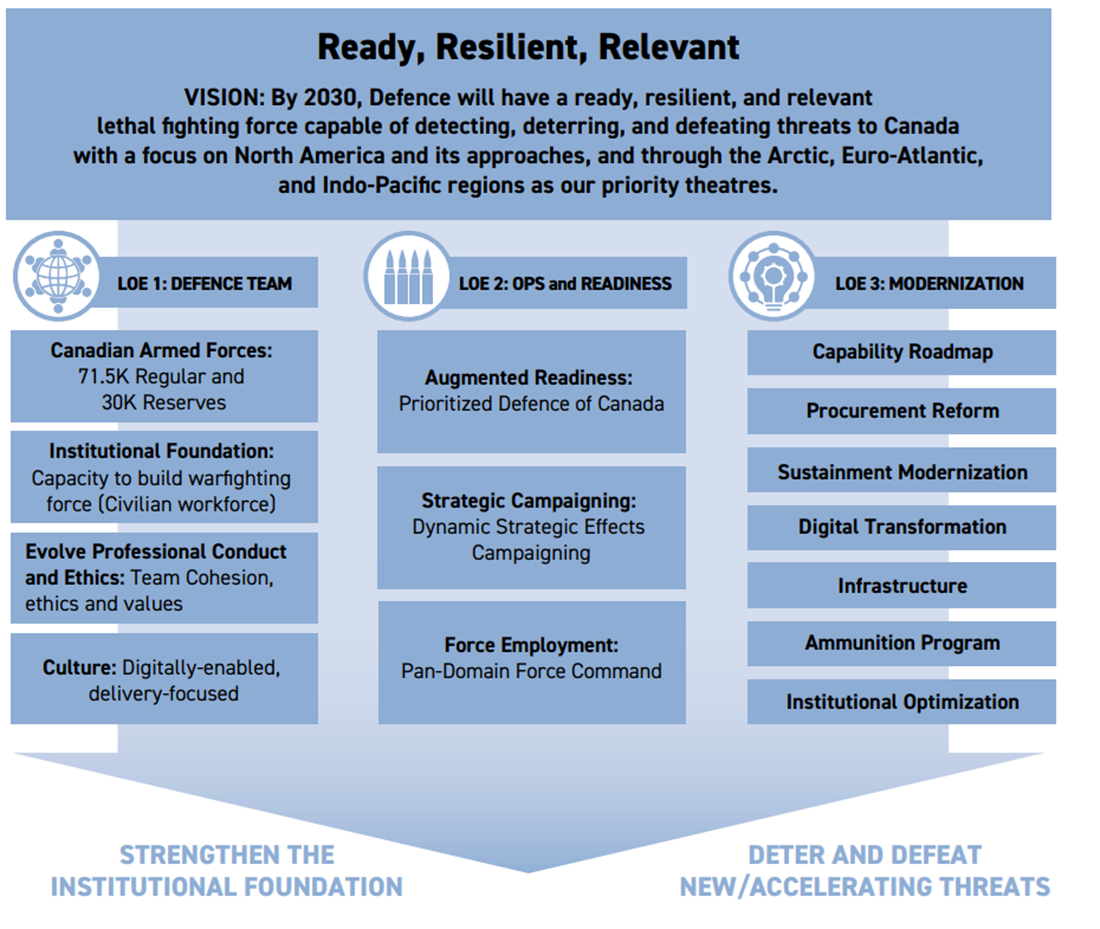
Caption
Ready, Resilient, Relevant
Vision: By 2030, Defence will have a ready, resilient, and relevant lethal fighting force capable of detecting, deterring, and defeating threats to Canada with a focus on North America and its approaches, and through the Arctic, Euro-Atlantic, and Indo-Pacific regions as our priority theatres.
Line of effort 1: defence Team
- Canadian Armed Forces
- 71.5K Regular and 30K Reserves
- Institutional Foundation:
- Capacity to build warfighting force (Civilian workforce)
- Evolve Professional Conduct and Ethics:
- Team Cohesion, ethics and values
- Culture:
- Digitally-enabled, delivery-focused
Line of effort 2: OPS and Readiness
- Augmented Readiness:
- Prioritized Defence of Canada
- Strategic Campaigning:
- Dynamic Strategic Effects Campaigning
- Force Employment:
- Pan-Domain Force Command
Line of effort 3: Modernization
- Capability Roadmap
- Procurement Reform
- Sustainment Modernization
- Digital Transformation
- Infrastructure
- Ammunition Program
- Institutional Optimization
Strengthen the Institutional Foundation
Deter and Defeat New/Accelerating Threats
Canadian Armed Forces Operations
Canadian Armed Forces Domestic and International Operations
North American Aerospace Defense Command (NORAD) Continental Operations

NORAD HQ
Integrated Tactical Warning Attack Assessment (ITW/AA) - 24/7/365
Detect, track, monitor missiles launched anywhere in the world, and assess potential attack on North America.
If required, the engagement of ballistic missile threats is executed by the United States through USNORTHCOM.
Maritime Warning - 24/7/365
Process, assess, and disseminate intelligence to warn of maritime threats to, or attacks against North America utilizing mutual support arrangements with other commands and agencies in the US and Canada.
NORAD Operational Regions
State Actor Air Response - 24/7/365
Detect, track, identify, and intercept foreign military air incursions into the US Air Defense Identification Zone (blue line) and Canadian Air Defense Identification Zone (red line) using integrated US and Canadian air power from locations across North America.
NORAD forces routinely detect, track, identify, and intercept Russian military aircraft and, for the first time in 2024, PRC military aircraft.
Intercept and Safe Passage Escort - Routine
Demonstrate NORAD’s rapid response capability by conducting the intercept, safe passage escort and handoff procedures of friendly aircraft, such as USSTRATCOM aircraft.
Op NOBLE DEFENDER (OND) - Routine
Demonstrate NORAD’s ability to launch US and Canadian forces at a moment’s notice from dispersed locations and defend North America from any and all approaches.
Demonstrate integrated CANUS operations across the Arctic in Alaska, Canada, as well as Pituffik SFB in Greenland.
Op NOBLE EAGLE (ONE) - 24/7/365
Established following 9/11, provide proactive, and reactive, responses to aircraft which may pose a threat to North America.
ONE informs NORAD’s operational approach to protect major national/international events, such as the G7.
Canadian Armed Forces Domestic Operations
[Redacted]
Canadian Armed Forces International Operations
[Redacted]
Canadian Armed Forces Special Operations
[Redacted]
Major Defence Procurements & Canadian Industry Relations
Overview of Major Procurements
ADM(Mat) Budget
Spent to date: ████████████
Anticipated Year End Budget ██████Footnote 14 Overplanning
Capital Projects
Spent to date: ███████████
Budget: ██████
Fleet Sustainment & ISS
Spent to date: ███████████
Budget: █████
OtherFootnote 15
Spent to date: ███████████
Budget: █████
Capital Projects
Canadian Multi‑Mission Aircraft
- First CP8A aircraft delivery is scheduled for Fall 2027.
RFI for Long‑term ISS occurred in Spring 2025. ██████████████████████████████████████████████████████████████████████████████████████████
Actuals: ███████████
2025–26 Budget: █████
River Class Destroyer
- Implementation contract for the build of the first three RCD ships, signed with Irving Shipbuilding Inc on 3 March 2025.
Full Rate Production on ship 1 began 25 April 2025 and first ship delivery forecast 2032.
Actuals: ███████████
2025–26 Budget: █████
Future Fighter Capability
- The first 8 CF35A are now in production.
First delivery scheduled for Fall 2026 to Luke AFB, Arizona for Canadian pilot training. Infrastructure and site development work ongoing at Cold Lake and Bagotville.
Actuals: ███████████
2025–26 Budget: █████
Joint Support Ship
JSS 1 schedule is currently under review with sea trial shifting to 2026 with delivery now expected in mid 2027. JSS 2 is scheduled for delivery in 2027. Most structural consolidation of the ship will occur in 2025.
Actuals: ███████████
2025–26 Budget: █████
Strategic Tanker Transport Capability
Three CC330 Husky aircraft now located in Canada, two aircraft supporting RCAF operations, one aircraft available as a backup in ready‑for‑flight condition. First new CC330 MRTT now in conversion in Getafe, Spain with delivery to Canada in 2027.
Actuals: ███████████
2025–26 Budget: █████
Fleet and Equipment Sustainment
Halifax Class Frigate
The Halifax Class In‑Service Support Contracts ensures fleet readiness through maintenance, engineering support, and timely acquisition of spare parts.
Actuals: ███████████
2025–26 Budget: █████
Victoria Class Submarines
Victoria Class In‑Service Support Contracts (VISS) for maintenance, repair, overhaul, and platform integration.
Actuals: ███████████
2025–26 Budget: █████
CH‑148 Cyclone
The Cyclone In‑Service Support Contracts ensures fleet readiness through maintenance, engineering support, and timely acquisition of spare parts.
Actuals: ███████████
2025–26 Budget: █████
CH‑149 Cormorant
The In‑Service Support Contract ensures mission readiness through comprehensive maintenance and support while the helicopters undergo a mid‑life upgrade.
Actuals: ███████████
2025–26 Budget: █████
█████████████████████
███████████████████████████████████████████████
███████████████████████████████████████████████████████████████████
██████████████████████████████████████████████████████████████████████████████████████████████████████████████████████████████████████████████████████████████████████████████████████████████████████████████████████████████████
██████████████████████████████████████████████████████████████████████████████████████████████████████████████████████████████████████████████████████████████
████████████████████████████████████████████████████████████████████████████████████████
███████████████████████████████████████████████████████████████████████████████████████████████████████████████████████████████████
██████████████████████████████████████████████████
High Visibility Projects / Initiatives
Arctic Over the Horizon Radar (A‑OTHR)
█████
████████████████
█████████████████████████
█████████████████████
███
- Ultra‑long‑range surveillance of Canada’s northern approaches about airborne threats.
- Stage 1 Minimal Viable Product installed by December 2029.
- A‑OTHR Program does not have an Initial Operational Capability. December 2029 could be considered as an Initial Capability. Between 2029 and 2043 the A‑OTHR Program next stages will be implemented in an iterative manner.
- Full Operational Capability by 2043.
Defence Enhanced Surveillance from Space (DESSP)
█████
████████████████
████████████████████████
███████████████████████
█████
Satellite system designed to support global intelligence collection while concentrating on monitoring maritime approaches to Canada ███████████████████████████████████████████████
█████████████████████████████████
███████████████████████████████
█████████████████████████████
█████████████████████████
███████████████████████
Enhanced Satellite Communications Project – Polar (ESCP‑P)
████████
████████████████
████████████████████████
████████████████████
████
- Dedicated, secure and resilient military satellite communications system addressing current limited communication capabilities in the Arctic above 65°N latitude, enabling real‑time situational awareness, decision‑making, and improved command and control.
███████████████████████████████████████████████████████████████████████████████████████████████████████████████████████████████
█████████████████████████████████████████████████████████████████████████████████████████████████████████████████████████████████
██████████████████████████
███████
████████████████
███████████████████████
█████████████████
██
███████████████████████████████████████████████████████████████████████████████████████████████████████████████████████████████████████████████████████████████████████████
██████████████████████████████████████████████████████████████████████████████████████████████████████████████████████████████████████████████████████████████████████████████████████████████████████████████████████████
Capital Project Portfolio
██████████████████████████
Identification ████████
Evolved Crypto Capability – Radio ████████
RCAF Air Weapons Coverage Expansion ███████
Intelligence Mission Data ███████
Worldwide Satellite Communications – Protected MILSATCOM Strategic ████████
Worldwide Satellite Communications – Protected MILSATCOM Tactical ████████
Worldwide Satellite Communications – Wideband ███████
Key Management Infrastructure – Hardening ██████
- Modernized Command and Control Information System
- Worldwide Satellite Communications – Narrowband
- North Watch (formerly P‑OTHR)
Options Analysis █████████
Enhanced Satellite Communications Project – Polar █████████
Science and Technology Enhanced Research Capability ████████
Defence Enhanced Surveillance from Space ████████
DEFENCEx ███████
Cyber Operations Training Eco‑System ███████
Evolved Crypto Capability – Telecommunications ███████
Strategic Radio Capability ████████
System of Training and Operational Readiness Modernization ███████
Military Pay Solution ████████
Secure C2 Mobile Device – Secure Tailored Solution ██████
Definition ███████
Automatic Identification Technology ███████
IT Infrastructure in Support of Command & Control ███████
Cyber Defence – Decision, Analysis, & Response ███████
Identity, Credential & Access Management ███████
Naval Communications Modernization ███████
Surveillance of Space II ███████
Electronic Health Record Platform ███████
Alpha Defence X ███████
Network Command & Control ██████
Defence Cryptographic Mod Omnibus Project ██████
- Meridian Standard
Arctic Over the Horizon Radar ██████████
Implementation ███████
Secure Radio Modernization ███████
Secure Radio ███████
Tactical Narrowband SATCOM Geosynchronous ███████
Classified Security Management Infrastructure ██████
CF Electronic Warfare Support Project ██████
Advanced Cryptographic Capabilities ██████
Medium Earth Orbit Search and Rescue ██████
Search and Rescue Mission Management System Replacement ██████
Digital Biometrics Collection & Identity Management █████
- Agave Gold
Overview of Canada’s Defence Industrial Strategy
Summary
Overview of Canada’s Defence Industrial Strategy, which aims to rebuild and modernize Canada’s defence industrial base so it can better equip the Canadian Armed Forces, while maximizing growth, job creation and economic benefits for Canadians.
Background
- Canada’s Defence Industrial Strategy (DIS) sets out the Government’s plan to rebuild Canada’s sovereign defence industrial base so that it can better equip the CAF, support Allies, and generate economic benefits for Canadians.
- The DIS responds to a more dangerous and competitive global security environment in which advanced technologies – such as AI, quantum, space, cyber, and autonomous systems – are increasingly central to modern warfare and deterrence.
- Budget 2025 committed $6.6 billion over five years to launch the initial investments – the “Early Moves” – of the DIS.
- The DIS public document developed by the Department of National Defence (DND) and Innovation, Science and Economic Development Canada (ISED) is tentatively scheduled to be released in mid-February 2026.
Considerations
Engagement with Industry and Canadians
- Industry engagement has been a priority in the development of the Defence Industrial Strategy with engagements with over 2,000 Canadian industry representatives, from Small Medium Businesses to Prime Contractors. These engagements served to identify issues with the relationship between the Government of Canada and the private sector.
- Six roundtables were conducted between the Minister of National Defence and major industry primes to discuss how industry and government can better collaborate on critical CAF capabilities, such as Land Systems, Shipbuilding, Aerospace, C4ISR, Ecosystem Support, and Venture Capital.
- The Department has conducted extensive Federal-Provincial-Territorial engagement, with meetings, roundtables, and regional visits. Collaboration with Other Government Departments has developed strong cross-departmental relationships, to allow for coordination on DIS priorities. Departmental officials also had strong representation at a variety of domestic and international tradeshows.
- Meetings and long-term engagement planning with a variety of post-secondary institutions and academics has also provided critical insights as to how the DIS can support the development of a strong Canadian workforce, and the broader development of Canada’s Defence Industrial Base.
- These engagements were collated into a broader "What-we-heard" report, which directly informed the development of the DIS, ensuring that future GoC – industry collaboration is better placed to deliver capabilities into the hands of the Canadian Armed Forces (CAF).
Public DIS
- The current draft of the DIS was developed jointly by DND and ISED in close consultation with other government departments. The strategy is anchored around five pillars:
- Renewing our Relationship with Industry
- The Defence Investment Agency & “Build-Partner-Buy”
- Investing Purposefully to Strengthen an Innovative Canadian Defence Sector
- Securing Supply chains for Key Inputs and Goods
- Working with Key Domestic Partners, including in Canada’s North and Arctic
- The Defence Investment Agency (DIA) is positioned as the central delivery vehicle of the DIS, with a mandate to align procurement with industrial policy, accelerate capability delivery, and better connect the CAF with industry.
- The DIS frames defence investments as both a national security imperative and economic opportunity – linking military readiness to job creation, innovation, and industrial growth across Canada.
- The Strategy identifies sovereign capabilities that are critical for the CAF to defend Canada, including space, quantum, AI, munitions or digital capabilities. The document also highlights the importance of key assets like critical minerals, and underscores the Government’s intent to build strategic partnerships.
DIS Early Moves
- Even though the DIS is not yet published, the Government already announced a first set of initiatives to deliver capabilities to the Canadian Armed Forces and position Canada’s industrial base for long-term growth. These investments are laying the foundation for the success of the DIS and are key to the Government’s efforts to reach 2% of Gross Domestic Product in defence spending in fiscal year 2025-26.
- Investments announced to date include:
- $68.2 million over three years to establish the Bureau of Research, Engineering and Advanced Leadership in Innovation and Science (BOREALIS). BOREALIS will accelerate the delivery of cutting-edge capabilities for defence, reduce barriers to commercialization, and align investments with mission-critical capability gaps.
- $1.0 billion to establish a Defence Platform at the Business Development Bank of Canada to provide loans, venture capital, and advisory services to help small-and medium-sized businesses contribute to Canada’s defence and security capabilities.
- $656.9 million over five years to develop and commercialize dual civilian-military technologies in key industries such as aerospace, automotive, marine, cybersecurity, artificial intelligence, biodefence, and life sciences.
- $334.3 million over five years to support Canada’s quantum industry and provide pathways to technology adoption in defence-related applications and industries (this includes $92 million over two years for the launch of Phase 1 of the Canadian Quantum Champions Program to anchor top Canadian quantum companies and talent at home).
- $443.0 million over five years to support the development of innovative critical minerals processing technologies, support joint investments with Allies in Canadian critical minerals projects and develop a critical mineral stockpiling mechanism to strengthen Canadian and Allied national security.
- $182.6 million over three years to support space launch capabilities and rocketry research and development.
- This includes $25 million this fiscal year for IDEAS challenge to accelerate the advancement of Canadian-designed space launch technology to enable the launch of Canadian payloads from Canadian soil.
- $528.5 million in funding for the Canadian Space Agency to contribute – on behalf of Canada - to the European Space Agency through the Canada-ESA Cooperation Agreement. This contribution will advance research and development of Canadian-made space technologies for civilian and defence purposes.
- $357M over 3 years to the Regional Development Agencies (RDAs) for the Regional Defence Investment Initiative (RDII) to support Canadian businesses and organizations looking to grow their capacity, innovate, or adapt products and services to supply the defence sector.
- $244.2 million over three years for the Defence Industry Assist program to provide funding and advice to high-potential, innovative Canadian Small and Medium Enterprises to advance made-in-Canada defence and dual-use technologies.
- A full list and description of initial DIS initiatives can be found in the Early Moves placemat.
Defence Industrial Strategy Initial Investments
Sovereign Capabilities
Space Launch (DND)
- This initiative will support the rapid development of domestic space launch infrastructure in Canada. Investments will help reduce Canada’s dependence on foreign countries to get critical space capabilities into orbit, and will directly support Canadian innovators solving defence and security challenges.
Rocketry R&D (DND)
- This initiative will invest in the research and development of space rocketry technology (materials, propulsion systems) to produce space launch capability, and will leverage the expertise of Canadian innovators in industry and academia.
Research and Development
BOREALIS (DND/CSE/NRC)
- This initiative will create BOREALIS to advance cutting-edge technologies that support the CAF with made-in-Canada solutions, positioning Canada as a leader in defence and security innovation.
Dual-Use Space Technology Development (CSA)
- This initiative is designed to help retain and grow Canadian industrial capacity to develop advanced dual-use space capabilities that are essential to Canada’s defence and security requirements. Canadian companies will be able to be awarded contracts across a variety of strategically important dual-use space technologies.
Dual-Use Technology Development & Commercialization (ISED/NRC)
- This initiative will support the development and commercialization of defence and dual-use technologies. It will leverage existing programs within ISED and NRC to invest funds to bring more Canadian-made innovation to the CAF.This initiative will establish the Canadian Quantum Champions Program to support supply chains, R&D, talent, and adoption of quantum technologies in defence applications.
Quantum Response to DARPA QBI (ISED/NRC)
- This initiative will help establish the Canadian Quantum Champions Program. The program will help anchor quantum technologies in Canada by providing funding, building a robust supply chain, offering access to R&D and expertise, and supporting early application and adoption in defence-related applications and industries.
Quantum Ecosystem Support (ISED/NRC)
- Together with the Quantum Response to DARPA initiative, this initiative will make significant investments across the entire spectrum of research and development, talent cultivation, and commercialization to develop a thriving Canadian quantum ecosystem.
Aerospace Technology Demonstration Platform (NRC)
- This initiative will serve as a cornerstone for advancing innovation and airborne defence capability development within Canada’s ecosystem through cutting-edge research, testing, and demonstration of emerging technologies.
Defence Industry Assist (NRC)
- This initiative will provide funding and advisory services to SMEs developing priority defence and dual-use technologies. These efforts will support high-potential and innovative firms across Canada that are developing technologically innovative products and services that can help meet the needs of the CAF.
Drone Innovation Hub (NRC)
- This initiative will establish a national Drone Innovation Hub (DIH) to support the acceleration of drone innovation in Canada. It will create a coordinated national ecosystem that connects government, industry, and academia to advance drone and counter-drone technologies and help equip the CAF in a key area of modern warfare.
Financial Support for the Industry
BDC Defence Fund (ISED)
- Funding to the Business Development Bank of Canada (BDC) for a defence fund to support businesses in Canada’s defence industrial base. This fund will allow the BDC to expand and deepen its financing, venture capital investment and advisory services to businesses that help strengthen Canada’s defence and security capabilities.
Infrastructure in the North
Nuclear Energy (NRCan)
- The Government of Canada will be conducting a feasibility study that will assess the potential use of microreactors (a category of small modular nuclear reactor), to supply heat and electricity for remote and Northern DND and Canadian Armed Forces (CAF) facilities and operations.
Supply Chains
Critical Mineral Processing (ISED/NRCan)
- This initiative will support research, development, and processing activities that advance secure and sustainable supply chains. It focuses on accelerating innovation, building domestic capacity in rare earth magnets and amorphous steel, and enabling the production of materials essential to defence.
Critical Mineral Stockpiling (NRCan)
- The Government will create a mechanism to expand the production, buying, stockpiling, and selling of critical minerals essential for national defence purposes. This initiative will provide, as a first step, enhanced market intelligence, analysis and advice that will be foundational to informing critical mineral stockpiling.
Investments in Supply Chain Development (RDAs)
- This initiative will support the integration of businesses into defence supply chains; increase the innovation and production capacity of businesses; and support business that produce dual use technology to supply the defence sector. This investment will build a robust defence industrial ecosystem, while bolstering regional economic benefit.
Nitrocellulose (DND)
- This initiative will support production capability in Canada by providing funding to construct and deliver an operational nitrocellulose production facility by 2030.
Export Promotion
Defence Export Promotion Strategy (GAC)
- This initiative will develop and invest in a Defence Export Promotion Strategy. The objectives of the Strategy will be to increase Canada’s overall defence exports, to expand existing and create new markets for Canadian exports and support the overall growth and sustainability of Canada’s defence industrial base.
Enhanced Presence at Airshows (ISED)
- This initiative will support and increased Government of Canada presence at the next Farnborough International Airshow (FIA) in July 2026 and the next Paris Air Show (PAS) in June 2027, the world’s largest aerospace trade events.
Canadian Forces Morale And Welfare Services (CFMWS)
Overview of the Canadian Forces Morale and Welfare Service (CFMWS) and Non-Public Property
CFMWS – Serving those who serve
January 2026
About Us
We provide morale and welfare support to the CAF
Mandated by DND/CAF and through the Non-Public Property (NPP) framework, we contribute to operational readiness and CAF Reconstitution.
We are a purpose-built social enterprise
All our profits are invested into programs and services to benefit CAF members, Veterans and their families.
We are member and employee-centric
Our employees understand our members. We contribute to their self-reliance, resilience and readiness by improving their mental, social, physical, financial and family wellbeing.
We contribute to a larger vision
We work lockstep with DND and other government partners to contribute to the larger Defence mission and other Government of Canada objectives.

Caption
Illustration of a tree diagram representing community wellness, with roots labeled as various revenue sources like CAF revenue, retail revenue, supporting a trunk labeled "Community Wellness." Branches and leaves highlight key wellness components including mental, physical, social, financial, family care, resilience, self-reliance, and operational readiness, emphasizing interconnected factors contributing to overall community health.
Mission, Vision, Values
Mission
To improve the military community’s resilience and well-being through the design, delivery and evaluation of wellness enhancing offerings to contribute towards operational readiness, recruitment & retention of the CAF.
Vision
Improving lives around the world.
- Mental
- Social
- Physical
- Financial
- Family
Values
We Care: We put our people first, we care for our members, our community.
One Team: We are one team, we have each others backs and get it done together for our members.
Integrity: We act with integrity and strive to do the right thing, we say what we mean and do what we say.
Creative: We constantly look for new ideas and find creative ways to provide our members with the best possible experience.
Throughout this presentation, the term military community refers to the CAF community that CFMWS serves:
- Regular and Reserve Force
- Veterans
- CAF families
Our Value Proposition
Our employees are passionate, driven, invested and proud to be serving those who serve. They are dedicated to the CAF and delivering programs and services designed to create vibrancy and a sense of belonging regardless of the location.
CFMWS provides a unique value proposition for the Government of Canada where, through a social enterprise model, we reinvest our profits back into programs and services that enhance the resilience of the Defence and Security community by improving our members’ health and wellbeing.
Our Divisions
We are a purpose-built social enterprise. We help Canadian Armed Forces members, Veterans and their families build self‑reliance, resilience and readiness. Their mental, social, physical, familial and financial wellbeing is our overarching priority.

Caption
Pillars: Mental, Social, Physical, Financial, Familial
Organizational chart illustrating the divisions of CFMWS.
Top level: Chief Executive Officer of CFMWS Managing director, Non-Public Property (CEO MD, NPP) reports to Chief of Defence Staff (CDS). Non-Public Property Oversight and Advisory board (NPP OAB) reports to CDS on same level, horizontal to CDS. Chief Operating Officer (COO) Reports to CEO MD, NPP.
Second level: CFMWS National Programs aligned with DND and CDS policy goals across four main areas: SISIP Financial, Personnel Support Programs, Military Family Services, and CANEX.
Third level: Functional areas supporting programs: Marketing and Communications, Finance, SNPF CF Human Resources, Info Management and Technology, and Corporate Services.
Governance / Leadership
- Chief of the Defence Staff (CDS)
- Non-Public Property Oversight & Advisory Board (NPP OAB)
- Chief Executive Officer CFMWS / Managing Director, NPP (CEO, MD NPP)
- Chief Operating Officer (COO): Risk Management, Data Governance, Strategy and Strategic Planning, Performance Measurement, Infrastructure Strategy, Strategic Oversight Committee for APS110.
Program Areas
1. SISIP Financial: Exclusive provider of financial services to the CAF community. Tailored solutions include products, financial planning advice, investment products, financial counselling & education, and administration of the CAF LTD program with Manulife. Revenue generated is reinvested into CFMWS social enterprise. Over the last 6 years, contributed over M+ to support the CAF Community.
2. Personnel Support Programs: Fitness, Women’s Physical Wellness and Fitness Program, Reconditioning, Sports, Health Promotion, Deployment Support, Messes, Soldier On, Sponsorship, Special Event Planning, Newspapers, Museums, Recreation and leisure activities for CAF members and families to support operational readiness and to build a strong, vibrant military community.
3. Military Family Services: Support for those affected by relocations, absences, transitions. Offered in person and virtually. Funding and oversight of MFRCs. Service offerings include: Mental Health Support, Emergency Family Care, Access to Health Care, Spousal Employment, Education (Guidance Counselling), Scholarships and Grants, Special Needs, Second Language Training, Bereavement Support and Support to Our Troops.
4. CANEX: Established in 1968, Canada’s Military stores is a retail operation located on most Bases/Wings across Canada, with 35 locations, and online at CANEX.ca. CANEX offers retail products, commercial services and access to Concessions, National/Local retailers & Affinity partners to the CAF Community. Since 1980, CANEX operates NATEX as a retail concessionaire to NATO and CAF community in Europe.
Functional Areas
Marketing and Communications: Marketing and communications support to national operations and local business units. Employee communications, marketing, social media and CAF Public Affairs / MCU support.
Finance: Financial and accounting services to 1,300+ NPP entities. Authority for the Canadian Forces Central Fund Investments, SISIP Segregated Fund, CDS Delegation of Financial Authorities for Financial Administration of NPP, NPP Compliance and Assurance Program, and Consolidated Insurance Program.
SNPF CF Human Resources: Talent Acquisition, Performance Management, Total Compensation, Workplace Culture and Wellness, Payroll and Benefits, Occupational Health and Safety, Labour Relations, Pension, Employment Equity, Official Languages and Conflict Resolution.
Info Management and Technology: Maintain/operate the NPP network (NPPNet) and technology that supports CFMWS headquarters and business lines in delivery of programs/services across Bases/Wings in Canada and Europe. Focus on data security, cybersecurity prevention and migration of CFMWS applications to the cloud.
Corporate Services: Corporate Secretariat, administration, legal services, contracting, policy development, purchasing, travel services, Real Property and GOC (Government of Canada), environmental protection, ATIP and NPP education.
Our Staff
CFMWS employs the Staff of the Non-Public Funds, Canadian Forces (SNPF, CF) and uses the NPP accountability framework to control and deliver the programs in a unique social enterprise business model that not only creates real value for the CAF community but also reinvests back into health and wellness programs, which strengthen our members and their communities.
As a separate employer—defined in Schedule V of the FAA—SNPF, CF has the flexibility to manage the workforce to deliver services that meet our members’ changing needs.
Full Time: 2,403
Part Time: 644
Casual: 1,531
LOA/LTD: 236
Unionized: 1,102
Financial Administration Act (FAA) Schedule V, Separate Agency is the foundation of SNPF, CF.
Assigned to MND by two Orders-in-Council to allow for employee collective bargaining.
Treasury Board is not the employer.
SNPF, CF employees are not part of DND / CAF.
FAA Section 11 – Legislate powers of a Deputy Head to CEOs of Separate Agencies.
MND Order authorizes the CDS to exercise or perform the Ministerial powers or functions that are vested in the MND for the SNPF, CF.
Acting as the MND in this regard and using an SNPF, CF employment contract, the CDS recruited the CEO SNPF, CF to fulfill all SNPF, CF employer responsibilities. The CEO SNPF, CF is an SNPF, CF employee.
CEO SNPF, CF creates and administers the conditions of employment for all SNPF, CF jobs, both managerial and unionized (HR Pol). This includes recruiting, compensation / benefits, job classification and conflict management.
SNPF, CF has its own Pension Plan, governed by the Pension Committee that is appointed by the CEO SNPF, CF. The plan is externally administered.
SNPF, CF is subject to the CLP Part II, CHRA, OL Act, ATI and Privacy Acts and certain other federal legislation.
By Division
- CANEX: 11%
- SISIP Financial: 4%
- Military Family Services: 5%
- Personnel Support Programs: 69%
- Corporate Support Divisions: 11%

Caption
CFMWS – Our Staff: Infographic presenting an overview of Canadian Forces Morale and Welfare Services (CFMWS) workforce composition, organizational details, and employee demographics.
Left Section:
Operational Statistics:
- 39 locations across Canada and abroad
- 687 employees at headquarters
- 4,127 employees in the field
Average Salary (full-time employees):
- Category I: $50,373
- Category II: $88,932
Community Affiliation:
- 31% of employees have a CAF affiliation
- veterans or currently serving members: 10%
- military children: 8%
- military spouses: 13%
Right Section (Charts):
By Employment Category (Donut Chart):
- Category I: 3,129 employees (largest group)
- Category II: 1,671 employees
- Category III: 14 employees
By Age Group (Pie Chart):
- Traditionalists (1928–1945): <1%
- Baby Boomers (1946–1965): 11%
- Generation X (1966–1980): 26%
- Millennials (1981–1996): 36% (largest group)
- Generation Z (1997–2012): 27%
Data as of June 2025.
Our locations

Caption
Slide showing the geographic distribution of Canadian Forces Morale and Welfare Services (CFMWS) operations across Canada and internationally.
Main Map (Canada): A map of Canada is displayed with numerous red dots marking locations of bases and service sites across all provinces and territories. Densely clustered locations appear in Ontario and Quebec, with additional sites in Western Canada (British Columbia, Alberta, Saskatchewan, Manitoba), Atlantic Canada, and the North (including Yellowknife). A zoomed-in inset highlights the National Capital Region (Ottawa–Gatineau), showing multiple closely grouped locations.
Each location is labeled with a base or site name and accompanied by icons representing service divisions such as CANEX, SISIP Financial, Military Family Services (MFS), and other morale and welfare programs.
International Maps:
- Europe: Multiple locations are identified across Western and Central Europe, including the United Kingdom, Germany, and surrounding areas, indicating CAF support sites overseas.
- United States: Locations are marked across several states, including Alaska, Colorado, and the eastern United States.
- Western Asia: A smaller map highlights at least one location in Kuwait.
Our programs
We strengthen our members, so they are ready to serve Canada
- Physical fitness and injury prevention
- Participatory and/or competitive sport at local, regional, national and international levels, both inside and outside CAF
- Canadian Armed Forces Human Performance
- Health promotion
We enable our members’ financial wellbeing
- Insurance
- No-fee banking, savings and investment plans
- Financial planning and counselling
We provide opportunities for social connection and for adventure
- Recreation programs for adults and kids
- Messes, community clubs, campgrounds and other leisure activities
- Discounted travel opportunities, quick-service restaurants and everyday discounts
- Retail goods, services, savings and rewards through CANEX and its partners
- Discounts with other retail and travel partners across the globe
We support families
- Virtual Counselors available 24/7
- Military and Veteran family services across Canada, in the US and Europe
- Specialized support, including help with relationships, grief, moving, dealing with illness and injury, stress management and transitioning to civilian life
Our value to DND/CAF
- We deliver publicly-mandated and publicly- funded programs such as military fitness, sports, health promotion, financial counselling and military family services, on behalf of CAF and DND.
- We generate revenue through CANEX, SISIP Financial, and PSP Recreation and Leisure to deliver services tailored to community needs.
How we do it
- Through full alignment with CAF strategic direction. (e.g., Reconstitution, CAF Offer, SSE, BALANCE).
- By addressing systemic challenges, such as Seamless Canada.
Our value to our members
- We deliver programs that strengthen the mental, social, physical and financial wellness of CAF members, Veterans and their families.
- We generate revenue to deliver services tailored to community needs through CANEX, SISIP Financial, and PSP Recreation and Leisure, and return a portion of these profits to local Base/Wing funds to further support members.
Our 2024-27 Strategic Plan
Strategic Imperatives
- Achieve sustainable revenue sources.
- Improve quality of CFMWS experience.
- Increase operational efficiencies.
- Improve employee experience.
CFMWS Strategic Plan 2024–2027
- Strategic Goal – What we want to achieve: By 2027, we will achieve financial sustainability, and year-over-year profitability for all programs and services delivered within the non-public property framework.
- Foundation – What we are built upon: A-PS-110 MODERNIZATION
- Strategic Imperatives – What our core game plan will be:
- Achieve Sustainable Revenue Sources
- Improve Quality of CFMWS Experience
- Increase Operational Efficiencies
- Improve Employee Experience
- Tier 1 Measures – How success will be measured:
- Net Income
- Net Promoter Score
- Operating Costs
- Employee Engagement Score
- Objectives – Where will we focus resources:
- Confirm sustainability & value proposition
- Evaluate & implement monetization opportunities
- Develop Digital Transformation Roadmap & implement priority technology activities
- Evaluate & reassess Service Delivery Framework
- Rationalize delivery of public programs
- Rationalize delivery of non- public programs for net profitability
- Develop integrated infrastructure plan & prioritize for investment
- Conduct core process review & prioritize for reengineering
- Realign business practices & functional authorities
- Develop Future Strategic Workforce Plans
- Implement Enterprise Data Analytics & Info Management Program
- Implement Talent Management Strategy
- Implement Digital People Management System
- Implement Workplace Wellness Programs
- Implement Total Rewards Programs
The Connection
- CFMWS Strategic Imperatives + CDS Priorities = Improve the CAF Community’s Resilience and Wellbeing through the design, delivery and evaluation of wellness enhancing offerings to contribute towards operational readiness, recruitment & retention of the CAF.
- Improve the Quality of the CFMWS Experience
- Improve Employee Experience
- Increase Operational Efficiencies
- Achieve Sustainable Revenue Sources
- Supporting Our People
- Advancing Professionalism
- Enhancing Capabilities
- Operational Readiness
About NPP
- National Defence Act (ss 2, 38-41) is the foundation for Non-Public Property.
- NPP is vested in the CDS and Unit COs (NDA ss 38, 39).
- NPP is subject to MND direction (NDA s 41)
- NPP is not subject to the FAA (NDA s 41)
- CDS owns NPP accountability framework.
- Audited by ADM(RS) and the private sector.
- The NPP Oversight and Advisory Board (OAB) is a Crown NPP administrative construct created by the CDS. Not legislated, has no fiduciary authority and acts as an advisory committee (like AFC).
- The MD NPP acts on behalf of the CDS within DOAs established by the CDS and reports directly to the CDS.
- Delegation of Authority last update – May 2023
Governance Committees

Caption
Organizational chart showing NPP governance committees and reporting relationships. Blue boxes represent governance committees, white boxes represent positions, and red text identifies the committee chair. At the top is the CDS. Reporting lines connect the CDS to the NPP Audit Committee, the CEO SNPF, CF and MD NPP, and the NPP Board. The NPP Audit Committee is chaired by an appointed chair. The NPP Board is chaired by the CDS. The CEO SNPF, CF and MD NPP connects to the EXMB, which is chaired by the CEO. The EXMB connects to ETSC, the Enterprise Technology Steering Committee, chaired by the COO, and EPRC, the Enterprise Performance Review Committee, chaired by the CEO. The chart also shows the Investment Committee, chaired by the COO, connected to Investment Policy, and the SNPF, CF Pension Board, chaired by the COO.
Sources of Funding and CFMWS Expenditures (FY 2024-2025)

Caption
This image is a complex financial infographic combining a treemap-style visualization of expenditures with a summary of funding sources for a total expenditure of $194.6 million. On the left, a large, multi-level block diagram shows expenditures divided into recipient categories based on Service Level Agreements (SLA) with CAF Personnel, CAF families, NPP Governance, and Deployed Operations. Within each recipient category containing varying-sized rectangular blocks representing programs such as CAF Fitness & Sports (the largest block), PSP Ops & Admin, Financial Counselling & Education, Military Family Resource Centres (MFRC) and more. A consolidated summary titled Expenditure by Source of Funding ($194.6M) reiterates totals across all spending, showing $164.2M reimbursed by DND (C108/C109), $23.7M reimbursed by DND (C190-Deployed Operations), and $6.7M CFCF contributions, visually linking the treemap distribution of programs to their funding sources.
Program offerings
- Fitness
- Sports
- Health Promotion
- Recreation, Leisure & Special Interest Activities
- Human Performance Research & Development
- Soldier On
- Deployment Support
- Op Santa
- Messes
- CAF Newspapers
- Sponsorship & national event planning support
- Fitness and Sports Leadership Quals
- Mental Health Support
- Emergency Family Care
- Access To Health Care
- Spousal Employment
- Community Integration
- Relocation Support
- Workplace Absence Support
- Transition Support
- Education (Guidance Counselling)
- Special Needs Of Loved Ones
- Second Language Training
- Bereavement Support
- National and community strategic partnerships
SISP Financial
Our services
Insurance Protection
- Life Insurance
- General Officers’ Insurance
- Critical Illness Protection
- Travel Insurance
Investing
- Investment Portfolios
- TFSA, RRSP, RESP, FHSA
Financial Planning
- Pension Expertise
- CAF Release Planning
- Estate Planning
- Deployments and Moves
- Education
Credit Counselling
- Budgeting, Managing Debt
- Grants and Loans
- Creditor Protection, Bankruptcy
Financial Education
- Briefings and Webinars
- Learning Portal
CANEX
Products and services
- Retail Services
- 35 CANEX stores
- Wholesale - Alcohol, Tobacco, Beverage, HABA
- E-Commerce
- CANEX.ca
- 3rd Party Fulfilment Program
- BOPIS (Buy Online Pick-up In-Store)
- Affinity Partners
- BMO
- The Personal Insurance
- CANEX Home Heating Program
- Concessions & Additional Services
- 135+ Concessions: Barber shops/salons, Food Services/Financial Services, Health, Personal & Professional Services
- 75+ Local Partners
- 500+ vending machines
- 75+ATMs
- Seasonal food trucks
- Self-serve CANEX micro markets
- Programs
- CANEX No Interest Credit Plan
- CANEX Rewards
- CF One Member Appreciation
- CANEX Price Match
Support Divisions
Human Resources
- Recruitment and Onboarding
- Learning and Development
- Talent Management and Performance
- Total Rewards (Compensation & Benefits)
- Payroll
- Workplace Wellness
- Labour Relations & Collective Bargaining
- Legislated Programs (Occupational Health and Safety, Official Languages, Diversity & Inclusion)
- Centre for Conflict Resolution and Ethics
Finance
Programs:
- Canadian Forces Central Fund (CFCF) Banking
- CFCF investment and treasury (grants and loans)
- CAF NPP Accounting System - PROPHET (Business Owner)
- Consolidated Insurance Program (CIP)
- Oversight of NPP Corporate Cards
- Debit/e-transfer/Credit Card Payment Solutions
Activities:
- NPP Accounting Services
- Financial Planning & Analysis
- Compliance and Assurance Reviews
- NPP Governance - Command Support
- Stewardship (Bases/Wings/Units (Reg and Res))
- NPP Financial Policies and Directives (Including CDS Financial Delegation of Authority for NPP)
Information Services
- Management, operation and support of the Non-Public Property Network
- NPP Network
- On-premises and Cloud Infrastructure
- Cybersecurity
- Applications
- Technology Procurement, Contracting and Vendor Management
- NPP Network User Support
- Capital IM/IT Portfolio management
- Business Analysis
- Project management and implementation
- Technology leadership and Innovation
Corporate Services
- Corporate Counsel and Legal Services
- Corporate Secretariat
- Administration Services
- ATIP
- NPP Real Property and Environment
- QCC Management
- Contracting
- Travel Services
Current Issues
- Federal Real Property Prioritization
Marketing & Communications
- Marketing
- Employee and Member Communications
- Media and Public Relations
- Issues management
- Translation Services
- Social Media
- Brand & Creative
- Member Customer Service
- Business Operations
- Website Management
Current Issues and Concerns
- A‐PS‐110 Modernization
- SISIP
- Reinsurance Funding Agreement (RFA).
- CAF Long‐Term Disability. Salary After Release (SAR) and modernization
- Child Care
- MFRC Governance
CFMWS. Invested in your life.
Communications Security Establishment (CSE)
Overview of the Communications Security Establishment
Winter 2026
CSE within Canada’s Current National Security Apparatus
- Canada’s security and intelligence community defends the safety and security of Canada’s territory, government, economy, and people, and provides insights to promote and protect Canadian interests.
- The national security apparatus works to:
- Produce intelligence
- Assess key issues and events
- Reduce threats
- Build resilience
- Screen people and investments for security concerns
- Intelligence and law enforcement agencies work together along with a range of departments and with international partners.

Caption
Diagram depicting Ministers responsible for Canada’s Core Intelligence Organizations within the National Security Apparatus:
- National Security and Intelligence Advisor to the Prime Minister
- Privy Council Office (PCO)
- Minister of National Defence
- National Defence (DND) and Canadian Armed Forces (CAF)
- Communications Security Establishment (CSE)
- Minister of Public Safety
- Canada Border Services Agency (CBSA)
- Royal Canadian Mounted Police (RCMP)
- Integrated Terrorism Assessment Centre (ITAC)
- Canadian Security Intelligence Service (CSIS)
- Public Safety (PS)
- Minister of Finance
- Financial Transactions and Reports Analysis Centre (FINTRAC)
- Minister of Foreign Affairs
- Global Affairs Canada (GAC)
CSE’s Role Is To
- Collect and report on foreign intelligence in line with the Government of Canada intelligence priorities.
- Provide cyber security, information assurance/secure communications for the Government of Canada, as well as guidance and services to help protect systems of importance to the Government of Canada.
- Take action online through foreign cyber operations to disrupt and degrade foreign threat actors and activities in support of Canadian international affairs, defence and security, and to defend systems of importance to the Government of Canada.
- Provide technical and operational assistance to federal law enforcement and security agencies, including DND/CAF.
- Lead the Canadian Centre for Cyber Security, which offers cyber security advice to external stakeholders and the public.
CSE’s Mandate
- Our mandate is defined in the Communications Security Establishment Act (CSE Act), enacted in 2019.
- As Minister of National Defence, you play a direct role in determining how CSE operationalizes its mandate by issuing Ministerial Authorizations, Orders and Directives that help give effect to CSE’s statutory authorities.
- CSE is explicitly prohibited from directing its activities at Canadians anywhere in the world, or at any person in Canada.
- CSE’s activities are subject to independent oversight by the Intelligence Commissioner (IC) and retroactive review by the National Security and Intelligence Review Agency (NSIRA) and the National Security and Intelligence Committee of Parliamentarians (NSICOP).

Caption
CSE’s mandate as it is presented in the CSE Act. The mandate is divided into 5 parts:
- Foreign Signals Intelligence
- CSE’s ability to collect Foreign Signals Intelligence through the use of advanced techniques.
- Acquire information from or through the Global Information Infrastructure (GII) located outside Canada including by engaging or interacting foreign entities located outside Canada.
- CSE’s ability to collect Foreign Signals Intelligence through the use of advanced techniques.
- Technical and operational assistance
- Provide assistance to federal law enforcement and security agencies, CAF, and DND.
- Use advanced techniques to support partners’ activities, including cyber operations for governments-authorized missions.
- Provide assistance to federal law enforcement and security agencies, CAF, and DND.
- Cybersecurity and Information Assurance
- Defend important Canadian networks.
- Provide advice, guidance, and services to protect important networks across the country, federal institutions, and electronic information and infrastructures of importance to the Government of Canada.
- Defend important Canadian networks.
- Defensive Cyber Operations
- Disrupt foreign cyber threats targeting important Canadian networks by taking online action.
- Defend systems designated by the MND as being of importance to Government of Canada.
- Disrupt foreign cyber threats targeting important Canadian networks by taking online action.
- Active Cyber Operations
- Interfere with foreign online efforts that threaten Canada.
- Online action to degrade, disrupt, influence, respond to, or interfere with foreign online efforts and capabilities as they relate to international affairs, defence or security.
- Interfere with foreign online efforts that threaten Canada.
- Accountability measures:
- National Security and Intelligence Review Agency (NSIRA)
- Intelligence Commissioner (IC)
- National Security and Intelligence Committee of Parliamentarians (NSICOP)
Delivering the Mandate: Foreign Intelligence objectives
- CSE acquires and analyzes electronic information to detect and inform the Government of Canada on activities of foreign entities that seek to undermine Canada’s national security and prosperity. Our foreign intelligence also provides insights with an information advantage to Canadian policy makers.
- CSE’s intelligence reporting offers:
- Unique insights into, and advance warning of foreign threats to Canada to prevent surprises that could harm Canadians, Canadian institutions, or allies;
- Unique insights to support foreign and economic policy and decision-making; and
- Information to support trade, economic security, law enforcement and military operations by providing information that goes far beyond public sources.
Intelligence Cycle
- Intelligence priorities are set by Cabinet and further refined into intelligence requirements
- CSE collects foreign signals (emails, phone calls)
- CSE analyzes signals and produces foreign intelligence reports
- CSE disseminates intelligence reports to domestic and international clients and partners
- CSE collaborates with international partners to provide a larger intelligence picture
- Intelligence reports inform Canada’s decision making and help identify new intelligence gaps
Delivering the Mandate: Foreign Intelligence — Measures and Mechanisms
- In 2024/2025, CSE provided 2,878 reports to 3,016 clients from 32 federal departments and agencies.
- Reports can only be read by authorized users across the Government of Canada and the Five Eyes. Robust mechanisms ensure this information is shared safely:
- Electronic dissemination
- Reports are shared via Canada’s Top-Secret Network (CTSN) – run by CSE and used to collaborate and communicate at the Top-Secret level.
- Client Relations Officers (CROs)
- CSE employees embedded across the Government of Canada who deliver intelligence reports to authorized users, such as Cabinet ministers.
- SIGINT Dissemination Officers (SDOs)
- Employees of other Government of Canada departments who are accredited by CSE to share intelligence reports with authorized clients within their departments.
- Electronic dissemination
- Guided by the Government of Canada’s priorities, topics include:
- hostile state activity (e.g. cyber threat activity, espionage, foreign interference and malign influence, counterintelligence, and intellectual property theft);
- terrorism and violent extremism;
- People’s Republic of China actions and intent;
- Russia’s invasion of Ukraine;
- Arctic sovereignty; and
- Border security.
Delivering the Mandate: Cyber Security
- CSE’s Canadian Centre for Cyber Security (Cyber Centre) provides advice, guidance and services to help defend Canada against cyber threats and foster a stronger, more resilient cyberspace in Canada.
- The Cyber Centre:
- Defends federal government networks – for example by deploying sensors on endpoint devices (e.g. servers, laptops) that automatically detect malicious activity like malware to defend against threats.
- Leads Canada’s federal response to cyber security events.
- Provides a unified source of expert advice, guidance, services, and support on cyber security and threat assessments for Canadians and Canadian organizations.
- Works in collaboration with all levels of government, the private sector, industry, academia, critical infrastructure, and international partners.
- Supports cyber resilience in Canadian research, economic and investment activities.

Caption
The mandate of CSE on Cyber Security:
- Advice and Guidance
- Community Building
- Cyber Defence Services
- Incident Handling
- Information Assurance
- Threat Intelligence
- Access to actionable cyber threat intelligence
Delivering the Mandate: Information Assurance
- CSE is responsible for information assurance, known as Communications Security (COMSEC) for the Government of Canada — a fundamental part of cyber security which protects sensitive information and prevents our information from being accessed by adversaries, using encryption which:
- Converts data into unreadable code, accessible only with keys — a strong defence against cyber threats
- Helps verify that data has not been altered during transmission
- Enables trust and confidence among stakeholders, partners and the public.
- As the backbone of information security, encryption enables the military equipment to identify 'friend or foe' and keeps national security operations and cabinet deliberations safe from breaches.
- At the nexus of COMSEC, CSE:
- Provides the Government of Canada and some industry partners with secure hardware, software and cryptographic keys;
- Works with federal and international partners to ensure rigorous cryptography standards; and
- Is working to prepare for the emergence of quantum computers — which could break encryption and may be available as early as the 2030s.

Caption
The mandate of CSE on Information Assurance:
- Unencrypted document
- Encrypt
- Encrypted document in transit
- Unencrypt
- Unencrypted document
Delivering the Mandate: Foreign Cyber Operations
In 2023, CSE used DCO capabilities against a foreign ransomware group that was targeting multiple Canadian critical infrastructure organizations.
The Cyber Centre worked to mitigate the compromise within Canada, while the foreign cyber operations team acted in cyberspace to interfere with the cybercriminals’ foreign servers, thus reducing the effectiveness and profitability of their activities.
- CSE can take action online in support of Canada’s international affairs, defence, and security, and to defend federal systems and systems of importance to the Government of Canada.
- As Minister of National Defence, you authorize CSE to conduct Active and Defensive Cyber Operations. The Minister of Foreign Affairs must be consulted for defensive cyber operations and must consent to active cyber operations.
- Defensive Cyber Operations (DCO) disrupt foreign activities aimed at federal institutions and systems of importance (e.g. energy grids, telecoms networks, healthcare databases, banking systems). For example, CSE could prevent cyber criminals from stealing information from a Government of Canada network by disabling their foreign server.
- Active Cyber Operations (ACO) are proactive actions to disrupt foreign based threats to Canada’s defence, security, or international affairs. For example, CSE used active cyber operations to counter foreign groups in their dissemination of violent extremism materials online.
- The CAF and CSE have a longstanding partnership in developing advanced technical and specialized capabilities for providing intelligence to support military operations. Over the last decade, the partnership has evolved to include collaboration in the areas of cybersecurity, and defensive and active cyber operations. Through CAFCYBERCOM, CSE continues to conduct joint cyber operations with the CAF to support their mission objectives.
- Cyber operations must not:
- target Canadians or anyone in Canada
- interfere with the course of justice
- interfere with the course of democracy
- cause death or bodily harm
Delivering the Mandate: Technical and Operational Assistance
- As Canada’s national cyber security and foreign intelligence agency, CSE has unique technical and operational capabilities that can help other federal organizations keep Canadians safe and secure.
- CSE is authorized to assist:
- Federal law enforcement and security agencies:
- Royal Canadian Mounted Police (RCMP)
- Canadian Security Intelligence Service (CSIS)
- Canada Border Services Agency (CBSA)
- Department of National Defence (DND) and Canadian Armed Forces (CAF)
- Federal law enforcement and security agencies:
- When assisting federal partners, CSE acts under their legal authority (e.g. judicial warrants).
- In 2024/25, CSE provided assistance to 51 requests from federal partners.
Implementing Recent Defence Investments
- In June 2025 the Prime Minister committed to increase Canada’s defence spending to meet current NATO targets of 2% annual GDP in 2025/26 and further committed to NATO’s new Defence Investment Pledged to dedicate 5% of annual GDP by 2035.
- As part of these announcements, CSE will receive up to $8.3 billion over five years, beginning in 2025-26, to modernise and secure digital infrastructure that will deliver resilient Canadian solutions to safeguard the country’s most sensitive information, communications, and operations. These efforts include:
Investing in Infrastructure
Ensuring Canada’s classified community can share information with the right people at the right time.
Investing in Cryptography
Developing Canada’s sovereign, cryptographic capabilities through partnerships with research and industry.
Investing in technology
Providing digital capabilities that are future proof and capable for the challenges of the future.
Investing in Artificial Intelligence
Partnering with Canadian AI companies to implement leading-edge technologies.
Collaboration in Action: Synchronizing CSE’s Mandate
- CSE’s cyber security, foreign intelligence and cyber operations mandates work together to achieve a range of outcomes that benefit Canadians.
- Having one agency carry out this full mandate provides CSE and Canada with unique advantages.
Cyber Incident
A Canadian critical infrastructure organization reports a ransomware attack to the Cyber Centre.
Cyber Security (Digital Forensics)
The Cyber Centre’s incident response team identifies a prominent ransomware group as the culprit.
Foreign Intelligence
CSE gathers foreign signals intelligence on the ransomware group and advises several government clients, as well as senior leadership. This intelligence is also used to enable cyber operations and cyber resilience.
Foreign Cyber Operations
CSE and Five Eyes partners conduct cyber operations to disrupt the group and deter future incidents.
Cyber Security (Cyber Resilience)
The Cyber Centre uses digital forensics and foreign intelligence to improve Canada’s cyber resilience and cyber defence. They also provide advice and guidance to critical infrastructure to help them defend against future attacks.
Collaboration in Action: FIVE EYES Partnership
- CSE is a proud and valuable member of the Five Eyes, the world’s longest-standing and closest intelligence-sharing alliance.
- The Five Eyes is a key element in Canada’s intelligence and security landscape, providing a strategic advantage in understanding and responding to global events.
- This enduring partnership continues to deliver results that make the citizens of all five nations safer by:
- Sharing foreign intelligence;
- Supporting joint foreign cyber operations;
- Ensuring interoperability and redundancy of systems;
- Conducting classified research of strategic importance; and
- Communicating threats and guidance jointly.
- This partnership adds weight to public communications when Five Eyes speak as one voice. On joint publications regarding topics like cybercrime, AI, and threats to critical infrastructure, the message is amplified.
- While CSE maintains deep and longstanding partnerships with our Five Eyes partners, these relationships are governed by clear mandates, operational boundaries, and oversight and review mechanisms that ensure Canadian autonomy is preserved at every level.
Collaboration in Action: Beyond the Five Eyes
- CSE maintains long standing partnerships outside the Five Eyes, with key international allies. Working closely with domestic and international partners, CSE leverages its mandate to identify threats, defend against them and take action to disrupt the activities of malicious foreign actors. For example:
- To enhance Arctic Sovereignty, CSE works with international allies to provide foreign intelligence and advance partnerships in areas such as cyber defence, economic security and countering foreign interference.
- In support of Ukraine’s resistance to Russia’s ongoing unjustifiable invasion, CSE shared our file triage and malware analysis platform with the Ukrainian Forces, providing the same in-depth malware discovery services that are used to protect Government of Canada networks.
- Alongside NATO allies, CSE contributes to deterrence against Russia, by engaging in efforts to secure critical infrastructure, and enhance partner capacity with cyber security counterparts, including Latvia.
- CSE is a key contributor to the development of international advisories, guidance, and recommendations in partnership with key European and Indo-Pacific partners (e.g., Estonia, Finland, Germany, Japan, the Netherlands), to improve civil societies’ and industry partners’ awareness of and resilience to state-sponsored cyber threats.
How we accomplish our mission
At CSE, our people are our greatest strength. Our workforce is made up of dedicated individuals who draw from their diverse skillsets, backgrounds, perspectives and experiences to protect our country, 24/7.
The complex problems we face require a wide range of perspectives, skills, and mindsets to tackle them, and this means increasing representation at all levels in the organization is a top priority.
With over 3,800 employees, CSE’s workforce is comprised of a wide range of specialists who are dedicated to keeping Canada and Canadians safe.
We are a thought leader and pathfinder in emerging digital and cyber technologies, with a research program focused on quantum cryptography, artificial intelligence and advanced analytics.
Innovation and agility are fundamental to how we execute our mission and increasingly represent the key to our future.
We operate within a robust oversight and review system and uphold our culture of compliance, lawfulness, and transparency in the conduct of our mandate to maintain the trust and confidence of Canadians.
We deliver to protect Canadians, defend Canadian values and reinforce Canada’s role as a trusted partner on the world stage.
CSE’s Organizational Structure

Caption
The organizational structure of the Communication Security Establishment (CSE):
- Chief Communications Security Establishment Canada
- Government of Canada Senior Official for Cyber Security
- Head Canadian Centre for Cyber Security
- Deputy Chief Signals Intelligence
- Deputy Chief Authorities, Compliance and Transparency
- Deputy Chief Innovative Business Strategy and Research Development – Strategic Policy, Planning and Partnerships
- Deputy Chief Enterprise Technologies and Solutions
- Deputy Chief Corporate Services
- Associate Head Canadian Centre for Cyber Security
- General Counsel and Executive Director Legal Services
- Director General Audit, Evaluation and Ethics
- Director General Public Affairs and Communications Services