
Canadian Forces Provost Marshal Annual Report 2025-2026
Canada’s Military Police
Highly skilled soldiers and police officers serving in Canada and abroad
Office of the Canadian Forces Provost Marshal and Military Police Group
2200 Walkley Road
Ottawa, ON, K1A 0K2
Telephone: 613-949-1000
Fax: 613 949-1637
Table of contents
- Message from the Canadian Forces Provost Marshal
- Message from the Canadian Forces Military Police Chief Warrant Officer
- About the Canadian Forces Military Police (MP)
- MP Organizational Renewal
- MP Program, Compliance, and Oversight
- MP Equipment and Future Capabilities
- MP Individual Training
- MP Operations and Exercises - Highlights
- Annexes


Catalogue No. D3-13F-PDF
ISSN 2561-8490 (Online)
Message from the Canadian Forces Provost Marshal
It is my pleasure to present the Canadian Forces Provost Marshal Annual Report for the fiscal year (FY) 2025-2026. The intent of the annual report is to inform those within the Department of National Defence (DND) and the Canadian Armed Forces (CAF), as well as the public, on the activities of the Military Police (MP) throughout the previous fiscal year.
The year 2025, and the beginning of 2026, marked the onset of significant MP organizational renewal to better align the Canadian Forces Military Police (CF MP), specifically the Canadian Forces Military Police Group (CF MP Gp), with the evolving CAF structure and contemporary operational realities. In my second year fulfilling the obligations of this office, we are making changes that ensure the MP are better enabled in their responsibilities of policing, but also security, mobility support, and the management of captured persons in support of Canadian Armed Forces (CAF) operations domestically and around the world. I detail the purpose of these internal changes, as well as the future structure of the MP organization, within the second chapter of this report.
It was announced in December 2025 that the CF MP Gp will join the newly established Level 1 Command, Canadian Joint Forces Command (CJFC). The transition of the CF MP Gp from the Vice Chief of the Defence Staff to CJFC will be deliberate, conditions-based, and carefully managed to preserve the integrity of the MP Program and its independence within the military justice system.
The Office of the CFPM will remain under the general supervision of the VCDS. I would like to extend my gratitude to the current and former Vice Chiefs of the Defence Staff who have supported the CF MP Gp throughout their tenure.
I continued to fulfill the role of President of the NATO MP and Gendarmerie Type Force (MPGTF) Community of Interest (MPGTF CoI) to ensure our work as a CoI continues to evolve and support the CAF contributions to NATO missions. Our work with Allies allows us to coordinate current and future activities and fosters partnerships that better prepare and enable MP to function in a multinational environment, together, with purpose to achieve the common objectives. I attended the MPGTF Chiefs Conference, hosted by Sweden in 2025. The conference focused on modern challenges like drone technology by MP in theatres of war, the continued support to Ukraine through the Military Law and Order Service, and the next steps for the community of NATO MPGTF. I look forward to hosting the next MPGTF Chiefs Conference in Canada, scheduled for Fall 2026.
Finally, I would like to impress upon the reader that I am immensely proud of the work that MP have conducted this past FY, many examples of which can be found in this report. The MP have continued to adapt to the challenges that we face with resilience, drive and a commitment to the safety and security of DND/CAF community and the wider public. As the MP build a more agile, integrated, and future-ready organization, we are ensuring that the MP remains strong, trusted, and ready for the full spectrum of MP functions required by the DND/CAF.
Message from the Canadian Forces Military Police Chief Warrant Officer
As I reflect on the past year serving as the MP Branch Chief Warrant Officer, and more recently as the CF MP Gp Chief Warrant Officer, I do so with pride in our people and confidence in the direction of our Branch. This year was characterized by purposeful change and sustained effort to ensure the MP remain relevant, capable, and prepared to operate in an increasingly complex security environment.
Engagement with NATO Allies remained a key focus, including active participation in the NATO MP Command Senior Enlisted Leader Forum hosted in Bucharest, Romania, under the NATO MP Centre of Excellence. This forum enabled collaboration among senior enlisted leaders, strengthened interoperability, and supported the development of professional, credible, and operationally effective Non Commissioned Members (NCM) capable of advising commanders in multinational contexts.
Significant organizational renewal across the MP enterprise continued, aligning structures with evolving CAF command frameworks and operational requirements. Throughout this transition, emphasis was place on leadership continuity, professional integrity, and enabling members to deliver the full.
In parallel, the modernization and alignment of NCM training continuum progressed, strengthening coherent pathways for both Regular Force and MP Primary Reserve. This work ensures members remain adaptable, operationally relevant, and prepared to support commanders across domestic and international operations.
The Branch will look to enhance operations with emerging capabilities, including drone integration and digital modernization of investigative processes, enhancing situational awareness, efficiency, and responsiveness. Continued strong interest from Canadians seeking to join the MP under numerous programs reflects the professionalism and credibility of our Branch.
This year’s honours and awards further underscore the dedication and excellence demonstrated daily by our members. None of these achievements would be possible without their commitment and professionalism. I remain fully committed to advocating for our people and ensuring the MP remain a trusted, capable, and future ready force in support of the CAF and the Defence Team.
About the Canadian Forces Military Police (MP)
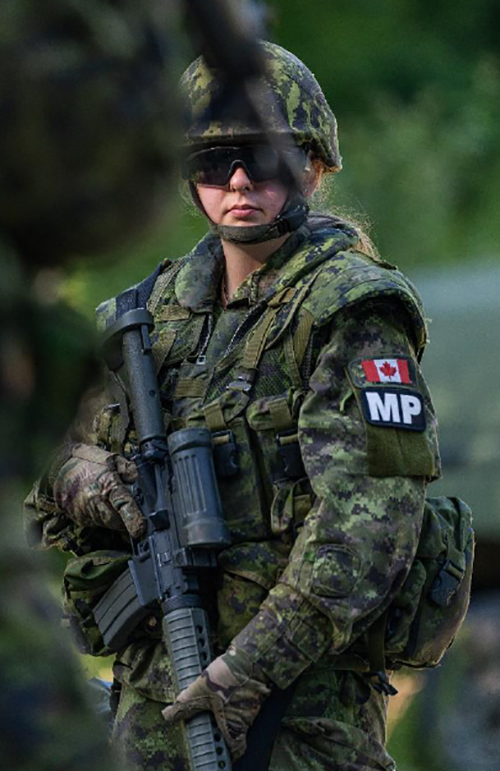
Caption
A Military Police Reservist participates in field training during summer military police qualification activities.
Mission
The CF MP provides professional policing, security, detention, and operational support to the CAF and DND globally, across the full spectrum of military operations.
Vision
The CF MP will generate and sustain a credible and professional MP force properly resourced and enabled to conduct operations in the joint, combined environment through the implementation of its assigned mission and core functions.
Values
MP are expected to conform to the standards established by the MP Professional Code of Conduct (MPPCC), which embraces the following values:
- Loyalty
- Accountability
- Integrity/Ethics
- Competence
- Pride/Professionalism
Structure and Independence
The CFPM is appointed by the CDS and is the functional authority for military policing within the CAF and the designated advisor to the MND and the CDS on military policing matters. The person assigned to the position of the CFPM is also appointed as the Commander of the CF MP Gp and exercises full command over all MP personnel independently from the CAF Chain of Command (CoC) when performing policing duties and functions.
The CFPM is supported directly by two senior officers who hold the positions of Deputy Canadian Forces Provost Marshal (DCFPM) and the Deputy Commander (DComd) of the CF MP Gp.
The DCFPM executes, on behalf of the CFPM, their responsibilities under the National Defence Act (NDA) and oversees the Office of the CFPM which includes the selection and training of MP, production of policing policy, conducting oversight and evaluation, and ensuring compliance and accountability of the MP.
The DComd of the CF MP Gp remains responsible for the oversight of the physical delivery of the MP program by the CF MP Gp, domestically and overseas.
MP Organizational Renewal
Modernizing for the MP Mission
A cohesive and modern CF MP with clear authorities, optimized resource sharing, structured support, effective command and control (C2), and oversight across both policing and operational support functions was the goal of MP organizational renewal. The renewal occurred across three lines of effort that were undertaken in FY 25-26: Office of the CFPM, Operation FOCUS, and CF MP Gp HQ restructure.
Office of the CFPM structural optimization
Within the Office of the CFPM, three new positions will oversee three distinct areas:
- Assistant DCFPM (ADCFPM) Compliance - will comprise of the Public Affairs section and the Office of Professional Standards.
- ADCFPM Program - will supervise the MP Analytics Support Centre, MP Oversight and Evaluation, MP Policy and MP Information Release Section.
- The Occupational Authority Manager - will advise on the management, selection, and development of MP Branch personnel, supporting the CFPM as the occupational authority for MP and MP Officer (MPO) trades.
Over this past year initial growth to carry out these functions and future growth in personnel is anticipated, resulting in increased capacity and capability for evaluation of policing files, as well as investigations into alleged MP misconduct, either in the execution of their policing duties and functions or because of a potential breach of the MP Professional Code of Conduct.
Strategic Advisor Reserves
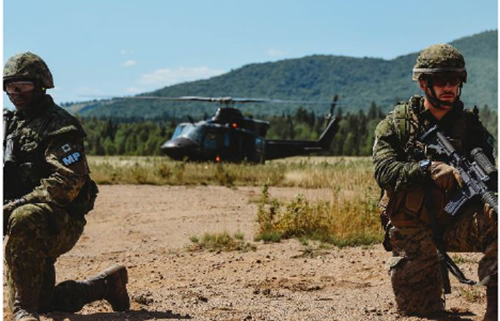
Caption
Military Police members participate in air mobility training alongside a Royal Canadian Air Force helicopter during a field exercise.
Colonel Jason Quilliam assumed the role of Strategic Advisor Reserves (SAR) in June 2025, serving as the principal advisor to the CFPM on governance, readiness, and employment, while providing strategic leadership and oversight in support of the MP Primary Reserve (MP PRes).
Through direct engagement with MP PRes units across Canada, including visits to each company, the SAR gained valuable insight into local challenges and opportunities, ensuring that policies and initiatives are informed by the lived realities of members at the sub-unit level. Ongoing stakeholder engagement with the Canadian Army, Chief of Reserves, and NATO partners has supported alignment on modernization efforts, including the evolution of operational structures under initiatives such as Op FOCUS, while reinforcing the importance of total force integration, readiness, and clear operational roles.
These efforts have been complemented by initiatives to strengthen readiness, infrastructure, and personnel sustainability. Enhancements to facilities, such as the modernization of 14 MP Platoon lines in 2026, have improved planning, training, and deployment capabilities, directly supporting domestic operational responsiveness. At the same time, the SAR has contributed to improving MP PRes strength through engagement on recruitment, retention, and employment opportunities, helping to identify gaps and inform future approaches. Continued collaboration with Reserve stakeholders aims to better align MP PRes capabilities with operational requirements while supporting the professional development and effective utilization of Reserve members across the MP enterprise.
Operation FOCUS
In FY 25-26, the CF MP Gp planned and began to implement a modernized structure that sees the elimination of dual role MP units, streamlines support functions, enhances oversight and readiness, and is designed to respond more effectively to today’s operational needs and the evolving expectations of the Defence Team.
A structure aligned to modern demands
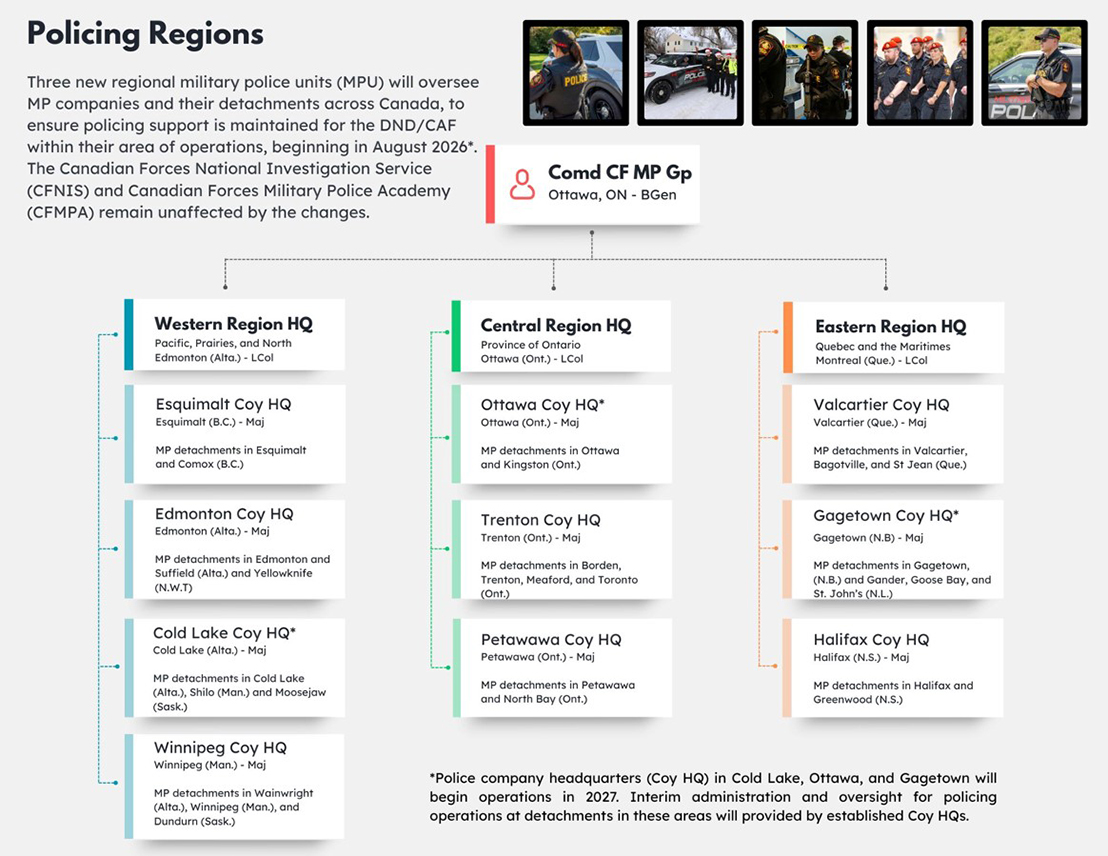
Under Operation FOCUS, CF MP Gp will introduce a streamlined model that consolidates all policing activities under three new regional Military Police Units (MPUs): MPU Western Region, MPU Central Region, and MPU Eastern Region. Each region will supervise MP companies and detachments within its geographical area, strengthening consistency, service delivery, and national coherence in military policing effects across Canada (Figure 1). The Canadian Forces National Investigation Service, who investigates serious, complex, and sensitive matters within DND/CAF maintains its organizational structure and was not affected by these changes.
Text version
Policing Regions
The graphic shows an organizational chart depicting the structure of new policing regions under the command of the Canadian Forces Military Police Group with images of military police personnel wearing their black law enforcement uniforms in the top right. It is shown that three new regional military police units will oversee MP companies and their detachments across Canada, to ensure law enforcement by the military police is maintained for the Department of National Defence and the Canadian Armed Forces within their areas of operations, beginning in August 2026.
- Western Region, shown by the colour blue, will oversee MP companies in Esquimalt, Edmonton, Cold Lake and Winnipeg.
- Esquimalt Company will oversee detachments in Esquimalt and Comox, British Columbia.
- Cold Lake Company will oversee detachments in Cold Lake, Alberta, Shilo, Manitoba, and Moosejaw, Saskatchewan.
- Winnipeg Company will oversee detachments in Winnipeg, Manitoba, Wainwright, Alberta, and Dundurn Saskatchewan.
- Central Region, shown by the colour green, will oversee MP companies in Ottawa, Trenton, and Petawawa.
- Eastern Region will oversee MP Companies in Valcartier, Gagetown, Halifax.
- Ottawa Company will oversee detachments in Ottawa and Kingston, Ontario.
- Trenton Company will oversee detachments in Trenton, Borden, Meaford, and Toronto, Ontario.
- Petawawa Company will oversee detachment in Petawawa and North Bay, Ontario.
- Eastern Region, shown by the colour orange, will oversee MP companies in Valcartier, Gagetown and Halifax.
- Valcartier Company will oversee detachments in Valcartier, St-Jean sur Richilieu, and Bagotville, Quebec.
- Gagetown Company will oversee detachments in Gagetown, New Brunswick, and Gander, Goose Bay, and St. John’s, Newfoundland.
- Halifax Company will oversee detachments in Halifax and Greenwood, Nova Scotia.
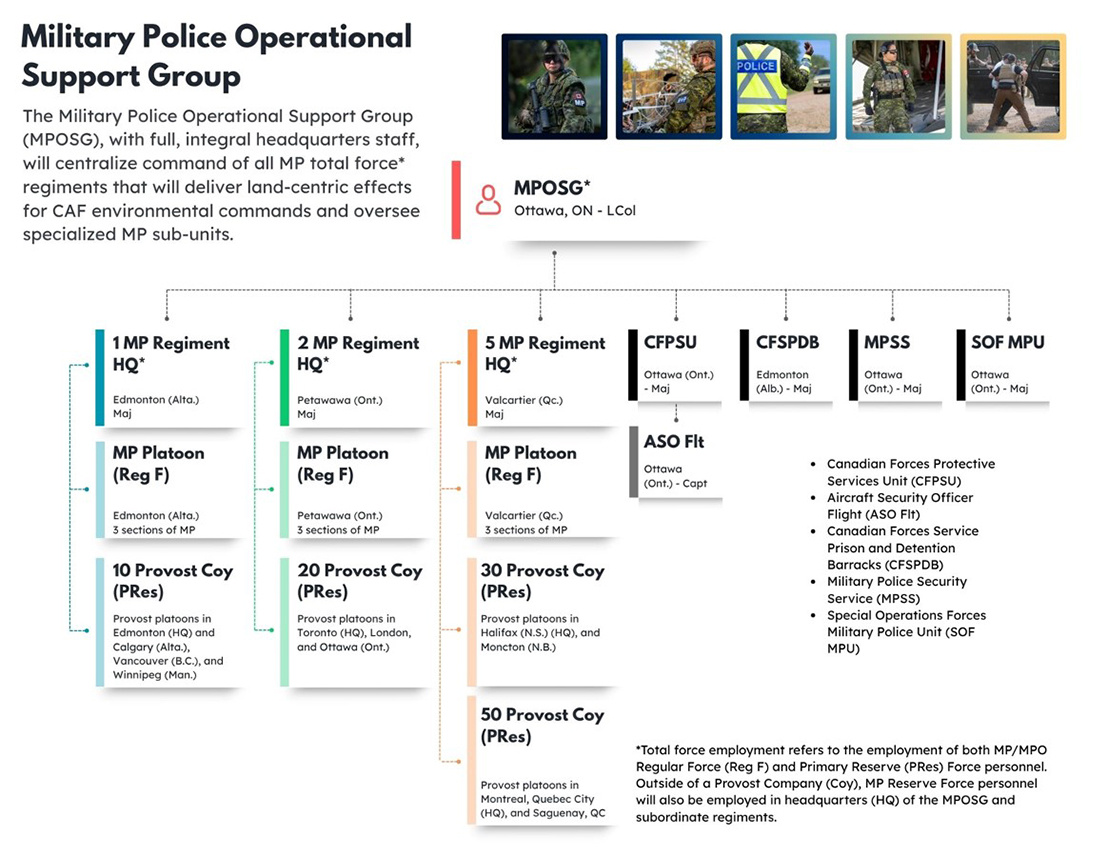
Alongside the establishment of regional MPUs, the CF MP Gp will stand up a new Military Police Operational Support Group (MPOSG). This Level 3 formation will oversee specialized MP capabilities, including protective services, detention, and security. MPOSG will also centralize coordination for MP operational support functions across CAF operations and in support of environmental commands (Figure 2).
Text version
Military Police Operational Support Group
The graphic shows an organizational chart depicting the structure of the new Military Police Operational Support Group with images of military police personnel conducting operational support tasks such as management of captured persons, mobility support, traffic control and aircraft and personnel security tasks.
It shows that 7 units of combined Regular Force and Primary Reserve personnel, will report to this new group within the Canadian Forces Military Police. They are shown from left to right, as:
- 1 Military Police Regiment, that oversees 1 Military Police Platoon, located in Edmonton, Alberta and 10 Provost Company, with sub-units in Edmonton, Calgary, Vancouver and Winnipeg.
- 2 Military Police Regiment, that oversees 1 Platoon, located in Petawawa, Ontario and 20 Provost Company, with sub-units in Toronto, London, and Ottawa, Ontario.
- 5 Military Police Regiment, that oversees 1 Platoon, located in Valcartier, Quebec and 30 and 40 Provost companies with sub-units in Halifax, Nova Scotia, Moncton, New Brunswick, and Montreal, Quebec City, and Saguenay, in Quebec.
- Canadian Forces Protective Services Unit, in Ottawa, Ontario, who will also oversee the Aircraft Security Officer Flight located in also in Ottawa, Ontario.
- Canadian Forces Service Prison and Detention Barracks, in Edmonton, Alberta.
- Military Police Security Services, headquartered in Ottawa, Ontario.
- Special Operations Forces Military Police Unit headquartered in Ottawa, Ontario.
Clarifying focus and strengthening oversight
Caption
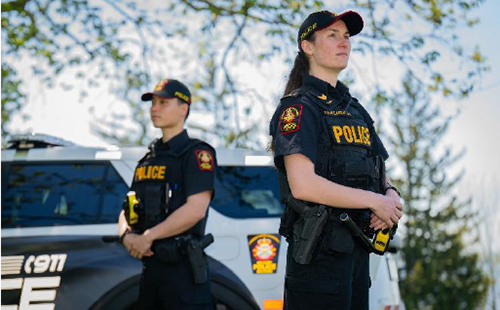
Military Police personnel from the Kingston Detachment participate in a photoshoot at CFB Kingston, Ontario, on May 26, 2026, posing in front of a marked patrol vehicle.
A key change introduced through organizational renewal is the removal of dual‑role MP units. MP personnel assigned to policing roles will focus exclusively on law enforcement duties, while those in operational support roles will work within MPOSG. This separation reinforces the perception of independence in policing, clarifies roles and responsibilities, and strengthens oversight.
The new structure simplifies command and control by clarifying reporting lines and responsibilities. This improves unity of effort and enhances overall readiness by ensuring people and resources are aligned to their core functions. MP members will still be trained for the dual role that they are expected to deliver in support of the CAF/DND. A new MP training directive will standardize the baseline training required for all MP personnel, whether assigned to an MP detachment, a field platoon, or an MP headquarters.
Timeline for implementation
Structural changes to the organization will begin during Active Posting Season (APS) 2026, with Initial Operational Capability expected later the same year. Existing MP detachments will remain where they are, while new headquarters elements at Levels 3 and 4 are established to support the transition.
A stronger foundation for the future
MP organizational renewal represents a major step toward building a more agile, resilient, and future-ready MP capabilities for the DND/CAF. This transformation is not simply structural; it is strategic. It positions the MP to meet the challenges of today and anticipate the demands of tomorrow. The Defence Team can expect clearer mandates, strengthened perception of independence in policing, and improved support across CAF operations as the new model takes effect in July 2026.
CF MP Gp Headquarters restructure
The CF MP Gp headquarters (HQ) initiated its own structure review to improve coordination, streamline processes and ensure efficient and effective support to the CF MP Gp in three distinct areas: policing effects, MP Compliance, and MP Program. The HQ restructure was aligned with Op FOCUS and the CF MP Gp transition to CJFC to reinforce and compliment the separate change efforts already underway.
In the delivery of military policing effects, and effective April 1, 2025, the roles of Assistant Chief of Staff (ACOS) Personnel and ACOS Plans were implemented, replacing ACOS Reserve and ACOS Readiness, respectively. The change to the titles of these personnel and growth of positions in these areas align with the established continental staff functions of personnel management (ACOS Personnel) and strategic and operational planning (ACOS Plans).
Under ACOS Plans, a J5 function will be introduced and represents a significant modernization milestone for CF MP Gp, enabling a more proactive, coherent, and future‑focused planning posture across the enterprise. The J5 will lead the development of 1 to 5-year planning calendars, MP capability development, strategic scans, and the first generation of J5 Planning Directives, while initiating external engagement with key partners such as Command Military Personnel, Assistant Deputy Minister (Information Management), and Canadian Joint Operations Command.
Under ACOS Personnel work was undertaken to streamline human resources and administrative support for all Defence Team members within CF MP Gp, including Regular and Reserve Force personnel, and civilian employees. Since its establishment, the section has continued to mature, aligning processes and improving service delivery. Notably, it has achieved early success in strengthening administrative functions, particularly through more efficient and responsive civilian staffing initiatives.
MP Program, Compliance, and Oversight
The Office of the CFPM, directed by the DCFPM, ensures the effective and efficient management and execution of the CFPM’s responsibilities as written in the National Defence Act (NDA) relating to the MP program, compliance with selection of training standards and selection, and oversight of MP investigations and members.
Updates on Reviews
Judicial Reviews
Recently a judicial decision was rendered in favour of the Attorney General regarding three judicial reviews pertaining to the application of Part IV of the NDA. The Office of the CFPM will now move forward to determine the manner in which internal processes can be amended in the classification of conduct complaints and the legislative requirements for disclosure.
Implementation of External Reviews and Advisory Panels
The OCFPM continued to work closely with the Director External Reviews Implementation Secretariat (DGERIS) under Chief Professional Conduct and Culture.
Third Independent Review of the National Defence Act (authored by the Honourable Morris Fish)
Work continues on the remaining recommendations made by the Honourable Morris Fish whereby the CFPM was noted as the Office of Primary Interest (OPI) or had shared responsibilities with other Military Justice System actors.
- IR3 17 (collection, retention and centralization of data on civil offences) - Partial Implementation - Work continues to expand data offerings. Slated for full implementation and publication of datasets in the CFPM 2026-2027 Annual Report.
- IR3 18 - Substantially Implemented (exercise of military jurisdiction over civil offences committed by persons subject to the Code of Service Discipline) - Expected full implementation in 2026 with the publishing of applicable of portions of MP Policy Manual for the Defence Team and the larger public.
- IR3 35 (Publication and analysis of arrests and pre-trial custody) – Partial implementation - Delays in programing to publish required data sets will delay full implementation to the CFPM’s 2026-2027 Annual Report.
Additionally, In FY 25/26 eight recommendations made by the Honourable Justic Fish that proposed changes to the NDA were before House of Commons as part of Bill C-11. As of the writing of this report, Bill C-11 is being studied in committee in the Senate of Canada. The CFPM will act expeditiously should any changes that concern the authorities or independence of the CFPM under the NDA come into effect.
Independent External Comprehensive Review (authored by the Honourable Louise Arbour)
The CFPM continues to implement the interim recommendation of the Honourable Louis Arbour in that allegations of criminal code sexual offences occurring in Canada are referred to civilian police of concurrent jurisdiction in a victim-centric, trauma-informed approach.
The final recommendation to be implemented (Recommendation 5 – removal of CAF jurisdiction for Criminal Code Sexual Offences) requires legislative changes to the NDA that were presented as part of Bill C-11. The CFPM will act expeditiously should any changes that concern the CAF jurisdiction over Criminal Code Sexual Offences come into effect. As of the writing of this report, Bill C-11 is being studied in committee in the Senate of Canada.
Further, the CF MP are leading a Criminal Code Sexual Offences Operational Framework working group in Ontario. This working group aims to develop a framework for the transfer of cases and includes participants from the Ontario Association of Chiefs of Police, the Ontario Solicitor General and the Ministry of the Attorney General.
Recommendations from the MND Advisory Panel on Systemic Racism and Discrimination
In 2026, the MP also developed protocols to exchange information concerning extremism as part of the CAF’s wider effort to combat extremism and further culture change. The information sharing agreement addresses legal and operational restrictions, as well as the appropriate and relevant use of police, security and intelligence information across DND security partners.
Selection and Training Standards
Caption
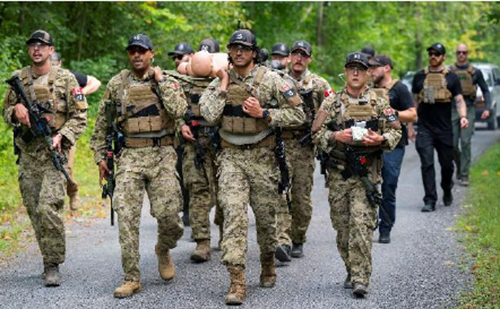
Candidates of Close Protection Operator Course 2501 conduct a casualty evacuation scenario on July 27, 2025 at Connaught Range, Ottawa, Ontario.
The CFPM is responsible for the establishment of selection and training standards applicable to MP candidates, and compliance with those standards. The addition of an Occupational Authority Manager to the Office of the CFPM in 2026 will strengthen the support to the CFPM in their responsibilities of development and talent management of MP personnel.
MP Selection
The MP Selection section is responsible for the coordination and implementation of selection standards that determine the suitability of candidates for MP, MPO, and Close Protection Operator, in support of effective and efficient MP force generation. Additionally, the section oversees compliance with selection assessment standards by delivering training, conducting quality control, and providing technical guidance. Through these functions, the integrity, reliability and accessibility of selection processes are safeguarded and support the recruitment and sustainment of a capable and professional MP force.
During FY 25/26, MP Selection processed a total of 376 MP applicant files across non-commissioned member and officer streams, successfully advancing 222 candidates to suitability determination. The section maintained steady processing momentum across both civilian and in-service pipelines, ensuring a consistent flow of candidates into force generation.
MP Policy
Caption
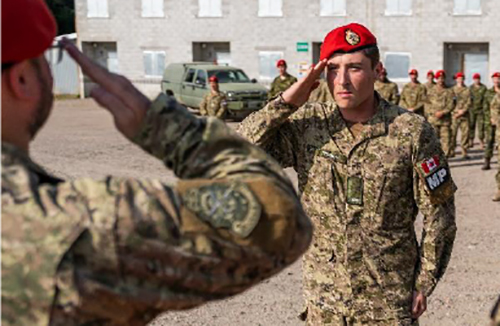
Members of the Canadian Forces Military Police Academy participate in a graduation parade during a ceremony recognizing successful completion of military police training.
The MP Policy section, within the Office of the CFPM, develops and maintains MP policies and procedures, ensuring they remain operationally relevant, legally compliant, and aligned with CFPM priorities. In collaboration with internal and external partners, the Policy Section provides clear, consistent, and accountable frameworks that support effective, lawful, and professional MP operations across DND and the CAF, reinforcing transparency, predictability, and public trust. The MP Policy is also responsible for integrating recommendations from both internal and external stakeholders into policy instruments and preserving historic policy records.
This reporting period included important updates to the Mental Health Intervention and Criminal Code Sexual Offences policies and the introduction of a new Welfare Checks policy. Together, these changes strengthen trauma informed, legally compliant responses to individuals in crisis. The Sexual Offences policy reinforces a victim centric approach and ensures victims are enabled to make an informed choice between MP and civilian police investigations concerning criminal code sexual offences.
Compliance with MP Investigative Standards
The MP Oversight and Evaluation (O&E) section was re-established in October 2025 and plays a critical role in promoting transparency, accountability, and operational effectiveness within the CF MP Gp. Responsible for conducting strategic evaluations of policing units nationwide, the section identifies systemic issues and ensures compliance with federal legislation, MP policies and CAF regulations. While self-evaluations or audits have always been required, the re-introduction of strategic evaluations provides added assurances that issues are identified, and action taken and that policies are applied consistently across CF MP Gp. A total of six (6) self- or strategic evaluation audits were performed in FY 25-26 in units across Canada.
Through either self- or strategic evaluations, several deficiencies were evident across multiple organizational and operational areas including:
- Persistent staff shortfalls that contributed to reduced oversight of investigative files and delays in file progression.
- Reduced operational effectiveness due to aging facilities, vehicles, and communications systems.
- Training challenges, including a shortage of bilingual instructors.
- Procedural issues that led to inconsistent investigative approaches, client communication, and evidence management.
The issues identified by O&E section and MP units signal the need for continued investment in MP resources and modernization efforts, and the maintenance of internal evaluations that will be achieved through the planned organizational renewal - Op FOCUS and additional resources in the Office of the CFPM. Despite these challenges, the MP continue to demonstrate strong professionalism in their interactions with both the public and CAF/DND members and maintain positive working relationships with external law enforcement partners.
MP Conduct & MP Professional Code Investigations and Outcomes
The CFPM is responsible for investigations in respect of MP conduct that is inconsistent with the professional standards applicable to the MP or the Military Police Professional Code of Conduct. Maintaining the trust of the public that MP serve is essential, and the CFPM remains committed to ensuring that all complaints are addressed thoroughly, fairly, and as expeditiously as possible.
Over the past year, the MP have sustained efforts to improve efficiency, transparency, and accountability in the Office of Professional Standards (PS)
Additional staff has led to more timely review of complaints and streamlined investigative procedures to reduce case timelines. Increased communication directly with complaints has led to a greater understanding of the value of participating in informal resolution (IR), an effective approach that allows concerns to be addressed promptly and, when possible, resolved immediately to a complainant’s satisfaction. In previous years, less than 2% of complaints were resolved by informal resolution, whereas in 2025, 10% of complaints have been resolved through IR.
NDA Part IV complaints
From the period of January 1, 2025, to December 31, 2025, 73 new complaints were received by PS, and a total of 64 investigations were concluded, the majority of which were complaints that were received in previous years (Table 1). In 2025, 23 of the 73 complaints received in the calendar year were not investigated because they did not meet the requirements for investigation under the NDA Part IV (Table 1).
Upon completion of NDA Part IV investigation, a report is provided to the complainant detailing a summary of the complaint, findings of the investigation, summary of action that has been or will be taken, and the right for the complainant to request a review by the Military Police Complaints Commission (MPCC) (Figure 3). Observations and recommendations based off the findings, regardless of the findings being substantiated or not, are shared with MP leadership to implement meaningful change to prevent reoccurrence or reiterate policies and best policing practices to MP members.
When a complainant requests a review by the MPCC, the CFPM is required to provide the MPCC with all information and materials relevant to the conduct complaint as detailed in Part IV of the NDA. The CFPM, through the Office of PS, has been diligent in providing all required information to the MPCC to support their investigative processes for the purposes of their review. On average, information requested by the MPCC has been disclosed within 30 days, with only the necessary redactions applied and primarily due to client-solicitor privileged information (Table 2).
The CFPM ensures that all recommendations put forward by the MPCC Chairperson are formally addressed and appropriate action is taken to rectify identified issues (Table 2). In doing so, the CFPM clearly identifies the specific Military Police policies that will be amended, or the training enhancements that will be implemented. Alternatively, the CFPM explicitly outlines where no amendments are required. In cases where no action is to be taken, the CFPM provides a detailed rationale, citing existing policy, current training, or established best policing practices. While all recommendations made by the MPCC are given thorough consideration, recognition is also given to the necessity of professional judgment by Military Police members; not every unique situation can or should be governed by prescriptive policy, as MP must retain the flexibility to respond effectively to the circumstances at hand.
Unlike public complaints under review by MPCC, for which disclosure is mandatory, disclosure in support of Public Interest Investigations conducted by MPCC, is voluntary. The interpretation of the NDA in this regard was recently supported through a judicial review and subsequent decision, in favour of the Attorney General. Nonetheless, the CFPM demonstrates cooperation through the disclosure of information upon request, while taking measures to maintain the privacy of persons and internal processes.
MP Credential Review Boards
The Office of PS is also responsible for investigating potential breaches of the MP Professional Code of Conduct (MPPCC) and administers the MP Credentials Review Board (MPCRB), a process that aims to assess breaches of the MPPCC by credentialed MP. The board, made up of MPO, non-MP CAF officers, external civilians, and non-commissioned MP, makes recommendations to the CFPM on the suitability for a MP/MPO to retain their policing credentials. Additionally, when concerns arise regarding untrained MP (e.g. undergoing initial training and at the Canadian Forces Military Police Academy), a Suitability Review Board is convened to review the case and provide recommendations to the CFPM regarding the for retention of the MP/MPO.
In 2025, 39 MPPCC investigations into alleged breaches of the Code were completed. Two of the 39 investigations were related to a matter that is currently subject to a Public Interest Hearing led by the MPCC.
Outcomes
A total of four (4) MPCRBs were convened in 2025 and resulted in findings in favour of a breach of the code for all cases by the credential review board and accepted by the CFPM. In each case, the CFPM determined that each member was deemed suitable to continue serve as a MP. Outcomes varied across the cases: in one instance, the member’s suspension was continued until all assigned terms and conditions were satisfied. Two other members were issued terms and conditions but were permitted to resume full policing duties and functions while completing them. The fourth member elected to voluntarily release immediately following the MPCRB decision, and as a result, no terms and conditions were imposed.
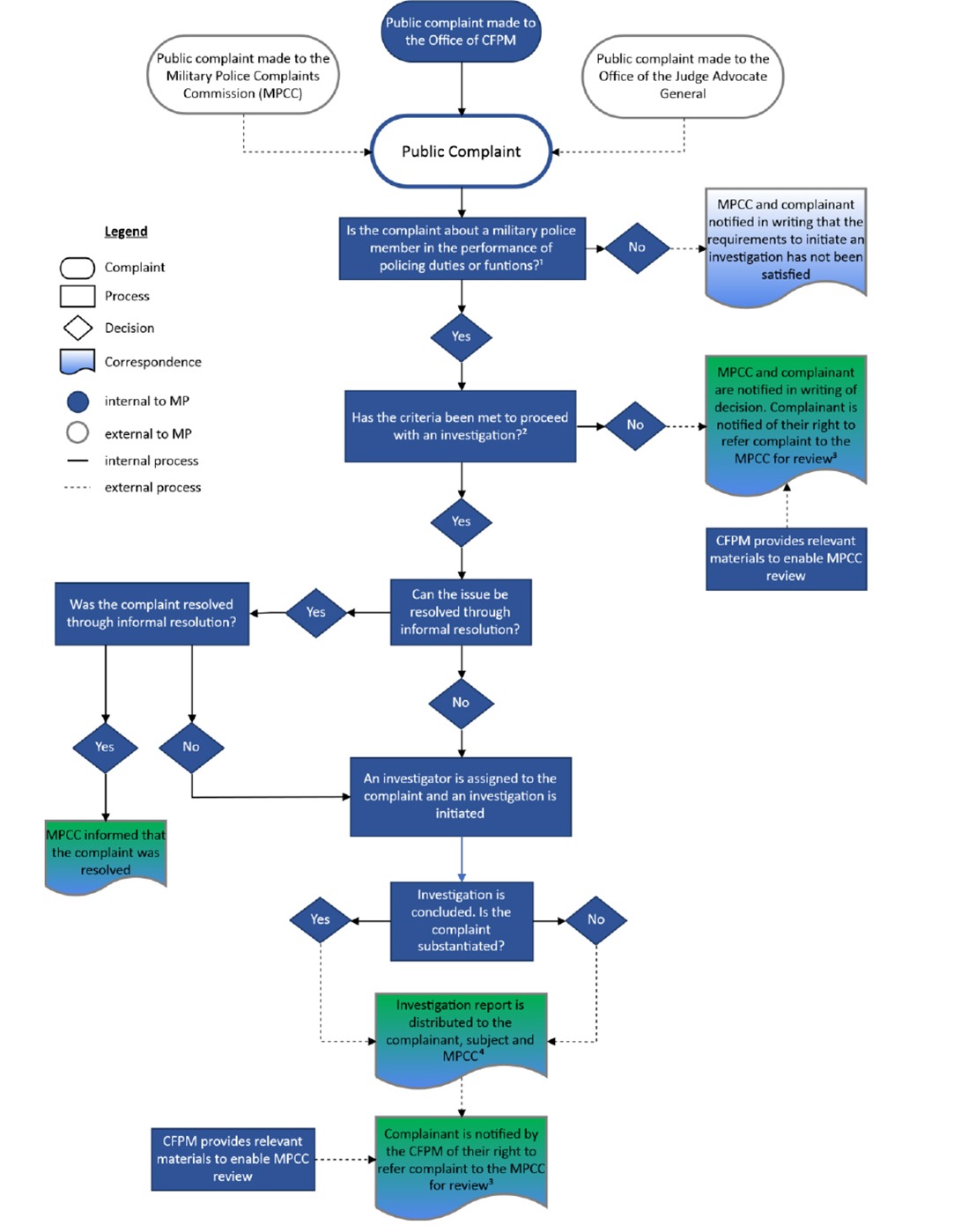
Text version
Legend
- Complaint
- Process
- Decision
- Correspondence
- Internal to MP
- External to MP
- Internal process
- External process
Process (not on chart)
Public complaint made to the Office of the CFPM
Public complaint made to the Office of the Judge Advocate General
Public complaint made to the Military Police Complaints Commission
- Public Complaint
- Is the complaint about a military police member in the performance of policing duties and functions?Return to footnote 1
- No - MPCC and complainant notified in writing that the requirements to initiate an investigation has not been satisfied
- Yes
- Has the criteria been met to proceed with an investigation?Return to footnote 2
- No: MPCC and complainant are notified in writing of decision. Complainant is notified of their right to refer the complaint to the MPCC for reviewReturn to footnote 3
- CFPM provides relevant materials to enable MPCC review
- Yes
- Can the issue be resolved through informal resolution?
- Yes
- Was the complaint resolved through informal resolution?
- Yes: MPCC informed that the complaint was resolved.
- No: Step 5.
- Was the complaint resolved through informal resolution?
- No – step 5
- Yes
- An investigator is assigned to the complaint and an investigation is initiated.
- Investigation is concluded. Is the complaint substantiated?
- Yes: The MPCC and the complainant are informed of the decision in writing. The complainant is informed of their right to refer the complaint to the MPCC for review.
- The CFPM provides the relevant documents to enable the MPCC to conduct its review
- No: The MPCC and the complainant are informed of the decision in writing. The complainant is informed of their right to refer the complaint to the MPCC for review.Return to footnote 4
| complaints | total |
|---|---|
| Public complaints received in 2025 | 73 |
| Public complaints carried forward and ongoing as of December 31, 2025 | 91 |
| Reason for closure | Number |
|---|---|
| Complaint not related to policing duties and functionsReturn to footnote 1 | 3 |
| Complaint not related to a MP (no jurisdiction) | 4 |
| Complaint withdrawn by complainant | 6 |
| Complaint Closed IAW s. 250.28Return to footnote 2 | 1 |
| Closed by Informal Resolution | 7 |
| MPCC denied extension of time limit | 2 |
| Total files not investigated under NDA Part IV | 23 |
| Received 2025 | Number concluded |
|---|---|
| Founded | 0 |
| Unfounded | 5 |
| Received 2024 | |
| Founded | 1 |
| Unfounded | 2 |
| Received 2023 | |
| Founded | 12 |
| Unfounded | 17 |
| Received 2022 | |
| Founded | 7 |
| Unfounded | 12 |
| Received 2021 | |
| Founded | 1 |
| Unfounded | 4 |
| Received 2020 | |
| Founded | 2 |
| Unfounded | 1 |
| Total Files investigated and concluded in 2025 | 64 |
| MPCC file number | Days for disclosure by CFPM to MPCC | MPCC Findings | MPCC findings consistent with PS | MPCC recommendations (number) | Action to be taken by CFPM | Action already taken by CFPM | No action required by CFPM |
|---|---|---|---|---|---|---|---|
| 2025-018 (review (R)) | 0 | vexatious | yes | 0 | |||
| 2023-014 (R) | 6 | 1 - not substantiated (NS) | yes | 1 | 1 | ||
| 2023-061 (R) | 18 | 2 - NS | yes | 4 | 4 | ||
| 2023-047 (R) | 16 | 1 - NS | yes | 0 | |||
| 2019-037 (R) | 8 | 2 - NS | yes | 1 | 1 | ||
| 2023-030 (R) | 12 | 1 – substantiated (S); 1 - NS | yes | 4 | 3 | 1 | |
| 2023-019 (R) | 13 | 2 – S | no | 7 | 6 | 1 | |
| 2021-010 (R) | 42 | 3 – S; 1 – NS; 2 – partially substantiated | no | 20 | 9 | 3 | 8 |
| 2024-046 (R) | 14 | 1 - S | n/aReturn to footnote 1 | 3 | 3 | ||
| 2024-020A (R) | 25 | 2 - S | n/aReturn to footnote 1 | 3 | 3 | ||
| 2022-050 (R) | 12 | 4 – NS | n/aReturn to footnote 1 | 0 | |||
| 2023-006 (PII) | 6 | 1 – S; 1 - NS | n/aReturn to footnote 2 | 16 | 10 | 4 | 2 |
MP Equipment and Future Capabilities
MP Equipment Improvements
Alcohol Screening Devices Life-cycling
Life cycling of Alcohol Screening Devices (ASDs) was conducted to replace aging equipment and standardize roadside screening on a single approved device, except where local calibration support or interoperability with Royal Canadian Mounted Police detachments made this impractical. The initiative resulted in the replacement and distribution of 108 ASD units to 17 MP detachments across seven provinces, ensuring continuity of roadside screening capability for impaired driving offences.
Soft Body Armour Ballistic Plates
During the fiscal year, a capability deficiency related to ballistic protection for female patrol officers was addressed after they were assessed as posing a potential safety risk regarding projectile deflection during active engagements. In coordination with the CAF Technical Authority, two appropriately sized ballistic plate variants were tested and approved as a mitigation measure. One variant, available from existing operational stock, was immediately issued to female patrol MPs, while delivery of the second variant is anticipated in the first quarter of FY 26/27.
Arctic MP Operational Patrol Dress (Arctic MPOPD)
As implementation of the Next Generation MP Occupational Patrol Dress (NGMPOPD) is ongoing, an interim solution was implemented to address extreme cold weather operational requirements. ACOS Support facilitated a trial and evaluation of outer, mid, and base layer clothing at MP Detachment Yellowknife. Feedback from this trial will inform future Use of Force policy considerations, address immediate cold weather clothing needs, and support development of the NGMPOPD project.
Digital Interview Recording
A controlled, Defence Wide Area Network–enabled trial of a Digital Interview Recording capability was initiated to assess its suitability for MP investigative operations and to modernize digital evidence handling. The trial evaluated an end to end interview workflow, including secure capture and upload, audit and digital disclosure processes, AI enabled transcription and redaction, automated chain of custody, near real time evidence availability, and the elimination of physical media and manual handling.
The initiative also assessed fixed interview room configurations and a Portable Interview Kit to support field and remote interviews while maintaining evidentiary integrity. Widely used across Canadian policing, including the RCMP and multiple municipal and provincial services, the trial was conducted to validate operational value, security, and governance considerations, and to inform decision making regarding potential future adoption.
Capability Development: Future MP Equipment and Technology
In FY 2025–2026, the Capability Development Team (CDT) ensured MP remained prepared for the full spectrum of CAF operations and adaptable to evolving policing techniques and technologies to maintain a relevant and ready policing service within the CAF and broader law‑enforcement community.
Through the work of the CDT, alongside input from MP stakeholders and subject‑matter experts across various MP specialties, the following projects were identified by the Capability Development Committee, in order of priority:
- Digital Evidence Management System – Body-worn cameras
- Conducted Energy Weapon
- Next Generation MP Operational Dress
- Duty Ammunition (5.56 mm)
- Duty Ammunition (9 mm)
- Frangible Ammunition (9 mm)
- Frangible Ammunition (5.56 mm)
- C8A4 (Canadian Modular Assault Rifle)
- Professional Standards Software
- Offender Management Software
Soldier Systems
Caption
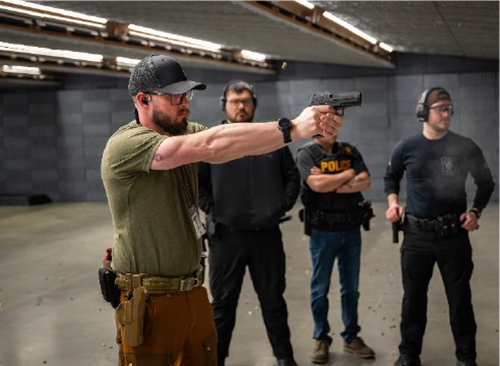
Military Police personnel conduct pistol drills during the Military Police Security Services pre-deployment training on March 24, 2026 at Connaught Range in Ottawa, Ontario.
Carbine Modernization - After an unprecedented budgetary increase this FY, the CAF leveraged the enhanced funding availability move forward on the carbine replacement project, that will see the new carbine platform in the hands of the CAF, MP included, much sooner than originally anticipated. The CDT continues its collaboration with Directorate Soldier Systems Program Management to ensure that the next generation of duty carbine, and its accoutrements, are tailor-made for the full spectrum of MP functions from policing to Close Protection and Aircraft Security Operation, on delivery.
MP Service Pistol (C24) – The replacement directive for the updated Height Adjustable Belt Loop and delivery of additional Close Engagement Ammunition Simulation System kits remain ongoing. As the C24 nears project close out, the CDT continues to research further improvements for the firearm platform including completing Red Dot Sights and fostering improvements to firearm training for the MP.
Next Generation Conducted Energy Weapon (CEW) – The CDT is moving forward on a project to upgrade the MP CEW to the Taser 10. The Taser 10 is a current generation non-lethal platform that, when combined with the training and information management systems to support its implementation, will generate improvements for continued CEW use by MP, operationally.
Ammunition Modernization - The CDT is moving ahead, alongside Directorate Ammunition and Explosive Management and Engineering, to bring both 9mm and 5.56mm Frangible Training Ammunition (FTA) and enhanced duty ammunition into MP service. FTA is ideal for indoor ranges and close-quarters battle training, makes MP training safer, due to reduced toxicity and ricochet risks, and makes training more realistic owing to the use of steel plate targets. Outside of the training environment, the CDT are identifying modern types of duty ammunition that is better tailored to policing applications, tested through use of the FBI Protocol as a baseline, and produces higher performance while minimizing collateral effects.
C4ISR Systems
Caption
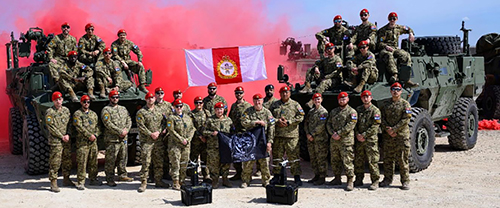
Members of the Canadian Forces Military Police, serving with the Multinational Brigade Latvia Military Police Company, gather at Ādaži Military Base, Latvia, on May 28, 2025, to mark the conclusion of their tour.
As technology advances the MP must also evolve in how technologies are employed in support of effective and efficient policing, security, and operational support to the CAF.
Uncrewed aerial systems (UAS) – The CF MP have made significant strides on an initiative to incorporate UAS into both policing and operational support tasks such as incident scene documentation, search operations, aerial surveillance and patrol, public order support, force protection, and evidence gathering.
Delivery of the first UAS platform that meets the current needs identified and aligns with existing CAF governance on UAS capabilities, the Parrot-Anafi UKR, is expected to be delivered prior to the end of 2026. The work to date by CF MP Gp ensures that UAS will be legally and safely employed to support policing, security and operational support tasks in both domestic and international deployed environments. Base-line training for MP within the CAF and outside agencies commenced in 2026, ensuring that the platform can be employed immediately on receipt by MP. Work will continue in FY 26-27with partners internal to the CAF, as well as other law enforcement agencies that already employ UAS capabilities.
Digital Evidence Management Software (DEMS)/Body Worn Cameras – The CDT has completed work on a memorandum of understanding with Axon’s DEMS to begin building new information management system capabilities to standardize how MP work and share information with other law enforcement agencies and justice system partners with heightened efficiency. In concert, MP are also exploring the use of body-worn cameras, creating an additional layer of MP accountability while building a strong mechanism to gather evidence for modern policing.
MP Individual Training
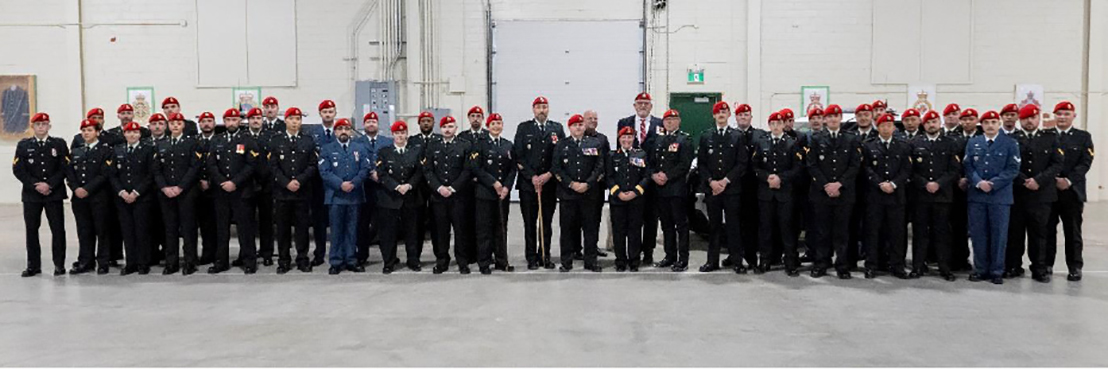
Caption
Canadian Forces Military Police Academy course 2502 graduation ceremony group photo in Borden Ontario, 05 December 2025.
During FY 2025/26, the Canadian Forces Military Police Academy (CFMPA) continued to modernize MP training through focused advancements in digital learning, curriculum development, and operationally relevant instruction. Emphasis was placed on strengthening training governance, updating lesson content, and enhancing Use of Force training, instructor development, and supporting equipment. Together, these efforts reinforce CFMPA’s commitment to delivering professional, adaptive, and mission ready training across the MP Branch.
Training by the Numbers
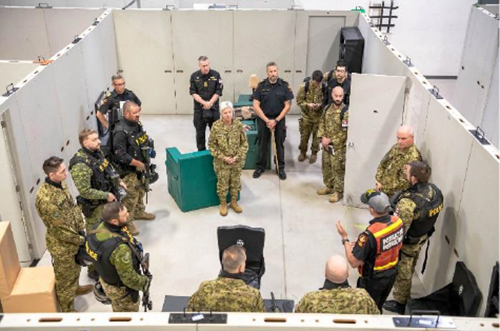
Caption
Canadian Armed Forces Military Police members and civilian law enforcement participants receive a briefing from an instructor during a training scenario inside a simulated environment facility.
CFMPA maintained student levels through an innovative blend of in-house, distance learning and decentralized MP Individual Training and Education (IT&E). The graduates along CFMPA’s four (4) Lines of Effort (LoE) are below, totaling three hundred and ninety-four (394) students that graduated:
- LoE Development Phase 1 (MP Junior Patroller Course/MP Officer Course) – 88 graduated
- LoE Advanced Training (Qualification Level (QL) 5/Primary Reserve (PRes) QL5/Use of Force Instructor/MP Investigator Course) – 131 certified
- LoE Distance Learning (QL6A/Pres, QL6A/QL6B) – 87 certified
- LoE Decentralized Training (Soldier Qualification/ PRes QL3/Close Protection Operator Course/MP Surveillance Course) – 88 certified
Technology and E-Learning Advancements
CFMPA continued to advance the modernization of MP training through expanded use of digital learning technologies and improvements to online instructional content. Building on previous DLN 3.0 initiatives, the Academy progressed the development of a modular Use of Force (UoF) e-learning platform designed to deliver standardized knowledge training across the MP enterprise through interactive, scenario-based modules. Courseware development increasingly incorporates multimedia elements, knowledge checks, and learner-centred design to improve engagement and knowledge retention. In parallel, CFMPA continued the modernization of MP training governance and the development of modular instructional structures to support future blended learning delivery. The Academy is also exploring partnerships with external academic institutions, including Seneca Polytechnic, to integrate artificial intelligence tools that can enhance Master Lesson Plan (MLP) development, streamline course updates, and support more efficient instructional design processes. These initiatives aim to deliver more scalable, adaptive, and modern learning solutions while improving the quality and consistency of MP training.
Lesson Content and Development
In FY 25/26, CFMPA continued the modernization of MP training through several key developments in lesson content. These included the validation and amendment of the Use of Force Instructor (UoFI) Qualification Standard and Plan (QSP), the development of the Regular Force Corporal QSP, and the conduct of Main Lesson Plan (MLP) development boards for the Military Police Officer Course (MPOC). CFMPA also initiated a comprehensive rewrite of the MPOC Qualification Standard to better align officer training with contemporary MP leadership and operational requirements. Collectively, these efforts strengthen training governance and ensure MP training remains aligned with the evolving operational demands of the CAF
Improvements in Use of Force Equipment
MP carry a range of tools designed to manage situations involving resistance and threats, while supporting the principles of lawfulness, necessity, proportionality, and officer/public safety. These tools are selected and used in accordance with the Criminal Code, provincial and federal policies, and the National Use of Force Model.
CF MP Gp procured new training and operational varieties of a multi-use rescue tool that combines a small baton with a window break point and seat belt cutter. The red coloured training variety omits the window break point and cutter, allowing for the safe introduction of critical training equipment while mitigating risks to all participants. The operational variety will be silver in colour, sheathed in a scabbard that will mount to a belt, pocket or additional webbing worn by MP during the execution of their military and policing duties.
To properly implement the use of the tool in training and eventually, operationally in military policing, CFMPA began a train-the-trainer program with UoFIs during combatives training. The initial implementation and training will enable CFMPA UOFIs to make updates to lesson plans, prior to instructing candidates on the use of the new equipment for eventual use operationally.
Individual Law Enforcement Training
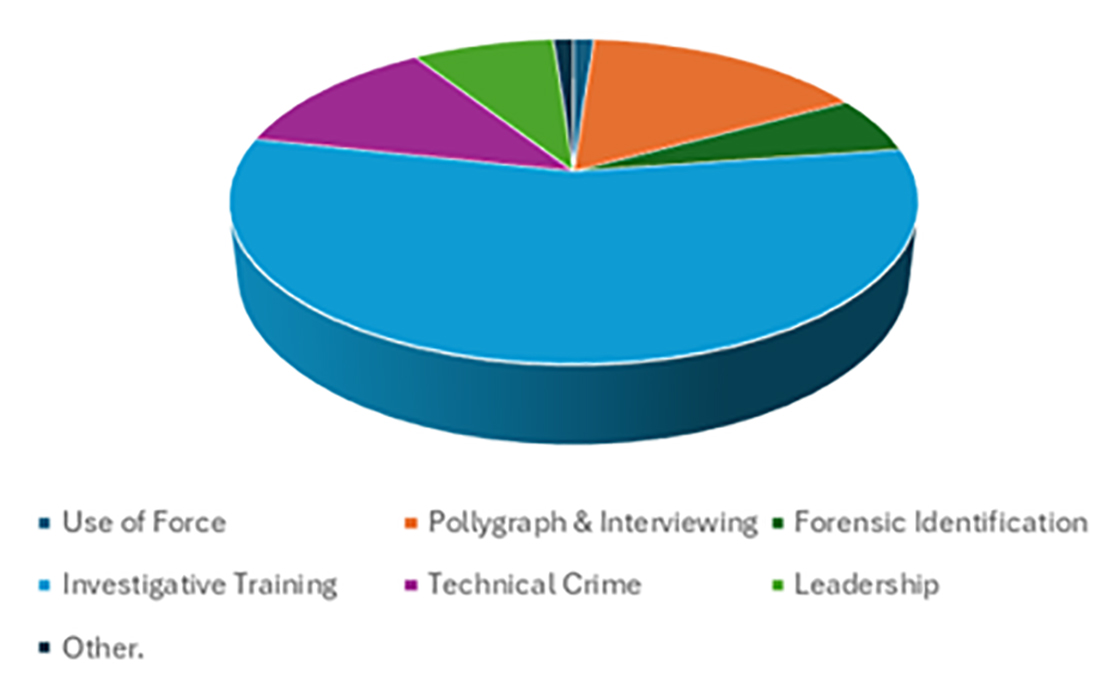
Additional individual training amplifies and compliments knowledge beyond what personnel have already learned at CFPMA and develops them professionally. Additional professional development is provided to MP Gp members, commensurate with Canadian Policing standards and practices. In FY 25-26, 318 MP Gp personnel went on 37 different training courses, across 11 training institutions.
Through partnerships with Canadian provincial and municipal Police Colleges and training centres, industry, the Canadian Police Knowledge Network (CPKN), and Foreign MP Schools abroad, including the NATO MP Centre of Excellence, MP have attained additional professional development in topics such as: National (Canadian) Use of Force Program
- National (Canadian) Drug Recognition Examiner Program
- Forensic Identification
- Investigative Training
- Leadership
- Polygraph and Interviewing, and
- Technical Crime
Course distribution by Theme
Text version
| School | Course | Total |
|---|---|---|
| AXON | Master CEW Instructor | 1 |
| CATC | Advanced Polygraph Examiner | 1 |
| CPC | Forensic Identification | 1 |
| Advanced Sexual Offence Investigator | 2 | |
| Anti-Corruption Investigation Techniques | 2 | |
| Financial Investigations | 2 | |
| Major Case Management: Team Commander | 3 | |
| Organized Crime | 2 | |
| Investigative Phased Interviewing | 5 | |
| Computer Forensic Examiner | 1 | |
| Internet Evidence Analysis | 1 | |
| Mobile Device Acquisition & Analysis | 2 | |
| Digital Technologies for Investigators | 1 | |
| Cybercrime Investigator | 1 | |
| Using the Internet as and Intelligence Tool | 2 | |
| Peer2Peer Investigator | 3 | |
| ENPQ | Enquêtes sur l’abus physique et le décès de jeunes enfants | 1 |
| Agent de renseingment criminel | 2 | |
| LSI | Scientific Content Analysis | 2 |
| NH | Fall Protection and Rescue Training | 1 |
| OPC | Search Warrant | 14 |
| Sexual Assault Investigation | 4 | |
| Domestic Violence Investigation | 3 | |
| Fraud Investigation | 1 | |
| Death Investigation | 2 | |
| Investigating Offences Against Children | 3 | |
| Hate Crime Investigation | 1 | |
| Investigative Interviewing Techniques | 8 | |
| DRE | 5 | |
| TPS | Scene of Crime Officer | 2 |
| VPD | Undercover Operator | 2 |
| CPKN | Various | 230 |
| FMOST | Women's Leadership Institute | 1 |
| NATO MP Jr Officer | 1 | |
| NATO MP Sr Officer | 2 | |
| NATO MP Sr NCO | 1 | |
| MP in Hybrid Warfare | 2 | |
| Totals | 318 |
Health and Wellness of the Force

Caption
Military members came together to participate in the Payne Train and Dinning Challenge on April 22nd to honour members Cpl Matt Dinning and Cpl Randy Payne that passed away in 2008 while serving abroad in Afghanistan.
Over the past year, the CF MP Health and Wellness Committee has continued to advance initiatives aimed at strengthening the physical and mental health of MP members. Building on its mandate, the committee has led substantive progress on the revision of the Road to Mental Readiness for Military Police (R2MR4MP) program and has advanced proposals to integrate MP Balance with the CAF’s new performance application enhancing access to modern, data informed wellness tools.
The R2MR4MP program was updated to better support members, leaders, and overall readiness. Working with Canadian Forces Health Services, the CFMPA improved how the training is delivered in garrison by combining online learning with more hands on, instructor led practice. The content was validated by health professionals, tailored to the realities of MP work, and strengthened through real world scenarios, with increased emphasis on Policing Persons in Crisis. In FY 2025/26, these improvements supported the training of 81 new members and 173 leaders, helping them better manage stress, support their teams, and maintain performance. After formal training, members and leaders will continue to receive support through online Unit and Leadership Toolboxes, which provide easy, on demand access to mental readiness resources for self study and unit refresher training, helping sustain health, readiness, and effectiveness throughout the member’s career.
Following the initial trials, the Canadian Forces Morale and Welfare Services Physical Performance Platform (HexFit app) continue to demonstrate positive outcomes among CFMPA staff and students, with strong engagement and favourable feedback. As the CAF’s new performance app, CFMPA personnel, HexFit provides a comprehensive digital platform that enables personalized fitness and nutrition programming, remote progress tracking, and direct communication between members and trainers via a mobile application. An official rollout in both official languages is anticipated in the near future, with the next bound focused on establishing a distinct MP Group within the app and integrating MP Balance, another online resource on the Distance Learning Network 3.0 supporting fitness, nutrition, sleep, and mental health, toward the end state of a personalized, robust, and comprehensive MP-specific health and wellness application accessible on personal mobile devices.
MP Operations and Exercises
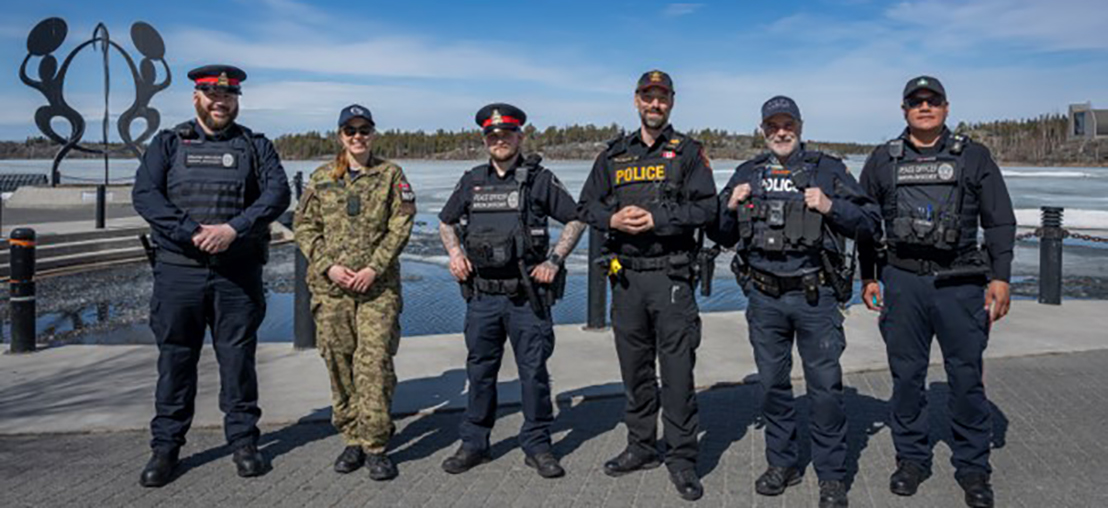
Caption
Members of the Canadian Armed Forces Military Police and local law enforcement participate in a community barbecue in support of National Police Week in Yellowknife, Northwest Territories, on May 11, 2026.
The CF MP Gp executes policing, security, detention and operational support tasks for the Defence Team. Throughout fiscal year 2025–2026, MP delivered exceptional and wide ranging contributions, consistently enabling CAF and DND operations across all environments. Their professionalism, adaptability, and commitment ensured effective support to commanders and partners alike, regardless of the complexity, location, or nature of the task.
Operations
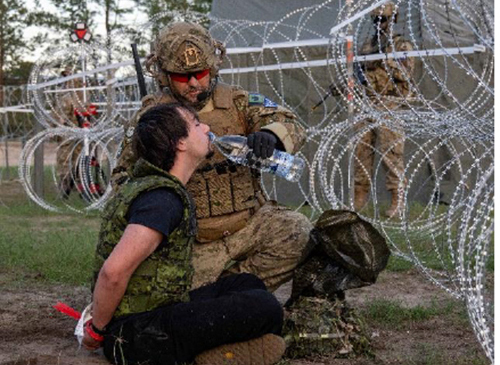
Caption
A Canadian Armed Forces member role-plays a detainee during a prisoner of war exercise conducted by Military Police at Ādaži Military Base, Latvia, on September 2nd, 2025.
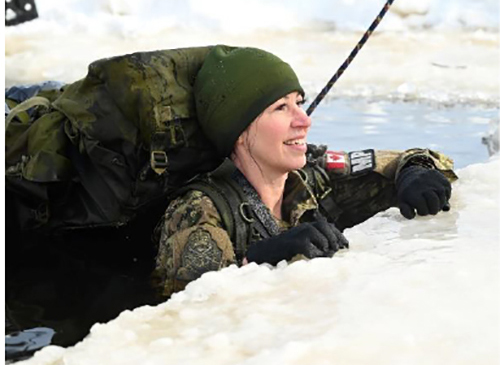
Caption
Members of 43 Military Police Platoon of Saguenay took part in a self rescue exercise conducted jointly with the Régiment du Saguenay on February 15th, 2026.
Across all formations, MP formations and units sustained a high operational tempo while supporting domestic security, expeditionary missions, and global engagements. Units enhanced interoperability through exercises with Canadian, NATO, and allied partners, while contributing to named operations such as REASSURANCE, UNIFIER, PRESENCE, and AMARNA. Specialized capabilities including close protection, embassy security, aircraft security, and special operations support ensured the protection of personnel, assets, and senior officials worldwide.
MP Primary Reserve (MP PRes) members played a critical role in strengthening total force employment by increasing operational availability and supporting both domestic tasks and international deployments. Their contributions included integration into deployed missions, notably through the establishment of a new three-year Class B MP PRes Platoon employment concept in support of Operation REASSURANCE, reinforcing the depth and sustainability of deployed MP capabilities.
Operational success was reinforced through strong coordination with host nations, interagency partners (e.g., RCMP, Global Affairs Canada), and multinational frameworks. Investigative services continued to address serious and sensitive matters, while new initiatives such as wastewater analysis improved awareness of emerging risks to personnel and institutions. High readiness, rapid deployment capacity, and sustained mission support demonstrated the adaptability and professionalism of MP across all environments.
Training
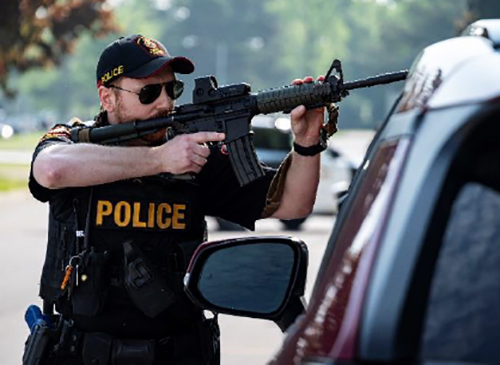
Caption
Members of 21 Military Police Flight and other organizations conducted Exercise Astral Defender, designed to prepare for crisis response at 8 Wing Trenton on 12 June 2025.
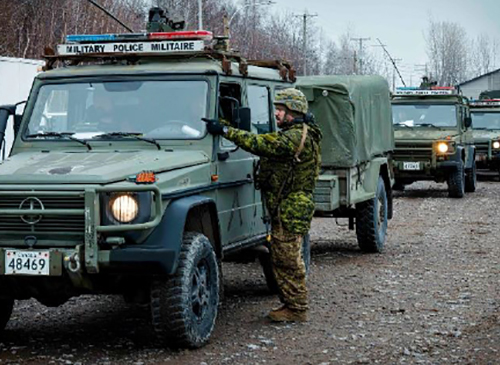
Caption
Members of 5 Military Police Platoon arrive in Trois Rivières, Quebec, in G Wagons while deployed on Exercise MAPLE RESOLVE, on April 16, 2026.
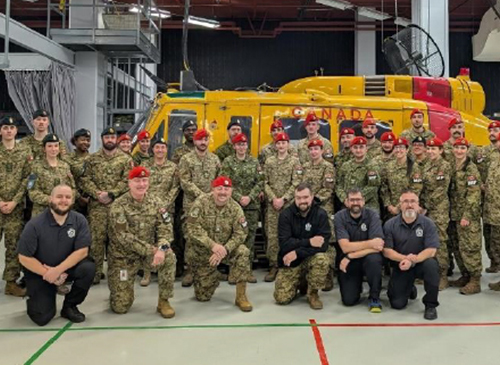
Caption
Military Police members and Royal Canadian Air Force Search and Rescue personnel pose for a group photo following joint training activities.
Training efforts focused on improving readiness, accessibility, and alignment with operational demands. Integration with Army and CAF planning systems enhanced early identification of requirements and participation in key exercises. Modular and simulation-based approaches increased flexibility for both Regular and Reserve members while strengthening interoperability.
MP PRes members expanded their training footprint through participation in Close Support Training, attendance on both Regular Force and Primary Reserve courses at CFMPA, and the introduction of modularized training that improved flexibility and accessibility. These initiatives supported sustained force generation and improved access to key qualifications.
Specialized training expanded across several domains, including close protection, aircraft security, close quarters battle, and uncrewed aircraft systems, ensuring personnel are prepared for complex and high-risk scenarios. Innovation in training was demonstrated through the Medical Policeman Exercise, a first-of-its-kind initiative delivered in partnership with the CAF Health Services Centre Simulation Centre. Using a crawl-walk-run model, participants progressed through realistic medical and tactical scenarios, resulting in measurable improvements in confidence and capability. This initiative highlighted the adaptability of MP PRes in leveraging local simulation resources to deliver high-quality training despite limited access to instructors.
Innovation
Innovation efforts focused on enhancing efficiency, safety, and operational capability. Personnel developed and validated practical solutions such as modular transport systems for detainee handling, improving deployment speed and reducing physical strain. Emerging technologies, including uncrewed aircraft systems, expanded surveillance and reconnaissance capabilities, while data-driven initiatives like wastewater monitoring provided new insights into health and security trends.
Across the organization, innovation was characterized by the integration of lessons learned from operations and training, ensuring continuous improvement and modernization of MP capabilities in support of evolving mission requirements.
Community Engagement
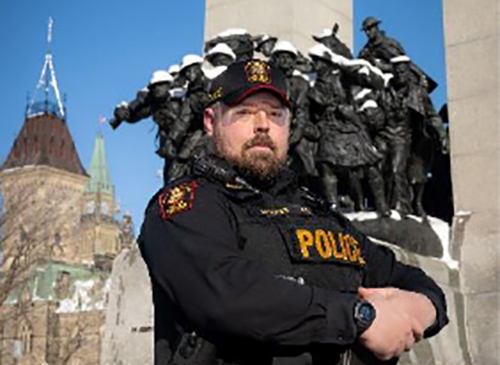
Caption
A Canadian Armed Forces Military Police member stands in front of the National War Memorial in Ottawa, Ontario, wearing operational uniform with visible police insignia and equipment.
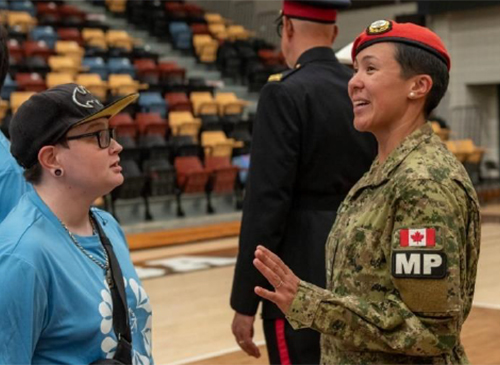
Caption
Members of the Air Force Military Police Group participate in the Law Enforcement Torch Run during Special Olympics Manitoba at the end of June, helping guide more than 350 athletes into the venue during the opening ceremony.
MP personnel demonstrated a strong commitment to community engagement both domestically and abroad, reinforcing trust and fostering positive relationships. Deployed members supported local initiatives, charitable activities, and outreach efforts, contributing to host communities and strengthening Canada’s presence internationally. Engagements ranged from supporting educational and social programs to participating in commemorative events that honoured service and sacrifice. These efforts reflect the professionalism, values, and dedication of MP members, while enhancing cooperation with local populations, partners, and stakeholders.
Honours and Awards
Throughout the FY 25-26, many exemplary MP members were presented with honours and awards in recognition of their hard work and dedication to the MP Branch and the Canadian Armed Forces. Honours and awards are more than ceremonial; they help set expectations, reinforce values, and inspire the next generation of leaders.
MP of the Year
The MP of the Year Award is an important recognition that the CFPM issues once a year recognize the extraordinary work of MP in the execution of their duties. Celebrating achievements like this reinforces positive role modelling, encourages pride in the profession, and supports retention by demonstrating that exceptional service is noticed and valued. Military Police Junior Officer of the Year
Military Police Junior Officer of the Year
Lieutenant (Navy) O’Shea (Canadian Forces National Investigation Service

Caption
A Canadian Armed Forces Military Police officer receives a certificate of recognition alongside colleagues during an awards presentation, with official flags displayed in the background.
Senior Regular Force MP of the Year
Petty Officer First Class Bregante (1 Military Police Squadron)

Caption
A certificate recipient poses with Military Police personnel and organizational representatives following a recognition award presentation.
Senior Primary Reserve Force MP of the Year
Sergeant Bilodeau (5 Military Police Regiment)

Caption
A certificate recipient poses with Military Police personnel and organizational representatives following a recognition award presentation.
Junior Regular Force MP of the Year
Corporal Martin (5 Military Police Regiment)

Caption
A recipient is presented with a certificate of recognition during a Military Police award presentation ceremony, with colleagues and organizational representatives gathered for a group photo.
Junior Primary Reserve Force MP of the Year
Master Corporal El-Shourbagy (2 Military Police Regiment)
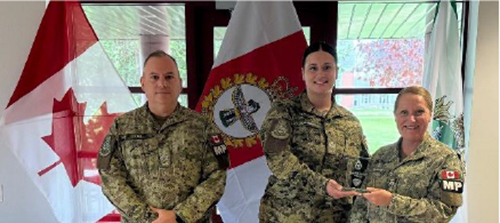
Caption
A Military Police Reservist receives an award during a presentation ceremony recognizing contributions and service within the Military Police Reserve.
Annexes
- Annex A – Mp Reported Incident Statistics
- Definitions
- Annex B - The MP in Numbers
- Annex C - CF MP Gp in Canada
- Annex D - Map – MP on named CAF Operations
- Annex E - Map – MP Security Service (MPSS)
Annex A – Mp Reported Incident Statistics
Law enforcement agencies collect vast quantities of data in their response to incidents and the resulting search for answers through investigation. Whereas investigations are focused on incident level outcomes, Data Management and Analytics (DMA) is focused on the organization and analysis of the aggregated data, to gain a better understanding of our effectiveness and how to support evidence-based decision making at all levels of the CAF/DND.
The data contained in this report is based on data extracted on April 30, 2026 from the Security and Military Police Information System (SAMPIS). The data set includes reports received up to and including December 31, 2025. As investigations continue to mature, this data is updated in SAMPIS to reflect new information and outcomes. Consequently, minor variations are to be expected when comparing numbers over time, with the most substantial changes noticeable when comparing the previous year’s data to reports last FY.
Unless otherwise stated, the numbers and analysis presented include only General Occurrence (GO) reports in which MP were the sole or lead investigating agency. These figures exclude joint investigations where another agency is the lead, for example, criminal code sexual offence investigations transferred to civilian police in a victim-centric, trauma informed approach.
Observations and special studies
National Security
A review was conducted to identify records of special interest to national security. Incidents considered were offences under the Foreign Interference and Security of Information Act, as well as offences or security reports pertaining to terrorism, espionage, sabotage, subversion and organized crime. There were relatively few incidents that fell into this category.
The most significant incident concerning national security was jointly investigated by the MP and RCMP that concluded in 2025. There were a small number of investigations into the release of classified information that were determined to be accidental in nature and no charges were pursued. When a security incident is reported, the MP work with other civilian police, as well as partners at the Director General Defence Security or the Canadian Forces Counter-intelligence Unit, as applicable.
Criminal Code Sexual Offences
With a victim centric approach to support the ongoing referral of criminal code sexual offenses to civilian police of concurrent jurisdiction (since December 2021), there is a noticeable drop in the number of violent crimes that are reflected in the data. The MP have consistently published data on the length of time to complete criminal code sexual offence investigations since this data was first provided to Mme Arbour for the purposes of the Independent External Comprehensive Review. There is no known comparable data with any other police force in Canada.
No individual investigation can be compared to a “time standard” because it must be evaluated on its own merits and take into consideration the requirement for an impartial and thorough investigation. The imposition of time standards could have an undue influence on quality.
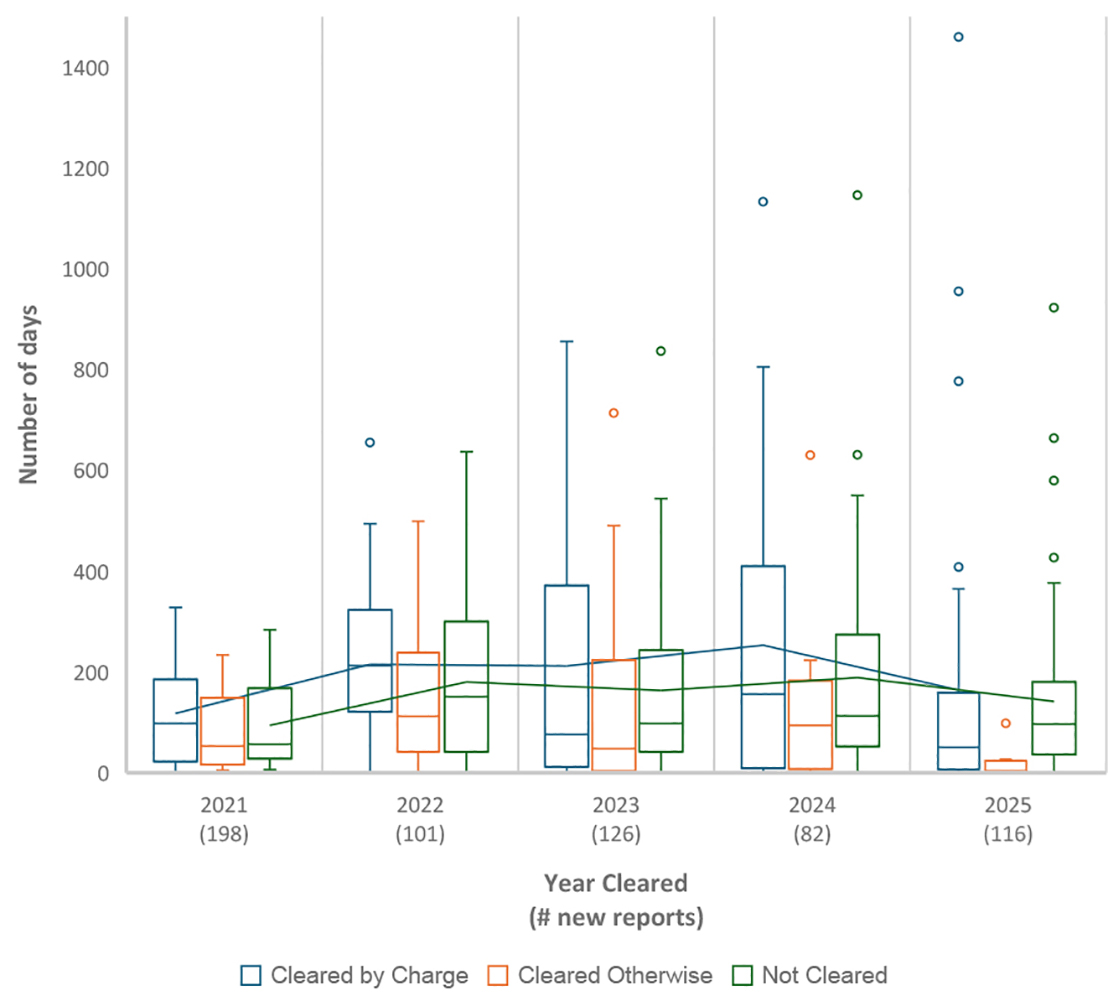
In this year’s report, the presentation of data has shifted from the length of time to complete the investigation by reporting period to the year the investigation was cleared (Figure A-1). The figures provided include the total number of investigations along with the minimum and maximum time to complete the investigations, as well as the median (middle) and the mean (average). Evaluation of the data presented needs to be examined in aggregate, over time, and in the context of calls for service, staffing and other workload and human resources data.
In the five-year period from 2021 to 2025 there is an increase in the average length of time it took to conclude criminal code sexual offence(s) investigations, whether cleared or concluded without meeting the threshold to lay charges (not cleared). This increase can be attributed in part to the fluctuations in the number of new reports received. The average peaks in 2024, with a noticeable drop for 2025, which can be attributed at least in part to a roughly 35% drop in new reports received from 2023 to 2024. It is important to note that more than half of the reports were cleared below the average, highlighting the impact that outliers (significantly more complex investigations) have on the overall average, and the limitations of evaluating the average length of time to complete an investigation.
Figure A-1 - Time to complete criminal code sexual offence(s) investigations. The number of new reports received each calendar year are indicated in parentheses.
Text version
| Year Cleared | Cleared by Charge | Cleared Otherwise | Not Cleared |
|---|---|---|---|
| 2021 (198) |
0 | 5 | 6 |
| 0 | 5 | 10 | |
| 1 | 14 | 12 | |
| 4 | 16 | 19 | |
| 5 | 21 | 20 | |
| 7 | 30 | 21 | |
| 7 | 41 | 22 | |
| 10 | 53 | 23 | |
| 20 | 80 | 24 | |
| 23 | 87 | 27 | |
| 34 | 87 | 28 | |
| 37 | 149 | 28 | |
| 59 | 162 | 29 | |
| 61 | 174 | 33 | |
| 71 | 234 | 33 | |
| 74 | 37 | ||
| 84 | 39 | ||
| 85 | 40 | ||
| 98 | 43 | ||
| 98 | 48 | ||
| 127 | 48 | ||
| 128 | 49 | ||
| 151 | 54 | ||
| 160 | 57 | ||
| 161 | 57 | ||
| 176 | 66 | ||
| 176 | 69 | ||
| 183 | 72 | ||
| 185 | 81 | ||
| 187 | 84 | ||
| 190 | 98 | ||
| 197 | 121 | ||
| 252 | 125 | ||
| 266 | 139 | ||
| 271 | 151 | ||
| 272 | 165 | ||
| 287 | 169 | ||
| 328 | 170 | ||
| 183 | |||
| 198 | |||
| 199 | |||
| 201 | |||
| 202 | |||
| 204 | |||
| 210 | |||
| 252 | |||
| 257 | |||
| 284 | |||
| 2022 (101) |
0 | 0 | 0 |
| 1 | 1 | 1 | |
| 1 | 1 | 2 | |
| 5 | 35 | 7 | |
| 5 | 48 | 12 | |
| 9 | 56 | 19 | |
| 9 | 76 | 20 | |
| 11 | 86 | 23 | |
| 14 | 112 | 25 | |
| 24 | 144 | 25 | |
| 43 | 195 | 28 | |
| 55 | 196 | 28 | |
| 61 | 206 | 32 | |
| 113 | 271 | 33 | |
| 124 | 300 | 35 | |
| 132 | 365 | 42 | |
| 140 | 499 | 45 | |
| 140 | 50 | ||
| 144 | 53 | ||
| 157 | 64 | ||
| 157 | 65 | ||
| 167 | 80 | ||
| 174 | 80 | ||
| 177 | 81 | ||
| 187 | 82 | ||
| 200 | 105 | ||
| 201 | 108 | ||
| 202 | 117 | ||
| 203 | 118 | ||
| 222 | 122 | ||
| 225 | 137 | ||
| 226 | 151 | ||
| 233 | 162 | ||
| 237 | 165 | ||
| 238 | 182 | ||
| 263 | 183 | ||
| 274 | 197 | ||
| 275 | 203 | ||
| 281 | 214 | ||
| 283 | 246 | ||
| 288 | 258 | ||
| 310 | 258 | ||
| 320 | 267 | ||
| 323 | 275 | ||
| 323 | 280 | ||
| 335 | 295 | ||
| 343 | 296 | ||
| 361 | 300 | ||
| 361 | 306 | ||
| 361 | 312 | ||
| 364 | 315 | ||
| 379 | 325 | ||
| 393 | 330 | ||
| 394 | 337 | ||
| 420 | 342 | ||
| 449 | 349 | ||
| 494 | 362 | ||
| 655 | 366 | ||
| 367 | |||
| 457 | |||
| 473 | |||
| 504 | |||
| 637 | |||
| 2023 (126) |
0 | 0 | 0 |
| 0 | 0 | 0 | |
| 0 | 2 | 0 | |
| 0 | 2 | 1 | |
| 1 | 3 | 10 | |
| 3 | 3 | 12 | |
| 3 | 12 | 15 | |
| 6 | 14 | 17 | |
| 7 | 16 | 20 | |
| 9 | 42 | 29 | |
| 9 | 47 | 32 | |
| 11 | 48 | 34 | |
| 12 | 57 | 39 | |
| 12 | 76 | 42 | |
| 12 | 100 | 47 | |
| 12 | 114 | 49 | |
| 20 | 202 | 50 | |
| 27 | 224 | 51 | |
| 31 | 226 | 53 | |
| 35 | 373 | 57 | |
| 46 | 461 | 59 | |
| 48 | 490 | 60 | |
| 62 | 714 | 80 | |
| 66 | 82 | ||
| 67 | 87 | ||
| 74 | 92 | ||
| 76 | 97 | ||
| 76 | 98 | ||
| 79 | 99 | ||
| 84 | 101 | ||
| 115 | 119 | ||
| 126 | 124 | ||
| 131 | 127 | ||
| 160 | 141 | ||
| 165 | 165 | ||
| 217 | 168 | ||
| 240 | 177 | ||
| 263 | 188 | ||
| 281 | 190 | ||
| 284 | 203 | ||
| 372 | 232 | ||
| 372 | 243 | ||
| 381 | 262 | ||
| 454 | 290 | ||
| 475 | 318 | ||
| 480 | 329 | ||
| 518 | 331 | ||
| 552 | 375 | ||
| 635 | 379 | ||
| 643 | 398 | ||
| 692 | 426 | ||
| 738 | 496 | ||
| 783 | 520 | ||
| 850 | 544 | ||
| 856 | 837 | ||
| 2024 (82) |
0 | 0 | 0 |
| 0 | 0 | 1 | |
| 0 | 1 | 1 | |
| 0 | 10 | 8 | |
| 2 | 10 | 8 | |
| 7 | 23 | 11 | |
| 7 | 84 | 21 | |
| 12 | 104 | 22 | |
| 23 | 147 | 27 | |
| 88 | 175 | 40 | |
| 102 | 178 | 46 | |
| 108 | 197 | 46 | |
| 116 | 223 | 50 | |
| 126 | 630 | 55 | |
| 156 | 56 | ||
| 186 | 56 | ||
| 223 | 56 | ||
| 251 | 56 | ||
| 319 | 75 | ||
| 329 | 80 | ||
| 338 | 89 | ||
| 365 | 91 | ||
| 454 | 96 | ||
| 455 | 102 | ||
| 485 | 103 | ||
| 508 | 104 | ||
| 753 | 113 | ||
| 805 | 114 | ||
| 1133 | 116 | ||
| 136 | |||
| 163 | |||
| 184 | |||
| 187 | |||
| 190 | |||
| 196 | |||
| 212 | |||
| 243 | |||
| 244 | |||
| 252 | |||
| 263 | |||
| 286 | |||
| 294 | |||
| 308 | |||
| 314 | |||
| 403 | |||
| 413 | |||
| 421 | |||
| 425 | |||
| 445 | |||
| 470 | |||
| 550 | |||
| 631 | |||
| 1146 | |||
| 2025 (116) |
0 | 0 | 0 |
| 0 | 0 | 1 | |
| 1 | 0 | 1 | |
| 1 | 0 | 2 | |
| 1 | 1 | 2 | |
| 2 | 1 | 3 | |
| 4 | 6 | 5 | |
| 4 | 6 | 5 | |
| 7 | 13 | 5 | |
| 7 | 27 | 10 | |
| 8 | 98 | 13 | |
| 14 | 99 | 21 | |
| 17 | 33 | ||
| 29 | 36 | ||
| 32 | 36 | ||
| 34 | 42 | ||
| 37 | 43 | ||
| 41 | 46 | ||
| 49 | 50 | ||
| 52 | 50 | ||
| 54 | 53 | ||
| 62 | 58 | ||
| 78 | 62 | ||
| 98 | 73 | ||
| 109 | 80 | ||
| 141 | 80 | ||
| 142 | 86 | ||
| 153 | 96 | ||
| 154 | 97 | ||
| 175 | 105 | ||
| 177 | 105 | ||
| 273 | 106 | ||
| 324 | 109 | ||
| 365 | 110 | ||
| 408 | 110 | ||
| 777 | 112 | ||
| 955 | 114 | ||
| 1460 | 130 | ||
| 147 | |||
| 147 | |||
| 148 | |||
| 154 | |||
| 189 | |||
| 195 | |||
| 210 | |||
| 221 | |||
| 248 | |||
| 288 | |||
| 301 | |||
| 307 | |||
| 311 | |||
| 377 | |||
| 427 | |||
| 580 | |||
| 664 | |||
| 923 |
Controlled Drugs and Drug Use
Studies show that there is a high comorbidity between mental illness and substance use disorders in the Canadian Armed Forces. In its role of investigating and reporting on criminal and service offences, the MP are involved in the enforcement of the Controlled Drugs and Substances Act, the Cannabis Act and the Queen’s Regulations and Orders for the CAF/DND. The latter of the three sets out conditions for use of drugs by members, specifically prohibiting the use of drugs except as prescribed by a medical practitioner or in the case of over-the-counter medication, in accordance with the accompanying instructionsReturn to footnote 1.
The ratio of possession offences to supply and production offences decreased slightly in 2023 and 2024, before increasing in 2025 as shown in Figure A-2. This is consistent with the increase in drug related offences being pursued as a service infraction, rather than a service or criminal offence. As the number of incidents remains small, statistical analysis is difficult. Guidance from the Public Prosecution Service of Canada suggests that prosecution of possession related offences should be reserved for instances where there are aggravating factors beyond just self-harm, and that alternatives should be consideredReturn to footnote 2. However, given the importance of operational readiness in the Canadian Armed Forces, these offences can have a more significant impact.
Figure A-2 – Ratio of possession to production/supply offences from 2021 to 2025.
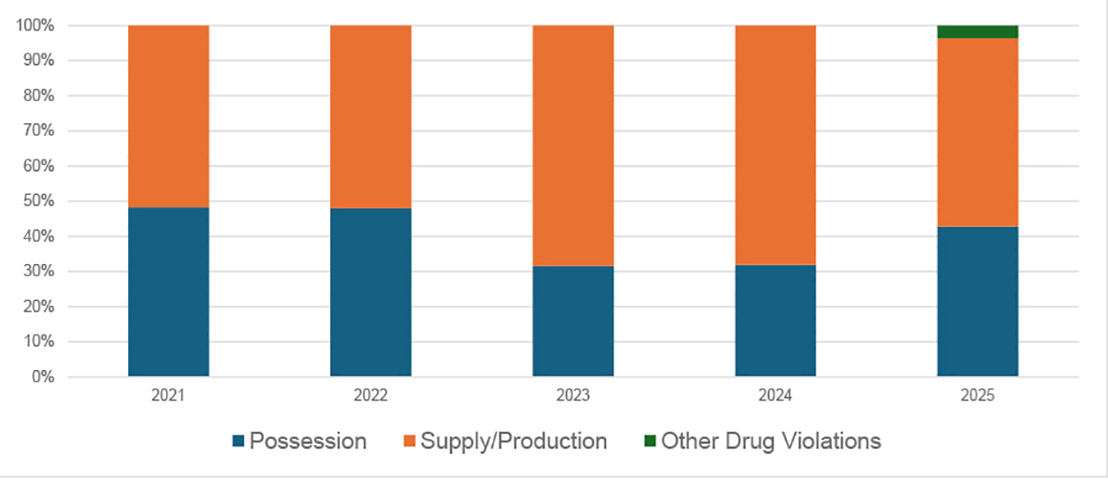
Text version
| - | 2021 | 2022 | 2023 | 2024 | 2025 |
|---|---|---|---|---|---|
| Possession | 14 | 12 | 6 | 8 | 12 |
| Supply/Production | 15 | 13 | 13 | 17 | 15 |
| Other Drug Violations | 1 |
The changes to the Military Justice System and the introduction of service infractions in 2022 affords a chain of command the opportunity to reinforce military order and discipline while avoiding the criminalization of mental health. Following the implementation of service infractions, there is a noticeable shift in outcomes for drug related incidents, as shown at Figure A-3. When comparing Figure A-3 (below) to later tables in this annex, it is important to note that this section is not addressing drug offences, but all incidents involving drug use.
Figure A-3 – Breakdown of incidents related to drug use by outcome
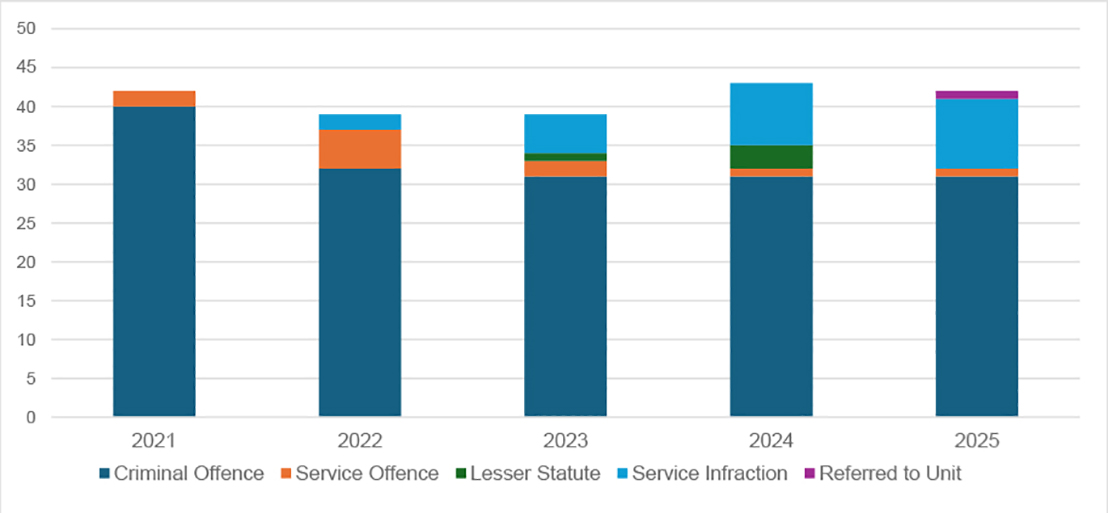
Text version
| - | 2021 | 2022 | 2023 | 2024 | 2025 |
|---|---|---|---|---|---|
| Criminal Offence | 40 | 32 | 31 | 31 | 31 |
| Service Offence | 2 | 5 | 2 | 1 | 1 |
| Lesser Statute | 1 | 3 | |||
| Service Infraction | 2 | 5 | 8 | 9 | |
| Referred to Unit | 1 |
Table A-1 categorizes incidents by the most serious violation; however, this section also considers incidents involving drugs as a secondary offence. While the vast majority are offences contrary to the Controlled Drugs and Substances Act, drugs can be involved in or a factor in other offences and remain a persistent concern.
| - | - | Year of Report | ||||
|---|---|---|---|---|---|---|
| 2021 | 2022 | 2023 | 2024 | 2025 | ||
| Drug Offence | CDSA | 29 | 25 | 19 | 25 | 28 |
| Cannabis Act | 5 | 3 | 6 | 2 | ||
| Criminal code | Assaults & Firearms Offences | 2 | 1 | 1 | ||
| Sexual Violations | 1 | 1 | 1 | |||
| Violations Deprivation of Freedom | 1 | |||||
| Break and Enter | 1 | 1 | ||||
| Fraud | 1 | |||||
| Weapons Offences | 2 | 1 | 1 | |||
| Other Criminal Code | 1 | |||||
| Impaired Operation | 1 | 1 | 3 | 2 | ||
| National Defence Act | Service Infraction | 2 | 5 | 8 | 9 | |
| Service Offence | 2 | 3 | 2 | 1 | 1 | |
| Civil Offence | 2 | |||||
Incident Statistics
The annual incident statistics tables constitute the remainder of this annex. The data provides details on the number of reported incidents, the number of founded incidents, and the number of cleared incidents. Definitions for each of these categories are contained at the end of the annex. Please note that while reference is made to the Statistics Canada Uniform Crime Reporting Survey, it has been adapted to meet DND/CAF unique needs and figures released herein will vary from data produced by Statistics Canada. Although an incident may be cleared by charges, these data do not include the outcomes of judicial processes.
| Categories | |||||
|---|---|---|---|---|---|
| Report Types | 2021 | 2022 | 2023 | 2024 | 2025Return to footnote 1 |
| Calls for ServiceReturn to footnote 2 | 36,268 | 38,107 | 39,829 | 38,033 | 38,613 |
| Field InquiriesReturn to footnote 3 | 35,589 | 33,928 | 32,055 | 31,899 | 29,805 |
| TicketsReturn to footnote 4 | 1,696 | 1,473 | 1,564 | 2,018 | 1,644 |
| Crimes Against the Person (Total Violent Offences) | |||||
| Founded | 442 | 395 | 428 | 386 | 396 |
| Cleared | 249 | 229 | 226 | 199 | 183 |
| Weighted Clearance Rate | 55.9 | 56.2 | 50.8 | 46.6 | 33.1 |
| Crimes Against Property | |||||
| Founded | 484 | 553 | 575 | 597 | 523 |
| Cleared | 45 | 50 | 78 | 75 | 60 |
| Weighted Clearance Rate | 12.2 | 10.3 | 17.1 | 16.2 | 12.5 |
| Other Criminal Code Violations | |||||
| Founded | 125 | 86 | 116 | 123 | 133 |
| Cleared | 79 | 62 | 57 | 73 | 83 |
| Weighted Clearance Rate | 58.4 | 67.3 | 41.2 | 35.6 | 61.0 |
| Drug Violations | |||||
| Founded | 33 | 28 | 23 | 29 | 28 |
| Cleared | 12 | 9 | 10 | 10 | 7 |
| Weighted Clearance Rate | 32.9 | 13.7 | 27.6 | 28.1 | 15.2 |
| National Defence Act | |||||
| Founded | 535 | 334 | 207 | 124 | 161 |
| Cleared | 330 | 189 | 78 | 59 | 73 |
| Weighted Clearance Rate | 61.7 | 56.6 | 37.7 | 47.6 | 45.3 |
| Other Federal Statutes | |||||
| Founded | 11 | 1 | 17 | 13 | 26 |
| Cleared | 1 | 0 | 10 | 6 | 20 |
| Weighted Clearance Rate | 2.4 | 0.0 | 64.8 | 50.4 | 45.3 |
| Criminal Traffic Violations | |||||
| Founded | 99 | 107 | 129 | 97 | 91 |
| Cleared | 79 | 89 | 97 | 66 | 61 |
| Weighted Clearance Rate | 68.2 | 64.5 | 57.0 | 48.6 | 51.1 |
| Total Non-Violent Offences | |||||
| Founded | 1,287 | 1,109 | 1,067 | 983 | 962 |
| Cleared | 546 | 399 | 330 | 289 | 304 |
| Weighted Clearance | 43.2 | 31.7 | 27.4 | 26.4 | 29.8 |
| Grand Total | |||||
| Founded | 1,729 | 1,504 | 1,495 | 1,369 | 1,358 |
| Cleared | 795 | 628 | 556 | 488 | 487 |
| Weighted Clearance Rate | 49.1 | 41.6 | 38.3 | 34.5 | 31.4 |
| 2024 | 2024 | ||||||||
|---|---|---|---|---|---|---|---|---|---|
| RepReturn to footnote 1 | FndReturn to footnote 2 | WCRReturn to footnote 3 | RepReturn to footnote 1 | FndReturn to footnote 2 | WCRReturn to footnote 3 | ||||
| Categories | # | # | /100 | # | Δ | # | Δ | /100 | Δ |
| Crimes Against the Person | 411 | 386 | 46.6 | 425 | 14 | 396 | 10 | 33.1 | (13.5) |
| Violations Causing Death | 0 | 0 | - | 3 | 3 | 3 | 3 | 0.0 | 0.0 |
| Sexual Assault | 66 | 66 | 39.5 | 94 | 28 | 92 | 26 | 43.9 | 4.4 |
| Sexual Crimes Against Children | 10 | 9 | 67.9 | 8 | (2) | 8 | -1 | 34.5 | (33.4) |
| Other Sexual Crimes | 7 | 5 | 31.4 | 17 | 10 | 16 | 11 | 26.0 | (5.3) |
| Historical Sexual Crimes | 2 | 2 | 0.0 | 0 | (2) | 0 | -2 | 0.0 | |
| Assaults & Firearms Offences | 170 | 163 | 76.4 | 156 | (14) | 147 | -16 | 48.9 | (27.5) |
| Violations Deprivation of Freedom | 5 | 5 | 96.5 | 9 | 4 | 7 | 2 | 85.7 | (10.8) |
| Robbery & Other Violence | 149 | 134 | 26.5 | 135 | (14) | 120 | -14 | 21.3 | (5.3) |
| Commodification of Sexual Activity | 2 | 2 | 0.0 | 3 | 1 | 3 | 1 | 0.0 | 0.0 |
| Crimes Against Property | 645 | 597 | 16.2 | 570 | (75) | 523 | -74 | 12.5 | (3.6) |
| Arson | 4 | 4 | 50.0 | 5 | 1 | 4 | 0 | 50.0 | 0.0 |
| Break and Enter | 63 | 57 | 21.1 | 58 | (5) | 55 | -2 | 10.9 | (10.1) |
| Theft Over $5000 | 50 | 43 | 3.3 | 47 | (3) | 42 | -1 | 8.1 | 4.8 |
| Theft Under $5000 | 285 | 264 | 6.1 | 278 | (7) | 260 | -4 | 9.6 | 3.6 |
| Possess or Traffic Property | 8 | 8 | 47.2 | 4 | (4) | 4 | -4 | 25.0 | (22.2) |
| Fraud | 77 | 67 | 22.8 | 57 | (20) | 48 | -19 | 18.9 | (3.8) |
| Mischief | 158 | 154 | 15.6 | 121 | (37) | 110 | -44 | 14.3 | (1.3) |
| Other Criminal Code Violations | 137 | 123 | 35.6 | 158 | 21 | 133 | 10 | 61.0 | 25.3 |
| Group 1 | 104 | 95 | 39.3 | 115 | 11 | 99 | 4 | 73.1 | 33.8 |
| Group 2 | 17 | 12 | 27.5 | 32 | 15 | 24 | 12 | 25.0 | (2.4) |
| Weapons Offences | 16 | 16 | 33.3 | 11 | (5) | 10 | -6 | 74.4 | 41.1 |
| Drug Violations | 30 | 29 | 27.6 | 30 | 0 | 29 | 0 | 16.2 | (11.4) |
| Possession | 9 | 8 | 44.7 | 13 | 4 | 13 | 5 | 49.4 | 4.7 |
| Trafficking | 18 | 18 | 28.1 | 16 | (2) | 15 | -3 | 13.0 | (15.1) |
| Import/Export | 1 | 1 | 0.0 | - | (1) | - | -1 | - | 0.0 |
| Other Drug Violations | - | - | - | 1 | 1 | 1 | 1 | 0.0 | 0.0 |
| Cannabis Act | 2 | 2 | 0.0 | - | (2) | - | -2 | - | 0.0 |
| National Defence Act | 147 | 125 | 48.0 | 178 | 31 | 161 | 36 | 45.3 | (2.7) |
| Service Offence | 146 | 124 | 47.6 | 177 | 31 | 160 | 36 | 45.0 | (2.6) |
| Civil Offence | 1 | 1 | 100.0 | 1 | 0 | 1 | 0 | 100.0 | 0.0 |
| Other Federal Statutes | 17 | 13 | 50.4 | 31 | 14 | 26 | 13 | 45.3 | (5.1) |
| Criminal Traffic Violations | 104 | 97 | 48.6 | 98 | (6) | 91 | -6 | 51.1 | 2.5 |
| Dangerous Operation | 3 | 3 | 100.0 | 6 | 3 | 5 | 2 | 68.8 | (31.2) |
| Impaired Operation | 77 | 71 | 74.5 | 58 | (19) | 52 | -19 | 95.3 | 20.8 |
| Flight | 6 | 6 | 33.3 | 8 | 2 | 8 | 2 | 50.0 | 16.7 |
| Other Traffic Violations | 18 | 17 | 23.4 | 26 | 8 | 26 | 9 | 19.1 | (4.3) |
| Provincial Offences | 299 | 189 | 97.8 | 374 | 75 | 246 | 57 | 97.5 | (0.3) |
| Government Property Traffic Act | 185 | 184 | 97.8 | 240 | 55 | 240 | 56 | 97.5 | (0.3) |
| Provincial Traffic | 106 | 127 | 21 | 0 | 0.0 | ||||
| Provincial Statutes | 5 | 5 | 7 | 2 | 6 | 1 | 0.0 | ||
| Municipal Bylaw | 3 | (3) | 0 | 0.0 | |||||
| Non-Criminal Events | 1,785 | - | - | 1,682 | (103) | - | - | - | - |
| Accident/Injury | 54 | - | - | 45 | (9) | - | - | - | - |
| Vehicle Accident | 582 | - | - | 560 | (22) | - | - | - | - |
| Property Damage | 354 | - | - | 334 | (20) | - | - | - | - |
| Persons in Crisis | 679 | - | - | 637 | (42) | - | - | - | - |
| Death Investigation | 21 | - | - | 16 | (5) | - | - | - | - |
| Family Discord | 81 | - | - | 68 | (13) | - | - | - | - |
| Civil Dispute | 11 | - | - | 16 | 5 | - | - | - | - |
| Miscellaneous | 3 | - | - | 6 | 3 | - | - | - | - |
| Discipline | 250 | - | - | 243 | (7) | - | - | - | - |
| Service Infraction | 124 | - | - | 118 | (6) | - | - | - | - |
| Alcohol Misconduct | 4 | - | - | 7 | 3 | - | - | - | - |
| Professional Misconduct | 118 | - | - | 115 | (3) | - | - | - | - |
| MP Code of Conduct | - | - | 1 | 1 | - | - | - | - | |
| Weapons | 4 | - | - | 2 | (2) | - | - | - | - |
| Police Support | 186 | - | - | 181 | (5) | - | - | - | - |
| Assistance to Civilian Police | - | - | 110 | - | - | - | - | ||
| Animal Control | - | - | 20 | - | - | - | - | ||
| Other | - | - | 51 | - | - | - | - | ||
| Security | 3,332 | - | - | 3,239 | (93) | - | - | - | - |
| Departmental Security Program | 3,145 | - | - | 3,109 | (36) | - | - | - | - |
| Lost and Found | 187 | - | - | 130 | (57) | - | - | - | - |
| Other Reports | 194 | - | - | 127 | (67) | - | - | - | - |
| Administration | 12 | - | - | 23 | 11 | - | - | - | - |
| Criminal Intelligence | 97 | - | - | 33 | (64) | - | - | - | - |
| MP Administration | 4 | - | - | 4 | - | - | - | - | |
| System Admin | 81 | - | - | 67 | (14) | - | - | - | - |
| Grand Total General OccurrencesReturn to footnote 4 | 7,537 | 1,559 | 37.6 | 7,336 | (201) | 1,606 | 47 | 34.6 | (3.0) |
| 2024 | 2025 | |||||
|---|---|---|---|---|---|---|
| Category | Reported | Cleared | Weighted Clearance | Reported | Cleared | Weighted Clearance |
| Crimes Against the Person | 411 | 386 | 46.6 | 425 | 396 | 32.6 |
| Crimes Against Property | 645 | 597 | 16.2 | 570 | 523 | 12.5 |
| Other Criminal Code Violations | 137 | 123 | 35.6 | 158 | 133 | 61.0 |
| Drug Violations | 30 | 29 | 27.6 | 30 | 29 | 16.2 |
| National Defence Act | 147 | 125 | 48.0 | 178 | 161 | 45.3 |
| Other Federal Statutes | 17 | 13 | 50.4 | 31 | 26 | 45.3 |
| Total Excluding Traffic | 1,387 | 1,273 | 34.1 | 1,392 | 1,268 | 30.5 |
| Criminal Traffic Violations | 104 | 97 | 48.6 | 98 | 91 | 51.1 |
| Files Cleared | |||||||||||
|---|---|---|---|---|---|---|---|---|---|---|---|
| Length of Investigation (Days) | Length of Investigation (Days) | ||||||||||
| Year | Type | # Files | Min | Max | Median | Mean | # Files | Min | Max | Median | Mean |
| 2021 | SA | 81 | 0 | 1,460 | 226 | 281 | 18 | 5 | 714 | 87 | 185 |
| SC | 4 | * | * | * | * | 1 | * | * | * | * | |
| OT | 1 | * | * | * | * | 0 | |||||
| HI | 3 | * | * | * | * | 4 | * | * | * | * | |
| Total | 89 | 0 | 1,460 | 225 | 276 | 23 | 5 | 714 | 149 | 183 | |
| 2022 | SA | 30 | 0 | 955 | 153 | 255 | 11 | 0 | 630 | 112 | 170 |
| SC | 4 | * | * | * | * | 1 | * | * | * | * | |
| OT | 2 | * | * | * | * | 0 | |||||
| HI | 0 | 3 | * | * | * | * | |||||
| Total | 36 | 0 | 955 | 129 | 237 | 15 | 0 | 630 | 86 | 163 | |
| 2023 | SA | 34 | 0 | 777 | 39 | 113 | 16 | 0 | 224 | 45 | 88 |
| SC | 6 | 11 | 338 | 151 | 161 | 2 | * | * | * | * | |
| OT | 2 | * | * | * | * | 3 | * | * | * | * | |
| HI | 2 | * | * | * | * | 1 | * | * | * | * | |
| Total | 44 | 0 | 858 | 55 | 138 | 22 | 0 | 224 | 48 | 78 | |
| 2024 | SA | 18 | 0 | 408 | 118 | 126 | 7 | 0 | 175 | 10 | 55 |
| SC | 5 | 0 | 554 | 23 | 139 | 1 | * | * | * | * | |
| OT | 1 | * | * | * | * | 1 | * | * | * | * | |
| HI | 0 | 0 | |||||||||
| Total | 24 | 0 | 554 | 113 | 139 | 9 | 0 | 175 | 10 | 45 | |
| 2025 | SA | 28 | 0 | 169 | 39 | 54 | 12 | 0 | 99 | 4 | 27 |
| SC | 3 | * | * | * | * | 0 | |||||
| OT | 5 | 0 | 175 | 7 | 40 | 1 | * | * | * | * | |
| HI | 0 | 0 | |||||||||
| Total | 36 | 0 | 177 | 39 | 56 | 13 | 0 | 99 | 6 | 26 | |
| 2021-2025 Combined | SA | 191 | 0 | 1,460 | 131 | 199 | 64 | 0 | 714 | 51 | 115 |
| SC | 22 | 0 | 554 | 64 | 131 | 5 | 0 | 271 | 35 | 71 | |
| OT | 11 | 0 | 365 | 43 | 124 | 5 | 0 | 76 | 23 | 32 | |
| HI | 5 | 160 | 858 | 197 | 450 | 8 | 16 | 373 | 132 | 155 | |
| Total | 81 | 0 | 1,460 | 226 | 281 | 18 | 5 | 714 | 87 | 185 | |
* Information not published due to the small number of incidents. These values are incorporated into the subtotals for the year, type and grand total.
SA – Sexual Assault
SC – Sexual Crimes Against Children
OT – Other sexual crimes, e.g., voyeurism, sharing intimate images.
HI – Historical Incidents occurring prior to 4 January 1983
| Year | Incident Type | Founded | SMSRC Flag | RMC Flag | Cadet Flag | Drugs/Alcohol Involved | Family Violence |
|---|---|---|---|---|---|---|---|
| 2024 | Historical Sexual Violations | 2 | 0 | 0 | 0 | 1 | 1 |
| Sexual Assault | 66 | 13 | 5 | 10 | 53 | 16 | |
| Sexual Violations Against Children | 9 | 2 | 0 | 0 | 3 | 5 | |
| Other Sexual Violations | 5 | 0 | 2 | 3 | 0 | 0 | |
| Subtotal | 126 | 21 | 13 | 18 | 63 | 33 | |
| 2025 | Historical Sexual Violations | 0 | 0 | 0 | 0 | 0 | 1 |
| Sexual Assault | 92 | 2 | 6 | 17 | 29 | 11 | |
| Sexual Violations Against Children | 8 | 1 | 0 | 3 | 0 | 3 | |
| Other Sexual Violations | 16 | 0 | 2 | 5 | 1 | 0 | |
| Subtotal | 82 | 15 | 7 | 13 | 59 | 21 | |
| Total | 208 | 36 | 20 | 31 | 122 | 54 |
Note 1: This table list reports of specific incidents generated over the designated year which were identified as founded but may still be ongoing, cleared by charges or charges recommended, or cleared otherwise.
Note 2: An investigation may involve one or more of the above flags, and the total number of incidents may be less than the sum of each individual flag.
Definitions
- Calls for Service
- Incidents reported to the Military Police, by telephone or in person reporting to a Military Police Unit, Detachment or CFNIS Regional Office.
- Charged/Subject Chargeable (CSC)
- A subject who has been charged, or where police have sufficient grounds to lay a charge against the identified individual in connection with the reported incident.
- Cleared
- An incident is considered cleared when a CSC has been identified in connection with the incident. Files may be cleared by charge or cleared otherwise.
- Not cleared
- The investigation was concluded without meeting the threshold to lay charges in connection to a criminal or service offence.
- Cleared by Charge
- An incident is cleared by charge when police lay a charge, or in cases where police recommend charges in provinces or situations where Crown charge approval is required (e.g., BC, QC, NB).
- Cleared Otherwise
- An incident is cleared otherwise when police have sufficient grounds to charge a CSC in connection with the incident, however police do not lay a charge. Reasons may be discretionary (e.g., diversion), or they may be outside police control (e.g., death of accused).
- Field Inquiry
- A Field Inquiry is a type of self-directed or police-initiated activity. Military Police do not engage in the practice commonly known as carding. Field inquiries refer to the following:
- Security patrols of defence establishments;
- Access control duties under the Defence Controlled Access Area Regulations;
- RIDE Program check stops; and
- Investigation of suspicious activity resulting in contact with member(s) of the public
- Founded Incident
- An incident is presumed founded, unless it has been deemed frivolous, vexatious or a determination that it is unfounded has been made.
- General Occurrence
- The predominant type of military police report. Incidents to which MP respond and investigate are recorded as General Occurrences.
- Unfounded
- It has been determined through police investigation that the offence reported did not occur, nor was it attempted. This designation requires a positive determination based on evidence that shows that the incident did not occur, rather than simply an absence of proof that it did occur.
- Weighted Clearance Rate
- The weighted clearance rate is the total number of cleared incidents multiplied by their respective weights, divided by the number of founded incidents multiplied by their respective weights. This results in a score out of 100. This score is not a percentage, because not all incidents are equally weighted.
(Incidents cleared by charge + Incidents cleared otherwise) x Weight Total Founded Incidents x Weight
Annex B - The MP in Numbers
| MP Regular Force Personnel | Authorized (Preferred Manning Level) | Actual (Trained Effective Strength) |
|---|---|---|
| Officers | 189 | 149 |
| Non-Commissioned Members (NCM/NCO) | 1205 | 935 |
| Total | 1394 | 1084 |
| MP Reserve Force Personnel | Authorized (Preferred Manning Level) | Actual (Trained Effective Strength) |
|---|---|---|
| Officers | 49 | 38 |
| Non-Commissioned Members (NCM/NCO) | 640 | 390 |
| Total | 689 | 428 |
| MP Group Gender Distribution | Officer | NCM/NCO |
|---|---|---|
| Female (Regular Force) | 26% | 18% |
| Male (Regular Force) | 74% | 82% |
| Female (Reserve Force) | 18% | 16% |
| Male (Reserve Force) | 82% | 84% |
Annex C - CF MP Gp in Canada
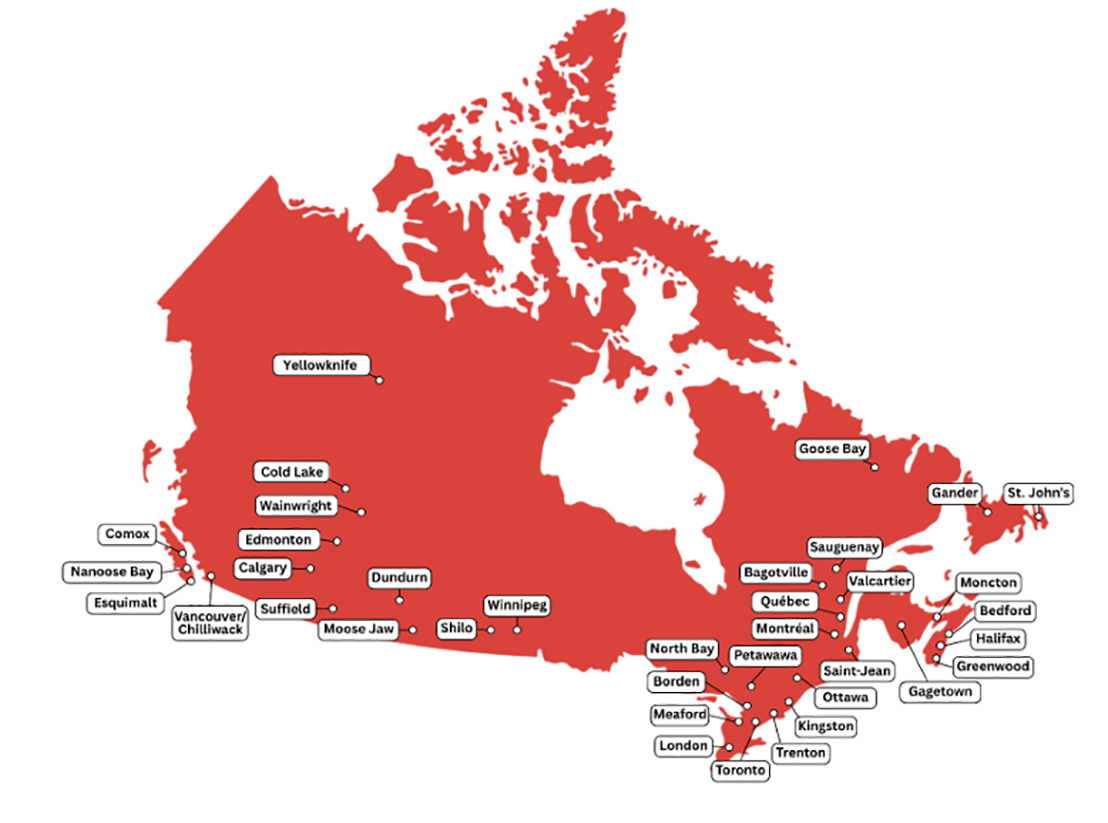
Text version
A map of Canada illustrates the cities in each province where military police units are located. They are:
British Columbia
- Chilliwack/Vancouver
- Comox
- Esquimalt
- Nanoose Bay
Alberta
- Calgary
- Cold Lake
- Edmonton
- Suffield
- Wainwright
Saskatchewan
- Dundurn
- Moose Jaw
Manitoba
- Shilo
- Winnipeg
Ontario
- Borden
- Kingston
- London
- Meaford
- North Bay
- Ottawa
- Petawawa
- Toronto
- Trenton
Quebec
- Bagotville
- Montréal
- Québec City
- Saguenay
- Saint-Jean-sur-Richelieu
- Valcartier
New Bruinswick
- Gagetown
- Moncton
Nova Scotia
- Bedford
- Greenwood
- Halifax
Newfoundland and Labrador
- Gander
- Goose Bay
- St. Johns
Territories
- Yellowknife
The Canadian Forces Military Police Group Headquarters is located in Ottawa, On
Annex D - Map – MP on named CAF Operations
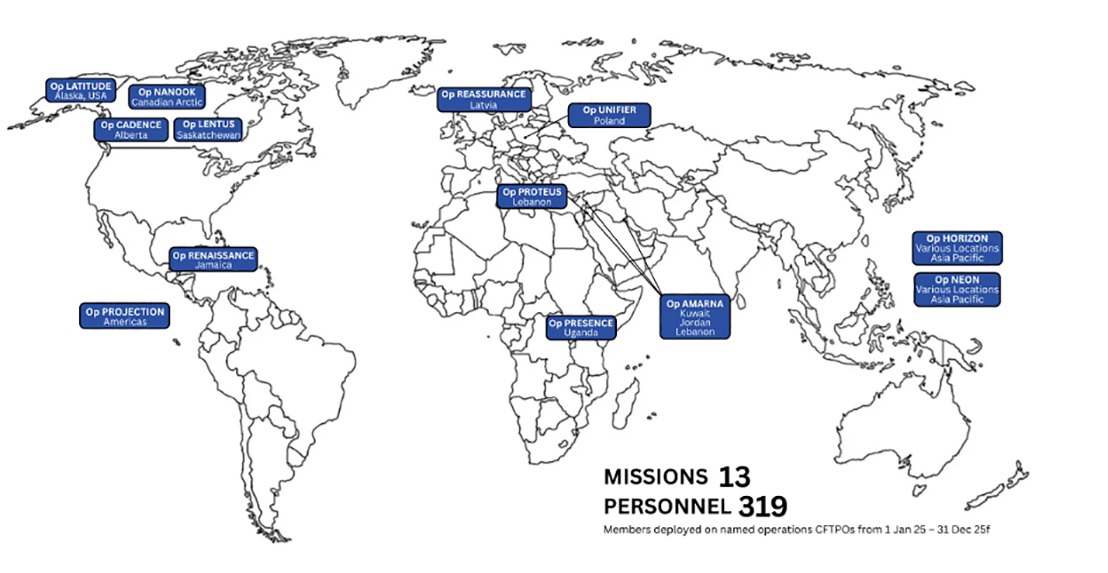
Text version
A map of the world identifies the locations where Canadian Military Police personnel are deployed on named Canadian Armed Forces operations. They are:
- Op LATITUDE – Alaska, USA
- Op NANOOK – Canadian Arctic
- Op CADENCE – Alta.
- Op LENTUS – Sask.
- Op RENAISSANCE – Jamaica
- Op PROJECTION – Americas
- Op REASSURANCE – Latvia
- Op UNIFER – Poland
- Op PROTEUS – Lebanon
- Op AMARNA – Kuwait, Jordan, Lebanon
- Op PRESENCE – Uganda
- Op HORIZON – Various Locations Asia Pacific
- Op NEON – Various Locations Asia Pacific
319 Military police personnel were spread over 13 missions.
Annex E - Map – MP Security Service (MPSS)
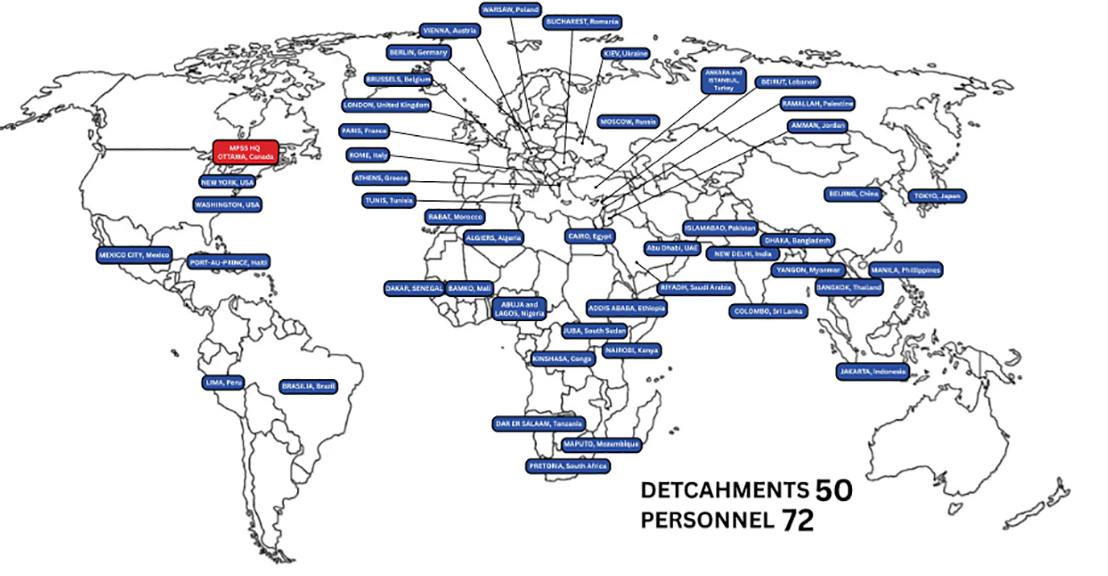
Text version
A map of the world that illustrates in which cities Canadian Military Police personnel from the Military Police Security Service are present. They are:
- Abu Dhabi, UAE
- Abuja, Nigeria
- Addis Ababa, Ethiopia
- Algiers, Algeria
- Amman, Jordan
- Ankara, Türkiye
- Athens, Greece
- Bamako, Mali
- Bangkok, Thailand
- Beijing, China
- Beirut, Lebanon
- Berlin, Germany
- Brasilia, Brazil
- Brussels, Belgium
- Bucharest, Romania
- Cairo, Egypt
- Colombo, Sri Lanka
- Dakar, Senegal
- Dar es Salaam, Tanzania
- Dhaka, Bangladesh
- Islamabad, Pakistan
- Istanbul, Türkiye
- Jakarta, Indonesia
- Juba, South Sudan
- Kinshasa, DR Congo
- Kyiv, Ukraine
- Lagos, Nigeria
- Lima, Peru
- London, United Kingdom
- Manila, Philippines
- Maputo, Mozambique
- Mexico City, Mexico
- Moscow, Russia
- Nairobi, Kenya
- New Delhi, India
- New York, USA
- Ottawa, Canada (MPSS HQ)
- Paris, France
- Port-au-Prince, Haiti
- Pretoria, South Africa
- Ramallah, Palestine
- Rabat, Morocco
- Riyadh, Saudi Arabia
- Rome, Italy
- Tokyo, Japan
- Tunis, Tunisia
- Vienna, Austria
- Warsaw, Poland
- Washington, USA
- Yangon, Myanmar
A total of 50 detachments and 72 personnel are present across the globe conducting security services.