
Cyclical Audit of Civilian Staffing - 2026
Table of Contents
At a Glance
- The departmental civilian staffing function operates within the Public Service Employment Act (PSEA) and the Public Service Commission of Canada’s (PSC) Appointment Delegation and Accountability Instrument (ADAI) framework to ensure merit-based, fair, transparent and non-partisan hiring.
- Director Staffing Policies and Programs (DSPP) added new mandatory elements to the staffing process to meet PSC requirements in October 2024. These changes strengthen fairness, transparency and merit-based decision making.
- PSC requires departments to perform cyclical assessments of their staffing processes at least every five years. The last review for the Department was in 2020.
- The audit looked at 96 appointment files and found an average compliance rate of 89 percent.
- DSPP monitors and reports through dashboards, regular reviews and targeted audits. These results are used to improve staffing practices.
Alternate Formats
Assistant Deputy Minister (Review Services)
Background
PSC requires departments to perform cyclical assessments of their staffing processes at least every five years. These assessments help deputy heads evaluate the health of their organizational staffing system, identify areas to be improved and plan potential measures to address weaknesses. The last cyclical staffing audit for the Department was in 2020. It showed the Department met policy requirements but needed better information management.
ADM(HR-Civ) manages civilian staffing to meet departmental objectives. An effective staffing system, hiring qualified candidates according to staffing requirements, is fundamental to departmental success. ADM(HR-Civ)’s priorities for 2025 to 2027 include providing timely, effective staffing and data-driven strategies to attract the highly skilled, diverse workforce needed to deliver the Department’s mission.
As noted in Figure 1, there were approximately 11,800 civilian staffing appointments in fiscal years (FY) 2023/24 and 2024/25. This number will increase as the Department is expected to hire thousands of new employees in the coming years.
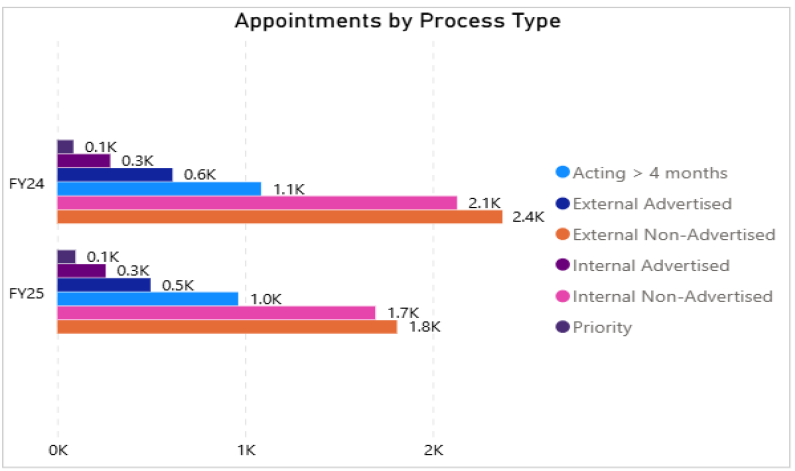
Figure 1 Summary
Key Findings and Risks
Finding 1: A staffing framework has been established that aligns with Public Service Commission requirements.
Federal staffing activities operate within the framework of PSEA as well as PSC’s ADAI and appointment policy. These rules make sure hiring is based on merit, is non-partisan and reflects fairness, transparency and equal access. To support these rules, the Department has a set of directives Footnote 1 that guide staffing decisions, ensuring that they meet all legal and policy requirements.
In October 2024, DSPP added new mandatory elements to the staffing process to meet PSC requirements. These changes strengthen fairness, transparency and merit-based decision making through clearer articulation of organizational needs, conditions of employment and competency statements on job posters.
By including factors like employment equity, the Military Spouse Initiative, workforce adjustment and conflict-of-interest checks in staffing documents, the Department of National Defence (DND) ensures hiring decisions support workforce planning and equity principles in line with PSC policy. Adopting these values and ethics and conflict-of-interest directives reinforces PSC’s expectations for integrity and non-partisanship in staffing. Together, these measures demonstrate respect for and adherence to the legislative and policy requirements governing federal appointments.
PSC requires departments to monitor that staffing follows the policies and legislation under the delegated staffing authority set in ADAI. ADM(HR-Civ)’s Accountability, Responsibility, and Authority Framework clearly separates staffing operations from monitoring roles. Oversight is built into ADM(HR-Civ) through the DSPP group. DSPP does second-level monitoring by reviewing samples of appointments to ensure they are complete and compliant. If problems are found, DSPP suggests fixes, and Director National Staffing Operations uses this feedback to make the necessary changes.
Finding 2: Overall, 89 percent of civilian staffing appointments met legislative and policy requirements.
PSC’s appointment policy sets out requirements that govern all appointments in the public service. The policy outlines the requirement for appointment records to be maintained for at least five years. The audit team sampled 96 appointment files to assess whether they followed policy requirements.
The files showed proof that hiring decisions were based on merit and that managers with delegated authority made the appointments within their area of responsibility. Key documents were usually present (Annex C), for example:
- signed letter of offer (100 percent);
- explanation of the selection decision (94 percent);
- priority clearance (96 percent); and
- Statement of Merit Criteria (96 percent).
There are opportunities to improve documentation to fully meet mandatory policy requirements. The weakest area was the organizational needs assessment (58 percent), which supports the basis for hiring.
ADM(HR-Civ) expects full compliance for these policy requirements. To track this, they will use a colour-coded heat map Footnote 2 to highlight areas that need attention, as found during DSPP file reviews. Staffing advisors also have a Staffing Documentation and Acceptable Evidence Guide to help them keep files complete and accurate. The guide is a checklist of the documents that should be kept in each appointment file. Using this checklist is optional for staffing advisors, but requiring its use would help make sure files are complete and easy to monitor. Following internal information management standards would improve file completeness, decrease the risk of missing key documents and ensure legal and policy requirements are met.
Staffing advisors play an important role in guiding sub-delegated managers by providing tailored advice and support based on training, coaching, guidance documents and experience. They ensure the completeness of staffing files, advise on compliance requirements and share responsibility for information management with managers. To do this well, staffing advisors must complete training, including two mandatory courses—Staffing for HR Specialists, parts 1 and 2—from the Canada School of Public Service. The audit found that 84 percent of staffing advisors involved in the sampled appointment files had finished both courses.
ADM(RS) Recommendation
Management Response
ADM(HR-Civ) acknowledges the recommendation and will implement measures to ensure the consistent, mandatory use of a standardized staffing checklist to support effective information management and alignment with current staffing policies and directives.
Finding 3: Staffing performance is tracked, shared and monitored to help support continuous improvement.
ADM(HR-Civ) creates and shares monitoring reports and dashboards to show compliance trends, suggest corrective actions and track progress on improvements. These reports are supported by insights from PSC’s annual report, the Survey of Staffing and Non-Partisanship and other internal and external reviews.
Monitoring is guided by the DSPP monitoring plan, which lists the reviews planned for a given FY. These activities include cyclical compliance assessments, targeted file sampling and thematic audits conducted at varying intervals. Director National Staffing Operations incorporates quarterly feedback from DSPP reports to correct identified issues, ensuring that lessons learned are promptly applied.
Performance is tracked using indicators such as compliance rates, timeliness of staffing actions and quality of documentation. This structured approach ensures that monitoring results inform continuous improvement initiatives across the staffing function.
ADM(HR-Civ) has introduced several initiatives to fix issues like inconsistent staffing procedures, misclassified appointments and slow hiring processes. For example, hiring managers must now sign the Articulation of Selection Decision to reinforce accountability. Process codes have been expanded to improve reporting accuracy.
In partnership with ADM(RS), ADM(HR-Civ) has also introduced an employee attestation, related to values and ethics, at the time of the employment offer. The goal is to improve understanding and adherence to the conflict-of-interest declaration process across the Department. Other initiatives include modernizing the Human Resources Development Program and creating a knowledge centre to centralize guidance. These actions show ADM(HR-Civ)’s ongoing commitment to improving staffing practices.
ADM(HR-Civ) is preparing for increased staffing demands by adding more staffing resources and introducing a workload allocation and distribution model. This model clarifies roles and responsibilities; improves accountability for performance; and helps the Department stay compliant and maintain service standards while adapting to evolving needs.
Conclusion
ADM(HR-Civ) oversees civilian staffing and is responsible for timely and effective staffing to support the Department. Federal staffing follows PSEA as well as PSC’s ADAI and appointment policy to ensure merit-based, fair, transparent and non-partisan hiring. The Department supports this framework with directives that ensure compliance.
The audit found strong overall compliance of civilian staffing appointments. Strengthening information management practices, including mandatory use of the staffing checklist, would help ensure complete and auditable files. Staffing advisors play an essential role in supporting managers and maintaining compliance. Continued completion of mandatory training will reinforce the use of guidance tools and further enhance compliance.
Monitoring and reporting mechanisms are well established. ADM(HR-Civ) has introduced initiatives to improve processes, accountability and efficiency, and it is preparing for future staffing demands. These actions reflect a strong commitment to continuous improvement and readiness to meet evolving Defence Team needs.
Annex A: Management Action Plan
| Recommendation 1: | Management Action | |
|---|---|---|
ADM(HR-Civ) should require the use of the staffing checklist. Making it mandatory would improve information management and help ensure staffing files are complete and aligned with current policies and directives. OPI: ADM(HR-Civ) |
ADM(HR-Civ) recognizes the importance of the consistent use of the staffing checklist to support effective information management and to ensure staffing files are complete, accurate and aligned with applicable legislation, policies and directives. To address this recommendation, ADM(HR-Civ) will require the mandatory use of the staffing checklist for applicable staffing actions. Clear direction will be communicated to staffing practitioners, and guidance materials will be updated as needed to reinforce expectations. |
|
1.1. Develop and implement a standardized staffing checklist. A bilingual, automated and accessible staffing checklist that incorporates PSC’s mandatory staffing file requirements and the DND Staffing Documentation and Acceptable Evidence Guide. |
Timeline April to June (Q1) 2026
|
|
1.2. Enhance the staffing checklist to address identified areas of lower compliance. An enhanced checklist that highlights areas identified as lower compliance, including:
|
April to September (Q1 to Q2) 2026 |
|
1.3. Issue mandatory direction on the use of the new checklist. Direction issued to the staffing community that the use of the new staffing checklist is mandatory for all appointment processes and that it must be retained on the appointment file. The requirement will exclude casuals, deployments, part-time exclusions and student employment. A communication will be sent to staffing advisors and human resources administrators to introduce the mandatory checklist and reinforce expectations. |
April to June (Q1) 2026 |
|
Table A.1. Summary
Annex B: About the Engagement
Objective
The objective was to provide assurance that DND has a staffing function that ensures qualified individuals are appointed in accordance with PSC policy and direction.
Scope and Approach
The engagement focused on DND’s staffing processes, including internal, external, advertised and non-advertised staffing, as well as acting appointments lasting longer than four months. It also examined the organizational processes, tools and activities supporting effective staffing. This included a review of appointments and appointment-related data focusing on the period April 1, 2023, to September 30, 2025.
Excluded From Scope:
- Acting appointments lasting less than four months; casual, seasonal and student employment; and appointments made pursuant to the veteran preference provisions set out in PSEA
- IT system (Human Resources Management System) controls
Sampling Methodology
The engagement reviewed 96 civilian staffing files out of a total of 11,891 staffing actions completed in FYs 2023/24 and 2024/25. To make sure the sample reflected activity in each year, 25 percent of the files came from 2023/24 and 75 percent from 2024/25. Within each year, the audit team further divided the sample based on the types of staffing actions included in the audit. The files were chosen randomly using record numbers. The overall staffing data came from the staffing activities dashboard prepared by DSPP.
Annex C: File Review Scorecard
| Phase | Procedure | Compliance Rate | Yes | No | N/A | Total |
|---|---|---|---|---|---|---|
Pre-Assessment |
Statement of Merit Criteria |
95.83% |
92 |
4 |
0 |
96 |
Priority Entitlement Results |
96.15% |
75 |
3 |
18 |
96 |
|
Evaluation of Assessment Methods for Biases and Barriers |
82.93% |
68 |
14 |
14 |
96 |
|
Assessment |
Evidence of Essential Qualifications |
91.67% |
88 |
8 |
0 |
96 |
Evidence of Asset Qualifications |
87.50% |
28 |
4 |
64 |
96 |
|
Evidence of Operational Requirements |
87.88% |
29 |
4 |
63 |
96 |
|
Evidence of Organizational Needs |
58.33% |
7 |
5 |
84 |
96 |
|
Selection |
Articulation of Selection Decision |
93.75% |
90 |
6 |
0 |
96 |
Articulation of Selection Decision supports appointment on merit |
89.58% |
86 |
10 |
0 |
96 |
|
Notice of Consideration/Notice of Appointment/Notice of Acting Appointment |
96.23% |
51 |
2 |
43 |
96 |
|
Appointment |
Appointment made within manager’s chain of command |
96.88% |
93 |
3 |
0 |
96 |
Letter of offer signed by sub-delegated manager |
100.00% |
96 |
0 |
0 |
96 |
|
Oath/Solemn Affirmation |
85.37% |
35 |
6 |
55 |
96 |
|
Note: Compliance rates are calculated through the following formula: Compliance Rate = Yes ÷ (Total − N/A). |
||||||