
RE-ORG project overview: West Parry Sound District Museum (Museum on Tower Hill)
The West Parry Sound District Museum (commonly known as the Museum on Tower Hill) took part in the RE-ORG: Canada (Ontario) training program in 2014–15. Their mixed collection of 17,597 objects was stored in a space measuring 78 m²; 4600 of these objects were part of the RE-ORG project.
Project leads: Nadine Hammond and Marianne Bourgeois
Main storage challenges
- The storage area was overcrowded as a result of
- acquiring identical object types (30 irons, sock stretchers, etc.);
- acquiring objects not aligned with the museum’s mandate; and
- holding objects for safekeeping without the items being formally donated or accepted.
- There was limited accessibility to the collection and, therefore, limited ability to use the objects to engage the community (Figures 1 and 2).
- Vertical space within shelving units was underutilized (Figure 3).
- Objects were stored directly on the floor (Figure 4).
- Overcrowding resulted in reduced efficiency in answering client requests.
- An incomplete understanding of the entire collection led to less informed decisions during the acquisition process.
The influx of new objects created poor storage conditions for existing collections, as they needed to be shuffled and reorganized to provide more space for the incoming objects. Due to this shuffling, items were not in the location recorded in the database, making it difficult to locate them in the future.
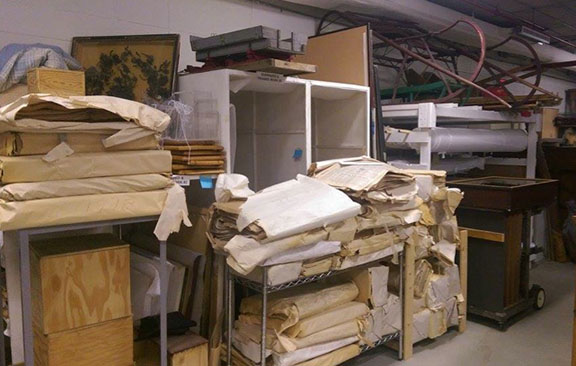
© Photo courtesy of the West Parry Sound District Museum
Figure 1. Before RE-ORG: inadequate storage systems and blocked access to collections.
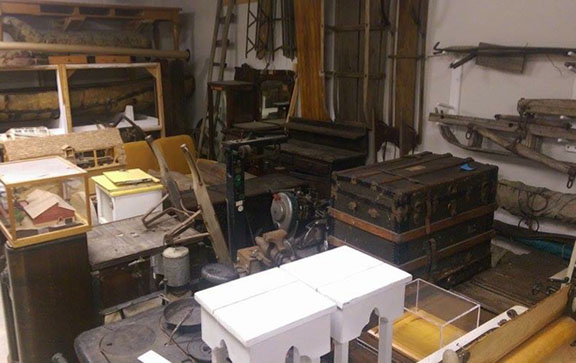
© Photo courtesy of the West Parry Sound District Museum
Figure 2. Before RE-ORG: access to the collection was difficult due to a lack of circulation space.
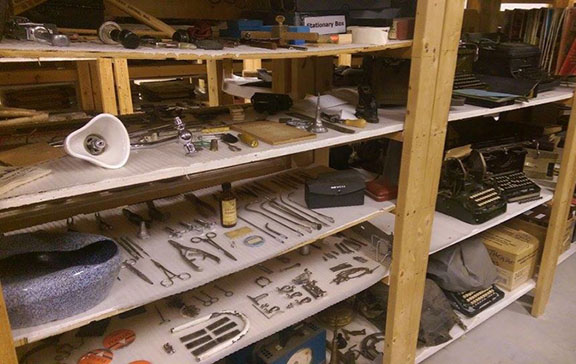
©Photo courtesy of the West Parry Sound District Museum
Figure 3. Before RE-ORG: tiny objects placed directly on shelves increased the risk of objects going missing, and it limited the effective use of vertical space within the shelving units.
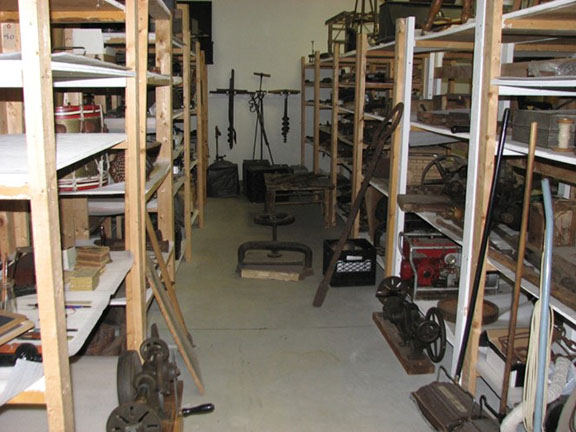
© Photo courtesy of the West Parry Sound District Museum
Figure 4. Before RE-ORG: several objects were stored directly on the floor, constituting tripping hazards.
Project details
Within a year, the West Parry Sound District Museum was able to make the following storage improvements:
- They rehoused and relocated objects to minimize risks and to use space more efficiently.
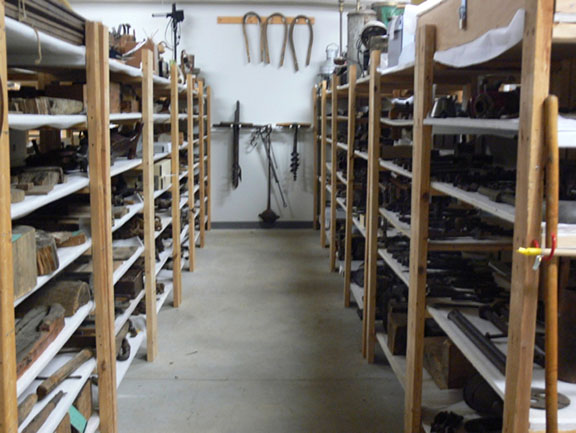
- They reconfigured and relocated storage units to improve space efficiency (Figure 5).
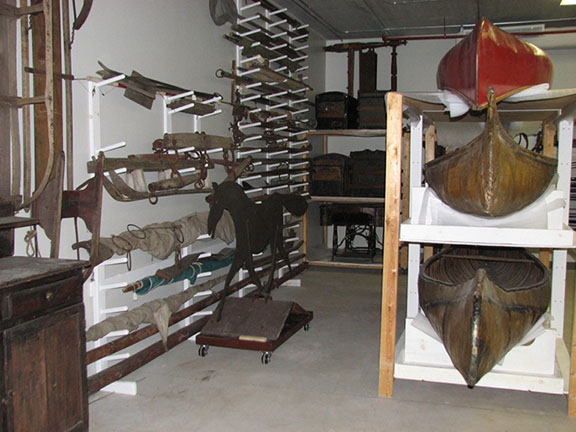
- They built new storage units using plywood, recycled lumber and polyethylene foam (Figure 6).
In addition, health and safety practices were improved. The storage area now remains free of dust and tripping hazards. Heavy objects were relocated to bottom shelves, and aisles were made wide enough to accommodate a rolling staircase in order to safely remove items stored on top shelves.
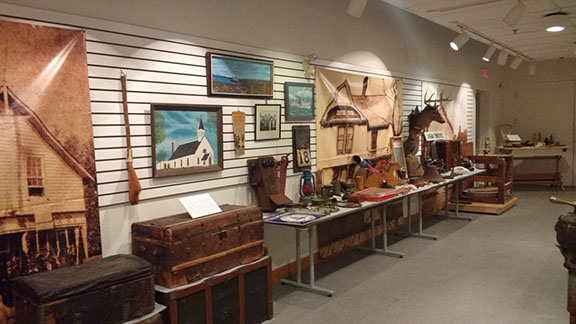
Finally, many problem objects were discovered throughout this process: objects without a visible accession number (including items that were not actually objects, objects that were not part of the collection or objects with illegible or ill-adhered accession numbers) and objects in multiples (some of which were severely deteriorated). The museum used this as an opportunity to engage the local community and invite them to provide any information they had about these objects by creating a special exhibition (Figure 7).
© Photo courtesy of the West Parry Sound District Museum
Figure 5. After RE-ORG: view of storage aisles, with no objects placed directly on the floor and additional shelves to better use the vertical space within storage units.
© Photo courtesy of the West Parry Sound District Museum
Figure 6. After RE-ORG: all objects large and small, wide and thin now have an adapted storage solution.
© Photo courtesy of the West Parry Sound District Museum
Figure 7. The Look What We Found exhibition to engage the local community in identifying some objects found during the reorganization.
The project took 82 days to complete with the help of no more than 2 team members during phases 1 to 3 and 10 team members during phase 4 (Table 1).
| RE-ORG phase | Number of weeks to complete | Number of team members |
|---|---|---|
| 1. Getting started | 3* | 2 |
| 2. Storage condition report | 3* | 2 |
| 3. Storage action plan | 6* | 1 |
| 4. Storage reorganization implementation | 3 | 10 |
*Not the sole focus of the individuals involved.
The RE-ORG project cost $28,000 to complete, with half being allocated to staff time and half to tools and storage furniture. The West Parry Sound District Museum was also successful in securing a $10,000 grant from the Museums Assistance Program for the project, as well as $7,300 through other methods (such as fundraising).
| Budget item | Amount (CAN$) |
|---|---|
| Staff time | 14,000 |
| Tools, supplies and materials | 9,200 |
| Storage furniture | 4,800 |
| External services (such as contractors) | 0 |
| Total project cost | 28,000 |
Based on the RE-ORG Self-evaluation Tool for Collections in Storage (PDF Version), the West Parry Sound District Museum made improvements in all four components of RE-ORG: “management,” “building and space,” “collection” and “furniture and small equipment.”
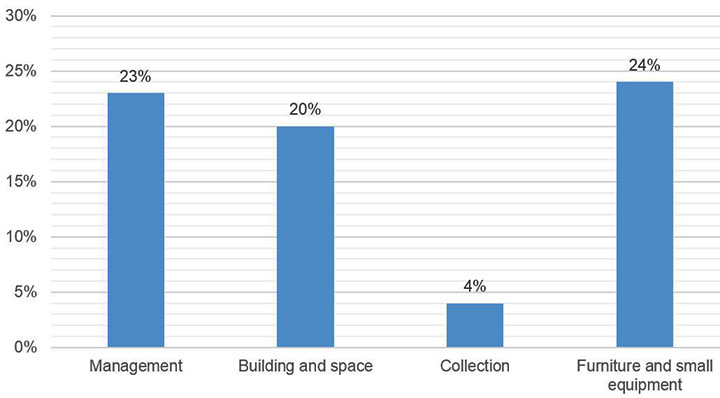
According to the results in Table 3, the “furniture and small equipment” component experienced the largest improvement with an increase of 24%. The “collection” component was improved by 4%, but improvements are ongoing (Figure 8).
| RE-ORG component | Score (before) | Score (after) |
|---|---|---|
| Management (maximum of 42 points) | 16 | 23 |
| Building and space (maximum of 54 points) | 36 | 47 |
| Collection (maximum of 51 points) | 26 | 28 |
| Furniture and small equipment (maximum of 33 points) | 16 | 24 |
© Government of Canada, Canadian Conservation Institute. CCI 132794-0076
Figure 8. Graph illustrating the percentage of improvement to the scores for the RE-ORG self-evaluation tool, calculated by comparing scores before and after the storage reorganization project.
Description of Figure 8
| RE-ORG component | Percentage of improvement |
|---|---|
| Management | 23% |
| Building and space | 20% |
| Collection | 4% |
| Furniture and small equipment | 24% |
Lessons learned
Based on the experience of the West Parry Sound District Museum, the following factors should be considered in future RE-ORG projects:
- Overestimate the time required for the physical reorganization (phase 4) in case you encounter unexpected tasks or delays with your project.
- Modify the methodology to meet your project's and organization’s needs. For instance, if you encounter problem objects or outliers (that is, non-standard objects with different requirements than most of the collection), define the objects’ requirements and develop custom solutions.
- Keep communication open among team members as well as interested staff and volunteers, so they are well aware of your project objective. With increased awareness, they should ideally make informed suggestions and decisions.
Additional resources
- Video showcasing West Parry Sound District Museum’s creative use of materials: “Creating Storage Solutions From Recycled Lumber (RE-ORG Canada)”
- Video of Nadine Hammond’s presentation at the 2015 RE-ORG: Canada (Ontario) one-day conference, “Museum on Tower Hill RE-ORG: Canada (Ontario) Storage Condition Report”
- Video of Nadine Hammond’s top “RE-ORG Tips”
- Video of the presentation by all RE-ORG Canada (Ontario) participants (including West Parry Sound District Museum) entitled “We’re All in This Together: A Collaborative Approach to Storage Reorganization” at the 2015 Ontario Museum Association Conference.
- Entries from the West Parry Sound District Museum in the Collection Storage Tips & Tricks resource about
- ICCROM web page describing the RE-ORG method