
RE-ORG project overview: Qualicum Beach Museum
The Qualicum Beach Museum took part in the RE-ORG: Canada (West) training program in 2017–18. Their mixed collection of 2000 objects was stored in a space measuring 55 m².
Project leads: Lorraine Bell and Kathy Dobinson
Main storage challenges
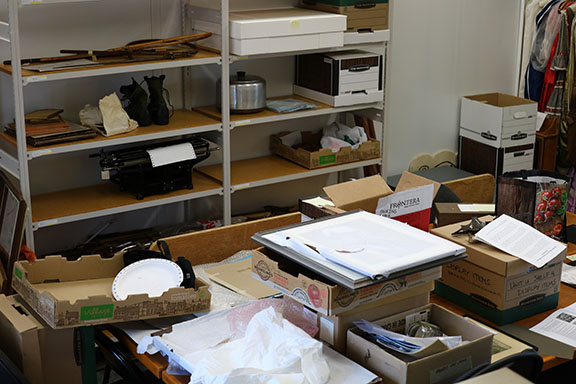
- There was limited room for collections because the space was also being used as a multipurpose area (Figure 1).
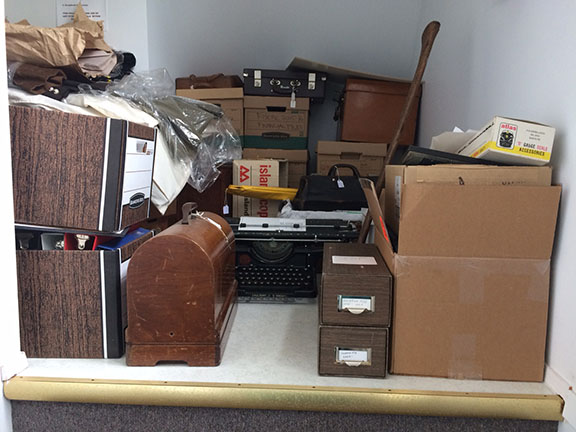
- Non-collection items were stored with the collection in a designated collections space (Figure 2).
- There was no designated area for collection processing.
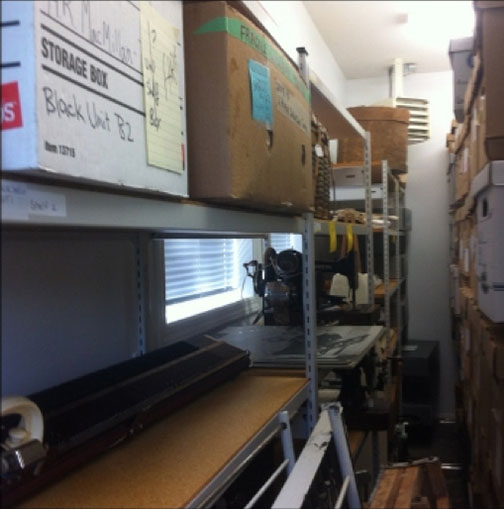
- Shelves were underutilized, and it was difficult to access collections (Figure 3).
© Photo courtesy of Qualicum Beach Museum
Figure 1. Before RE-ORG: view of the multipurpose area, which was used as temporary storage.
© Photo courtesy of Qualicum Beach Museum
Figure 2. Before RE-ORG: view of storage, showing both collection items and non-collection items awaiting deaccessioning being stored together.
© Photo courtesy of Qualicum Beach Museum
Figure 3. Before RE-ORG: view of storage, showing aisles blocked by non-collection items and underutilized shelf space along the back wall.
Project details
Within a year, the Qualicum Beach Museum was able to make the following storage improvements:
- They cleaned and reconfigured all designated collection storage spaces.
- They relocated old shelves and installed new ones with integrated drawers for smaller items (Figure 4).
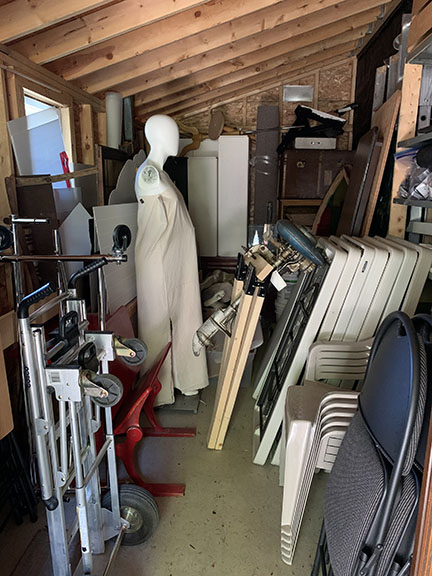
- They relocated non-collection material to a new designated area (Figure 5).
- They recovered dispersed collections and relocated them to the main storage area.
- They installed an air conditioning unit to maintain lower temperatures on hot summer days.
- They created specific areas for collections-related work (such as processing and temporary holding).
- They constructed custom-built slotted storage for framed collections (Figure 6).
- They installed a wall rack and hooks for hanging objects (Figures 7 and 8).
- They elevated large objects off the floor by storing them on pallets (Figure 9).

© Photo courtesy of Qualicum Beach Museum
Figure 4. After RE-ORG: new shelving units and drawers for smaller, more delicate items.
© Photo courtesy of Qualicum Beach Museum
Figure 5. After RE-ORG: all non-collection items were relocated to an outbuilding.
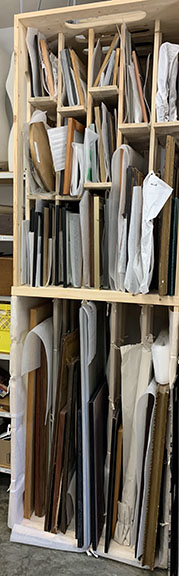
© Photo courtesy of Qualicum Beach Museum
Figure 6. After RE-ORG: custom-built slotted storage unit for framed works.
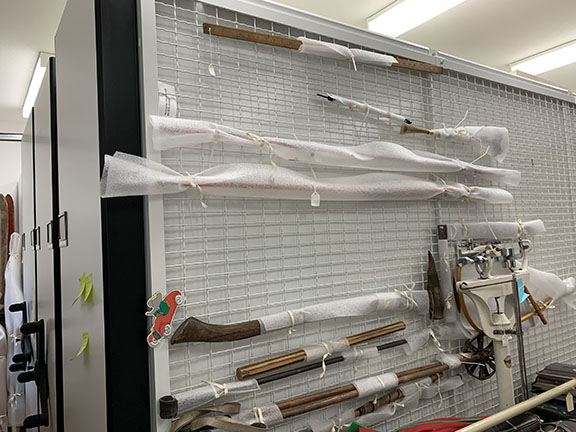
© Photo courtesy of Qualicum Beach Museum
Figure 7. After RE-ORG: wall rack for long and thin objects, which allowed a more efficient use of vertical storage surfaces.

© Photo courtesy of Qualicum Beach Museum
Figure 8. After RE-ORG: padded hooks for very long and thin objects installed above shelving units to maximize the use of wall space.
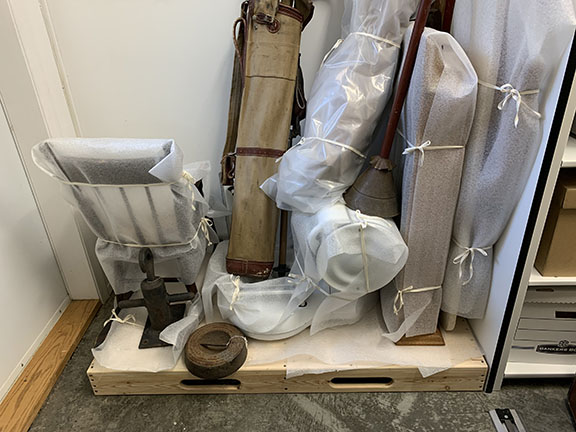
© Photo courtesy of Qualicum Beach Museum
Figure 9. After RE-ORG: large, oddly shaped objects stored and raised on pallets.
The project took approximately 11 months to complete with the help of no more than 5 team members during phases 1 to 3 and 9 team members during phase 4 (Table 1).
| RE-ORG phase | Number of months to complete | Number of team members |
|---|---|---|
| 1. Getting started | 2 | 4 |
| 2. Storage condition report | 4 | 5 |
| 3. Storage action plan | 1 | 4 |
| 4. Storage reorganization implementation | ~ 4 | 9 |
The RE-ORG project cost $23,602 to complete, with less than half being allocated to staff time and external services (Table 2). More than half of the budget was spent on tools and storage furniture. The Qualicum Beach Museum was also successful in securing a $10,000 grant from the Museums Assistance Program for the project.
| Budget item | Amount (CAN$) |
|---|---|
| Staff time | 7,525 |
| Tools, supplies and materials | 2,554 |
| Storage furniture | 11,523 |
| External services (such as contractors) | 2,000 |
| Total project cost | 23,602 |
Based on the RE-ORG Self-evaluation Tool for Collections in Storage (PDF Version), the Qualicum Beach Museum made improvements in all four components of RE-ORG: “management,” “building and space,” “collection” and “furniture and small equipment.”
According to the results in Table 3, the “management” and “furniture and small equipment” components experienced the largest improvement with an increase of 43% and 42%, respectively (Figure 10).
| RE-ORG component | Score (before) | Score (after) |
|---|---|---|
| Management (maximum of 42 points) | 12 | 30 |
| Building and space (maximum of 54 points) | 19 | 28 |
| Collection (maximum of 51 points) | 40 | 45 |
| Furniture and small equipment (maximum of 33 points) | 19 | 33 |
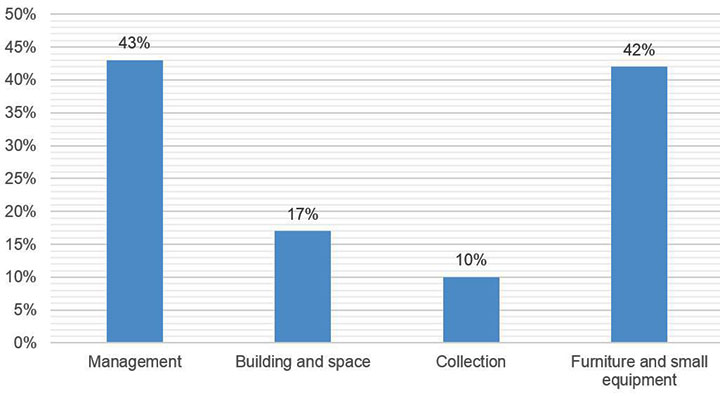
© Government of Canada, Canadian Conservation Institute. CCI 132794-0067
Figure 10. Graph illustrating the percentage of improvement to the scores for the RE-ORG self-evaluation tool, calculated by comparing scores before and after the storage reorganization project.
Description of Figure 10
| RE-ORG component | Percentage of improvement |
|---|---|
| Management | 43% |
| Building and space | 17% |
| Collection | 10% |
| Furniture and small equipment | 42% |
Lessons learned
Based on the experience of the Qualicum Beach Museum, the following should be considered in future RE-ORG projects:
- Do not underestimate the importance of having someone available who is handy with tools. RE-ORG projects can include repurposing old materials, so having an individual with carpentry skills could help you successfully reach your objectives without affecting your project timeline.
- Communicate with the board and management, whenever possible. RE-ORG projects do not happen overnight. They can be large undertakings, so having your board or management’s support is essential. RE-ORG projects also provide measurable results. By keeping your board or management informed, they can observe the improvement as it unfolds, which can assist you in obtaining additional financial resources in the future.
- The general public rarely gets a glimpse behind the scenes at museums. Sharing your RE-ORG project and experience with your community will educate the public and generate interest in the overall work of the museum.
Additional resource
- ICCROM web page describing the RE-ORG method