
RE-ORG project overview: Haida Gwaii Museum
The Haida Gwaii Museum took part in the RE-ORG: Canada (West) training program in 2017–18. Their collection contained over 20,000 archaeological objects of Indigenous origin stored in a 14.5 m² space called the lab storage room (Figure 1).
Project lead: Sean Young
Main storage challenges
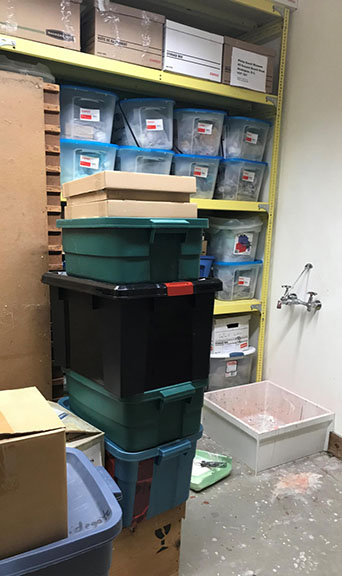
- There was insufficient space to store the collection (objects were stored on the floor, and units, on average, were 100% full) (Figures 1 and 2).
- They lacked appropriate storage furniture.
- There was a lack of trained personnel working with collections.
- It was difficult to track the location and other information about the collection.

© Photo courtesy of the Haida Gwaii Museum
Figure 1. Before RE-ORG: lab storage room, showing how access to the collection was blocked by items on the floor.
© Photo courtesy of the Haida Gwaii Museum
Figure 2. Before RE-ORG: lab storage room, showing how existing shelving was at full capacity.
Project details
In preparation for the storage reorganization project, the Collections Manager completed the following steps:
- He trained student volunteers on health and safety and basic collections care (such as handling, transporting, storing and documenting collections).
- He purchased basic equipment and packing material.
- He created a simple tracking chart to organize project tasks.
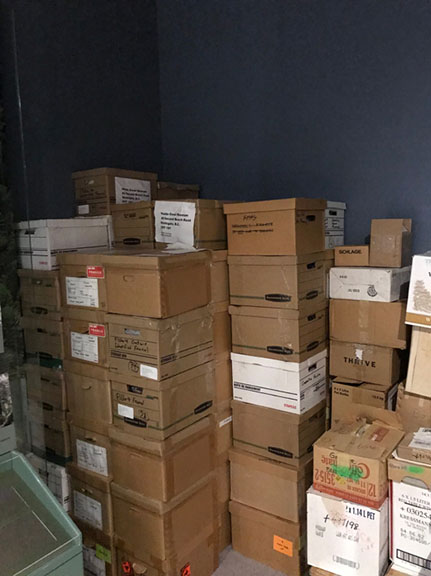
- He relocated collection items to temporary storage (Figure 3).
Within a year, the Haida Gwaii Museum was able to make the following storage improvements:
- They removed all non-collection items (items to discard, kitchenware, construction tools, etc.).
- They disassembled, donated or discarded old storage shelves.
- They completed building modifications (patched holes in walls, sealed the concrete floor, replaced an old sink, did minor plumbing work, etc.).
- They purchased and assembled new worktables and wall shelves.
- They assigned an identification number to all new storage units.
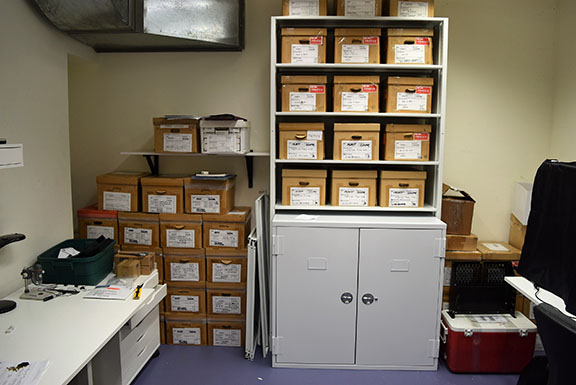
- They relocated collection items from temporary storage to new shelving units and a specimen cabinet (Figure 3).
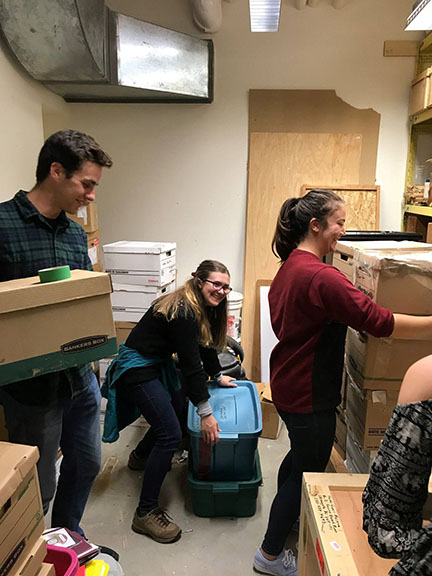
In 2019, the RE-ORG team began properly cataloguing, analyzing and storing their specimen collection, and the student volunteers contributed to implementing the action plan (Figures 4 and 5). As work remains ongoing, they have also started the process of entering all collections-related data into a newly acquired collections management database.
© Photo courtesy of the Haida Gwaii Museum
Figure 3. During RE-ORG: collection items stored in a temporary location.
© Photo courtesy of the Haida Gwaii Museum
Figure 4. During RE-ORG: student volunteers at work.
© Photo courtesy of the Haida Gwaii Museum
Figure 5. After RE-ORG: lab storage room.
The project took 16 weeks to complete with the help of no more than 10 team members throughout the 4 phases (Table 1).
| RE-ORG phase | Number of weeks to complete | Number of team members |
|---|---|---|
| 1. Getting started | 2 | 1 |
| 2. Storage condition report | 2 | 1 |
| 3. Storage action plan | 6 | 10 |
| 4. Storage reorganization implementation | 6 | 10 |
The RE-ORG project cost $13,500 to complete, with most financial resources being applied to storage furniture and project supplies (Table 2). The Haida Gwaii Museum was also successful in securing a $10,000 grant from the Museums Assistance Program for the project.
| Budget item | Amount (CAN$) |
|---|---|
| Staff time | 3,500 |
| Tools, supplies and materials | 2,700 |
| Storage furniture | 7,300 |
| External services (such as contractors) | 0 |
| Total project cost | 13,500 |
Based on the RE-ORG Self-evaluation Tool for Collections in Storage, the Haida Gwaii Museum made improvements in all four components of RE-ORG: “management,” “building and space,” “collection and furniture” and “small equipment.”
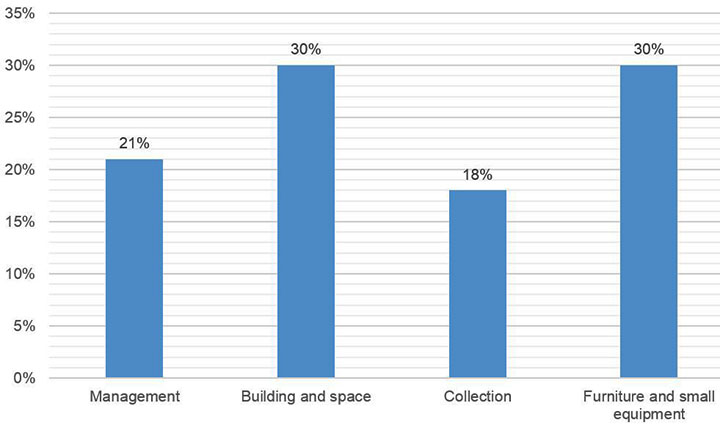
According to the results in Table 3, the components “building and space” as well as “furniture and small equipment” experienced the largest improvement with an increase of 30% each (Figure 6).
| RE-ORG component | Score (before) | Score (after) |
|---|---|---|
| Management (maximum of 42 points) | 22 | 31 |
| Building and space (maximum of 54 points) | 20 | 36 |
| Collection (maximum of 51 points) | 21 | 30 |
| Furniture and small equipment (maximum of 33 points) | 8 | 18 |
© Government of Canada, Canadian Conservation Institute. CCI 132794-0020
Figure 6. Graph illustrating the percentage of improvement to the scores for the RE-ORG self-evaluation tool, calculated by comparing scores before and after the storage reorganization project.
Description of Figure 6
| RE-ORG component | Percentage of improvement |
|---|---|
| Management | 21% |
| Building and space | 30% |
| Collection | 18% |
| Furniture and small equipment | 30% |
Lessons learned
Based on the experience of the Haida Gwaii Museum, the following should be considered in future RE-ORG projects:
- Be effective with managing your time to avoid negative impacts on your project. It not only can have adverse effects on your budget, but it can affect your project scope and team morale.
- Ensure you have enough “hands on deck.” For a RE-ORG project, having too many people can be as detrimental as having too few people. Identify your needs and plan accordingly.
Additional resource
- ICCROM web page describing the RE-ORG method