
Action plans for official languages: overview of impacts and progress made

The Action Plan for Official Languages 2023–2028: Protection–Promotion–Collaboration is injecting $1.4 billion in new investments in support of 33 new or enhanced initiatives, which are being carried out in partnership with 19 federal institutions.
This is in addition to the ongoing investment of $2.7 billion in 49 existing initiatives.
These 82 initiatives represent a total investment of $4.1 billion over 5 years (2023–2028) in concrete supports for the protection and promotion of our two official languages.
The cumulative societal results of these investments date back to the first Action Plan in 2003 and are grouped according to the four pillars of the Action Plan.
Pillar 1: Immigration Continuum from Home Country to Integration in Host Communities
Pillar 1 of the Action Plan aims to support the implementation of measures deployed across the immigration continuum that contribute to restoring and increasing the demographic weight of Francophone minority communities.
Continuum in Francophone immigration
- Step 1: Promotion
- Step 2: Attraction
- Step 3: Selection
- Step 4: Reception
- Step 5: Settlement
- Step 6: Integration
Progress on Francophone immigration
- A new Policy on Francophone Immigration was launched in 2024 and includes 5 action areas spanning the entire immigration continuum.
- 12 projects are being funded by the Francophone Immigration Support Program, for a total investment of $9.3 million.
- 6 Francophone communities are participating in the Francophone Community Immigration Pilot.
Admissions of French-speaking permanent residents outside Quebec since 2020 (number and percentage)
- 2020
-
- Number of French-speaking permanent residents admitted: 5,755
- Percentage of French-speaking permanent residents’ admissions: 3.6%
- 2021
-
- Number of French-speaking permanent residents admitted: 6,950
- Percentage of French-speaking permanent residents’ admissions: 2.0%
- 2022
-
- Number of French-speaking permanent residents admitted: 16,380
- Percentage of French-speaking permanent residents’ admissions: 4.4%
- 2023
-
- Number of French-speaking permanent residents admitted: 19,635
- Percentage of French-speaking permanent residents’ admissions: 4.7%
- 2024
-
- Number of French-speaking permanent residents admitted: 30,550
- Percentage of French-speaking permanent residents’ admissions: 7.2%
In support of the 24 Welcoming Francophone Communities
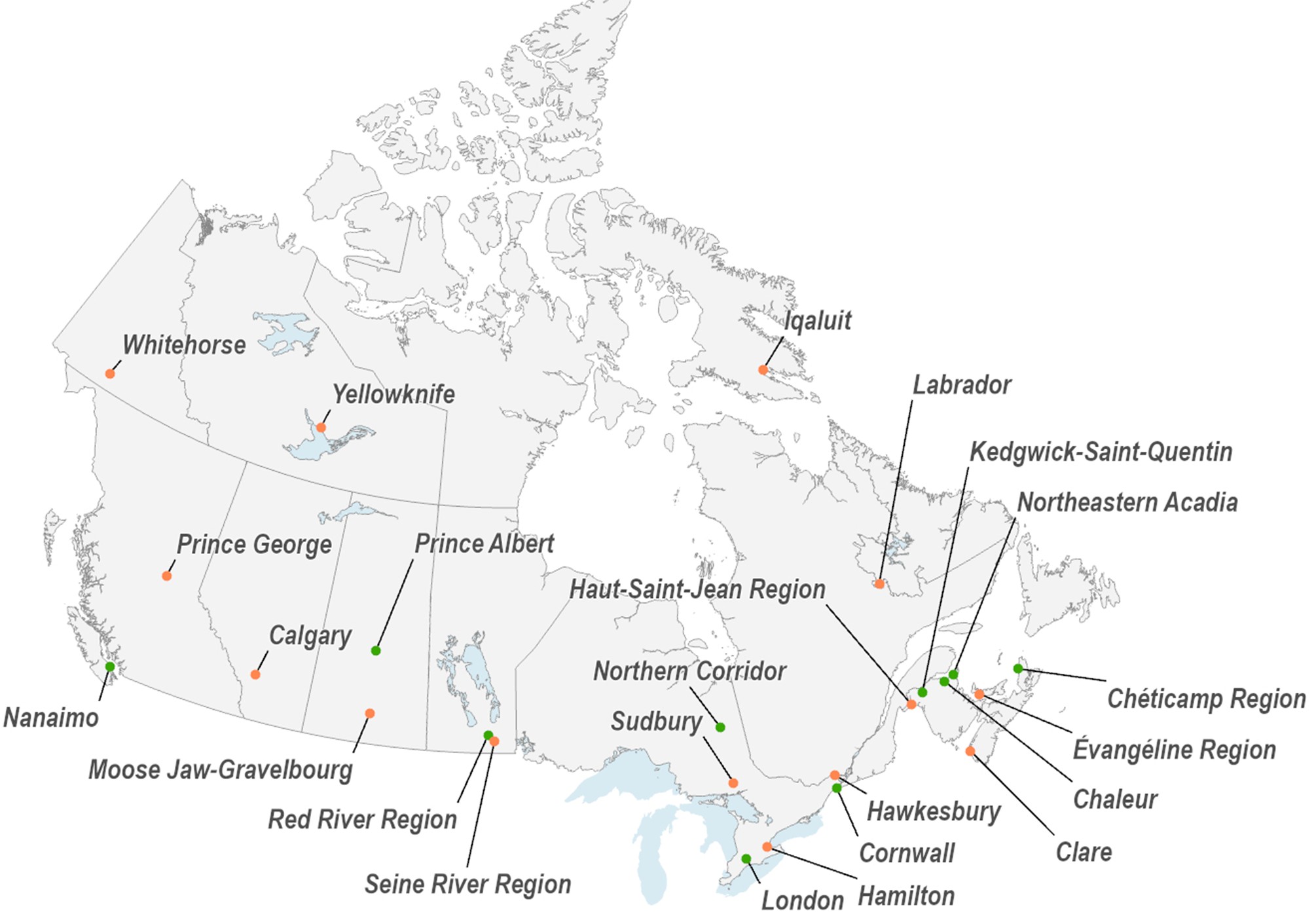
Source: Immigration, Refugees and Citizenship Canada (IRCC), Welcoming Francophone Communities initiative
14 communities established in 2020
- Calgary, Alberta
- Clare, Nova Scotia
- Hamilton, Ontario
- Hawkesbury, Ontario
- Iqaluit, Nunavut
- Labrador, Newfoundland and Labrador
- Moose Jaw and Gravelbourg, Saskatchewan
- Prince George, British Columbia
- Seine River region, Manitoba
- Haut-Saint-Jean region, New Brunswick
- Évangéline region, Prince Edward Island
- Sudbury, Ontario
- Whitehorse, Yukon
- Yellowknife, Northwest Territories
10 new communities in 2025
- North-Eastern Acadia, New Brunswick
- Chaleur, New Brunswick
- Cornwall, Ontario
- Northern Corridor, Ontario
- Kedgwick and Saint-Quentin, New Brunswick
- London, Ontario
- Nanaimo, British Columbia
- Prince Albert, Saskatchewan
- Chéticamp Region, Nova Scotia
- Red River Region, Manitoba
Pillar 2: Lifelong Learning of the Official Languages
Supported by long-standing federal–provincial and territorial collaboration, Pillar 2 of the Action Plan aims to strengthen the educational continuum for official language minority communities by supporting lifelong learning, preserving linguistic and cultural identity, and enabling Canadians to learn their second official language. Pillar 2 also supports the French-language research ecosystem in Canada by encouraging the creation, dissemination, and mobilization of scientific knowledge across the country.
Early childhood in Francophone minority communities
- Since 2018–2019, 1,683 new daycare spaces have been created under the Community Educational Infrastructure program. These are distributed among 33 municipalities.
Language education at the primary and secondary levelsFootnote 1
Minority-language instruction:
- There are 1,005 minority-language schools in 38 school boards across Canada, enabling 256,770 students in minority settings to receive instruction in their minority official language.
Second-language learning:
- 2.5 million people were actively learning English or French as a second language, and 482,733 students were enrolled in a French immersion program outside Quebec.
Post-secondary and continuing education
- Funded since 2012, 17 post-secondary institutions currently offer programs to train bilingual health personnel across Canada.
- An External Advisory Panel on the Creation and Dissemination of Scientific Information in French was established in October 2024.
- It comprises 10 members, including 2 co-chairs;
- As part of the online consultation, over 40 submissions and testimonials were received;
- Over 100 representatives and contributors from the French-language research ecosystem took part in the Advisory Panel’s meetings.
- There are 22 post-secondary institutions outside Quebec receiving funding, enabling them to offer a total of 1,200 French-language or bilingual programs.
Pillar 3: Strong Measures and Institutions in Support of Community Vitality
Pillar 3 of the Action Plan invests in sectors that are key to community vitality and that support comprehensive service offerings in minority settings.
Employment
- Up to 43,000 Canadians annually now have access to employment assistance services delivered by and for official language minority communities.
Justice
- 12 existing and 2 new organizations working on access to justice in both official languages are receiving core funding.
- 59 projects promoting access to justice in both official languages were funded in 2023–2024.
Strong institutions
- More than 400 non-governmental community organizations working to protect and promote our official languages are being supported across Canada.
Health
- 39 networks and 14 satellites, managed by Société Santé en français and the Community Health and Social Services Network, are receiving statutory funding.
Arts and culture
- Since 2011–2012, 877 literary works have been translated from one official language to the other through the National Translation Program for Book Publishing.
- Since 2018–2019, 550 projects have been funded via the Community Cultural Action Fund.
Pillar 4: Acting and Collaborating for the Substantive Equality of the Two Official Languages
Pillar 4 of the Action Plan aims to bolster the Government of Canada’s efforts and leadership on official languages by raising awareness among federal institutions about the importance of taking positive measures (policies and programs) to protect and promote the country’s two official languages, and by encouraging all key stakeholders and interested parties to work together to advance the substantive equality of the official languages.
- 9 million page views annually on the Language Portal of Canada;
- Nearly 6,500 participants in the 2022 Cross-Canada Official Languages Consultations;
- More than 300 participants in the consultations on the Partnerships to Strengthen Part VII of the Official Languages Act initiative;
- In 2021, 897,000 children were eligible for instruction in the minority official language at the primary and secondary levelsFootnote 1;
- In 2025, 3 sets of regulations are being developed to protect and promote the official languages.
Strengthening Part VII of the Act
Horizontal governance of official languages has been strengthened with a “by and for” communities approach:
- Improved interdepartmental coordination;
- Strengthened accountability;
- Ongoing dialogue and collaboration with all stakeholders;
- Research and dissemination of information on official languages;
- More positive measures.