
An Act to support the use of French
On this page
- Objectives of the Use of French in Federally Regulated Private Businesses Act
- Which businesses does it apply to?
- What are consumers’ rights?
- What are employees’ rights?
- What are the benefits for businesses?
- Complaints process
- To learn more about the Use of French in Federally Regulated Private Businesses Act and the proposed regulations
In 2023, the Use of French in Federally Regulated Private Businesses Act (UFPBA) was enacted by Parliament. The Act is intended to protect and promote the use of French by consumers and employees.
Objectives of the Use of French in Federally Regulated Private Businesses Act
The Act creates rights for consumers and employees to use French in the private sector. For many years, the federal government has protected the use of French in the public sector through the Official Languages Act regime. The UFPBA establishes the first legal framework governing the use of French in the federally regulated private sector.
Coming-into-force
Although the UFPBA has been enacted by Parliament, it is not yet in force. Before the regime can come into force, implementing regulations must be adopted. The proposed regulations are currently undergoing public consultation.
Participate in the consultation if you would like to make your voice heard.
Where does it apply?
The UFPBA does not apply throughout Canada. It applies in regions where there is a significant demand for services in French, that is, regions where a sufficient number of Francophones and Francophiles reside (referred to as “regions with a strong francophone presence”).
The proposed regulations currently under consultation set out the list of the regions concerned.
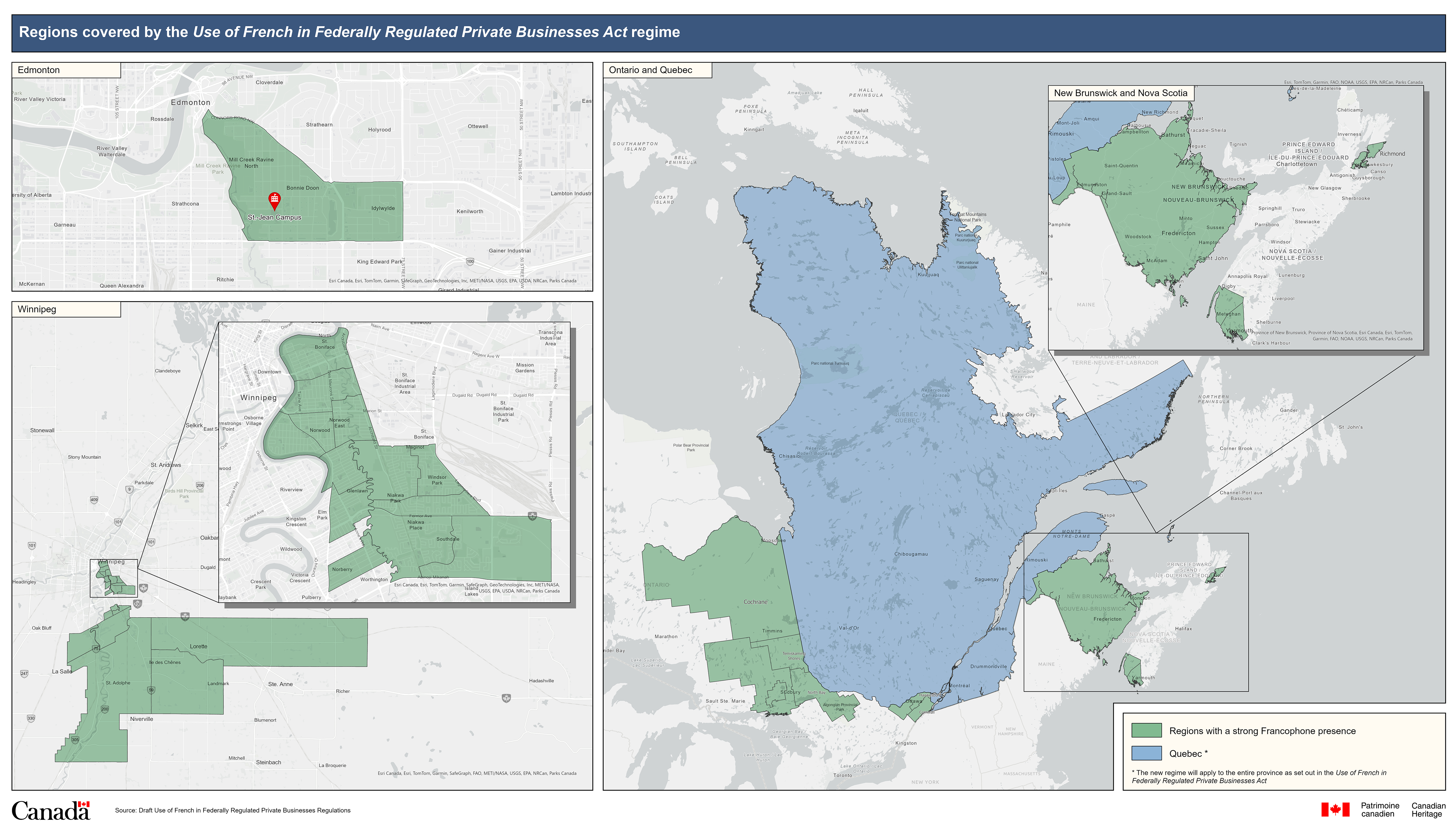
Regions covered by the UFPBA - text version
This map shows the regions where the Use of French in Federally Regulated Private Businesses Act regime applies.:
- In Quebec, the whole province as set out in the Use of French in Federally Regulated Private Businesses Act
The regime will apply to the following regions with a strong Francophone presence:
- In Edmonton, the areas around:
- Mill Creek Ravine North
- Bonnie Doon
- Idylwylde
- Saint-Jean Campus
- In Winnipeg, the areas around:
- St. Boniface
- Norwood
- Norwood East
- Glenlawn
- Niakwa Park
- Maginot
- Windsor Park
- Niakwa Place
- Norberry
- Southdale
- Lorette
- Iles des Chênes
- Landmark
- St. Adolphe
- In Ontario, around the sectors of:
- Cochrane
- Timmins
- Temiskaming
- Sudbury
- North Bay, including Algonquin Park
- Ottawa
- Eastern Ontario
- In Nova Scotia, the areas around:
- Digby
- Yarmouth
- Richmond, Southeast of Cape Breton
- In New Brunswick, the whole province
Regulatory exemptions: The proposed regulations would provide that activities carried out by federally regulated private businesses (FRPBs) on an “Indigenous territory,” as defined in the proposed regulations, would be exempt.
Participate in the consultation to provide your views or learn more.
Which businesses does it apply to?
The Act applies to large and medium-sized federally regulated private businesses, including large banks, telecommunications companies, parcel delivery companies and interprovincial transportation companies. Businesses under provincial jurisdiction are therefore not subject to the regime.
The federally regulated private sector encompasses several strategic industries, including:
- Telecommunications, including the Internet, telephone and mobile data service providers;
- Banks;
- Broadcasting;
- Postal, parcel and courier services, excluding Canada Post;
- Interprovincial transportation, including road, air (excluding Air Canada), rail (excluding CN), marine (excluding Marine Atlantic), bus, ferry and pipeline transportation;
- Specialized industries, such as animal feed, flour, grain and cereal products; and
- Technical and energy sectors, such as nuclear energy, mining, oil and gas.
Exclusions
Private businesses that are already subject to the Official Languages Act will be excluded from the regime under the Use of French in Federally Regulated Private Businesses Act, as will Indigenous organizations and entities authorized to act on their behalf. Broadcasting undertakings are also excluded from the application of the Act because they are subject to the Broadcasting Act, which contains provisions relating to official languages.
Threshold
Please note that the regime does not apply to all federally regulated businesses. It applies to large and medium-sized businesses, that is, businesses that meet a minimum size threshold.
The proposed regulations currently under consideration by Parliament provide that the regime would apply to the following businesses:
- In Quebec: all federally regulated businesses with 25 or more employees; and
- in regions with a strong francophone presence: federally regulated businesses with 100 or more employees across Canada.
Participate in the consultation to provide your views or learn more.
Exemptions for “Indigenous businesses”
The proposed regulations would exempt “Indigenous businesses” from language-of-work obligations (but not from language-of-service obligations).
Exemptions for certain activities
The proposed regulations would provide exemptions for certain business activities:
- The production of cultural goods in a language other than French;
- The conduct of international business in a language other than French; and
- Activities that must be carried out in a language other than French, for example, pursuant to protocols or agreements.
Consult the proposed regulations to learn more about the proposed exemptions.
Choice of regime in Quebec
In Quebec, businesses will have the choice between the federal regime and the provincial regime under the Charter of the French Language.
What are consumers’ rights?
Under the UFPBA, an employee of an FRPB whose position is connected to a workplace located in Quebec or in a region with a strong francophone presence would have the right to:
- communicate with the business in French
- obtain services from the business in French
- obtain documents and communications from the business in French.
Note that the business and the consumer may agree to use a language other than French, such as English.
What are employees’ rights?
Under the UFPBA, employees of FRPBs assigned to positions in workplaces in Quebec or in regions with a strong Francophone presence would have the right to:
- carry out their work and be supervised in French
- receive all communications and documents from the business in French, for example, documents related to offers of employment or promotion, conditions of employment, or labour relations
- use regularly and widely used work instruments and computer systems in French.
However, the UFPBA does not prevent an FRPB from providing an employee with communications or documents in English or another language other than French if the business and the employee agree to this.
What are the benefits for businesses?
The regime invites businesses to improve their service offerings in order to attract new consumers. The regions where the regime will apply are home to significant Francophone and Francophile populations. Businesses will therefore be able to demonstrate the excellence of their service to attract these consumers. These capabilities will also make businesses more competitive in regional and global markets.
Businesses could also benefit from improved employee retention by providing better services to their employees. In addition, improved internal communication and fewer language-related errors could increase operational efficiency. Furthermore, the ability to provide a bilingual work environment would make businesses more attractive to a broader pool of talent.
Complaints process
A person who believes that their rights have not been respected may file a complaint with the Office of the Commissioner of Official Languages. The Office of the Commissioner will conduct an investigation and may issue recommendations. The complaint will remain confidential.
In certain particularly complex cases involving labour relations, the Office of the Commissioner may offer the complainant the option of referring their complaint to the Canada Industrial Relations Board, the body that normally handles complaints in unionized workplaces.
In Quebec, if a business chooses to be subject to the provincial regime, the recourse regime set out in the Charter of the French Language will apply. The provincial regime will apply in place of the federal regime. The Office québécois de la langue française may therefore receive complaints.
Participate in the consultation if you would like to make your voice heard.