
Online disinformation
Online disinformation
Online disinformation is designed to trigger an emotional response. If it raises your eyebrows, it should raise questions.
Disinformation is false information that is deliberately intended to mislead. It is sometimes called “fake news”.
Transcript of the video
Voiceover: If it raises your eyebrow, it should raise questions. Check the facts before you share online. Learn more at Canada.ca/disinformation.
Super: Learn more at Canada.ca/disinformation.
Voiceover: A message from the Government of Canada.
[Canada wordmark]
Learn more about how disinformation spreads, who creates it and why.
On this page
How disinformation harms you
Most of us make decisions about our lives based on information we find online. Those decisions may be about our health, our finances, or other issues affecting our families and communities.
When we base our decisions on bad information, the choices we make may not be in our best interests.
Confusion
Disinformation makes it harder to find factual content you can trust.
Even if you don’t believe it, disinformation can create doubt and confusion. It can cause you to delay making important decisions that could affect your wellbeing.
Disinformation can continue to influence your beliefs even after you find out something is not true.
Health
Disinformation is particularly harmful when it concerns our health.
COVID-19 disinformation
According to Statistics Canada, 96% of Canadians who found COVID-19 information online saw content they suspected was false.
The Canadian Council of Academies estimates that misinformation about the safety of COVID-19 vaccines cost at least 2,800 lives in Canada in just 9 months.
Anti-vaccine information is often spread by individuals who believe it to be true. However, it is also spread by threat actors, including foreign states, to deliberately deceive and divide people.
Health scams
Disinformation about health and wellness products often appears as sponsored posts on social media or as pop-up ads on websites.
According to the Competition Bureau, the three most common types of health scam are:
- miracle cures
- weight-loss programs
- fake online pharmacies
This kind of disinformation can harm you because:
- you lose money paying for “treatments” that do not work
- you are less likely to seek qualified medical help
- the bogus products may in fact harm your health
Money
Financial disinformation causes harm in various ways.
Bad investments
If you make financial decisions based on false information, you can lose your money to bad investments or scams.
For example, in so-called pump and dump schemes, fraudsters buy a large amount of stock, spread disinformation to boost the price, then sell it off, crashing the price. Investors who believe the hype are left holding stock that is worth a lot less than they paid for it.
Cryptocurrency scams
According to the Competition Bureau, Canadians lost over $300 million to investment fraud in 2022. Many of those victims had fallen prey to deceptive ads on social media urging them to invest in cryptocurrency scams.
Some scams use fake celebrity endorsements to convince people to hand over their money. For example, criminals have used deepfakes of Elon Musk to trick people into cryptocurrency investment scams.
Source: Canadian Security Intelligence Service, Deepfakes: A real threat to a Canadian future
Democracy
Successful democracies rely on:
- confidence in key institutions
- trust and cooperation between citizens
- a shared understanding of basic facts
Disinformation can damage each of these by attacking, polarizing, and misinforming people. At its worst, disinformation can lead to political harassment, hate and violence.
Disinformation is also used by foreign states seeking to threaten the integrity of our elections and undermine confidence in the results.
Find out more about who is creating disinformation and why.
Tips and tools to spot disinformation
Disinformation can be hard to spot. These tips and tools can help you figure out if something you see online is true or not.
Look out for emotional red flags
Disinformation is designed to trigger your emotions. Shock, anger, fear and laughter all make us more likely to share content with others.
Emotional red flags include content that:
- triggers an emotional response
- makes a bold statement on a controversial issue
- makes an extraordinary claim
- seems too good to be true
- contains clickbait like “You won’t believe this video!”
If something you come across online really hits a nerve, consider doing a quick fact-check before sharing it with others.
Use fact-checking tools and services
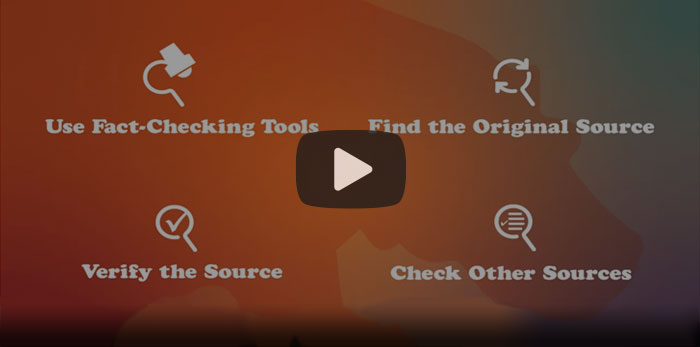
MediaSmarts offers these 4 tips to check if something is true online:
- Use fact-checking tools: See if a professional fact-checker has already debunked the story.
Fact-checking tools: - Find the source: Check the link to see who is responsible for publishing the information.
- Verify the source: Check Google or Wikipedia to see if the source is real and if it has a good reputation.
- Check other sources: Do a search to see if other news outlets are reporting the same story.
Do a reverse image search
A reverse image search can reveal if an image has been altered or copied from elsewhere on the internet.
To reverse search an image, copy the image, or the image’s URL into the search bar of an image search tool.
Search results will show if the image appears in other locations on the internet.
Image search tools:
Spot spoof websites
Fake news stories can be posted on fraudulent websites that are made to look legitimate. This is called spoofing.
These tips can help you spot a spoof:
- Do a Google search for the organization and follow the link. Does it go to the same place?
- Check the Wikipedia page for the organization. Does the information match?
- Perform a WHOIS lookup on the web address to see who owns it, and when it was registered.
WHOIS lookup tools:
Spot fake social media accounts
Disinformation is often spread using fake social media accounts. The Better Business Bureau recommends these tips for spotting fakes:
- Check the profile photo. Do a reverse image search to see if the profile photo has been copied from somewhere else online.
- Look for recycled images. Fake accounts often fill their feeds with stock images and memes. If there are no original photos, you may be dealing with a fake.
- Look for typos. Many spelling or grammar mistakes can be signs of a fake account.
- Look at the account profile. Is it very new? Does it contain details about the person? If not, be wary.
- Look for the verified badge. Some social media platforms have a verified badge, like the blue check on Instagram. If the person you want to follow is famous or influential, look for the verified badge on their profile.
- Look at the engagements. Account owners can buy fake engagement. If the comments seem random, contain only emojis, or all come from one person, the engagement may be artificial.
- Look at the follower-to-engagement ratio. Account owners can also buy followers. If an account has thousands of followers with very little engagement, it’s likely fake.
- Beware of polarized political opinions. If an account posts only one-sided political views, and never reveals information about the person posting, it may be a fake intending to mislead.
Source: Better Business Bureau, How to Spot a Fake Social Media Account

Counter disinformation
You’ve fact-checked a piece of online content and discovered that it is false. What next?
- Don’t share it: You don’t have to do anything at all. Just by not sharing false content you are helping to stop the spread of online disinformation.
If you do choose to take action, consider these 4 tips from MediaSmarts.
- Ask a question: Asking a question can be almost as effective as correcting false information. If you don’t want to do this publicly, you can send a private message. Try saying: “Are you sure?” or “Is that source reliable?”.
- Correct it: You can correct false information by giving accurate information instead. Make sure your information is from a reliable source and be sure to show where it came from. You don’t have to repeat the bad information or tell anyone they are wrong. Just share accurate information that shows the facts.
- Debunk it: If you can clearly show that the information is false, you can debunk it by saying it’s wrong and showing why. Don’t link to the false information or the original social media post. Use a screenshot instead.
- Report it: You can also report the disinformation to some social media platforms by clicking on the 3 dots and selecting “Report post”.
Source: MediaSmarts, Correcting disinformation
Find out more
Use your online influence to spread facts, not fakes. Consider sharing these resources about disinformation with your networks.
Non-government resources from across Canada
- MediaSmarts: Break the fake
- CIVIX: CTRL-F
- Digital Public Square
- Apathy Is Boring
- Media Ecosystem Observatory
Government of Canada resources
- Canadian Centre for Cyber Security: How to identify misinformation
- Canadian Centre for Cyber Security: Cyber threats and elections
- Canadian Security Intelligence Service: Deepfakes: A Real Threat to a Canadian Future
- Canadian Security Intelligence Service: Foreign Interference Threats to Canada’s Democratic Process
- Democratic Institutions: Protecting Democracy Toolkits
- Democratic Institutions: Countering Disinformation Guidebook for Public Servants
- Democratic Institutions: Video Series: Think twice before sharing online content
- Elections Canada: ElectoFacts fact-checker
- Global Affairs Canada: “Spamouflage” disinformation campaign
- Public Safety: Foreign interference
- Statistics Canada: Concerns with misinformation online, 2023