
CC130338 SAR Technician - Epilogue
Report / March 8, 2017 / Project number: CC130338 SAR - A Category
Location: Yorkton, Saskatchewan
Date: 8 March 2017
Status: Investigation Completed
The accident occurred during a 435 (Transport and Rescue) Squadron CC130H Hercules Search and Rescue training mission. The aircraft departed Winnipeg with a crew of nine and proceeded to the Pelly / Kamsak area of Saskatchewan to complete basic Search and Rescue sequences and then transited to the Yorkton airport with the intent of doing live static line parachute jumps followed by supply drops.
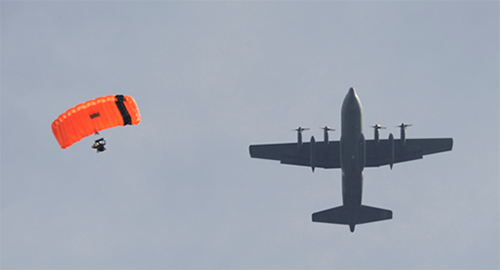
Once in the Yorkton area the aircraft was established at 2,000 feet above ground in level flight at 124 knots indicated airspeed in a flap 50 percent configuration and flown into wind over the desired target. The sky was clear, it was -16o Celsius and the surface wind was out of the northwest at 19 knots gusting to 24 knots. After completing their briefings and safety checks, the Search and Rescue Technician Team Leader exited the aircraft via the open rear ramp at the pre-determined point. The Team Leader exited using the “ball” style technique. The Search and Rescue Technician Team Member followed a few seconds after the Team Leader using the “reverse arch” (semi-sitting) exit technique.
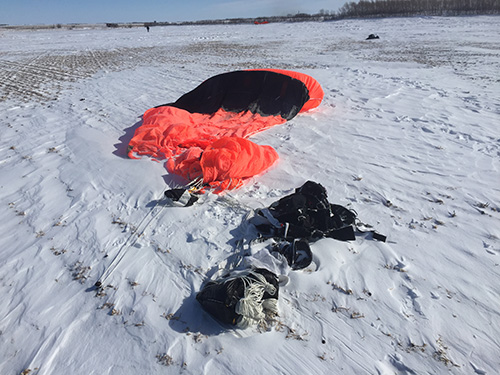
Immediately after leaving the aircraft the Team Member appeared to interact with the aircraft’s slipstream, causing his left leg to move upwards and his body to roll slightly to the right. As this was happening, the static parachute line system began to deploy his main parachute. The parachute did not deploy normally and the evidence strongly suggests that the main canopy suspension lines became severely twisted. This resulted in an uncontrollable parachute that entered a rapidly descending clockwise spiral.
The Team Member was observed to attempt to untwist the lines, and at one point performed the non-standard action of releasing his Search and Rescue – Personnel Equipment Lowering System bag, presumably to aid in the required kicking motion with his legs. His efforts were unsuccessful and while attempting to clear the twists he likely lost situational awareness of his altitude and descent rate. As a result, he did not take action to cut-away and deploy his reserve parachute before reaching the ground. The team member was fatally injured when he struck the ground.
The investigation did not find any evidence of an improper pack or a materiel failure of the Team Member’s equipment. Malfunctions during parachute jumps from the lower altitudes (for example 1,500 to 2,000 ft above ground) leave little time and action must be taken quickly to resolve the problem or cut-away the main parachute and deploy the reserve.
Preventive measures are focussed on enhanced training processes and the implementation of an automatic altitude awareness aural warning device.